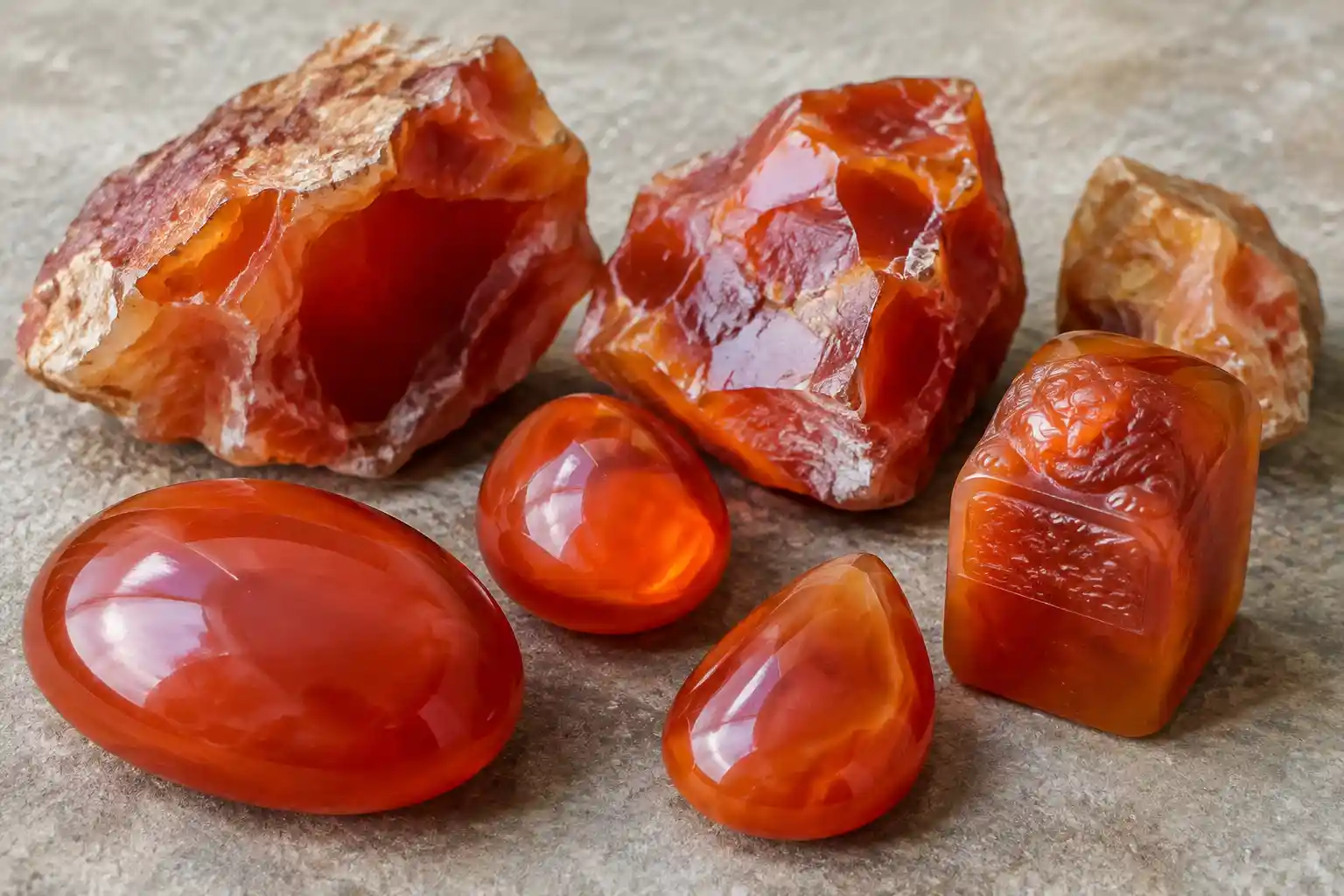
11 Hidden Carnelian Benefits: Meaningful Uses, Verified Facts & Important Cautions
Carnelian benefits begin with qualities that have made this orange-to-red chalcedony useful for thousands of years: attractive color, good toughness, useful quartz-family hardness, smooth polish, carving potential, and enough translucency to glow warmly when light passes through thinner areas. Carnelian is a microcrystalline silica gemstone in the chalcedony family, with colors ranging from pale orange and warm amber to reddish orange, deep red, and brownish red. Iron-bearing compounds are responsible for much of that characteristic color.
The stone’s physical qualities explain why carnelian appears so often in beads, seals, intaglios, cabochons, rings, necklaces, and archaeological jewelry. Its fine internal texture can hold carved detail while resisting everyday wear better than much softer decorative stones. Natural color variation also means a single piece can contain translucent orange zones, darker red concentrations, cloudy areas, and subtle banding that becomes more visible after polishing.
Modern crystal traditions add carnelian benefits involving motivation, confidence, creativity, courage, sexuality, vitality, or emotional energy. Those interpretations can remain meaningful as personal symbolism, but they are not established medical effects. Carnelian does not improve hormones, fertility, circulation, metabolism, sexual function, or mental health simply because its warm color is associated with energy.
11 Carnelian Benefits at a Glance
- Quartz-family hardness gives carnelian useful durability for many jewelry styles.
- Fine chalcedony texture provides good toughness and an excellent polished surface.
- Orange-to-red coloration offers strong visual warmth without requiring faceting.
- Translucency can create a glowing appearance when light enters thinner areas.
- Dense structure makes carnelian suitable for seals, intaglios, beads, and detailed carvings.
- Long historical use provides genuine archaeological and cultural interest.
- Collectors can compare natural color zoning, inclusions, translucency, and treatment.
- Identification practice teaches buyers to distinguish carnelian from dyed chalcedony, glass, and similar stones.
- Jewelry designers gain a versatile warm-colored gem that pairs with many metals and other stones.
- Modern symbolism can represent confidence, creativity, or purposeful action without medical claims.
- Straightforward care makes stable carnelian practical for long-term wear and ownership.
Quartz-Family Durability Is One of the Strongest Carnelian Benefits
Carnelian belongs to chalcedony, which generally falls around 6.5 to 7 on the Mohs hardness scale. Its microscopic intergrowth of silica structures also gives it good toughness compared with many gems that have prominent cleavage.
This combination creates several practical carnelian benefits. Rings, pendants, bracelets, beads, earrings, brooches, and carved pieces can all withstand normal use when protected from severe impact and abrasion. A polished cabochon is much more resistant to everyday scratching than calcite, fluorite, opal, or many other softer stones.
Hardness still has limits. Sapphire, diamond, and other harder gems can scratch carnelian, while a hard blow can chip an exposed edge or fracture a thin carving. Rings face the greatest risk because hands frequently strike countertops, doors, tools, and other hard surfaces.
Good care begins with accepting that durability is relative rather than absolute. One of the real carnelian benefits is that the stone offers a useful balance between attractiveness, toughness, polish, and wearability without requiring the caution demanded by extremely soft ornamental gems.
Warm Color and Translucency Give Carnelian Strong Visual Appeal
Color is among the most obvious carnelian benefits. Fine stones can show orange, reddish orange, red, or brownish red tones, with saturation and transparency varying across the gem.
Carnelian’s beauty usually comes from body color rather than brilliant faceting. Light entering a translucent cabochon can create an internal glow, especially around thinner edges. Darker stones may look nearly opaque in ordinary lighting but reveal warmer red or orange tones when viewed against strong transmitted light.
The color is generally associated with iron-bearing compounds within the chalcedony. Natural heating and geological processes can influence those compounds, while deliberate heat treatment is also widely used in the gemstone trade to improve or alter color.
Visual preference varies. Some buyers favor highly saturated red-orange stones, while others prefer lighter translucent pieces that show more internal texture. Uniform color is not automatically superior to natural zoning.
The best carnelian benefits for jewelry come from choosing a stone whose color remains attractive under normal lighting rather than relying only on heavily illuminated photographs.
Carnelian Has an Exceptional History as a Carving and Seal Stone
Historical use is one of the most substantial carnelian benefits. Chalcedony’s fine texture and durability made carnelian suitable for engraved seals, intaglios, beads, amulets, and personal ornaments across many ancient cultures.
Mesopotamian, Egyptian, Greek, Roman, Persian, South Asian, and later Islamic artisans all used carnelian or closely related reddish chalcedony in different periods and contexts. Its ability to hold fine engraved lines made it especially useful for seals that could leave impressions in clay or wax.
This history provides something modern crystal marketing often lacks: documented practical reasons for the gemstone’s importance. Carnelian was not valued only because of symbolic beliefs. It was workable, durable, visually attractive, and effective for carving.
Signet rings and engraved gems continued these traditions for centuries. A carved carnelian could carry a portrait, animal, religious motif, inscription, family device, or personal emblem.
These artistic carnelian benefits remain relevant today. Modern lapidaries still use the stone for cabochons, beads, seals, cameos, small sculptures, and engraved pieces because the same fine structure continues to support detailed work.
Lapidary Work Can Reveal Hidden Color Inside Ordinary Rough
Rough carnelian may not look particularly dramatic before cutting. Weathered surfaces, dull crusts, fractures, or attached host rock can hide the color and translucency inside.
Sawing and polishing reveal another group of carnelian benefits. A cutter can orient rough to maximize saturated color, minimize fractures, preserve unusual natural patterns, or create a shape that makes the best use of translucent zones.
Cabochons are especially effective because a smooth dome highlights body color without requiring exceptional transparency. Beads can also show rich color as they rotate, while flat seals and carvings provide enough surface for engraved details.
The fine chalcedony texture generally takes a smooth polish, creating a visual contrast between glossy finished surfaces and dull natural rough.
These carnelian benefits demonstrate how gemstone beauty can depend on both geology and craftsmanship. The stone provides color and structure, while cutting determines how successfully those qualities appear in the finished piece.
Jewelry Versatility Extends from Ancient Designs to Modern Minimalism
Carnelian works in many jewelry styles because warm orange and red tones pair naturally with a wide range of metals. Yellow gold and copper reinforce the warmth, while silver-colored metals create stronger contrast. Rose gold can produce a softer transition between metal and stone.
Large cabochons can serve as statement pieces without the extreme cost of many transparent red gemstones. Small beads work well in strands, bracelets, earrings, and mixed-stone jewelry. Engraved carnelian can also give signet rings a distinctly historical character.
These design possibilities are among the most practical carnelian benefits. The gemstone can appear ancient, formal, rustic, contemporary, or minimalist depending on cut and setting.
Its relative toughness also gives designers more freedom than extremely delicate gemstones. Protective settings remain sensible for rings, but pendants, earrings, and beads can generally perform well with ordinary care.
The warm body color also pairs effectively with black onyx, clear quartz, turquoise-colored stones, lapis, chalcedony, or neutral gems. The final design depends more on craftsmanship and color balance than on rigid pairing rules.
Carnelian Helps Explain the Diversity of Chalcedony
Mineral education is another valuable source of carnelian benefits. Carnelian belongs to the same wider chalcedony family as agate, onyx, chrysoprase, blue chalcedony, and several other familiar varieties.
This relationship demonstrates how gemstones with closely related silica chemistry can look dramatically different because of trace components, inclusions, microscopic structure, color centers, and geological conditions.
The general chalcedony benefits associated with toughness, polishing, carving, collecting, and quartz-family mineralogy help explain why carnelian has remained useful for so long. Carnelian adds a particularly recognizable orange-to-red palette to those physical advantages.
Students can compare carnelian with banded agate to see how uniform body color differs from obvious layered structure. They can also compare it with jasper, which tends to be more opaque because of abundant inclusions.
This makes carnelian more than a jewelry stone. A small specimen can become an accessible introduction to microcrystalline quartz and the role of iron in gemstone color.
Collecting Carnelian Rewards Natural Variation and Historical Context
Collectors may approach carnelian from several directions. Some prefer highly translucent polished stones, while others seek deeply saturated red pieces, archaeological-style beads, rough nodules, carved seals, or specimens with reliable locality information.
Color variation is part of the appeal. Pale orange, rich red-orange, brownish red, cloudy interiors, and subtle zoning can all occur. Natural inclusions and irregular color distribution may add character rather than automatically reducing desirability.
Treatment awareness is also important. Heat treatment can modify chalcedony color, and some commercial red or orange chalcedony may be dyed. Neither practice necessarily makes a stone unsuitable for jewelry, but disclosure matters when natural color is part of the purchase decision.
A person considering where to buy carnelian should therefore look for honest treatment information, realistic photographs, dimensions, condition, and seller accuracy rather than relying on dramatic claims about rarity or spiritual power.
These buying habits are among the more transferable carnelian benefits because the same principles apply across much of the gemstone market.
Identification Helps Separate Carnelian from Similar Orange and Red Stones
Orange and reddish stones are often difficult to identify from color alone. Carnelian may resemble dyed chalcedony, orange glass, fire opal without play-of-color, certain jaspers, sunstone, or other ornamental gems in photographs.
Translucency, luster, structure, hardness, refractive properties, inclusions, and microscopic features all help narrow identification. Chalcedony often has a characteristic dense texture and waxy appearance on natural fractured surfaces, while polishing produces a smoother vitreous surface.
Color concentration in fractures can sometimes suggest dye, though visual inspection is not always conclusive. Professional gemological testing provides stronger evidence when treatment or identity materially affects value.
These identification-focused carnelian benefits are useful because they encourage buyers to move beyond simple color matching. A stone is not carnelian merely because it is orange-red.
Accurate labeling improves both collecting and symbolic ownership because a person can appreciate the actual gem rather than an uncertain trade description.
Modern Symbolism Can Represent Creativity and Purposeful Action
Contemporary crystal practice frequently associates carnelian benefits with confidence, motivation, creativity, courage, ambition, vitality, and self-expression. The warm orange-red color makes many of these associations easy to understand.
A symbolic interpretation can remain practical. Someone might wear carnelian during a creative project because the stone represents experimentation and persistence. Another person may keep a polished piece near a workspace as a reminder to finish an important task rather than constantly beginning new ones.
Confidence can likewise be treated as preparation and willingness to act rather than a power supplied by the stone. A person giving a presentation may associate carnelian with courage, but knowledge, rehearsal, communication skill, and experience still matter far more.
Claims involving carnelian healing properties sometimes extend into fertility, sexuality, circulation, metabolism, hormones, or physical vitality. Those ideas belong to spiritual traditions and should not be presented as medical effects.
Carnelian benefits remain meaningful when symbolism supports intentional behavior without being mistaken for treatment.
Historical Symbolism Has Real Context but Should Not Be Universalized
Carnelian has genuine symbolic history in several cultures, which sets it apart from gemstones whose spiritual reputations are almost entirely modern. Ancient and historic peoples used reddish chalcedony in jewelry, seals, amulets, religious objects, and personal ornaments.
The meanings attached to those objects varied greatly. A carnelian bead in one culture should not automatically be interpreted through the beliefs of another. Archaeological use, religious symbolism, protective associations, status, artistic preference, and trade value all depended on time and place.
This gives historical carnelian benefits a richer context than the simple claim that it was universally a stone of courage or vitality. Real cultural history is more specific and more interesting.
Modern owners can appreciate that long human connection without pretending every current crystal interpretation comes directly from antiquity.
Proper Care Helps Preserve Carnelian for Generations
Stable carnelian is relatively straightforward to care for. Lukewarm water, mild soap, and a soft cloth or brush are usually sufficient for routine cleaning of untreated pieces.
Strong impacts should be avoided, particularly around thin carved sections or exposed cabochon edges. Separate storage prevents harder gemstones from scratching polished surfaces.
Treatment status matters. Dyed or specially treated stones may respond differently to heat, chemicals, or prolonged exposure, so gentle cleaning is the safest approach when history is uncertain.
Lapidary work requires additional precautions because chalcedony is silica-rich. Cutting, drilling, or grinding should use wet methods, ventilation, eye protection, and effective dust control. Fine crystalline silica dust should not be inhaled.
These care-focused carnelian benefits help preserve polish, color, carving, and historical-style workmanship for long-term ownership.
Important Cautions Keep Carnelian Benefits Evidence-Based
Carnelian’s orange-red color has encouraged associations with blood, vitality, reproduction, sexuality, and physical energy, but visual symbolism does not create a biological mechanism.
There is no established evidence that wearing carnelian improves fertility, testosterone, estrogen, circulation, sexual function, metabolism, red blood cells, or athletic performance. Iron-bearing color compounds inside chalcedony do not become nutritional iron through skin contact.
Someone may still find a carnelian ring motivating because it carries personal meaning. That experience can be genuine without becoming a medical effect.
The most reliable carnelian benefits remain durability, carving potential, jewelry versatility, historic use, mineral education, collecting, identification, and personal symbolism.
Conclusion
Carnelian benefits include chalcedony durability, good toughness, glowing orange-to-red color, carving and engraving potential, long historical use, jewelry versatility, collecting value, gemstone identification, and meaningful personal symbolism. Its combination of fine texture and warm color explains why carnelian has remained important across many periods of jewelry and lapidary history.
Modern themes of creativity, confidence, courage, or motivation can add personal significance when they remain symbolic. The strongest carnelian benefits come from understanding the stone as iron-colored chalcedony, appreciating its craftsmanship and history, and avoiding unsupported health claims.
FAQs
What are the main carnelian benefits?
The most verifiable carnelian benefits include jewelry durability, carving, engraving, collecting, historical interest, attractive color, lapidary versatility, identification practice, and personal symbolism.
What is carnelian made of?
Carnelian is a microcrystalline silica gemstone in the chalcedony and quartz family. Iron-bearing compounds contribute to its orange, red, and brownish-red colors.
Is carnelian durable?
Yes. Chalcedony generally has a Mohs hardness around 6.5 to 7 and good toughness, making carnelian suitable for many jewelry styles with sensible care.
Was carnelian used in ancient jewelry?
Yes. Carnelian has a long documented history in beads, seals, engraved gems, jewelry, and amulets across several ancient and historic cultures.
Can carnelian be heat treated?
Yes. Heating has long been used to influence color in chalcedony, and treatment should be disclosed when it matters to the buyer.
Can carnelian be dyed?
Dyed chalcedony occurs in the market. Natural carnelian also exists, so treatment disclosure and gemological examination are useful when natural color affects value.
What does carnelian symbolize?
Modern symbolism commonly connects carnelian with creativity, confidence, motivation, courage, vitality, and purposeful action.
Does carnelian improve fertility or sexual health?
There is no established medical evidence that carnelian improves fertility, hormone levels, sexual function, or reproductive health.
Does carnelian provide iron to the body?
No. Iron-bearing compounds within solid chalcedony do not function as nutritional or medicinal iron through normal wearing or handling.
Is carnelian good for everyday jewelry?
Many well-set pieces are suitable for regular wear. Rings still benefit from protection against hard impacts, while pendants and earrings usually face less mechanical stress.
How should carnelian be cleaned?
Use lukewarm water, mild soap, and a soft cloth or brush for stable pieces. Avoid strong impacts, harsh chemicals, and aggressive cleaning when treatment status is uncertain.
Carnelian benefits described as healing, hormonal, fertility-related, emotional, or energetic effects remain spiritual and personal beliefs and should not replace qualified medical or mental-health care.