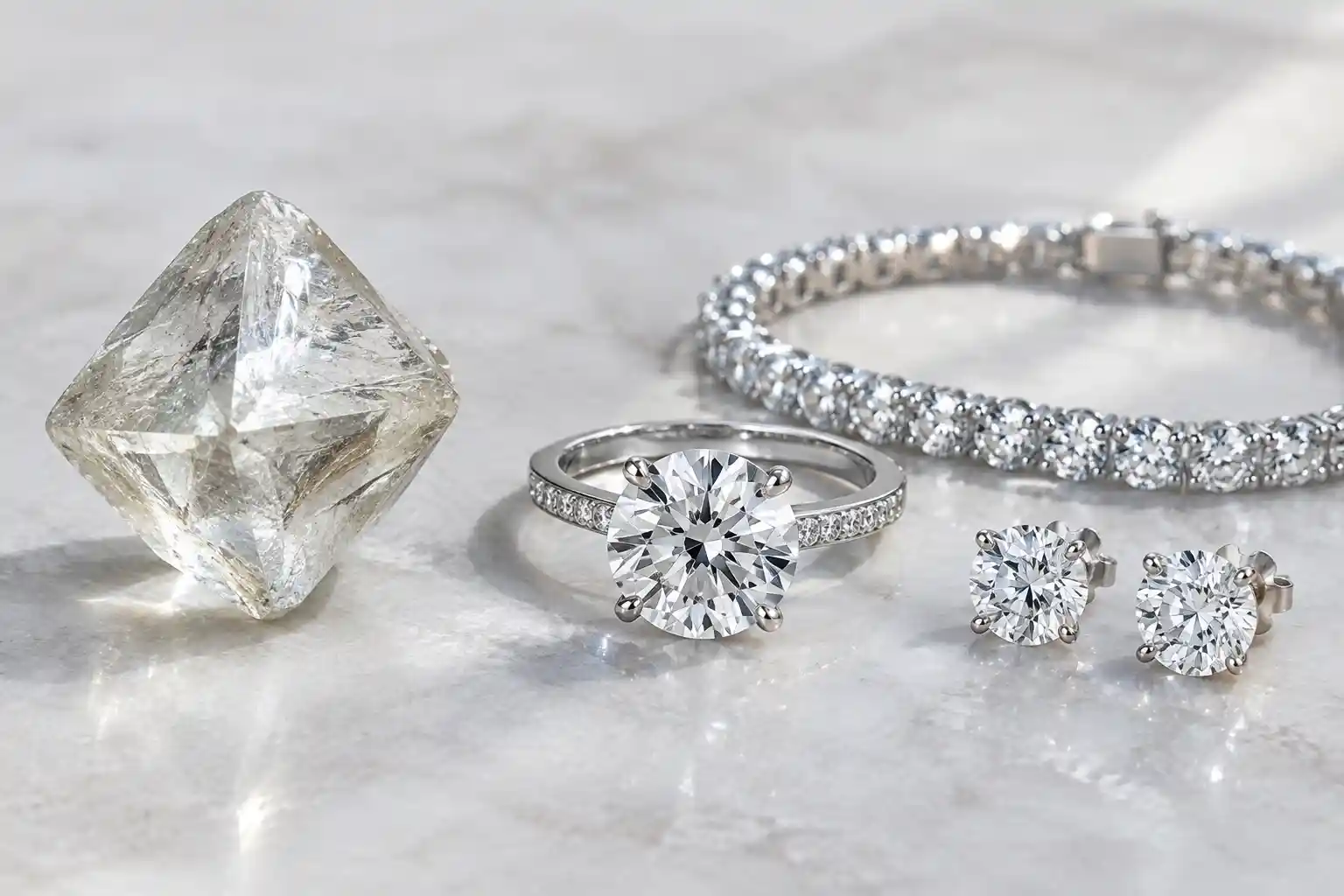
7 Hidden Diamond Benefits: Deep Uses, Hidden Facts & Responsible Use
Diamond benefits begin with a combination of properties unmatched by most familiar gemstones: extreme hardness, high refractive index, strong dispersion, exceptional thermal conductivity, useful chemical stability, and a crystal structure built entirely from carbon. These characteristics explain why diamond occupies important roles in jewelry, precision cutting, grinding, drilling, scientific research, thermal management, and high-performance engineering. Its cultural reputation may focus on rarity, romance, and luxury, but the practical story of diamond extends far beyond engagement rings.
Diamond ranks 10 on the Mohs hardness scale, making it the hardest naturally occurring mineral used commonly as a gemstone. Hardness, however, refers primarily to resistance to scratching rather than resistance to every kind of damage. Diamond has cleavage directions along which a sufficiently sharp impact can split it, so the familiar description of diamond as indestructible is inaccurate. A well-set diamond can withstand generations of normal jewelry wear, but sensible setting design and care remain important.
These measurable properties provide substantial diamond benefits without requiring healing claims. Modern spiritual traditions sometimes associate diamonds with clarity, strength, commitment, courage, purity, or amplified intention, but those interpretations are symbolic. Wearing a diamond does not medically strengthen bones, improve brain function, cure disease, balance hormones, or change emotional health through an established gemstone-specific effect.
7 Diamond Benefits at a Glance
- Exceptional hardness provides outstanding resistance to scratching and helps polished facets remain crisp through long-term wear.
- High refractive index and dispersion create brilliance, contrast, and spectral fire in well-cut gemstones.
- Durable jewelry performance makes diamond especially practical for rings and other pieces intended for frequent wear.
- Industrial hardness supports cutting, drilling, grinding, polishing, and abrasive applications.
- Exceptional thermal conductivity gives diamond value in specialized scientific and technological uses.
- Gemological complexity provides important lessons in natural versus laboratory-grown stones, treatments, grading, and identification.
- Cultural and personal significance can make diamond a powerful symbol of commitment, achievement, continuity, or remembrance without requiring medical claims.
Exceptional Hardness Is the Most Practical Diamond Benefit
Hardness is the physical property most closely associated with diamond, and it remains one of the clearest diamond benefits. A diamond surface resists scratching from nearly every substance encountered in ordinary jewelry wear, which allows properly polished facets to retain sharp junctions and reflective surfaces for very long periods. This helps explain why diamonds work so effectively in engagement rings, wedding jewelry, heirloom pieces, and other designs expected to endure repeated handling.
Hardness should still be understood correctly. It does not mean a diamond cannot break. Diamond possesses crystallographic cleavage, and a strong impact delivered in an unfavorable direction can chip or split a stone. Exposed points on pear, marquise, princess, and other angular cuts deserve particular protection because concentrated force at a corner can cause damage even when the surface itself resists scratching.
Setting design therefore remains part of durability. Prongs must be secure, sharp corners can benefit from protective metal, and rings should still be removed during heavy manual work. The long-term diamond benefits of hardness become most useful when the gemstone is treated as extraordinarily scratch-resistant rather than physically invulnerable.
Brilliance and Fire Give Diamond Its Distinctive Optical Appeal
Diamond’s optical properties create another major set of diamond benefits. Its high refractive index allows a well-designed cut to redirect a significant amount of light back toward the viewer, producing the brightness traditionally associated with a fine diamond. Dispersion separates white light into spectral colors, adding flashes of red, orange, yellow, green, blue, and violet when lighting and cutting conditions allow.
Cut quality determines how successfully these properties become visible. A diamond with excellent color and clarity can still look unimpressive if proportions allow excessive light leakage. Conversely, a well-cut stone with modest clarity can appear exceptionally lively because light performance dominates casual observation.
Brilliance, fire, and scintillation describe related but different aspects of appearance. Brilliance concerns reflected white light, fire involves spectral flashes, and scintillation describes the shifting pattern of bright and dark flashes produced as the diamond, light source, or observer moves.
These diamond benefits explain why diamond quality grading cannot be reduced to carat weight. Cut, color, clarity, proportions, symmetry, polish, fluorescence, and personal visual preference all contribute to the finished appearance.
Diamond Performs Exceptionally Well in Frequently Worn Jewelry
The combination of hardness, brilliance, availability in calibrated shapes, and established setting techniques makes jewelry durability one of the most familiar diamond benefits. Rings endure far more mechanical stress than earrings or pendants, so a gemstone that resists surface abrasion has a practical advantage in pieces worn every day.
Diamonds can be cut into rounds, ovals, cushions, emerald cuts, pears, marquises, radiants, princess cuts, and numerous specialty shapes. This variety allows designers to work with different proportions, visual styles, and setting systems while retaining the same fundamental carbon crystal.
Long-term wear also makes maintenance important. Oil, soap, lotion, and skin residue can coat a diamond and dramatically reduce apparent brilliance because light is no longer entering and leaving clean surfaces. Gentle cleaning appropriate to the jewelry setting can restore much of the original brightness without any change to the stone itself.
The practical value becomes especially obvious in a diamond engagement ring, where the center stone may be exposed to daily wear for decades. Hardness does not remove the need for secure prongs, periodic inspection, and careful handling, but it gives diamond an unusually strong foundation for lasting jewelry.
Industrial Cutting and Abrasion Show That Diamond Is More Than a Gem
Industrial applications demonstrate diamond benefits that have nothing to do with luxury. Extreme hardness allows diamond particles, coatings, and cutting surfaces to abrade substances that would rapidly wear ordinary tools. Diamond is therefore used in grinding, sawing, drilling, polishing, precision machining, and other applications where controlled abrasion matters.
The diamond used industrially does not need the visual qualities demanded by jewelry buyers. Small synthetic crystals, polycrystalline diamond, diamond coatings, or lower-gem-quality natural stones can perform useful work because hardness and wear resistance matter more than color or clarity.
This distinction provides a valuable lesson about gemstone value. A property can have completely different importance depending on context. A visible inclusion might reduce the value of a faceted jewelry diamond while having little relevance to an abrasive application. A tiny synthetic diamond unsuitable for an engagement ring may still be technologically useful.
Diamond benefits therefore extend from personal ornament into manufacturing and engineering, making diamond unusual among gemstones whose commercial identity is primarily decorative.
Exceptional Thermal Conductivity Creates Scientific and Technical Value
Diamond conducts heat extremely well, which gives it applications in situations where heat needs to move rapidly away from sensitive components. This property is separate from electrical conductivity because most pure diamond behaves as an electrical insulator while conducting heat efficiently.
Specialized diamond components can therefore serve as heat spreaders, windows, sensors, research components, and parts of advanced technological systems. Synthetic diamond production has expanded many of these possibilities because crystals can be manufactured for engineering requirements rather than selected only from mined rough.
Thermal conductivity also plays a role in gem identification. Traditional diamond testers commonly exploit the fact that diamond conducts heat differently from many older simulants such as cubic zirconia. Modern identification can require more sophisticated instruments because moissanite and laboratory-grown diamonds introduce additional challenges.
These scientific diamond benefits reveal why the gemstone’s importance cannot be explained by hardness alone. Carbon arranged in the diamond structure produces a package of mechanical, optical, and thermal properties that make the crystal useful in several unrelated fields.
Diamond Teaches Important Lessons About Natural, Laboratory-Grown, and Simulated Gems
Modern diamond buying requires precise terminology, and that makes gemological education one of the most useful diamond benefits. Natural diamond and laboratory-grown diamond share the fundamental diamond crystal structure and carbon composition, although their growth environments differ. A diamond simulant such as cubic zirconia or moissanite is different because it resembles diamond visually while possessing a different chemistry and crystal structure.
Treatments add another layer. Some natural diamonds may be subjected to processes designed to modify color or clarity, while laser drilling, fracture filling, high-pressure treatment, irradiation, annealing, and other methods can influence commercial descriptions and value. Disclosure matters because appearance alone may not reveal what happened to a gemstone after formation.
Someone preparing to buy diamond therefore benefits from independent grading information, clear disclosure of natural or laboratory-grown origin, treatment information where relevant, measurements, cut data, and realistic expectations about resale and rarity.
Learning these distinctions improves judgment across the gemstone market because it reinforces an important principle: visual similarity does not establish identical identity.
Diamond Can Carry Powerful Personal Meaning Without Healing Claims
Cultural symbolism is one of the oldest human uses of precious objects, and diamond benefits from an especially strong modern association with commitment, endurance, achievement, celebration, and remembrance. A diamond ring may represent a marriage, a pendant may commemorate a milestone, and an inherited stone may eventually become more valuable emotionally than economically.
These meanings do not require the gemstone to alter the body. An object can become important because of the event it represents, the person who gave it, the craftsmanship surrounding it, or the history accumulated during ownership.
Diamonds are sometimes described in spiritual practice as amplifiers of intention, courage, purity, clarity, or personal strength. Those themes can be used symbolically, but they should not be presented as evidence that diamond changes neurological activity, physical health, or emotional disorders.
Personal diamond benefits become strongest when the stone supports memory, identity, or celebration through human association rather than unsupported medical promises.
Responsible Diamond Ownership Includes Provenance, Disclosure, and Realistic Value Expectations
Responsible use extends beyond cleaning and setting security. Diamond sourcing, grading, natural versus laboratory-grown origin, treatment disclosure, seller transparency, and documentation all matter when the purchase is significant.
Market value can vary substantially according to carat weight, cut, color, clarity, shape, grading report, natural or laboratory-grown origin, rarity, fluorescence, brand, and overall demand. A high purchase price does not guarantee future appreciation, and retail jewelry should not automatically be treated as an investment.
Ethical and provenance concerns also deserve attention. Buyers may prefer documented supply chains, recycled diamonds, antique jewelry, or laboratory-grown options according to their priorities. No single choice answers every environmental, social, economic, and traceability question, so transparency is more useful than simplistic marketing claims.
Understanding these considerations allows the real diamond benefits of durability, beauty, science, and symbolism to remain separate from assumptions about guaranteed financial value or moral superiority.
Conclusion
Diamond benefits include exceptional hardness, outstanding optical performance, long-term jewelry durability, industrial abrasion, remarkable thermal conductivity, gemological education, and strong personal symbolism. Few gemstones combine decorative, scientific, technological, and cultural importance so extensively.
The most useful understanding of diamond respects both its strengths and its limits. A diamond can resist scratching while still chipping, look exceptionally brilliant while still depending on good cutting, and carry deep emotional significance without possessing medical powers. Responsible buying, accurate identification, secure settings, and realistic expectations allow the verified diamond benefits to stand on their own.
FAQs
What are the main diamond benefits?
The most verifiable diamond benefits include exceptional scratch resistance, brilliance, fire, long-term jewelry wear, industrial cutting and abrasion, thermal conductivity, gemological education, and personal symbolism.
Why is diamond so hard?
Diamond consists of carbon atoms bonded within an exceptionally strong three-dimensional crystal structure. This structure gives diamond the highest position on the Mohs hardness scale.
Can a diamond break?
Yes. Diamond is extremely hard but can chip or split because it has cleavage directions. Sharp impacts remain a risk, particularly around exposed corners and points.
Is diamond suitable for everyday rings?
Yes. Its exceptional scratch resistance makes diamond particularly practical for frequently worn rings, although the setting should still be inspected and the stone protected from strong impacts.
What makes a diamond sparkle?
High refractive index, dispersion, precise faceting, symmetry, polish, and movement of light all contribute to brilliance, fire, and scintillation.
Are laboratory-grown diamonds real diamonds?
Yes. Laboratory-grown diamonds have the fundamental carbon composition and diamond crystal structure of diamond, although they are produced in controlled facilities rather than forming naturally underground.
Does diamond have healing benefits?
There is no established clinical evidence that wearing diamond treats disease, strengthens organs, improves mental health, regulates hormones, or produces other medical effects.
Diamond benefits described as healing, amplifying, protective, emotional, manifestation-related, or energetic effects remain spiritual and personal beliefs and should not replace qualified medical or mental-health care.