7 Real Goshenite Benefits: Gentle Uses, Hidden Facts & Responsible Use
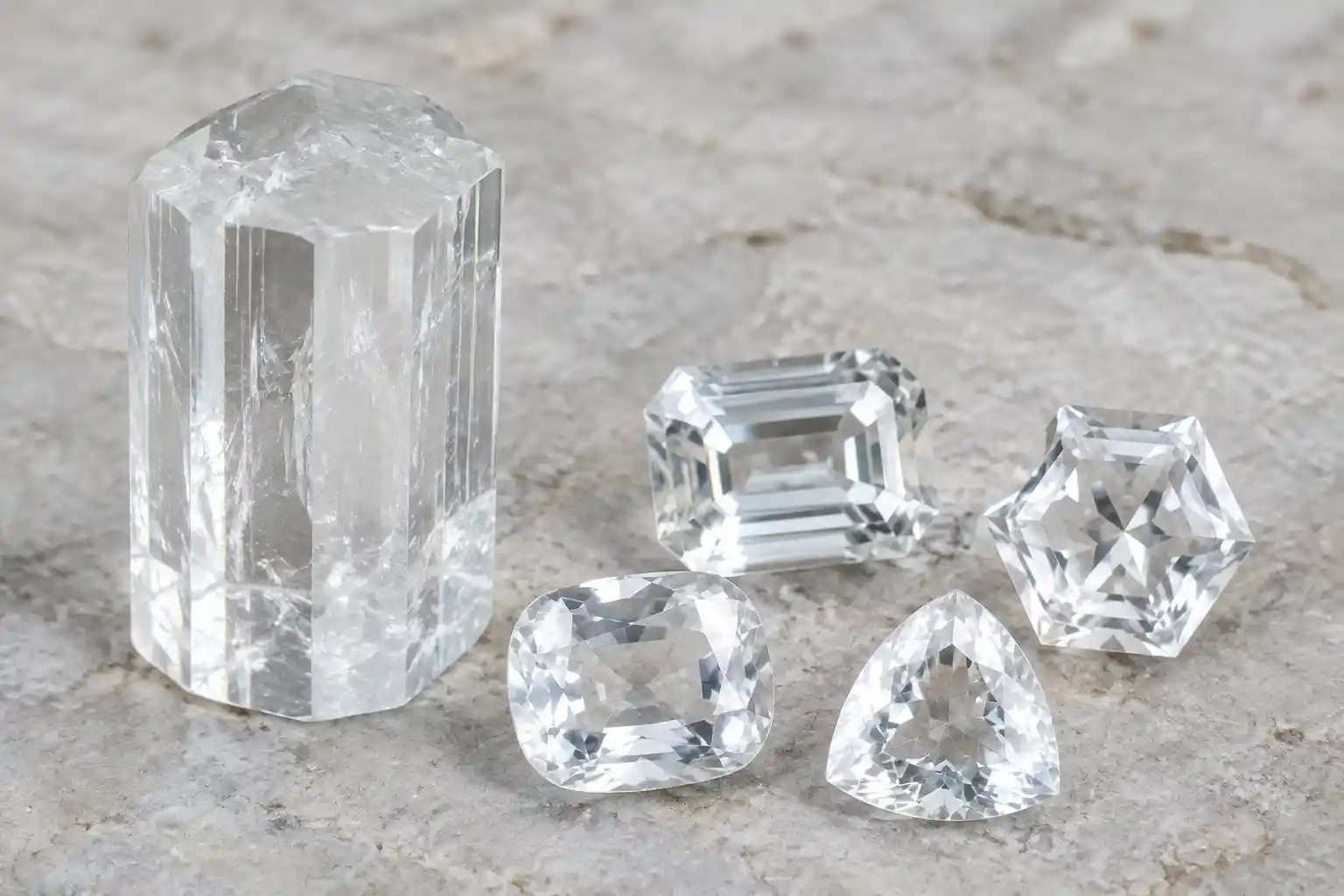
Goshenite benefits begin with a characteristic that sounds simple but is surprisingly informative: it is the colorless to nearly colorless variety of beryl. The same mineral family also produces green emerald, blue aquamarine, pink morganite, and yellow-to-golden beryl, yet relatively pure beryl can remain essentially colorless when strong coloring influences are absent. Goshenite therefore offers an unusually clear way to understand how trace elements and structural defects transform one mineral family into gemstones with dramatically different appearances.
The gemstone combines that transparency with a Mohs hardness of about 7.5 to 8, vitreous luster, hexagonal crystallography, and the ability to occur as transparent crystals large enough for faceting. These properties create practical Goshenite benefits for collector jewelry, mineral education, gem identification, lapidary work, inclusion study, and the comparison of different beryl varieties. Its lack of strong body color also makes internal features easier to observe in some specimens because there is little saturation to obscure them.
Modern crystal traditions sometimes associate Goshenite benefits with clarity, honesty, simplicity, open-mindedness, or a fresh start. Those themes make intuitive symbolic sense for a transparent colorless stone, but they should remain separate from health claims. Goshenite does not medically improve eyesight, memory, concentration, emotional disorders, or neurological function through ordinary wearing or handling.
7 Goshenite Benefits at a Glance
- Exceptional colorlessness and transparency provide a clear view of beryl’s natural optical character.
- Mohs hardness around 7.5 to 8 gives Goshenite useful scratch resistance for many jewelry applications.
- Transparent rough can be faceted into bright collector gems and large clean stones.
- Its place within the beryl family makes Goshenite valuable for comparing color chemistry among emerald, aquamarine, morganite, and other beryls.
- Hexagonal crystals, pegmatite formation, and visible inclusions give Goshenite strong geological and educational value.
- Historical use of clear beryl for optical lenses adds unusual cultural and technological interest.
- Modern symbolism can represent clarity, simplicity, or deliberate thinking when kept separate from medical claims.
Colorless Beryl Makes Goshenite Exceptionally Useful for Understanding Gem Color
One of the deepest Goshenite benefits is educational because the stone reveals what beryl can look like before strong color becomes the dominant feature. Beryl has the idealized composition Be₃Al₂Si₆O₁₈, and comparatively pure examples can be colorless. Other members of the beryl family gain their familiar colors through trace elements, structural defects, or combinations of both. Chromium and vanadium are associated with emerald green, iron influences several blue and yellow beryls, and manganese contributes to the pink tones of morganite.
Goshenite provides a natural reference point for these comparisons. Place a transparent colorless beryl beside aquamarine, morganite, heliodor, and emerald, and the family relationship becomes easier to understand because crystal structure remains related even while color changes dramatically. This makes Goshenite benefits particularly valuable for students learning that a gem variety name often describes one expression of a mineral rather than an entirely unrelated substance.
Colorlessness should not automatically be interpreted as absolute chemical purity. Natural beryl can contain minor elements and internal features while still appearing nearly colorless to the eye. The useful point is that none of those influences creates enough visible absorption to dominate the stone with a strong body color.
Beryl Hardness Gives Goshenite Practical Jewelry Durability
Goshenite generally falls around 7.5 to 8 on the Mohs hardness scale, placing it above quartz in scratch resistance and making it practical for many jewelry styles. This is one of the most useful Goshenite benefits because colorless stones are frequently compared with gems such as rock crystal, white sapphire, topaz, and diamond, yet their durability profiles differ substantially.
Hardness does not mean the gemstone cannot break. Beryl is brittle, and inclusions or fractures can create vulnerable areas within an individual stone. Sharp corners, thin girdles, and exposed points therefore deserve sensible protection, particularly in rings that receive frequent impact. Earrings and pendants are easier environments because they encounter considerably less mechanical stress.
A well-cut Goshenite can nevertheless perform successfully in regular jewelry when setting design and wear habits match its actual properties. Bezels, halos, and secure prongs can protect vulnerable edges without hiding the stone’s transparency, while routine inspection helps identify loose settings before damage occurs.
These Goshenite benefits make the gemstone useful for someone who enjoys colorless jewelry but wants something mineralogically different from quartz or diamond. The appeal lies not in pretending Goshenite is another gemstone but in appreciating colorless beryl on its own terms.
Large Transparent Crystals Create Attractive Faceting Opportunities
Goshenite can occur as transparent crystals with enough size and clarity to produce substantial faceted gems. That combination provides unusual Goshenite benefits for lapidaries because colorless rough places more attention on cutting precision than on body color. When little or no color is available to distract the eye, windowing, poor symmetry, weak polish, or uneven facet junctions become particularly obvious.
The refractive index of beryl is significantly lower than diamond, so Goshenite should not be expected to produce diamond-like fire or brilliance simply because both gemstones can appear colorless. Skilled cutting instead aims for balanced brightness, attractive proportions, clean facet reflections, and an outline that uses the rough efficiently. Large emerald-style cuts, cushions, ovals, rounds, and specialty shapes can all work when the starting crystal is sufficiently transparent and structurally sound.
Clarity also influences the finished appearance. Some Goshenite contains fluid inclusions, fingerprint-like healed fissures, tubes, crystals, or other internal features typical of beryl formation. A highly transparent specimen may produce a clean collector gem, while an included crystal can become more interesting under magnification even if it receives a lower commercial clarity assessment.
Someone evaluating Goshenite quality should therefore consider transparency, cutting, polish, internal condition, size, natural colorlessness, and overall visual performance together rather than treating carat weight as the sole measure of value.
Goshenite Connects Directly with Emerald, Aquamarine, Morganite, and Other Beryls
Few Goshenite benefits are as useful for gemstone education as its family relationship. Emerald, aquamarine, morganite, heliodor, red beryl, and Goshenite can all be discussed within the larger beryl system even though their commercial identities are completely different.
This relationship demonstrates how relatively modest chemical differences can influence appearance dramatically. Blue aquamarine may contain iron-related color centers, green emerald depends primarily on chromium and/or vanadium, while colorless Goshenite lacks enough effective coloring influence to produce comparable saturation. The result is an excellent example of why mineral species and gem variety should not be treated as interchangeable terms.
Physical similarities remain visible underneath the color differences. Beryl varieties share hexagonal crystallography, broadly comparable hardness, similar optical character, and related geological settings, although individual deposits and compositions can vary substantially.
This makes Goshenite benefits useful for anyone building a teaching collection. One tray containing several beryl varieties can show how one mineral framework produces colorless, blue, green, pink, and yellow gemstones without turning each color into a completely unrelated mineral.
Pegmatite Geology and Hexagonal Crystals Add Scientific Interest
Goshenite commonly occurs in granitic pegmatites, geological environments capable of concentrating elements that may be relatively scarce in ordinary crustal rocks. Pegmatites can produce very large crystals because their late-stage fluids and melts allow certain minerals to grow under conditions favorable to coarse crystallization.
These geological Goshenite benefits become obvious in natural specimens. Beryl frequently forms prismatic hexagonal crystals, and colorless examples can preserve clear faces, internal growth features, associated minerals, and relationships with quartz, feldspar, mica, or tourmaline. A matrix specimen therefore offers information that disappears once the beryl is removed and faceted.
Important colorless beryl has been found in several regions, including Brazil, Pakistan, China, Africa, Sri Lanka, and the United States. The name Goshenite itself comes from Goshen, Massachusetts, where the variety was historically described. That namesake gives the stone a particularly clear example of how locality names become embedded in gemological terminology.
Collectors may therefore value Goshenite for very different reasons. A transparent faceted gem emphasizes clarity and cutting, while a natural hexagonal crystal on pegmatite matrix emphasizes geology, provenance, and crystal growth.
Historical Optical Use Gives Colorless Beryl an Unusual Human Story
One of the most fascinating Goshenite benefits lies in the history of transparent beryl as an optical substance. Before modern optical glass became inexpensive and consistent, clear beryl was among the hard transparent substances that could be polished for viewing aids and lenses. Historical accounts connect transparent beryl with early magnifying and spectacle applications, and the linguistic relationship between beryl and words for spectacles in several European languages reflects the long association between clear beryl and seeing.
This history should not be exaggerated into a claim that every early lens was Goshenite as the variety is defined today. Historical terminology was less precise, and transparent minerals used in optics were not always recorded according to modern gemological classification. Still, the association of clear beryl with lenses is well established enough to give Goshenite benefits a rare technological dimension.
The symbolism is also easy to understand without becoming mystical. A transparent stone historically connected with seeing can naturally represent observation or clarity, yet that does not mean wearing Goshenite medically improves eyesight. Historical optical use depended on physically shaping transparent beryl into a lens, not on gemstone energy.
Gem Identification Separates Goshenite from Other Colorless Stones
A colorless faceted gemstone can be surprisingly difficult to identify by appearance alone. Quartz, topaz, white sapphire, colorless zircon, synthetic products, glass, diamond, and Goshenite may overlap enough visually that careful testing becomes necessary.
This provides another important set of Goshenite benefits for gemological education. Refractive index, birefringence, specific gravity, optical character, inclusions, hardness, crystal form, and spectroscopy can all contribute to identification. Goshenite is uniaxial negative like other beryl, and its measurable optical properties distinguish it from many alternative colorless gems even when photographs appear nearly identical.
Visual comparison with diamond deserves particular caution. Goshenite lacks diamond’s very high refractive index and dispersion, so a correctly cut Goshenite normally has a softer optical appearance. This difference is not a defect. It simply reflects a different mineral.
Someone preparing to buy Goshenite should therefore prioritize accurate species identification, transparency, cutting, dimensions, treatment disclosure, and realistic expectations rather than buying the stone primarily because a seller compares it with diamond.
Modern Goshenite Symbolism Works Best Around Clarity and Simplicity
Contemporary crystal practice often connects Goshenite benefits with clarity, truth, simplicity, communication, fresh beginnings, open-mindedness, or mental organization. A colorless transparent gemstone naturally supports those themes visually, especially because nothing in the body color dominates the view through the stone.
A responsible interpretation keeps the symbolism personal. Someone may wear Goshenite during a period in which they want to simplify commitments, reduce unnecessary distractions, or communicate more directly. Another person may associate it with a fresh professional start or with the idea of approaching a decision without letting one preferred outcome distort the evidence.
These uses do not require a neurological effect. Goshenite cannot remove confusion biologically, improve memory through skin contact, or guarantee honest communication between people. The gemstone can instead function as an intentional object whose meaning comes from the owner’s own decisions and routines.
That distinction preserves the symbolic Goshenite benefits without asking the crystal to perform work that belongs to human judgment.
Responsible Care Preserves Clarity and Surface Polish
Although Goshenite is harder than quartz, it still benefits from ordinary gemstone care. Dirt, skin oils, cosmetics, and soap residue can reduce transparency and make a colorless stone appear dull because there is no saturated body color to distract from surface contamination. Gentle cleaning therefore has an especially noticeable effect.
Lukewarm water, mild soap, and a soft brush are suitable for many stable untreated stones. Strong impacts, sudden thermal stress, and harsh household chemicals remain unnecessary risks, while ultrasonic or steam cleaning should be considered according to the actual condition of the gem rather than assumed safe for every included specimen.
Beryl contains beryllium within its stable crystal structure, but finished Goshenite jewelry is not a nutritional or medicinal source of beryllium. The stone should not be ground, powdered, dissolved, or used in homemade drinking remedies. Lapidary work should also use wet methods, ventilation, eye protection, and suitable dust controls.
Responsible ownership allows the genuine Goshenite benefits of clarity, mineralogy, jewelry durability, collecting, and historical interest to remain the focus.
Conclusion
Goshenite benefits include colorless transparency, useful beryl hardness, faceting possibilities, beryl-family education, pegmatite geology, historical optical interest, gemstone identification, and gentle modern symbolism. Its apparent simplicity is precisely what makes the stone useful because it reveals the underlying character of beryl without a strong green, blue, pink, or yellow body color dominating the experience.
The strongest Goshenite benefits come from understanding the stone as colorless beryl rather than as an inexpensive substitute for something else. Good cutting, reliable identification, natural crystal form, locality, transparency, and personal appreciation all provide legitimate reasons to value Goshenite. Symbolic themes involving clarity or simplicity can add meaning when they remain separate from unsupported medical claims.
FAQs
What are the main Goshenite benefits?
The most verifiable Goshenite benefits include jewelry use, scratch resistance, gemological education, faceting, mineral collecting, beryl-family comparison, geological study, and historical optical interest.
What is Goshenite?
Goshenite is the colorless to nearly colorless variety of beryl, the same mineral family that includes emerald, aquamarine, morganite, and golden beryl.
How hard is Goshenite?
Goshenite generally has a Mohs hardness around 7.5 to 8, giving it useful resistance to everyday scratching.
Is Goshenite suitable for jewelry?
Yes. Well-cut Goshenite can be used successfully in rings, pendants, earrings, and other jewelry when normal care and appropriate setting protection are used.
Why is Goshenite colorless?
Relatively pure beryl lacks enough effective coloring elements or defect centers to create the strong green, blue, pink, or yellow colors found in other beryl varieties.
Was Goshenite used for lenses?
Transparent beryl was historically used for optical and viewing applications before modern optical glass became widely available, giving colorless beryl an interesting connection with early lenses and spectacles.
Does Goshenite have healing benefits?
There is no established clinical evidence that Goshenite improves eyesight, memory, concentration, neurological function, emotional disorders, or other health conditions through ordinary wearing or handling.
Goshenite benefits described as healing, clarity-enhancing, cleansing, communicative, chakra, or energetic effects remain spiritual and personal beliefs and should not replace qualified medical or mental-health care.