Green Fluorite Benefits: 9 Hidden Uses, Deep Symbolism & Verified Facts, Important Cautions
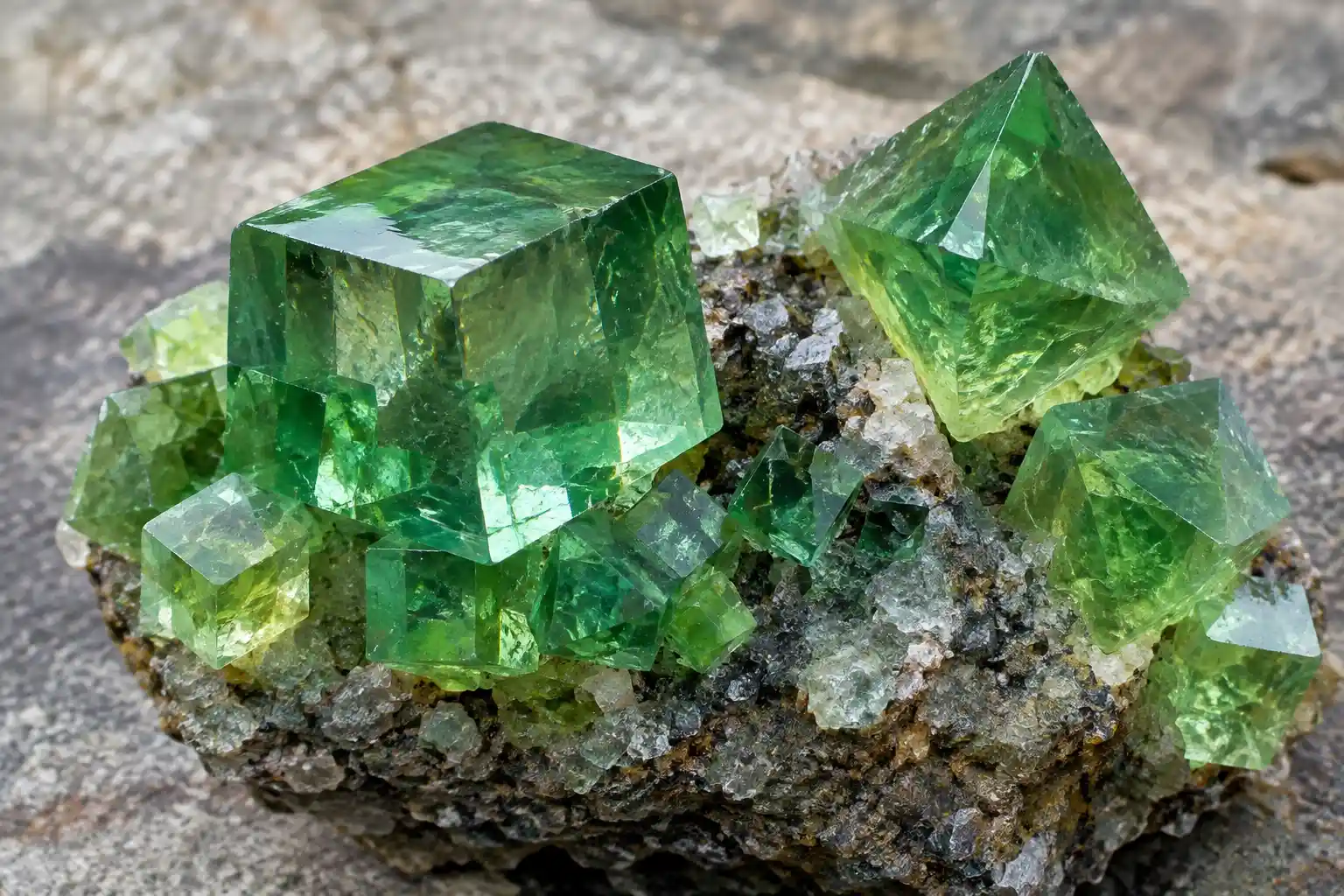
Green Fluorite benefits begin with a striking combination of color, crystal geometry, fluorescence in some specimens, transparency, cleavage, and mineral chemistry. Green Fluorite is calcium fluoride, CaF₂, and belongs to the same isometric mineral species as purple, blue, yellow, colorless, and multicolored fluorite. Its green color is not produced by one universal impurity in every specimen. Research into fluorite coloration shows that rare-earth ions, structural defects, irradiation-related color centers, oxygen-related defects, and the thermal history of a crystal can all contribute, with different green fluorites sometimes receiving their color through different microscopic mechanisms.
The mineral commonly forms cubes, octahedra, and modified combinations, while perfect octahedral cleavage creates an important distinction between natural growth forms and pieces produced by splitting larger crystals. Fluorite has a Mohs hardness of 4, so even a transparent gem-quality Green Fluorite remains much softer and more fragile than quartz, garnet, beryl, or corundum. This means its strongest practical roles are mineral collecting, educational display, specialized faceting, decorative carving, optical study, and carefully protected jewelry rather than demanding everyday rings.
Contemporary crystal traditions add Green Fluorite benefits involving concentration, organization, renewal, emotional balance, cleansing, and study. The green color makes some of those associations visually understandable, but the mineral does not medically improve memory, treat anxiety disorders, protect against electromagnetic fields, detoxify the body, or strengthen the immune system through ordinary wearing or display.
9 Green Fluorite Benefits at a Glance
- Green coloration can range from pale mint to deep yellow-green and intense emerald-like tones.
- Cubic and octahedral crystallography provides excellent examples of isometric crystal growth.
- Fluorescence in some specimens creates an additional optical feature under ultraviolet light.
- Transparent crystals can be faceted into vivid collector gems despite limited jewelry durability.
- Perfect octahedral cleavage teaches the difference between natural crystal faces and structural breakage.
- Color zoning and changing growth layers preserve evidence of complex crystal development.
- Identification encourages comparison with green glass, tourmaline, beryl, apatite, and other green gemstones.
- Carvings and display specimens can preserve strong color without subjecting the mineral to heavy wear.
- Modern symbolism can represent organization, perspective, or renewal when kept separate from medical claims.
Green Color Gives Fluorite Exceptional Visual Range
Color is the most immediate of the Green Fluorite benefits because specimens can range from very pale green through mint, yellow-green, grass green, blue-green, and deep saturated tones. Some crystals are almost uniformly colored, while others contain sharp zones that reveal separate episodes of crystal growth. Purple and green may even occur in the same specimen, producing geometric bands that follow the underlying cubic structure.
The origin of that green color is scientifically complex. Fluorite can contain rare-earth elements and structural defects whose electronic states interact with light, while natural irradiation and later thermal history can influence which color centers remain stable. Some green fluorites have been linked with samarium-related centers, while others have shown color mechanisms involving yttrium- and cerium-associated defects. This variation is important because a simple statement that one element always makes fluorite green would be inaccurate.
These Green Fluorite benefits become especially interesting for collectors because color can be studied alongside locality, zoning, fluorescence, transparency, and crystal habit. A vivid green cube is therefore more than a decorative object because its appearance can preserve evidence of crystal chemistry and geological history.
Cubic Crystals Make Green Fluorite Excellent for Mineral Education
Fluorite crystallizes in the isometric system and is especially famous for cubic crystals with sharply defined faces. Octahedra and modified cube-octahedron combinations also occur, while complex zoning can produce extraordinary geometric interiors in transparent specimens.
This crystallography creates Green Fluorite benefits for students because the shapes make symmetry easy to observe. A cubic specimen can be rotated while maintaining repeated equivalent faces, and naturally modified crystals demonstrate how several forms can coexist within one isometric structure.
Perfect octahedral cleavage adds another educational layer. Fluorite can split along four equivalent cleavage directions, creating triangular surfaces and octahedral fragments. Commercial fluorite octahedra are sometimes produced deliberately by cleavage rather than representing natural crystal growth, so understanding surface texture and edge relationships becomes part of responsible mineral identification.
Someone considering where to buy Green Fluorite may therefore want to know whether a specimen is a naturally grown crystal, a cleavage piece, a polished object, or a carved form. All can be attractive, but they preserve different aspects of the mineral’s structure.
Fluorescence Adds Another Layer to Green Fluorite’s Optical Interest
Fluorite is historically important to the study of fluorescence, and many specimens emit visible light when exposed to ultraviolet radiation. The intensity and color vary greatly according to locality, trace elements, crystal defects, and whether long-wave or short-wave ultraviolet light is used. Green body color therefore does not guarantee one specific fluorescence response.
This variability creates useful Green Fluorite benefits for collectors who enjoy comparing daylight appearance with ultraviolet behavior. Two green crystals that seem nearly identical under ordinary illumination may react very differently under UV, demonstrating that visible body color and fluorescence are separate optical phenomena.
Some fluorite localities are famous for particularly strong luminescence, while other visually spectacular specimens show little response. For this reason, fluorescence should be tested rather than assumed from the mineral name or green color alone.
The property also provides a valuable scientific lesson because fluorescence involves absorption of higher-energy radiation and re-emission at different wavelengths, while ordinary body color depends primarily on which parts of visible light are absorbed, transmitted, or reflected.
Transparent Green Fluorite Can Become a Striking Collector Gem
Transparent Green Fluorite can be faceted into unusually large and colorful gems because some crystals provide clean areas suitable for cutting. The resulting stones may display impressive green color and excellent transparency, but they remain collector gems first because Mohs hardness 4 and perfect cleavage create serious limitations for everyday jewelry.
Faceting itself requires care. The cutter must avoid cleavage directions, control pressure, and produce clean facet junctions on a relatively soft stone that can abrade during polishing. Large finished gems may look spectacular in display collections, yet their surface and edges can deteriorate quickly if treated like sapphire or topaz.
These Green Fluorite benefits are therefore strongest when rarity, color, cutting, and mineral identity are appreciated without demanding durability the species does not possess. Earrings and protected pendants are safer jewelry choices than exposed rings, while faceted stones kept in gem boxes or display cases can preserve crisp polish far longer.
The distinction between a beautiful gemstone and a durable everyday gemstone is especially clear with fluorite.
Perfect Cleavage Teaches Why Hardness Alone Never Defines Durability
Green Fluorite has a Mohs hardness of 4, but softness is only part of its durability profile. Perfect octahedral cleavage means the mineral can split readily along specific crystallographic planes, so an impact that reaches the wrong direction can damage a crystal quickly even when the overall specimen appears substantial.
This physical property creates one of the most practical Green Fluorite benefits for gemstone education because it demonstrates how hardness, cleavage, toughness, and stability describe different aspects of durability. A stone can resist some forms of abrasion yet remain vulnerable to breakage, while another may scratch more easily but tolerate impact better.
Collectors should handle delicate crystals over padded surfaces and store them separately from harder minerals such as quartz, beryl, topaz, corundum, and diamond. Even ordinary dust can contain quartz particles capable of scratching polished fluorite, which makes aggressive dry wiping a poor choice for valuable specimens.
Understanding these limits allows Green Fluorite to remain attractive for decades rather than turning normal handling into unnecessary damage.
Color Zoning Preserves the History of Crystal Growth
Many Green Fluorite crystals contain internal color zones that follow cubic or other geometric growth patterns. These bands can represent changes in chemical conditions, defect populations, radiation exposure, trace-element behavior, temperature, or other factors during and after crystal formation.
This gives Green Fluorite benefits strong geological and mineralogical value because a single crystal may preserve several episodes of growth rather than one uniform event. Transparent specimens can reveal these zones particularly well, with darker edges surrounding pale centers or green regions interrupted by purple, blue, or nearly colorless bands.
Lapidaries sometimes use this zoning creatively by orienting cuts so several colors remain visible in one finished gem. Collectors may prefer the crystal intact because geometric zoning can be more scientifically informative when natural faces and growth directions remain preserved.
In either form, color zoning turns Green Fluorite into a record of changing conditions rather than a simple block of green color.
Green Fluorite Identification Rewards Careful Comparison
Green transparent gemstones overlap visually enough that photographs can be misleading. Fluorite may resemble green tourmaline, apatite, beryl, glass, or other transparent stones when color and lighting dominate the image. Identification therefore provides another important group of Green Fluorite benefits.
Hardness, perfect cleavage, refractive properties, specific gravity, fluorescence, inclusions, crystal habit, and optical behavior can all contribute to diagnosis. Natural cubic shape is particularly useful in an uncut specimen, while professional testing becomes more important once the stone has been faceted and its original crystal form is lost.
Color alone should never establish identity. A deep emerald-like green fluorite does not become emerald because of saturation, just as the historical marketing term “chrome fluorite” does not prove chromium causes its color. Gemological testing can separate appearance from composition.
The general Fluorite benefits of crystal education, optical study, collecting, and identification become especially clear in green specimens because their color encourages comparison with several unrelated gemstone families.
Decorative Carvings and Display Pieces Suit Fluorite Better Than Heavy Wear
Green Fluorite is widely fashioned into spheres, towers, carvings, slabs, polished freeforms, and decorative objects because its color and zoning can be spectacular in larger pieces. Transparent or translucent areas allow light to enter the object, while polished surfaces reveal geometric bands that may be much less obvious on rough material.
These decorative Green Fluorite benefits work best when owners remember how soft the mineral is. A polished sphere can scratch if placed on a gritty shelf, and a carving can lose crisp edges if repeatedly handled against harder surfaces. Display away from persistent intense sunlight is also sensible for some fluorites because certain color centers may fade after extended exposure to strong light.
Gentle dusting, padded placement, and separate storage usually preserve the surface better than aggressive cleaning. Valuable crystals should never be treated as ordinary household ornaments simply because they are large enough to feel sturdy.
The stone’s visual value is best protected by matching its use with its real physical limits.
Modern Symbolism Can Represent Organization and Renewal Without Health Claims
Contemporary crystal culture frequently associates Green Fluorite benefits with mental organization, concentration, emotional balance, renewal, learning, and energetic cleansing. Cubic geometry provides an understandable visual foundation for themes involving structure, while green coloration naturally encourages associations with growth and renewal.
Someone may keep Green Fluorite on a desk because its geometric crystal form represents an organized approach to work, or use a specimen as a visual reminder to separate a complicated project into manageable stages. Another person may simply associate green color with starting again after a period of stress.
Beliefs involving Green Fluorite healing properties may extend these themes into claims about memory, anxiety, immune support, detoxification, neurological health, or protection from electromagnetic fields. These interpretations belong to spiritual or wellness traditions rather than established clinical evidence.
The mineral can symbolize clearer organization without medically changing concentration, just as it can represent renewal without biologically regenerating the body.
Important Cautions Include Fragility, Dust, Light, and Chemical Misuse
Green Fluorite benefits are easiest to preserve when the mineral’s softness and cleavage are respected. Valuable crystals should not be cleaned with abrasive compounds, hard brushes, steam, or aggressive ultrasonic methods, particularly when fractures or delicate crystal edges are present. Lukewarm water and very gentle cleaning may suit stable specimens, while matrix pieces require care based on every mineral present.
Lapidary work requires dust control because inhaling fine mineral particles is unnecessary and avoidable. Wet cutting, ventilation, eye protection, and appropriate respiratory precautions should be used when sawing, grinding, or polishing fluorite.
Chemical experimentation presents another important boundary. Fluorite is calcium fluoride, but that composition does not make collector crystals dietary fluoride sources, dental treatments, or ingredients for homemade remedies. The mineral should not be ground, ingested, or exposed casually to strong acids.
These cautions protect both the specimen and the owner while leaving the genuine Green Fluorite benefits of color, fluorescence, crystallography, collecting, and symbolism fully intact.
Conclusion
Green Fluorite benefits include vivid coloration, cubic and octahedral crystallography, fluorescence, collector-gem potential, cleavage education, growth zoning, identification value, decorative use, and thoughtful modern symbolism. Its green color can arise through complex defect and rare-earth-related mechanisms rather than one universal coloring element, adding scientific depth to an already visually distinctive mineral.
The strongest Green Fluorite benefits become clearer when the stone’s limitations are treated as seriously as its beauty. Mohs hardness 4 and perfect cleavage make it unsuitable for rough everyday wear, yet those same properties help make fluorite an excellent teaching mineral. Modern symbolism involving organization, renewal, or concentration can add personal meaning without being presented as medical treatment.
FAQs
What are the main Green Fluorite benefits?
The most practical Green Fluorite benefits include mineral collecting, crystallography, fluorescence study, color zoning, faceting for collector gems, gemstone identification, decorative carving, and mineral education. Modern symbolism involving organization, renewal, concentration, or perspective can also be personally meaningful, but these themes should remain separate from claims about physical or mental-health treatment.
What causes Green Fluorite to be green?
Green color in fluorite can arise through several microscopic mechanisms rather than one universal coloring impurity. Rare-earth-related centers, structural defects, natural irradiation, oxygen-related defects, and the thermal history of the crystal may all contribute, and different green specimens can receive their color through different combinations of these processes.
How hard is Green Fluorite?
Green Fluorite has a Mohs hardness of 4, making it substantially softer than quartz, beryl, garnet, topaz, sapphire, or diamond. Perfect octahedral cleavage creates an additional weakness, so the mineral can both scratch relatively easily and split along structural planes after a poorly directed impact.
Is Green Fluorite suitable for jewelry?
Transparent Green Fluorite can produce beautiful faceted gems, but it is best used in protected pendants, earrings, occasional-wear pieces, or collector jewelry rather than exposed daily rings. Owners should protect the stone from impact, gritty surfaces, harder gemstones, and aggressive cleaning because maintaining sharp facet edges can be difficult once abrasion occurs.
Does all Green Fluorite fluoresce?
No. Fluorescence varies substantially with locality, impurities, defects, and the wavelength of ultraviolet radiation used, so green body color does not guarantee a strong response. Some specimens can be spectacular under ultraviolet light while visually similar crystals may show weak or negligible fluorescence.
Why does Green Fluorite sometimes have purple or colorless bands?
Fluorite crystals can record several episodes of growth and later alteration, while changes in defect structures, trace elements, irradiation, temperature, and local chemical conditions can produce different color zones. These geometric bands often follow crystal-growth patterns and can make one specimen scientifically as well as visually interesting.
Can Green Fluorite fade in sunlight?
Certain fluorite colors can be light-sensitive because some coloration depends on unstable defect centers, and prolonged strong illumination may change or weaken color in susceptible specimens. Sensitivity varies considerably, so valuable or intensely colored fluorite is safer when displayed away from persistent direct sunlight and excessive heat.
Is Green Fluorite safe to handle?
Ordinary intact specimens can generally be handled with normal care, although their softness and cleavage make physical damage a greater concern than routine skin contact. Cutting or grinding should use proper dust controls, and the mineral should not be ground for ingestion, used as a fluoride supplement, or subjected to unsafe chemical experiments.
Does Green Fluorite have healing powers?
There is no established clinical evidence that Green Fluorite treats anxiety disorders, memory problems, immune conditions, neurological illness, detoxification needs, or other health concerns through ordinary wearing or display. Its healing, concentration, cleansing, chakra, electromagnetic-protection, and energetic associations belong to spiritual and personal traditions and should not replace qualified medical or mental-health care.