11 Real Kyanite Benefits: Deep Uses, Hidden Facts, Responsible Use
Kyanite benefits extend far beyond the familiar blue crystal blades sold in mineral shops. Kyanite is an aluminum silicate, Al₂SiO₅, and belongs to the triclinic crystal system. It shares its chemical composition with andalusite and sillimanite, yet each mineral has a different crystal structure because it becomes stable under different combinations of temperature and pressure. Kyanite generally indicates relatively high-pressure metamorphic conditions, which makes it important to geologists studying how deeply buried rocks changed during mountain-building and regional metamorphism.
One of the most unusual Kyanite benefits is its strongly directional hardness. A bladed crystal may measure only about 4.5 to 5.5 along its length but approximately 6.5 to 7 across the blade, depending on exactly how the test direction is defined. This dramatic anisotropy once contributed to the older name disthene, meaning roughly “two strengths.” Kyanite also has prominent cleavage and brittle tenacity, so cutting it successfully requires a different approach from working with quartz, garnet, or sapphire.
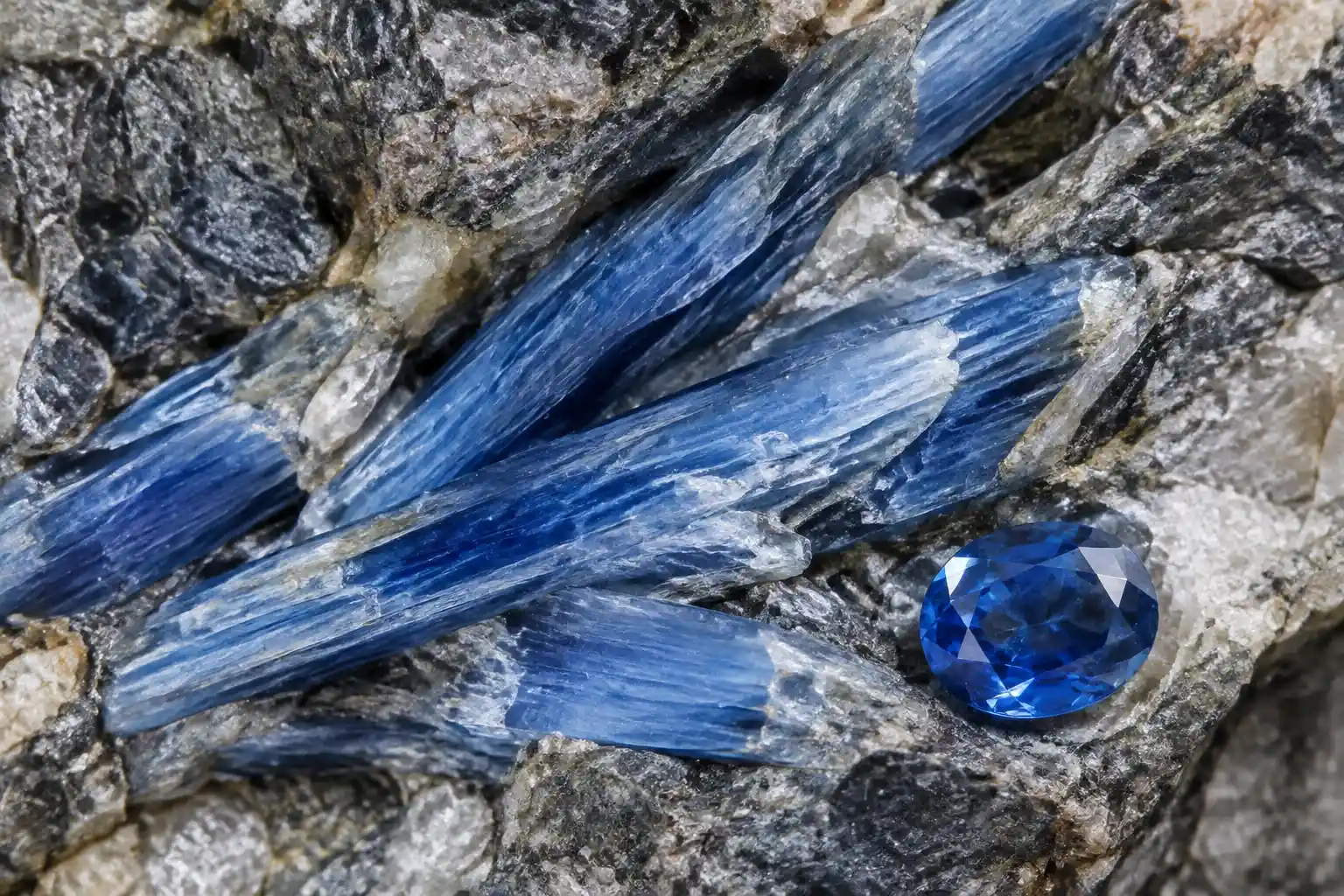
Color adds another dimension. Blue is the best-known variety, but Kyanite can also occur in white, colorless, gray, green, black, and less common yellow, orange, or pink tones. Transparent blue crystals can be faceted into attractive gemstones, while opaque or strongly included crystals remain desirable as mineral specimens, cabochons, or decorative pieces. Modern spiritual traditions associate Kyanite benefits with communication, calm, alignment, meditation, or energetic balance, but these beliefs should remain separate from claims about medical or psychological treatment.
11 Kyanite Benefits at a Glance
- Directional hardness makes Kyanite one of the clearest minerals for understanding anisotropic physical properties.
- High-pressure metamorphic occurrence helps geologists reconstruct the conditions under which rocks formed and changed.
- Blue transparent crystals can produce distinctive faceted gemstones with strong visual appeal.
- Bladed crystal habits make natural Kyanite specimens attractive for mineral collections and educational displays.
- Industrial Kyanite is valuable in refractory ceramics designed to withstand extremely high temperatures.
- Heating behavior makes Kyanite useful in applications where predictable expansion can compensate for shrinkage during firing.
- Its relationship with andalusite and sillimanite provides an important lesson in mineral polymorphism.
- Variable hardness, cleavage, and crystal shape make Kyanite useful for advanced lapidary education.
- Color variation provides collecting opportunities beyond the familiar blue variety.
- Gemological identification helps distinguish Kyanite from sapphire, blue tourmaline, aquamarine, glass, and other blue stones.
- Modern symbolism involving communication, perspective, or steadiness can remain meaningful when separated from medical claims.
Directional Hardness Makes Kyanite Physically Unusual
The most distinctive Kyanite benefits begin with hardness that changes dramatically according to direction. Most familiar gemstones are described by a relatively narrow Mohs hardness range, but Kyanite can behave much softer along the length of its blades and much harder across them. This difference reflects the anisotropic crystal structure rather than inconsistent testing or poor specimen quality.
For students of mineralogy, the effect provides a direct lesson in how atomic arrangement influences physical behavior. A crystal can be one mineral species and still resist scratching differently when force is applied along different crystallographic directions. This is a useful reminder that a single hardness number is often a simplification.
For lapidaries, directional hardness creates a practical challenge. One area of a stone may cut or polish faster than another, increasing the risk of uneven surfaces or accidental damage. Skilled work therefore requires awareness of orientation rather than simply applying the same pressure and abrasive sequence used for a more uniform gemstone.
This unusual property helps make Kyanite memorable even among experienced collectors.
Kyanite Helps Geologists Read Metamorphic Pressure Conditions
Kyanite is an important metamorphic mineral because its stability is tied strongly to pressure and temperature. It commonly forms in aluminum-rich rocks such as schist and gneiss that experienced elevated pressure during regional metamorphism. Its presence can therefore help geologists estimate the conditions that affected a rock during burial and tectonic deformation.
This geological role becomes even more valuable when Kyanite occurs with minerals such as garnet, staurolite, mica, quartz, or sillimanite. Mineral assemblages are interpreted together because one crystal rarely provides every answer independently. The resulting information can reveal how pressure and temperature changed as rocks traveled through a mountain-building system.
These Kyanite benefits make natural specimens scientifically useful even when they are not transparent enough for jewelry. A weathered blue blade in schist may carry more geological information than a flawless faceted gem because the surrounding rock preserves relationships with other minerals and structures.
Removing a crystal from its matrix can improve its display appearance while reducing that context, which is why well-documented specimens deserve careful preservation.
The Andalusite-Kyanite-Sillimanite Relationship Teaches Mineral Polymorphism
Kyanite, andalusite, and sillimanite all share the same basic chemical composition, Al₂SiO₅, yet they have different crystal structures. They are polymorphs, meaning the same chemistry can organize into different structures according to formation conditions.
Kyanite is associated with relatively higher-pressure conditions, andalusite with lower-pressure settings, while sillimanite is generally stable at higher temperatures. The exact boundaries depend on temperature and pressure together rather than one simple rule.
This gives Kyanite benefits substantial educational value because polymorphism demonstrates that chemical formula alone does not define every physical property. Crystal structure influences hardness, cleavage, density, habit, optical behavior, and stability.
The same principle appears elsewhere in mineralogy, but the Al₂SiO₅ system is especially important because its minerals are widely used to interpret metamorphic rocks. Kyanite therefore connects gem collecting with a fundamental geological concept.
Blue Kyanite Can Produce Distinctive Faceted Gemstones
Transparent gem-quality Kyanite can display an attractive blue ranging from pale sky-blue to saturated sapphire-like tones. Color may be uneven or zoned, with some crystals showing stronger blue in the central areas and paler edges. Skilled cutting can place the most attractive color where it contributes effectively to the face-up appearance.
Faceting remains challenging because directional hardness and cleavage complicate polishing. A cutter may encounter different resistance as the stone rotates on the lap, while internal fractures or cleavage can create additional risk. Successful stones therefore represent both good rough and considerable lapidary skill.
The more specific Blue Kyanite benefits include color appeal and jewelry use, but general Kyanite benefits extend across every color and form of the species. Transparent blue material is simply the most familiar gem expression.
Kyanite should not be judged by how closely it imitates sapphire. Its visual appeal comes from its own color zoning, pleochroism, crystal structure, geological origin, and less common presence in mainstream jewelry.
Bladed Crystals Give Kyanite Strong Mineral-Collector Appeal
Natural Kyanite commonly forms elongated blades, flat crystals, or radiating aggregates that look dramatically different from cubic fluorite, hexagonal quartz, or prismatic tourmaline. Fine specimens may occur on quartz, mica-rich schist, or other metamorphic matrix and can preserve natural striations, growth features, bends, or intergrowths.
These natural forms create Kyanite benefits for collectors who value crystallography and geological context. A transparent blade with excellent termination may be desirable for crystal quality, while a group of blue crystals on contrasting white quartz can have strong display appeal even if none of the individual crystals would produce a large faceted gem.
Black Kyanite often forms fan-like or radiating aggregates, giving it a markedly different appearance from transparent blue material. Collectors comparing black and blue varieties can see how color and crystal habit influence commercial perception while the mineral identity remains the same.
Condition matters because thin blades can chip and cleavage surfaces can separate under impact. Safe handling therefore preserves both appearance and scientific value.
Industrial Kyanite Has Important High-Temperature Uses
Many discussions of Kyanite benefits focus only on jewelry and crystal symbolism, yet industrial applications are far more important by volume. Kyanite is used in refractory products designed to perform at very high temperatures, including furnace components, kiln furniture, refractory bricks, mortars, foundry products, and certain high-temperature ceramics.
Its usefulness comes partly from what happens when Kyanite is heated strongly. The mineral transforms and contributes to the formation of mullite, an aluminum silicate phase valued for thermal stability and high-temperature strength. This behavior makes Kyanite useful in ceramic systems where resistance to heat and structural change is essential.
Industrial-grade Kyanite does not need gem transparency or vivid blue color. Chemical composition, particle size, impurities, firing behavior, and consistency become more important than appearance.
This contrast demonstrates why gemstone beauty represents only one part of a mineral’s value. The same species can serve collectors, jewelers, geologists, and industrial manufacturers for completely different reasons.
Predictable Thermal Expansion Can Be Useful During Ceramic Firing
Kyanite undergoes significant volume change when heated and converted into high-temperature phases. In carefully designed refractory formulations, that expansion can help offset shrinkage occurring elsewhere during firing, allowing manufacturers to control dimensions and reduce unwanted changes in finished products.
This thermal behavior is one of the less obvious Kyanite benefits because it has little connection with the polished blue crystals seen in jewelry. It arises from mineral structure and transformation rather than decorative qualities.
The industrial use also illustrates a larger principle in mineral science: a property that would be inconvenient in one setting can become beneficial in another. Expansion under heat might be undesirable for an ordinary building stone, yet controlled expansion can be useful in a ceramic recipe designed around it.
Kyanite therefore provides a good example of why minerals should be evaluated according to application rather than one universal concept of quality.
Kyanite Offers Advanced Lapidary Lessons
Directional hardness, brittle tenacity, cleavage, elongated crystal habit, and uneven color zoning make Kyanite a demanding stone to cut. These challenges give experienced lapidaries an opportunity to develop skills that are less important when working with more forgiving gems.
Orientation must account for both appearance and physical behavior. A cutter trying to preserve a richly colored zone may need to accept a shape that differs from the original plan, while polishing direction can affect how evenly a facet develops.
Cabochons can be suitable for included or translucent material, while transparent rough may justify faceting. Beads and carvings are also produced, but thin blade shapes and natural cleavage require care during drilling and finishing.
Kyanite benefits therefore include educational value for anyone learning that lapidary success depends on crystal structure rather than merely on choosing increasingly fine abrasives.
Kyanite Color Variety Expands Collecting Beyond Blue
Blue dominates commercial recognition, but Kyanite occurs in several additional colors. White and colorless crystals can be attractive for mineral collections, while green, gray, black, yellow, orange, and pink material provides unusual specialist interest.
Different colors can arise from trace elements, charge-transfer mechanisms, inclusions, and structural effects. Blue coloration is particularly associated with iron-related electronic interactions, while less common colors may involve other trace-element influences.
Color alone does not create a separate mineral species. A green blade and a blue blade can both be Kyanite if their chemistry and structure match the species definition.
This creates Kyanite benefits for collectors interested in assembling color suites or comparing how chemical variation affects one mineral. Provenance becomes especially useful because unusual colors may be associated with particular geological environments or localities.
Gemological Identification Protects Buyers from Blue Lookalikes
Transparent blue Kyanite can resemble sapphire, blue tourmaline, aquamarine, iolite, blue topaz, glass, or other blue gemstones in photographs. Its distinctive directional hardness is interesting scientifically but should not be used as a destructive identification test on a finished gem.
Professional testing can examine refractive properties, birefringence, pleochroism, density, inclusions, cleavage, and spectroscopy. These characteristics together distinguish Kyanite from other blue stones more reliably than color alone.
The unusual hardness behavior also explains why scratches on an old Kyanite stone may appear inconsistent from one direction to another. That does not necessarily mean the specimen is assembled or fake.
Accurate identification protects buyers from both overpaying for a misidentified stone and damaging a genuine gem through inappropriate care.
Modern Communication and Alignment Symbolism Needs Clear Limits
Modern crystal traditions frequently associate Kyanite benefits with communication, energetic alignment, meditation, calm, intuition, or the idea that Kyanite does not retain negative energy. Blue varieties are often connected with speech and throat-centered symbolism, while black varieties are commonly associated with grounding or protection.
These themes can function as personal symbolism. Someone may keep a blue Kyanite crystal near a journal because it represents careful communication, use a specimen during meditation because its bladed form provides a visual focus, or choose it to mark a period of deliberate personal change.
Beliefs surrounding Kyanite healing properties sometimes extend into anxiety, thyroid function, speech disorders, pain, nervous-system health, or emotional trauma. Those interpretations belong to spiritual and wellness practice rather than established clinical medicine. Kyanite can symbolize communication without treating the organs or psychological processes involved in communication.
Responsible Use Requires Care with Cleavage, Dust, and Industrial Assumptions
Finished Kyanite should be protected from hard impact because brittle tenacity and cleavage can lead to chips or splitting. Jewelry cleaning is safest when kept simple, using lukewarm water, mild soap, and gentle brushing rather than aggressive ultrasonic or steam treatment, particularly when the stone contains visible fractures.
Lapidary work requires appropriate dust control because Kyanite is a silicate mineral. Wet cutting, ventilation, eye protection, and suitable respiratory precautions are sensible when sawing, grinding, or polishing.
Industrial Kyanite uses should not be confused with home experimentation. Heating mineral specimens to extreme temperatures, grinding them into powders, or attempting refractory processes without proper equipment introduces risks unrelated to ordinary collecting.
Kyanite should also never be consumed as a source of aluminum, silicon, or trace elements. Mineral chemistry does not turn a collector crystal into a nutritional product.
Conclusion
Kyanite benefits include unusual directional hardness, metamorphic geological value, polymorphism education, blue gemstone beauty, natural crystal collecting, high-temperature industrial applications, predictable firing behavior, lapidary education, color diversity, gemological identification, and meaningful modern symbolism.
The strongest Kyanite benefits come from understanding the mineral’s contradictions rather than simplifying them. It can be soft and hard depending on direction, beautiful yet difficult to cut, useful as both a gemstone and industrial refractory mineral, and symbolically meaningful without being a medical treatment. Those genuine characteristics already make Kyanite exceptional.
FAQs
What are the main Kyanite benefits?
The most practical Kyanite benefits include mineral collecting, faceted gemstone use, metamorphic geology, teaching anisotropic hardness, industrial refractory production, ceramic applications, lapidary education, and gemstone identification. Modern associations involving communication, alignment, calm, or meditation can also carry personal meaning, but these remain symbolic rather than scientifically demonstrated health effects.
Why does Kyanite have two different hardnesses?
Kyanite’s crystal structure is anisotropic, so resistance to scratching changes according to crystallographic direction. Bladed crystals are substantially softer when tested along one direction and harder across another, making Kyanite one of the clearest mineral examples of why hardness cannot always be summarized by one single number.
What is Kyanite made of?
Kyanite is an aluminum silicate with the composition Al₂SiO₅ and crystallizes in the triclinic system. It has the same basic chemistry as andalusite and sillimanite, but the three minerals possess different crystal structures because they become stable under different pressure-and-temperature conditions.
Why is Kyanite important to geologists?
Kyanite commonly forms under relatively high-pressure metamorphic conditions in aluminum-rich rocks such as schist and gneiss. When interpreted together with other minerals and rock textures, its presence can help geologists reconstruct the pressure and temperature history experienced during burial, deformation, and mountain-building.
Is Kyanite suitable for jewelry?
Gem-quality Kyanite can be used successfully in earrings, pendants, brooches, beads, and carefully designed rings, but cleavage, brittleness, and directional hardness require thoughtful handling. Protected settings and lower-impact jewelry are sensible because a strong blow can damage the stone even where its cross-crystal hardness is relatively high.
Why is Kyanite used in high-temperature ceramics?
Industrial Kyanite transforms during intense firing and contributes to mullite formation, producing high-temperature ceramic properties useful in refractories. Its predictable expansion during firing can also help compensate for shrinkage in properly engineered ceramic formulations, making the mineral useful in furnaces, kilns, foundries, and other demanding thermal environments.
Is every Kyanite blue?
No. Blue is the most familiar color, but Kyanite also occurs in white, colorless, gray, green, black, and less common yellow, orange, or pink forms. These stones remain Kyanite when their mineral chemistry and structure match the species, so color varieties should not automatically be treated as separate minerals.
Is Kyanite the same as sapphire?
No. Kyanite is an aluminum silicate, while sapphire is corundum, an aluminum oxide with a completely different crystal structure and much greater hardness. Transparent blue examples can look similar in photographs, but professional gemological testing separates them through optical properties, density, cleavage, inclusions, and other measurable characteristics.
Does Kyanite help with communication or emotional balance?
There is no established scientific evidence that wearing Kyanite directly improves speech, communication ability, emotional regulation, anxiety, or neurological function. Someone may use the stone as a personal reminder to communicate carefully or as part of a reflective practice, but practical change comes through behavior, circumstances, and appropriate support rather than a demonstrated mineral effect.
Does Kyanite need energetic cleansing?
Claims that Kyanite never stores negative energy or cleanses itself belong to modern metaphysical traditions rather than measurable mineral science. From a physical-care perspective, Kyanite may need ordinary dust removal and gentle cleaning, while symbolic cleansing practices remain a matter of personal spiritual preference.
Does Kyanite have healing powers?
There is no established clinical evidence that Kyanite treats thyroid disease, speech disorders, anxiety, depression, pain, neurological conditions, trauma, or other physical or mental-health concerns. Kyanite benefits described as healing, aligning, calming, communicative, chakra-related, protective, or energetic effects remain spiritual and personal beliefs and should not replace qualified medical or mental-health care.