10 Real Lemurian Quartz Benefits: Helpful Traditions, Verified Facts, Important Cautions
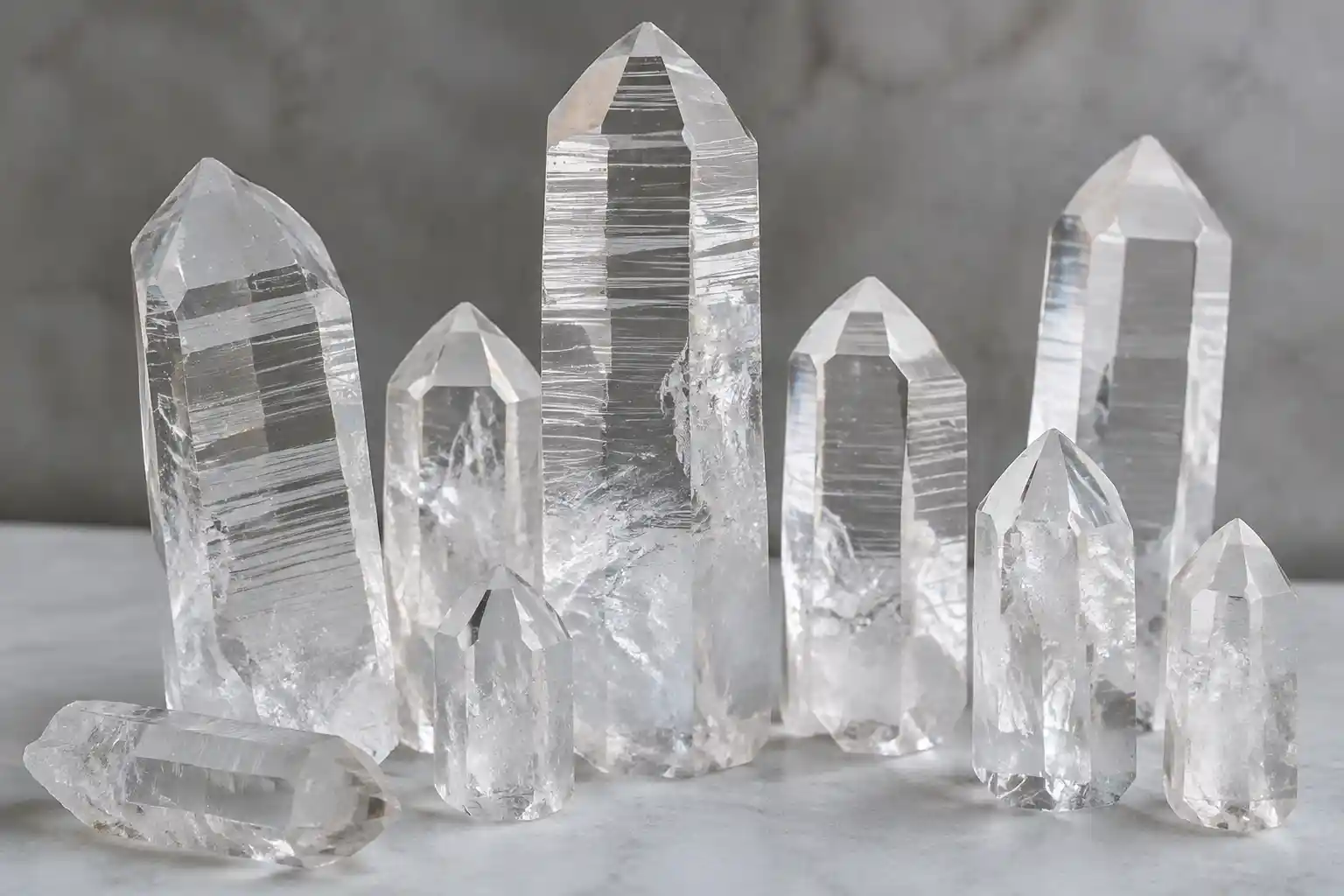
Lemurian Quartz benefits make the most sense when the crystal is understood first as natural quartz rather than as a separate mineral species. The name Lemurian Quartz, or Lemurian Seed Quartz, is used in the crystal trade for quartz points that commonly display pronounced horizontal ridges or ladder-like striations across one or more prism faces. Mineralogically, these stones remain quartz, with the chemical formula SiO₂, trigonal crystal structure, vitreous luster, and a Mohs hardness of 7.
The distinctive surface lines are real growth features, but they are not exclusive to crystals carrying the Lemurian trade name. Quartz can develop horizontal striations as crystal faces grow in changing conditions, and comparable markings occur in specimens from multiple localities. The trade designation became especially associated with striated quartz from Brazil, particularly material from Minas Gerais, although sellers now use the name more widely.
Many Lemurian Quartz benefits promoted today concern meditation, spiritual memory, energetic connection, or access to ancient knowledge. These belong to modern metaphysical traditions rather than established mineralogical or medical science. The strongest practical benefits come from quartz durability, visually interesting natural growth markings, collector appeal, educational value, decorative use, and the ability to serve as a meaningful focus during personal reflection without requiring unsupported healing claims.
10 Lemurian Quartz Benefits at a Glance
- Natural horizontal growth striations give many crystals a distinctive tactile and visual character.
- Mohs hardness 7 makes quartz reasonably durable for handling, display, and selected jewelry uses.
- Natural crystal points can be attractive collector specimens without polishing or extensive modification.
- Growth markings provide educational value for understanding how crystal faces develop.
- Transparent, translucent, frosted, pink-tinted, and included examples create visual variety for collections.
- Brazilian provenance can add geological and collector interest when locality information is reliable.
- Meditation or journaling use can provide a deliberate visual and tactile focus.
- Modern symbolism involving memory, wisdom, connection, and reflection can hold personal meaning.
- Quartz identity makes the stone useful for comparing trade names with formal mineral classification.
- Evidence-safe use allows spiritual traditions to be appreciated without treating the crystal as a medical treatment.
Natural Growth Striations Are a Distinctive Lemurian Quartz Benefit
Among the most recognizable Lemurian Quartz benefits are the horizontal ridges that cross the prism faces of many specimens. Crystal sellers sometimes describe these marks as ladders, barcodes, steps, or encoded lines because they may appear in repeated bands across otherwise smooth-looking quartz surfaces.
The lines are not carved records or writing. They are natural surface-growth features produced during crystallization. As a quartz crystal develops, changes in growth rate and conditions can leave tiny steps on its prism faces. When these become pronounced, the surface may feel ribbed under a fingertip and catch light differently from smoother crystal faces.
This makes a good specimen interesting even without any metaphysical interpretation. A collector can examine the ridges with magnification, compare one face with another, and see evidence of how the external crystal developed. Some crystals show strong lines on alternating faces, while others display finer or less regular markings.
The feature also demonstrates why trade names and mineralogical names are not always the same. The label Lemurian Quartz highlights a particular appearance valued by collectors and spiritual communities, but the underlying crystal remains quartz. Recognizing both levels of identity is one of the most educational Lemurian Quartz benefits.
Quartz Durability Supports Handling, Display, and Some Jewelry Use
Quartz has a Mohs hardness of 7, giving Lemurian Quartz reasonable resistance to scratching compared with many softer decorative stones. Natural points can be handled as mineral specimens, displayed on shelves, incorporated into collections, or carefully mounted in pendants and other jewelry.
Hardness does not make a crystal indestructible. Quartz has no perfect cleavage, but it can fracture with a conchoidal break and crystal tips can chip when dropped or struck. Long slender points and sharply terminated specimens deserve particular care because their geometry can concentrate force at vulnerable edges.
Collectors often prefer Lemurian Quartz in relatively natural form because the surface growth ridges are a major part of its appeal. Heavy polishing can remove or soften those features, so specimens intended to preserve the characteristic appearance are commonly left with natural prism faces while bases may be trimmed or stabilized for display.
These physical properties make Lemurian Quartz benefits more practical than many metaphysical descriptions suggest. A well-preserved specimen can be enjoyed for years when kept away from strong impacts, harder abrasive objects, and careless handling.
Collector Value Comes From Form, Striations, Clarity, and Provenance
Lemurian Quartz attracts collectors because natural points can vary significantly in shape, clarity, surface texture, color, inclusions, termination quality, and intensity of striation. One crystal may be water-clear with sharp ladder-like lines, while another may be milky, frosted, slightly smoky, pinkish, or filled with internal veils.
The trade name alone does not establish exceptional rarity. Striated quartz occurs outside the localities historically associated with Lemurian material, and sellers use the label with different levels of strictness. A collector therefore benefits from evaluating the actual specimen rather than paying solely for terminology.
Reliable provenance can add interest. The Lemurian Quartz trade name became particularly associated with crystals from the Serra do Cabral area of Minas Gerais in Brazil. When locality information is well documented, it gives the specimen a more useful geological context than a vague claim that it came from an unspecified sacred deposit.
Quality remains subjective because different buyers want different things. One person may prefer extremely pronounced ladder lines, another may value a completely intact termination, while another may choose unusual inclusions or soft pink coloration. The varied forms available are part of the appeal and make collecting one of the more tangible Lemurian Quartz benefits.
Lemurian Quartz Helps Explain the Difference Between Trade Names and Minerals
Another valuable aspect of Lemurian Quartz benefits is educational. Many gemstone and crystal names are formal mineral species, while others describe colors, habits, sources, treatments, commercial categories, or spiritual traditions. Lemurian Quartz is a good example of the second group.
Quartz is a recognized mineral with a specific chemistry and crystallographic identity. Lemurian Quartz does not possess a separate chemical formula, crystal system, hardness, or diagnostic property that makes it a new mineral species. The name is applied commercially to quartz crystals meeting particular visual or metaphysical expectations, especially pronounced horizontal striations.
The distinction matters when evaluating claims about rarity or authenticity. A natural quartz crystal can be completely genuine even if experts disagree about whether the trade label Lemurian should apply to it. Conversely, the presence of quartz chemistry does not prove a specimen came from the Brazilian locality associated with the original commercial material.
Understanding this distinction also helps with clear quartz benefits, because many practical properties attributed to Lemurian specimens are simply the normal physical characteristics of quartz. The special value of the Lemurian category lies mainly in crystal habit, surface appearance, provenance, collecting culture, and modern symbolism.
Natural Crystal Form Adds Decorative and Educational Appeal
Many Lemurian Quartz benefits can be enjoyed without cutting the crystal at all. Natural quartz points have geometric prism faces and terminations that already provide an attractive form, so they work well in mineral displays, teaching collections, photography, desk arrangements, or specimen cabinets.
Directional lighting can make the surface features especially visible. Light striking across the prism faces emphasizes horizontal ridges, frosted zones, small growth steps, and internal inclusions. A specimen that appears almost plain in diffuse illumination may become much more detailed under a side light.
This visual complexity makes the crystal useful for learning to observe rather than merely identify. Collectors can compare termination faces, crystal habit, clarity, attached matrix, contact marks, fractures, and surface growth. Such observations reveal how a naturally grown crystal differs from a polished point manufactured from a larger piece of quartz.
Natural form also matters when purchasing. Perfectly uniform grooves, highly regular machine-like marks, or a fully reshaped surface may deserve closer examination if a seller claims the piece retains untouched growth features. Genuine natural striations usually show small irregularities consistent with crystal formation rather than manufactured engraving.
Meditation and Reflection Can Be Practical Personal Uses
Meditation is frequently included among Lemurian Quartz benefits, but its usefulness can be described without claiming supernatural effects. A crystal point can serve as a visual and tactile object during quiet reflection, breathing exercises, journaling, intention setting, or other contemplative routines.
The ridged surfaces may make Lemurian Quartz particularly engaging to hold because the texture provides a noticeable sensory detail. Someone can trace the natural lines while concentrating on a question, goal, or personal value. The process may encourage attention simply because it gives the hands and eyes a consistent focus.
This type of ritual is different from saying that the quartz medically changes the nervous system or transmits healing frequencies. The crystal functions as a chosen object around which the person structures a practice. Similar roles can be played by beads, candles, photographs, religious objects, written phrases, or meaningful jewelry.
Using the crystal in this way keeps Lemurian Quartz benefits grounded in personal experience. A person can value the ritual without needing to prove that the stone contains invisible information or physically modifies the body.
Modern Spiritual Symbolism Gives Lemurian Quartz a Distinct Identity
The modern metaphysical story is one reason Lemurian Quartz has become recognizable. Contemporary crystal traditions often associate the horizontal lines with stored knowledge, spiritual memory, ancient wisdom, collective consciousness, personal awakening, or connection with a mythical civilization known as Lemuria.
These beliefs are modern spiritual interpretations, not mineralogical facts. The crystal lines formed through quartz growth, not through information being inscribed by an ancient society. There is also no established archaeological evidence that these quartz points were deliberately encoded by an advanced Lemurian civilization.
That distinction does not prevent symbolic use. Someone may interpret the lines as a metaphor for memory, learning, accumulated experience, or knowledge passed between generations. Those themes can make the crystal personally meaningful even when the literal ancient-record story is treated as mythology.
The value of symbolism often comes from the way it helps a person frame experience. A collector may see nothing more than fascinating quartz growth, while another owner may use the same crystal as a spiritual reminder of connection or wisdom. Both can appreciate the specimen without confusing belief with scientific identification.
Geological Provenance Can Be More Useful Than Mythical Provenance
One of the less discussed Lemurian Quartz benefits is the opportunity to appreciate a real geological origin instead of relying entirely on metaphysical stories. Brazilian quartz localities produce remarkable crystals through geological processes involving silica-rich fluids, open cavities, fractures, changing temperatures, and extended crystal growth.
The original commercial reputation of Lemurian Quartz became closely associated with Brazilian specimens, especially from Minas Gerais. Understanding where a specimen actually came from can make it more interesting because locality connects the crystal with real geology, mining history, and mineral collecting.
Not every stone sold under the trade name has documented provenance. Modern sellers may apply the term to quartz from other regions when the crystals show similar striations. That usage is not necessarily fraudulent if the seller is transparent about the source and treats Lemurian as a trade description rather than a scientific locality designation.
Collectors who care about origin should therefore ask for specific locality information instead of assuming that every Lemurian Quartz point came from the same Brazilian deposit. Clear provenance adds factual depth to the stone’s story.
Care Is Simple but Crystal Tips Still Need Protection
Quartz is durable enough for straightforward care, which is another practical advantage among Lemurian Quartz benefits. Dust can generally be removed with water, mild soap, and a soft brush when the specimen has no fragile matrix, coatings, adhesives, or other components requiring special treatment.
Natural points should still be handled carefully. A specimen dropped onto tile or stone can chip its termination, fracture along an existing internal weakness, or lose small attached crystals. Storing individual points so that tips do not strike harder minerals or one another helps preserve condition.
Aggressive mechanical cleaning is unnecessary for ordinary display pieces. Collectors should also consider any secondary minerals attached to a quartz specimen because those minerals may have different chemical sensitivities even when the quartz itself is relatively stable.
The growth striations themselves are surface features. Repeated abrasive polishing can reduce them, so preserving a natural Lemurian appearance means avoiding unnecessary resurfacing. For many collectors, an intact natural face is more important than achieving a perfectly glossy surface.
What Lemurian Quartz Benefits Do Not Include
Responsible discussion of Lemurian Quartz benefits requires clear limits. Quartz is useful for collecting, education, jewelry, display, meditation, and personal symbolism, but there is no established evidence that Lemurian Quartz diagnoses, treats, prevents, or cures medical or mental-health conditions.
Claims involving anxiety disorders, depression, trauma, neurological conditions, hormones, pain, circulation, sleep disorders, immunity, fertility, infection, detoxification, or organ function are not supported by established medical evidence. Silicon and oxygen within quartz do not enter the body therapeutically simply because a crystal is held or worn.
Modern claims concerning encoded information, ancient Lemurian records, energetic downloads, DNA activation, or scientifically measurable spiritual frequencies likewise should not be presented as established facts. They belong to metaphysical belief systems.
The beliefs documented around Lemurian Quartz healing properties can be understood as spiritual traditions with evidence limits rather than substitutes for medical care. A crystal does not need to treat disease in order to be attractive, meaningful, collectible, or useful in a personal reflective practice.
Conclusion
Lemurian Quartz benefits are strongest when they stay connected with the crystal’s real identity. These specimens are quartz, often valued for pronounced horizontal growth striations, natural crystal form, collector appeal, Brazilian provenance, durability, educational usefulness, and distinctive surface texture.
Modern traditions involving wisdom, memory, connection, and spiritual reflection can add personal meaning, but the Lemurian label is a trade and metaphysical designation rather than a separate mineral species. Appreciating the crystal’s real growth features while keeping spiritual claims evidence-safe creates a more accurate and useful understanding of what Lemurian Quartz can offer.
FAQs
What are the main Lemurian Quartz benefits?
The most practical Lemurian Quartz benefits include attractive natural crystal form, pronounced growth striations, Mohs hardness 7, collector interest, geological education, display value, and usefulness as a focus during meditation or journaling. Modern metaphysical traditions also associate these crystals with memory, wisdom, spiritual connection, and personal growth, but those themes are belief-based rather than established medical effects.
Is Lemurian Quartz a different mineral from clear quartz?
No. Lemurian Quartz is mineralogically quartz with the same SiO₂ composition and trigonal crystal structure as other natural quartz crystals. The term is a commercial and metaphysical label commonly applied to crystals with pronounced horizontal growth lines. The markings can be visually distinctive, but they do not create a separate mineral species or change the fundamental physical properties of quartz.
What are the horizontal lines on Lemurian Quartz?
The lines are natural growth striations or steps that developed on the prism faces as the quartz crystal grew. Changes in growth conditions can produce repeated ridges that look like ladders or barcodes. Modern spiritual traditions sometimes call these lines records or encoded information, but scientifically they are crystal-growth features rather than writing or stored messages.
Is every striated quartz crystal Lemurian Quartz?
Not necessarily in trade usage. Horizontal striations can occur naturally on ordinary quartz from many localities, so the presence of lines alone does not establish a unique mineral variety or Brazilian origin. Sellers differ in how narrowly they apply the Lemurian name, which is why provenance and an accurate description of the actual specimen are useful.
Where does Lemurian Quartz come from?
The commercial name became especially associated with striated quartz crystals from Minas Gerais in Brazil, including the Serra do Cabral region. Similar striated quartz occurs elsewhere, and modern sellers may use the Lemurian label for specimens from additional countries. A specific locality claim should therefore be supported by reliable provenance rather than assumed from appearance.
Can Lemurian Quartz be used for meditation?
Yes, it can be used as a visual or tactile focus during meditation, journaling, breathing exercises, or personal ritual. A person may trace the natural ridges or hold the crystal while concentrating on a particular intention. The usefulness of the practice can come from attention, routine, symbolism, and personal association without requiring the quartz to produce a medically active energy.
Is Lemurian Quartz durable?
Lemurian Quartz has the normal hardness of quartz, about 7 on the Mohs scale, making it reasonably resistant to ordinary scratching. Natural crystal tips can still chip or fracture if dropped or struck, and internal fractures may create vulnerable areas. Careful handling and individual storage help preserve sharp terminations and surface growth features.
Are Lemurian Quartz healing benefits scientifically proven?
No. Claims involving physical healing, emotional treatment, energy balancing, detoxification, hormone regulation, immune support, or disease treatment have not been established scientifically for Lemurian Quartz. Its demonstrated properties concern quartz mineralogy, hardness, crystal growth, optical appearance, collecting, and practical use as a decorative or symbolic object.
Lemurian Quartz benefits involving energy, healing, ancient records, or spiritual connection describe modern belief traditions and should not replace qualified physical or mental-health care.