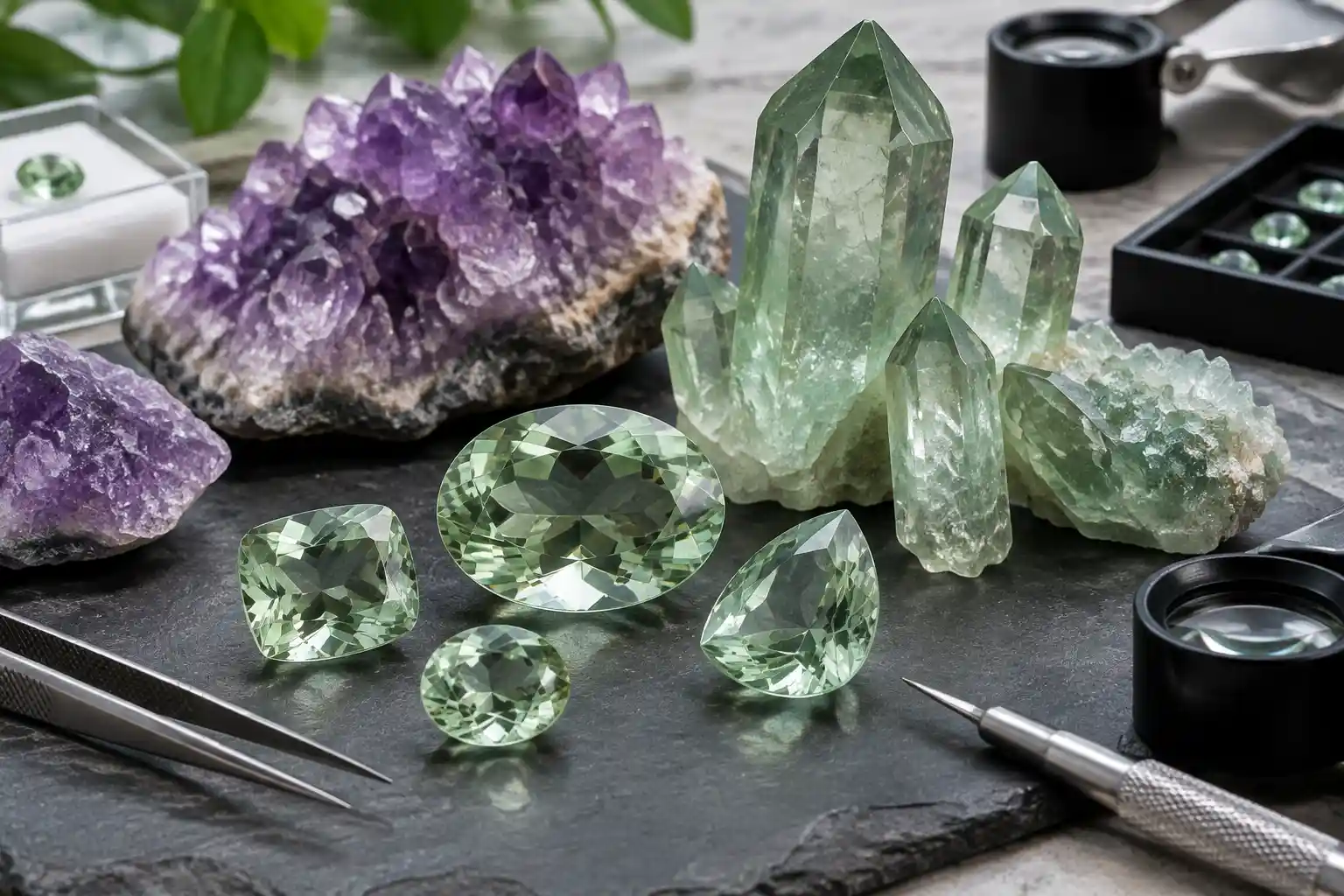
Prasiolite Benefits: 11 Popular Uses, Gentle Symbolism & Hidden Facts, Responsible Use
Prasiolite benefits begin with an important identification fact: prasiolite is green quartz. It is a transparent to translucent green variety of macrocrystalline quartz with the chemical formula SiO₂, Mohs hardness 7, vitreous luster, and the fundamental physical properties associated with quartz. Its color usually ranges from pale yellowish green through mint and gray-green to deeper leek or olive tones.
Most commercially available prasiolite does not acquire its green color naturally in the ground. Suitable amethyst from certain deposits can turn green when carefully heated, and green quartz can also be produced through irradiation of appropriate starting quartz. Naturally occurring prasiolite is known but comparatively uncommon. This treatment history is one of the most important Prasiolite benefits for buyers to understand because attractive green color alone does not prove natural-color origin.
Real Prasiolite benefits include quartz durability, faceting potential, jewelry versatility, attractive soft green color, gemological interest, collector value, and an excellent example of how treatment can alter gemstone color without changing the underlying mineral species. Modern crystal traditions may associate prasiolite with growth, compassion, abundance, emotional balance, or heart-centered symbolism, but these ideas should remain separate from claims that quartz treats heart disease, anxiety, hormonal conditions, circulation problems, or other illnesses.
11 Prasiolite Benefits at a Glance
- Mohs hardness 7 provides good resistance to ordinary scratching and supports frequent jewelry wear.
- Transparent quartz can be faceted into bright gemstones with good polish and attractive brilliance.
- Soft green color offers a distinctive alternative to more saturated emerald, tourmaline, or peridot.
- Larger clean gems can often be cut because quartz crystals can occur in substantial sizes.
- Prasiolite demonstrates how controlled treatment can change quartz color while preserving quartz identity.
- Natural green quartz is uncommon, giving well-documented natural-color specimens additional collector interest.
- Quartz mineralogy provides educational value through crystal structure, fracture, optics, and color modification.
- Pendants, earrings, rings, bracelets, and statement pieces can all make practical use of its durability.
- Accurate disclosure helps buyers distinguish natural green quartz from heat-treated or irradiated commercial stones.
- Modern symbolism can connect pale green color with growth, renewal, compassion, nature, or deliberate change.
- Simple care preserves Prasiolite benefits without exposing the stone to unnecessary heat, harsh chemicals, or unsupported wellness claims.
Green Quartz Identity Is the Foundation of Prasiolite Benefits
The most important Prasiolite benefit is straightforward mineralogical identity. Prasiolite is quartz, not a separate mineral species.
Its chemical composition is silicon dioxide, SiO₂, and its structure belongs to the quartz family alongside colorless rock crystal, purple amethyst, yellow citrine, smoky quartz, and several other named varieties.
This shared identity explains why Prasiolite has Mohs hardness 7 and generally useful jewelry durability. It also explains why treatment can change color without changing the stone into a new mineral.
A heated amethyst that becomes green is still quartz. The treatment changes color centers and related electronic behavior within the crystal rather than replacing quartz with another substance.
For buyers, this distinction matters because terms such as “green amethyst” are commonly used in retail even though prasiolite or green quartz is the more accurate gemological terminology for the finished green stone.
Most Commercial Prasiolite Gets Its Color Through Treatment
Treatment awareness is one of the most practical Prasiolite benefits because much of the green quartz offered in jewelry has been produced intentionally.
Certain amethyst responds to controlled heating by changing from purple to green instead of becoming the yellow-to-orange color associated with many heated citrines. Irradiation can also create green coloration in suitable quartz.
Not every amethyst responds this way. The starting stone must have the appropriate trace chemistry, defects, and color-center characteristics.
Treatment should not automatically be interpreted as fraud. Heat-treated natural quartz remains natural quartz. The important issue is disclosure, especially when a seller charges a premium by implying that the color developed naturally.
Anyone preparing to buy Prasiolite should therefore ask how the green color was produced when origin of color matters to the purchase.
A beautiful treated gemstone can still be entirely suitable for jewelry when represented accurately.
Natural Prasiolite Is Uncommon and Scientifically Interesting
Natural green quartz does occur, but it is considerably less common than treated commercial Prasiolite.
Natural color requires a suitable combination of impurities, irradiation history, thermal conditions, and crystal defects. Only particular geological environments produce that combination.
This rarity makes documented natural Prasiolite especially interesting to mineral collectors.
The challenge is that color alone may not prove whether the green developed naturally or through laboratory treatment. A pale green quartz crystal can look convincing regardless of how its color formed.
Locality, provenance, spectroscopy, irradiation features, inclusions, and other gemological evidence may become important when natural origin carries a significant premium.
For ordinary jewelry, such detailed investigation may be unnecessary. For expensive collector specimens, documentation becomes much more important.
Mohs Hardness 7 Makes Prasiolite Practical for Jewelry
Durability is one of the clearest Prasiolite benefits. Quartz has Mohs hardness 7, making it harder than feldspar, opal, fluorite, calcite, pearl, and many familiar ornamental gems.
This provides useful scratch resistance for rings, earrings, pendants, necklaces, brooches, and bracelets.
Prasiolite has no prominent gemstone cleavage, although strong impact can still produce conchoidal fracture or chips. Thin facet junctions, sharp corners, and exposed girdles deserve reasonable protection.
A well-cut Prasiolite ring can therefore tolerate normal wear better than many softer green gemstones, though it should still be removed during construction work, strenuous exercise, gardening, or other activities involving repeated impact.
Its durability is especially attractive because pale green transparent gemstones are not always available in large clean sizes at accessible prices.
Transparent Quartz Can Produce Attractive Faceted Gems
Prasiolite benefits faceting because transparent quartz can take a good polish and respond well to many established cutting styles.
Oval, round, cushion, emerald, pear, trillion, and fantasy cuts can all work when proportions are chosen carefully.
Pale color creates a particular challenge. If the stone is cut too shallowly, it may appear washed out. Skilled cutters may use larger sizes or deeper designs to preserve enough visual color while maintaining brightness.
Quartz has modest refractive index compared with diamond or sapphire, so Prasiolite does not produce the same intense brilliance. Its appeal is softer.
This makes it suitable for people who prefer understated transparent green gems rather than maximum sparkle.
Large faceted Prasiolite can be especially elegant because increased optical path length may strengthen pale color.
Large Clean Stones Can Offer Strong Visual Presence
Quartz crystals can grow relatively large, which creates another useful Prasiolite benefit.
Compared with some rare green gems, clean Prasiolite can be available in larger dimensions without requiring extraordinary collector-level prices. This allows designers to create substantial center stones, cocktail rings, pendants, and statement earrings.
Size alone should not determine quality.
A large stone with weak color, poor cutting, a large window, or dull polish may be less attractive than a smaller gemstone with balanced color and excellent proportions.
The factors affecting Prasiolite price therefore include color, clarity, cutting, size, treatment, natural-color claims, provenance, and overall appearance rather than carat weight alone.
For most jewelry buyers, an attractive face-up appearance matters more than maximizing size.
Prasiolite Teaches an Important Lesson About Gemstone Treatment
One of the most interesting Prasiolite benefits is educational. The gemstone demonstrates that treatment does not necessarily mean imitation.
When natural amethyst is heated into green quartz, the resulting gem remains natural quartz because its fundamental composition and crystal structure remain quartz. Only its color-producing electronic environment has changed.
This differs from a green glass imitation, which is not quartz, or a synthetic quartz crystal grown artificially, whose growth origin differs from natural quartz.
These categories matter:
Natural quartz describes geological origin.
Treatment describes what was done after formation.
Synthetic quartz describes human-grown crystal.
Imitation describes a different substance made to resemble Prasiolite.
Understanding these distinctions helps buyers evaluate many gemstones, not only green quartz.
Prasiolite Offers an Alternative Green Color for Jewelry Design
Color versatility is another practical Prasiolite benefit. Its pale green can combine well with white, yellow, or rose metals.
White gold and platinum create a cool appearance that emphasizes mint and gray-green tones. Yellow gold can warm the color, while rose gold creates stronger contrast.
Colorless diamonds can add brightness around a relatively soft green center stone. Alternatively, designers may combine Prasiolite with amethyst to highlight the relationship between green and purple quartz.
Because the hue is usually gentle rather than strongly saturated, Prasiolite works especially well in jewelry intended to feel light, understated, or contemporary.
It can also suit larger designs without appearing visually heavy.
Collector Interest Depends Strongly on Provenance and Color Origin
Most commercial Prasiolite is appreciated as a jewelry gemstone, but natural-color specimens can attract more specialized collector interest.
For collectors, a crystal with well-documented locality and convincing natural color may be more important than a flawless large faceted treated stone.
Treatment disclosure therefore changes the purpose of evaluation.
A jewelry buyer may care primarily about appearance, while a mineral collector may prioritize geological authenticity and locality.
Neither approach is inherently superior. They answer different questions.
Problems arise when a treated gem is sold at a natural-color premium without proper disclosure or when marketing language intentionally blurs those categories.
Pale Green Color Encourages Renewal and Growth Symbolism
Modern Prasiolite benefits commonly include symbolism involving renewal, growth, balance, compassion, nature, and new beginnings.
These associations arise mainly from green color symbolism rather than a unique ancient Prasiolite tradition.
Green naturally evokes leaves, plants, spring, landscapes, and new growth. Someone starting a new project may choose Prasiolite as a reminder of gradual development. Another person may associate the gemstone with restoring balance between work and personal commitments.
The symbolism becomes useful when it points toward intentional behavior.
Prasiolite does not make plants grow faster, guarantee personal transformation, or biologically create emotional balance.
It represents those themes because people connect green with growth and renewal.
Heart-Centered Symbolism Should Stay Separate From Cardiology
Green gemstones are frequently associated with the heart chakra in contemporary spiritual traditions, so Prasiolite benefits are often described in terms of love, compassion, emotional openness, or heart-centered energy.
These ideas can be meaningful within spiritual practice.
However, the heart chakra is not a medically established anatomical structure, and Prasiolite has not been shown to treat heart disease, high blood pressure, circulation problems, arrhythmias, or other cardiovascular conditions.
Similarly, silicon dioxide does not enter the body therapeutically through normal jewelry contact.
Claims described within Prasiolite healing properties should therefore remain clearly separated from evidence-based healthcare.
Someone may wear a green quartz pendant to symbolize compassion while still relying on medical professionals for actual cardiovascular health.
Prasiolite Care Is Straightforward but High Heat Should Be Avoided
Quartz is durable under ordinary conditions, so routine Prasiolite care is relatively simple.
Warm water, mild soap, and a soft brush are appropriate for many uncomplicated pieces. Hard impacts should still be avoided because quartz can fracture.
High heat deserves special caution. Because much Prasiolite color is produced or modified through treatment, unnecessary exposure to elevated temperatures during jewelry repair or cleaning is unwise.
Strong chemicals are also unnecessary.
Separate storage protects facet edges from harder gems such as sapphire and diamond while preventing the quartz itself from scratching softer jewelry.
A secure setting and occasional inspection of prongs are particularly useful for large center stones.
What Prasiolite Benefits Do Not Include
Prasiolite benefits do not include scientifically established treatment for heart disease, anxiety, depression, hormonal disorders, circulation problems, immune conditions, digestive illness, or other medical concerns.
Its green color does not prove a medically calming effect, and silicon dioxide does not function as a nutritional supplement through ordinary skin contact.
The gemstone already offers real value through quartz mineralogy, Mohs hardness 7, transparent green beauty, faceting, jewelry versatility, treatment science, collector interest, and modern symbolism.
Those qualities do not require unsupported medical claims.
Conclusion
Prasiolite benefits combine attractive green color with the durability and versatility of quartz. Mohs hardness 7, good polish, large clean sizes, faceting potential, jewelry adaptability, and treatment-related gemological interest make it a practical and educational gemstone.
Its most important buying consideration is origin of color. Much commercial Prasiolite is produced by treating suitable quartz, while natural green specimens are uncommon and deserve stronger documentation when sold at a premium. Renewal, compassion, nature, and growth can remain meaningful modern symbols when kept separate from medical claims.
FAQs
What are the main Prasiolite benefits?
The strongest Prasiolite benefits include Mohs hardness 7, attractive green color, good faceting potential, large clean sizes, jewelry versatility, quartz mineralogy, collector interest, and educational value related to gemstone treatment. Medical healing claims are not scientifically established.
What exactly is Prasiolite?
Prasiolite is transparent to translucent green quartz with the chemical formula SiO₂. It is a quartz variety rather than a separate mineral species.
Is Prasiolite natural?
Natural green quartz exists, but much commercial Prasiolite is produced by controlled treatment of suitable quartz, especially certain amethyst, or through irradiation. Treatment should be disclosed when known.
Is Prasiolite the same as green amethyst?
“Green amethyst” is a common retail term, especially when Prasiolite was produced from amethyst. Prasiolite or green quartz is the more precise name for the green finished gemstone.
How hard is Prasiolite?
Prasiolite has Mohs hardness 7 because it is quartz. This makes it suitable for many jewelry applications, including rings, although severe impact can still chip or fracture the stone.
Is Prasiolite good for everyday jewelry?
Yes, with ordinary care. Quartz offers good scratch resistance and no prominent gemstone cleavage. Rings should still be removed during activities that expose the gem to repeated hard impacts.
Why is Prasiolite green?
Green color can result from particular color centers and iron-related states within quartz. In commercial stones, controlled heating or irradiation can create the green appearance when the starting quartz has suitable characteristics.
Is natural Prasiolite rare?
Naturally occurring green quartz is relatively uncommon compared with treated commercial Prasiolite. Reliable provenance and gemological evidence become particularly important when a seller charges a premium for natural color.
Does Prasiolite symbolize growth?
Growth and renewal are common modern interpretations because pale green colors evoke leaves, spring, and nature. The symbolism is personal and cultural rather than a physical effect of quartz.
Can Prasiolite help the heart?
There is no established scientific evidence that Prasiolite treats heart disease, blood pressure, circulation disorders, or other cardiovascular conditions. Heart-centered claims belong to spiritual symbolism rather than medical treatment.
Does Prasiolite have healing powers?
There is no established scientific evidence that Prasiolite diagnoses, treats, cures, or prevents physical or mental-health conditions. Claims involving emotional healing, heart health, anxiety, hormones, circulation, or chakra effects belong to metaphysical interpretation rather than established medicine.
Prasiolite benefits involving healing energy, heart wellness, emotional treatment, circulation, or chakra effects reflect modern spiritual and personal interpretation and should not replace qualified physical or mental-health care.