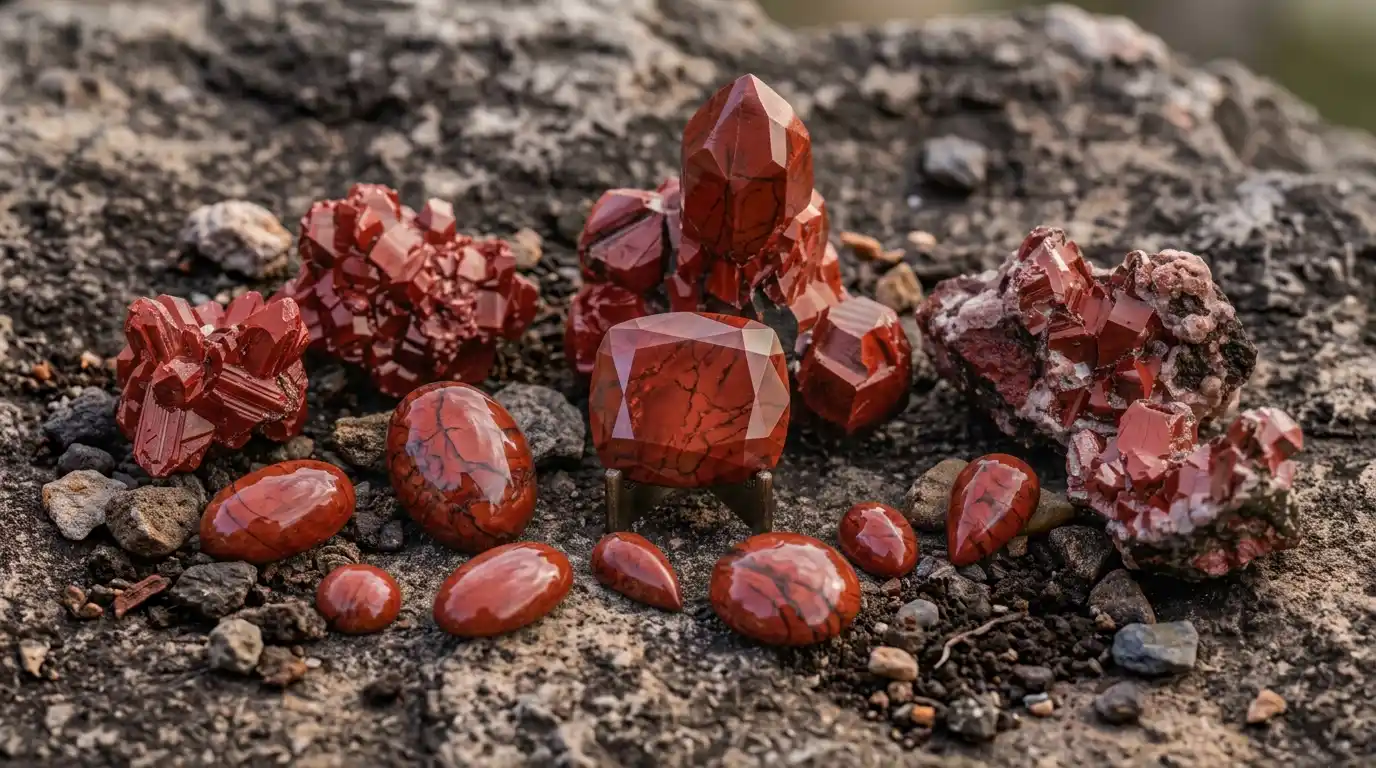
7 Real Red Jasper Benefits: Sacral Chakra Grounding & Iron Content Limits
Red jasper benefits begin with a durable silica-rich lapidary stone whose deep red color usually comes from finely dispersed iron oxides, particularly hematite. Jasper is commonly described as opaque to slightly translucent impure chalcedony or microcrystalline chert, although the name is also applied commercially to several opaque patterned stones. Its combination of quartz-rich composition, earthy coloration, polishability, and geological variety makes red jasper useful for jewelry, carving, collecting, mineral education, and decorative work.
The stone typically falls around 6.5 to 7 on the Mohs scale because quartz is its dominant component. This provides useful scratch resistance for beads, pendants, cabochons, bracelets, carvings, and many rings, although fractures, inclusions, and workmanship still influence durability. The red coloration also provides a practical example of how tiny mineral inclusions can dramatically change the appearance of a predominantly silica-rich stone.
Modern spiritual traditions add grounding, vitality, courage, sacral or root chakra symbolism, and emotional steadiness to discussions of red jasper benefits. These interpretations can support meditation, journaling, or personal rituals, but red jasper does not medically improve circulation, increase iron levels, regulate hormones, or treat psychological conditions.
7 Red Jasper Benefits at a Glance
- Its iron-rich red coloration gives red jasper strong decorative, jewelry, and collector appeal.
- Quartz-rich composition and Mohs hardness near 6.5 to 7 provide useful resistance to everyday scratching.
- Dense opaque texture allows the stone to take an attractive polish for cabochons, beads, carvings, and ornamental objects.
- Hematite and other iron-bearing inclusions make red jasper valuable for studying the relationship between mineral inclusions and color.
- Geological occurrence and provenance can reveal information about silica deposition, iron-rich environments, and rock formation.
- Modern grounding and sacral or root chakra traditions use red jasper symbolically for stability, motivation, reflection, and intentional action.
- Understanding iron chemistry, silica dust, fractures, treatments, and water exposure allows the stone to be handled and maintained more responsibly.
What Red Jasper Actually Is
One of the most useful red jasper benefits is educational because the stone demonstrates how gem trade terminology and strict mineral classification can overlap without being identical. Jasper is generally an opaque, silica-rich rock composed predominantly of microcrystalline quartz or chalcedony, with mineral impurities responsible for much of its color and pattern.
Red jasper commonly contains finely divided hematite, iron hydroxides, or related iron compounds. These particles can produce shades ranging from brownish red and brick red to strong earthy crimson, depending on their concentration, oxidation state, distribution, and the other constituents present.
This means red jasper should not be described as a single pure mineral with one fixed chemical formula. Quartz, SiO2, commonly dominates its silica component, while iron-bearing inclusions and other minerals make individual jasper occurrences compositionally more complex.
Understanding this mineralogical character helps separate genuine red jasper benefits from vague claims based only on color. Its beauty results from geological processes that placed silica and iron-bearing phases together over long periods of rock formation and alteration.
Iron Oxides Create Color, Not Nutritional Iron
The red coloration is one of the most recognizable red jasper benefits. Hematite, Fe2O3, is particularly important because microscopic hematite particles can color silica-rich rocks red even when individual hematite crystals are too small to see without magnification.
A polished surface may appear uniformly red, while another specimen contains darker bands, cream-colored veins, black inclusions, or irregular patterns. These differences can reflect changes in mineral deposition, oxidation, fracturing, silicification, and later geological alteration.
The presence of iron does not mean the stone provides nutritional iron. Iron atoms are locked within mineral structures, and wearing a polished red jasper bracelet does not transfer a medically useful dose of iron through the skin.
This distinction is important because some descriptions of red jasper benefits incorrectly connect its color with blood production, iron deficiency, circulation, or oxygen levels. The visual association between red color and blood may explain the symbolism, but it is not evidence of a physiological effect.
Red Jasper Benefits for Jewelry and Lapidary Work
Red jasper performs well as a lapidary stone because its fine-grained silica-rich structure can accept a smooth polish. Cabochons often display saturated color particularly well, while beads, pendants, earrings, carvings, seals, spheres, and decorative objects make use of its opacity and strong visual presence.
Its hardness gives red jasper practical advantages over softer ornamental stones. A properly polished cabochon generally resists light scratching better than calcite, fluorite, or gypsum, although harder substances such as corundum and diamond can still scratch it.
Toughness also depends on the individual piece. Natural fractures, veins, cavities, brecciated zones, or poorly bonded inclusions can create weaknesses even when the quartz-rich portion itself is reasonably durable.
These red jasper benefits explain why the stone has remained popular for objects expected to tolerate regular handling. A well-made pendant or bead strand can remain attractive for years when protected from severe impacts and inappropriate cleaning.
Geological Occurrence and Collector Value
Knowing where red jasper is found adds more scientific value than simply knowing that the stone is red. Jasper occurs in numerous geological environments and can be associated with sedimentary silica deposits, hydrothermal activity, volcanic sequences, iron formations, breccias, and replacement processes.
Some red jasper is closely associated with iron-rich geological formations, where silica and iron compounds accumulated or were redistributed during deposition and later alteration. Other occurrences form through silicification of rocks, veins, fractured zones, or chemically precipitated silica.
Collectors may value locality because deposits can produce recognizable colors, patterns, brecciation, associated minerals, or textures. A documented specimen preserves geological provenance that an unidentified polished stone cannot provide.
Red jasper benefits therefore extend into earth-science education. A specimen may demonstrate silica precipitation, iron oxidation, microcrystalline quartz, mineral inclusions, fracture filling, or relationships between jasper and neighboring rock units.
Sacral Chakra, Root Chakra, and Grounding Traditions
Spiritual descriptions of red jasper benefits frequently emphasize grounding. The deep earthy red color has encouraged associations with stability, endurance, practical action, boundaries, courage, and connection with physical surroundings.
Red jasper is more commonly associated with the root chakra in many contemporary crystal systems, although some practitioners also connect red or red-orange stones with sacral chakra themes. The red jasper chakra tradition can therefore vary according to the practitioner, color system, and spiritual school being followed.
Chakras are spiritual frameworks rather than anatomical structures. Red jasper does not physically activate the pelvis, reproductive organs, adrenal glands, nervous system, or another body system through proximity or skin contact.
Grounding can still have a useful symbolic meaning. Someone may hold the stone while reviewing priorities, planning practical tasks, journaling about personal boundaries, or deliberately redirecting attention toward immediate responsibilities.
Red Jasper Benefits for Reflection Without Healing Claims
Modern traditions sometimes describe red jasper benefits in terms of confidence, emotional strength, motivation, or recovery from stress. A polished stone can become a consistent visual or tactile reminder of an intention, especially when it is kept on a desk, carried during a difficult project, or used during meditation.
That use should remain separate from medical or psychological treatment. Claims surrounding red jasper healing properties sometimes include circulation, anemia, reproductive health, hormones, pain, digestion, anxiety, or other conditions, but such effects are not established by clinical evidence.
A more defensible practice is to use the stone as a prompt. Someone might associate red jasper with completing a daily walk, keeping a journal, maintaining a sleep routine, or approaching a challenging conversation calmly.
The behavior remains human. The gemstone provides symbolism and continuity rather than a biochemical or therapeutic intervention.
Iron Content Limits and Lapidary Dust Safety
Iron content is often misunderstood when discussing red jasper benefits. Hematite and other iron-bearing phases can explain the color, but the stone should not be ground into powder, swallowed, added to food, or placed in drinking water to obtain iron.
Cutting and grinding deserve a different type of caution because red jasper is silica-rich. Lapidary operations can create fine mineral dust, and dry cutting, sanding, or polishing should not be treated like ordinary household dust.
Professional lapidaries manage this risk through appropriate wet-working methods, ventilation, equipment, and respiratory controls suited to the operation. Casual collectors do not face the same exposure simply from wearing or holding an intact polished stone.
The practical distinction is straightforward. Finished red jasper jewelry is very different from deliberately creating airborne dust by drilling, grinding, sawing, or crushing the stone.
Water Exposure and Everyday Care
Red jasper is generally more resistant to brief water contact than many soft, porous, or highly cleavable gems, but that does not make prolonged soaking necessary. Whether red jasper is safe in water also depends on fractures, treatments, dyes, adhesives, and the construction of the jewelry.
For ordinary cleaning, lukewarm water, mild soap, and a soft cloth or soft brush are usually sufficient for an untreated intact stone. Rinse gently and dry thoroughly rather than leaving the piece submerged for extended periods.
Harsh acids, strong household chemicals, extreme heat, and abrupt temperature changes are unnecessary. Dyed or coated jasper deserves additional caution because cleaning products or repeated soaking may affect an applied treatment even when the underlying silica-rich stone is relatively resistant.
Jewelry should also be stored away from harder gemstones that could abrade polished surfaces. Separate compartments or soft pouches reduce unnecessary contact and preserve the finish.
Identifying Good Red Jasper
Good red jasper should be evaluated according to intended use rather than one universal grading formula. Jewelry buyers may prioritize rich color, attractive pattern, polish quality, minimal surface fractures, symmetry, and workmanship.
Collectors may care more about geological provenance, unusual textures, associated minerals, brecciation, natural surfaces, or a recognizable occurrence. A specimen with complex mineral relationships may be scientifically more interesting than a uniformly colored polished cabochon.
Natural red jasper can show substantial variation. Perfectly even color is not always a sign of superior quality, and unusually bright or uniform pieces deserve attention to treatment disclosure when appearance seems inconsistent with typical natural stone.
The strongest red jasper benefits come from accurately understanding what a specimen offers, whether that is jewelry durability, geological information, craftsmanship, collecting interest, or personal symbolism.
Conclusion
Red jasper benefits include durable lapidary use, strong red coloration, geological and mineralogical interest, collector appeal, and useful lessons about microcrystalline silica and iron oxides. Grounding and chakra traditions can provide personal symbolism, but the iron within the stone is not a nutritional supplement and spiritual use should remain separate from medical claims.
FAQs
What are the main red jasper benefits?
The main red jasper benefits include good polishability, useful scratch resistance, distinctive iron-rich coloration, jewelry and carving applications, geological interest, and collector value. Modern spiritual traditions also associate the stone with grounding, motivation, and lower-chakra symbolism, but these interpretations are belief-based.
What makes red jasper red?
Finely dispersed hematite and other iron-bearing compounds commonly create the red, brick-red, and reddish-brown colors seen in jasper. The exact shade depends on mineral concentration, oxidation, silica structure, and the geological history of the specimen.
Is red jasper a type of quartz?
Red jasper is predominantly a microcrystalline silica-rich stone commonly associated with chalcedony and chert. Quartz is a major constituent, but jasper commonly contains enough iron oxides and other inclusions that describing it as perfectly pure quartz would be inaccurate.
Does red jasper provide iron to the body?
No. The iron-bearing phases responsible for red coloration are locked within the stone and do not provide a useful nutritional dose through ordinary skin contact. Red jasper should not be powdered, swallowed, or used as an iron supplement.
Is red jasper connected with the sacral chakra?
Some modern practitioners associate red jasper with sacral chakra themes, but it is more frequently connected with the root chakra because of its dark red color and grounding symbolism. Chakra associations vary among spiritual systems and are not anatomical or scientifically demonstrated mineral properties.
Is red jasper durable enough for everyday jewelry?
Red jasper is relatively practical for jewelry because its quartz-rich composition gives it hardness around 6.5 to 7. Fractures, inclusions, sharp impacts, abrasive contact, and the design of the setting can still affect durability, so normal jewelry care remains important.
Can red jasper go in water?
Brief cleaning with lukewarm water is generally less concerning for intact untreated red jasper than for many softer stones. Prolonged soaking is unnecessary, particularly when the gem contains fractures, dyes, coatings, adhesives, or other components that may react differently.
Disclaimer: Grounding, chakra, emotional, vitality, and energetic descriptions of red jasper reflect spiritual beliefs and personal practices. Red jasper is not a medical treatment, does not provide nutritional iron through normal contact, and should not replace professional healthcare.