11 Popular Red Tiger’s Eye Benefits: Kundalini Energy & Asbestos Fiber Safety
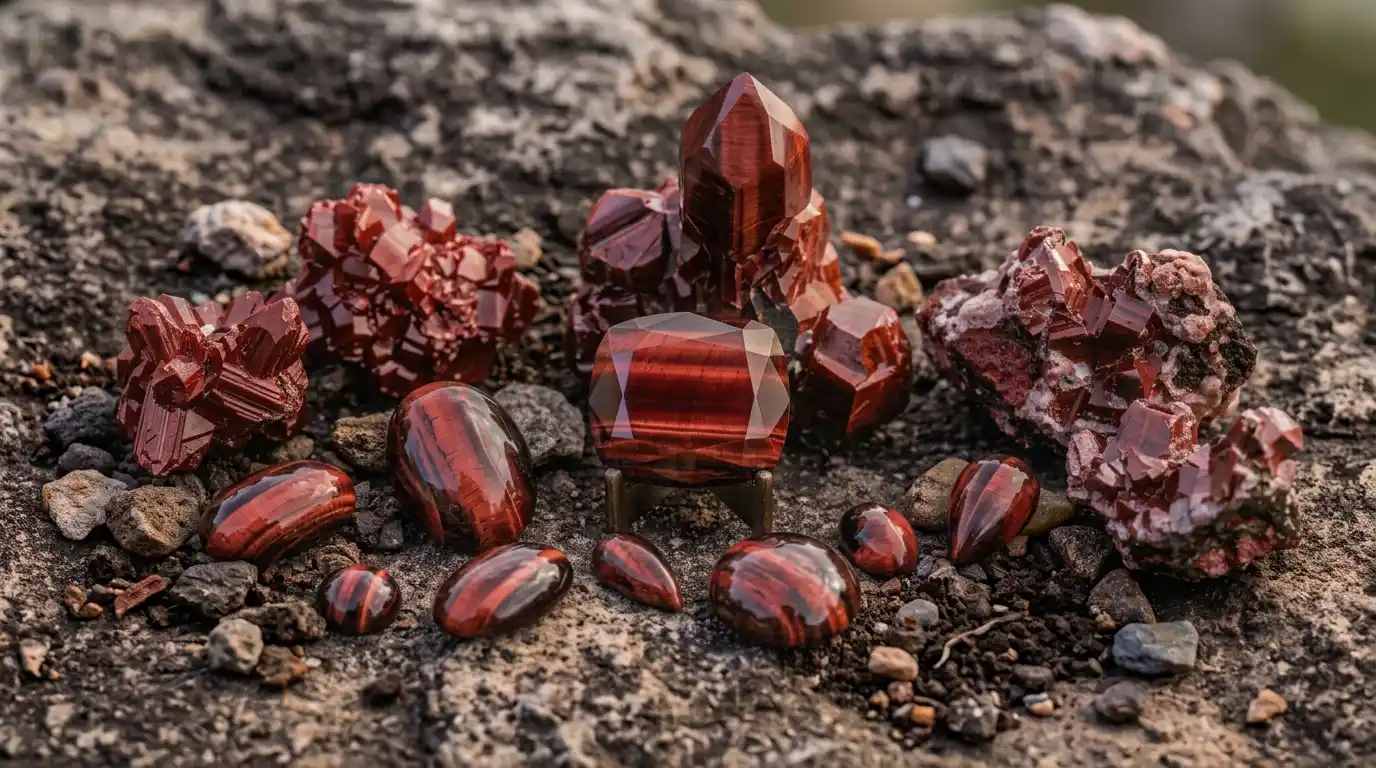
Red tiger’s eye benefits begin with one of the most distinctive optical features found in quartz: chatoyancy. Red tiger’s eye is a red to reddish-brown form of tiger’s eye, a quartz-rich lapidary stone whose aligned fibrous structures create a moving silky band of reflected light. Correctly oriented cabochons can produce a striking eye-like line that travels across the surface as the stone or light source moves.
The stone also deserves careful mineralogical explanation because tiger’s eye developed in association with fibrous iron-rich amphiboles, historically described in connection with crocidolite, an asbestiform variety within the riebeckite series. Much of the original fibrous component in golden and red tiger’s eye has been altered to iron oxides or hydroxides within quartz, but this geological history creates sensible safety questions when rough stone is aggressively cut, ground, drilled, or sanded.
Normal handling of an intact polished stone is very different from creating airborne mineral dust. Red tiger’s eye benefits can therefore be discussed without exaggerating the risk of wearing jewelry, while still recognizing that lapidary work requires proper dust control. Kundalini energy, vitality, confidence, and motivation belong to modern spiritual interpretations and should remain separate from mineral science and medical claims.
11 Red Tiger’s Eye Benefits at a Glance
- Strong chatoyancy creates the moving eye-like reflection that makes red tiger’s eye visually distinctive.
- Quartz-rich composition gives the stone Mohs hardness around 7 and useful scratch resistance for jewelry.
- Cabochon cutting can intensify the silky optical band when the fibrous structure is oriented correctly.
- Red and reddish-brown coloration provides an attractive alternative to classic golden tiger’s eye.
- Fibrous inclusions and alteration structures make the stone useful for studying mineral replacement, quartz growth, and optical phenomena.
- Geological provenance can connect individual specimens with iron-rich formations and important tiger’s eye deposits.
- Its combination of hardness and strong visual effect makes it suitable for beads, pendants, rings, carvings, and decorative objects when impact is controlled.
- Natural and heat-induced red coloration provides a useful lesson in treatment disclosure and gem identification.
- Modern kundalini traditions use red tiger’s eye symbolically for motivation, vitality, confidence, and intentional action.
- Understanding crocidolite-related fibrous structures helps separate normal jewelry handling from the respiratory risks of uncontrolled cutting or grinding dust.
- Appropriate cleaning, dry storage after washing, and protection from severe impact support long-term jewelry and collection use.
What Red Tiger’s Eye Actually Is
Understanding the mineral structure is essential to evaluating red tiger’s eye benefits. Tiger’s eye is a chatoyant variety of quartz containing aligned fibrous inclusions or alteration products associated with iron-rich amphiboles.
Older explanations often described tiger’s eye simply as quartz completely replacing preexisting crocidolite asbestos while preserving the original fibrous form. More detailed mineralogical studies have shown that its formation is more complex, with quartz and fibrous amphibole-related structures developing through vein growth and alteration rather than a simple one-step replacement model.
The finished stone is dominated by quartz, SiO2, which explains its approximate Mohs hardness of 7. The fibrous orientation remains optically important because it creates the directional reflection responsible for chatoyancy.
This structure makes red tiger’s eye benefits particularly useful for gemological education. One small cabochon can demonstrate quartz mineralogy, oriented inclusions, alteration, chatoyancy, treatment, cutting orientation, and the difference between hardness and respiratory safety during lapidary work.
Chatoyancy Is the Defining Optical Benefit
Chatoyancy is the strongest visual feature behind red tiger’s eye benefits. The term describes a narrow band of reflected light that resembles the opening and closing eye of a cat when a correctly cut stone moves under a light source.
In tiger’s eye, the effect depends on parallel or subparallel fibrous structures within the quartz-rich stone. Light interacting with those aligned features produces the silky band that appears to glide across a polished cabochon.
Cutting orientation is critical. A lapidary who places the fibrous structure incorrectly may produce a polished red stone with weak movement, while the same rough oriented correctly can show a bright, centered eye.
This is why tiger’s eye is usually cut as a cabochon rather than faceted. The curved surface displays the moving band more continuously and allows the observer to see the optical effect as the gem turns.
Red Color, Iron Oxidation, and Heat Treatment
The reddish coloration deserves attention because not every red tiger’s eye reaches the market through exactly the same history. Natural oxidation of iron-bearing constituents can produce red to reddish-brown zones, but heating golden or brown tiger’s eye is also a well-known way of developing stronger red coloration.
Heat can modify iron-bearing phases and intensify reddish tones. Proper treatment does not automatically make a gemstone undesirable, but disclosure matters because natural-color specimens and heated stones may be marketed differently.
The mineralogical origin behind red tiger’s eye color meaning should therefore be separated from spiritual interpretations. Red may symbolize vitality, passion, courage, or action to a wearer, while gemologically the color reflects iron chemistry and, in some stones, deliberate thermal treatment.
Very bright, unusually uniform, or inexpensive red tiger’s eye should not automatically be assumed fake. Instead, buyers should consider whether the seller clearly identifies treatment and whether the chatoyant structure remains consistent with genuine tiger’s eye.
Jewelry Durability and Everyday Use
One of the most practical red tiger’s eye benefits is its quartz-based hardness. Around Mohs 7, tiger’s eye generally resists everyday scratching better than fluorite, calcite, feldspar, and many softer ornamental stones.
Hardness does not make the stone unbreakable. The relationship between impact resistance and tiger’s eye durability still depends on fractures, workmanship, thickness, inclusions, setting design, and the force of an impact.
Cabochons work well in rings, pendants, bracelets, earrings, cufflinks, and beads. Rings and bracelets experience the greatest mechanical contact, so lower-profile settings and removal during sports, construction, weight training, or similar activities can reduce damage.
Storage also matters. Diamond, corundum, topaz, and other harder gemstones can scratch tiger’s eye, so separate compartments or soft pouches are useful for polished pieces.
Geological Formation and Collector Interest
Knowing where red tiger’s eye is found adds geological meaning to the stone. Important tiger’s eye occurrences are associated with iron-rich geological formations, particularly in regions where fibrous amphiboles, quartz-bearing fluids, and subsequent oxidation produced the structures required for chatoyancy.
South Africa is historically significant for tiger’s eye, while deposits in Western Australia and other regions have also produced notable quartz-rich chatoyant stones. Locality may influence color, banding, associated minerals, fiber orientation, texture, and collector interest.
The geological relationship between quartz and iron-bearing fibrous structures is especially valuable for study. Tiger’s eye preserves evidence of mineral growth, fracturing, fluid movement, alteration, and oxidation rather than being merely a uniformly colored variety of quartz.
Collectors may therefore value rough specimens, slabs, polished cabochons, or geological associations differently. A stone with documented provenance may carry more scientific interest than an anonymous polished bead even when both show attractive chatoyancy.
Kundalini Energy and Modern Red Tiger’s Eye Benefits
Kundalini energy appears frequently in modern discussions of red tiger’s eye benefits. Contemporary spiritual traditions may associate the stone’s red coloration and moving optical band with motivation, physical vitality, confidence, creativity, sexual energy, or the awakening of kundalini.
These are spiritual concepts rather than measurable gemological properties. Kundalini belongs to religious and contemplative traditions, and wearing red tiger’s eye has not been scientifically shown to activate the spine, nervous system, hormones, reproductive organs, or an anatomical energy channel.
The red tiger’s eye chakra association is often placed around the root or sacral chakra, depending on the spiritual system. The deep red coloration makes those symbolic connections understandable, but chakra maps vary between practitioners.
A safer interpretation treats the gemstone as a focus for intentional practice. Someone may associate it with starting difficult work, maintaining exercise discipline, speaking confidently, or returning attention to an important goal.
Motivation and Confidence Without Exaggerated Claims
Motivation is another popular theme among red tiger’s eye benefits. The stone’s red color and dynamic optical movement can make it an appealing object for someone who wants a physical reminder of action, persistence, or courage.
A person might keep a cabochon near a workspace and associate it with beginning the day’s most difficult task. Another may wear a bracelet as a reminder to pause, evaluate options, and act deliberately rather than procrastinating.
The gemstone itself does not increase testosterone, adrenaline, dopamine, physical stamina, or neurological performance. There is no established physiological mechanism through which holding quartz and iron-bearing inclusions creates those effects.
Claims grouped under red tiger’s eye healing properties should therefore remain separate from medical care. Symbolism can complement a person’s routines without being presented as treatment for fatigue, depression, anxiety, sexual dysfunction, hormonal conditions, or another health concern.
Asbestos Fiber Safety: What Actually Matters
The asbestos question is one of the most important technical issues surrounding red tiger’s eye benefits. Tiger’s eye formed in association with fibrous amphibole structures related to crocidolite, which is an asbestiform variety of riebeckite. Modern mineralogical research describes tiger’s eye as quartz containing aligned altered amphibole-derived fibers and iron oxide or hydroxide products.
This does not mean a polished bracelet should be treated like loose asbestos insulation. The principal health concern with asbestos-type fibers is inhalation when respirable fibers become airborne, and an intact polished stone is fundamentally different from friable fibrous rock or uncontrolled grinding dust.
Lapidary processing changes the exposure pathway. Sawing, drilling, sanding, grinding, or crushing rough tiger’s eye can create mineral dust that may contain respirable silica as well as fibrous amphibole-related particles, depending on the specimen.
For that reason, dry grinding tiger’s eye without appropriate controls is not a sensible hobby practice. Professional lapidary work should use suitable wet methods, ventilation, dust collection, protective equipment, and workplace procedures designed for mineral dust hazards.
Water Safety and Cleaning
Questions about whether red tiger’s eye can get wet should distinguish the quartz-rich stone from its jewelry setting and any treatments. Brief gentle washing is generally very different from repeated soaking, hot-water treatment, chemical exposure, or immersion of pieces containing adhesives.
Quartz is relatively resistant to ordinary clean water, but prolonged soaking provides no special benefit. Heat-treated, dyed, coated, fractured, or composite pieces may respond differently from untreated natural stone.
For ordinary cleaning, use lukewarm water, mild soap, and a soft cloth. Avoid aggressive chemicals, sudden temperature changes, abrasive powders, and unnecessary ultrasonic treatment when the stone has fractures or the setting is delicate.
After washing, dry the jewelry thoroughly. Sensible care preserves both the polished surface and the metal components without relying on elaborate cleansing procedures.
Evaluating Red Tiger’s Eye Quality
Quality in red tiger’s eye depends heavily on chatoyancy. A strong eye should move clearly across the stone as the light or viewing angle changes, and skilled cutting should position that band attractively across the cabochon.
Color is another factor. Some buyers prefer deep mahogany red, while others favor brighter reddish-brown bands or stones that retain golden areas alongside the red zones.
Treatment disclosure should be part of quality assessment rather than treated automatically as a defect. Heat-treated red tiger’s eye can still be attractive and genuine tiger’s eye, but buyers deserve to know when color has been intentionally modified.
Fractures, polish quality, symmetry, fiber orientation, size, locality, and setting workmanship also influence desirability. Spiritual claims do not establish authenticity or quality, so physical examination remains more useful than promises about energy strength.
Conclusion
Red tiger’s eye benefits include dramatic chatoyancy, quartz-based hardness, jewelry versatility, geological interest, collector appeal, and useful lessons in fibrous inclusions and iron alteration. Kundalini and chakra themes can serve as personal symbolism, while asbestos-related safety is mainly a concern when cutting, grinding, or otherwise generating airborne dust rather than during ordinary handling of intact polished jewelry.
FAQs
What are the main red tiger’s eye benefits?
Red tiger’s eye benefits include strong chatoyancy, attractive red coloration, Mohs hardness around 7, jewelry versatility, lapidary interest, and geological value. Modern spiritual traditions also associate it with motivation, confidence, kundalini energy, and lower-chakra symbolism, but these effects are not scientifically established.
Is red tiger’s eye natural?
Red coloration can occur naturally through iron oxidation, but heating golden or brown tiger’s eye is also commonly used to develop or strengthen red tones. A treated stone can still be genuine tiger’s eye, although responsible sellers should disclose treatment when known.
What creates the moving eye in red tiger’s eye?
The optical effect is chatoyancy. Parallel fibrous structures and altered amphibole-related inclusions within the quartz-rich stone reflect light directionally, producing a bright band that appears to move across a correctly oriented cabochon.
Is red tiger’s eye dangerous because of asbestos?
Normal handling of an intact polished stone is very different from inhaling airborne asbestos-type fibers. Greater caution is appropriate when sawing, drilling, grinding, sanding, or crushing tiger’s eye because those activities can generate fine mineral dust, including respirable silica and potentially fibrous amphibole-related particles.
Should I cut red tiger’s eye at home?
Uncontrolled dry cutting or grinding is not recommended. Lapidary work on tiger’s eye should use appropriate wet-working methods, ventilation or dust extraction, and protective procedures suitable for silica-rich stone and potentially fibrous inclusions.
Is red tiger’s eye durable for everyday jewelry?
Its quartz-rich composition gives it Mohs hardness around 7, making it reasonably resistant to scratching. It can still chip or fracture after strong impact, and rings or bracelets should be removed during activities likely to strike the stone against hard surfaces.
What chakra is red tiger’s eye associated with?
Modern crystal traditions commonly associate red tiger’s eye with the root or sacral chakra, while some practitioners connect it with kundalini symbolism. These are spiritual frameworks rather than anatomical systems or scientifically demonstrated effects.
Does red tiger’s eye increase energy or stamina?
There is no scientific evidence that the gemstone increases physical stamina, hormones, neurological activity, or metabolic energy. It may serve as a symbolic reminder for motivation or disciplined action, but the practical behavior comes from the person.
Can red tiger’s eye go in water?
Brief gentle cleaning with lukewarm water is generally different from prolonged soaking. Avoid unnecessary immersion when the stone is dyed, coated, fractured, glued into a setting, or combined with components that may be less water resistant.
Disclaimer: Kundalini, chakra, motivation, vitality, protective, and energetic descriptions of red tiger’s eye reflect spiritual beliefs and personal practices. Red tiger’s eye is not a medical treatment. Cutting, grinding, drilling, or sanding should be approached with appropriate mineral-dust controls rather than treating normal wear of intact polished jewelry as equivalent to occupational asbestos exposure.