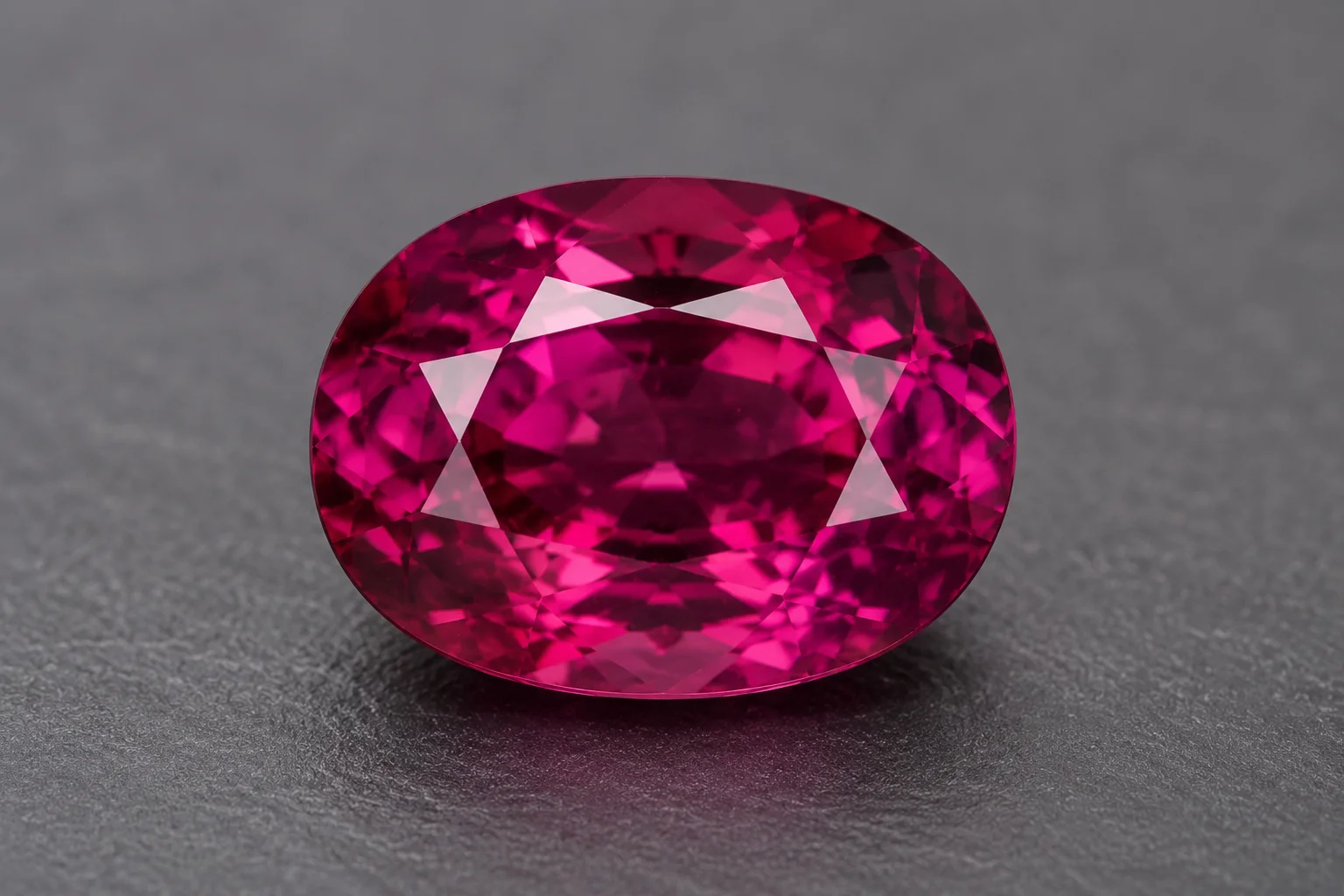
Rhodolite Garnet Meaning, Properties, Symbolism and Uses
Rhodolite is a transparent pinkish-red to purplish-red variety of pyrope–almandine garnet. Its brighter raspberry and rose-wine colors distinguish it from the darker brown-red appearance commonly associated with inexpensive garnet.
The name refers to the stone’s rose-like color. Rhodolite is not a separate mineral species; it occupies part of the chemical range between magnesium-rich pyrope and iron-rich almandine.
In modern crystal traditions, rhodolite symbolizes affectionate commitment, emotional courage, renewal and confidence that remains connected with empathy. It combines garnet’s broader themes of endurance and devotion with a lighter, more expressive visual character.
Those meanings are spiritual and cultural interpretations. Rhodolite does not provide medically proven healing, alter hormones, improve circulation or replace psychological care.
Rhodolite Garnet at a Glance
| Property | Rhodolite garnet |
|---|---|
| Mineral group | Garnet |
| Variety | Purplish-red pyrope–almandine garnet |
| Simplified chemistry | Magnesium–iron aluminum silicate |
| Typical colors | Raspberry, rose-red, pinkish red, purplish red, reddish purple and burgundy |
| Crystal system | Cubic |
| Refraction | Singly refractive and isotropic |
| Refractive index | Commonly around 1.74–1.76, depending on composition |
| Specific gravity | Commonly around 3.7–3.9 |
| Mohs hardness | Within the garnet range of approximately 6.5–7.5 |
| Cleavage | None |
| Tenacity | Brittle |
| Luster | Vitreous |
| Transparency | Transparent to translucent |
| Common inclusions | Needles, crystals, fingerprints, growth features and occasional fractures |
| Routine treatment | Most material is untreated; rare fracture filling may occur |
| Common use | Faceted jewelry, beads, collector stones and symbolic objects |
| Traditional themes | Commitment, emotional courage, renewal, confidence and grounded affection |
What Is Rhodolite Garnet?
The broader garnet meaning guide explains the entire garnet family.
Garnet is a mineral group made up of several related species with the same basic crystal structure but different chemical compositions.
Rhodolite belongs principally to the pyrope–almandine series. Magnesium dominates the pyrope component, while iron dominates almandine.
Natural crystals commonly contain both end-member components plus smaller amounts of grossular or spessartine.
Because garnet compositions blend continuously, rhodolite is defined through a combination of color, chemistry and gemological convention rather than one rigid formula.
The complete family structure appears in Types of Garnet.
Rhodolite, Pyrope and Almandine
Pyrope garnet is magnesium-rich and commonly appears deep red, purplish red or pink-red.
Almandine garnet is iron-rich and often appears darker brownish red, red-purple or nearly black in thick material.
Rhodolite occupies a visually attractive region between them. It generally contains enough pyrope character to remain brighter and more purple than ordinary almandine.
This relationship does not mean that every pyrope–almandine mixture qualifies as rhodolite. Very dark, strongly brown or ordinary red stones may be described simply as pyrope–almandine garnet.
Laboratory chemistry can place a gem within the series, while the variety name reflects accepted color usage.
Why Is It Called Rhodolite?
The name derives from words associated with rose color.
Early named material became known for a lighter, more rose-like appearance than traditional deep-red garnet.
The term describes color rather than a separate crystal structure.
Retailers may also use raspberry garnet, grape garnet or rose garnet for selected shades. These are commercial descriptions and do not establish a new species.
A stone advertised as rhodolite should remain recognizably pinkish, purplish or raspberry red rather than simply dark brown-red.
Rhodolite Color
Rhodolite ranges from pinkish red and rose-red to strong purplish red and reddish purple.
Some stones resemble raspberry, cranberry, red wine or ripe plum.
Tone strongly affects appearance. A medium-to-medium-dark stone usually returns more visible color than an extremely dark one.
Brown modifiers generally reduce the classic rhodolite look, while an excessive blue-purple appearance may move the stone toward other garnet trade descriptions.
Color can change with lighting. Warm light emphasizes red, while cool daylight-equivalent light may strengthen purple.
The broad symbolism of garnet color appears in Garnet Color Meaning.
Does Rhodolite Change Color?
Ordinary rhodolite may shift subtly between redder and more purple appearances under different lights.
That shift is not necessarily a true color-change phenomenon.
Rare garnets with suitable vanadium or chromium chemistry can show a more dramatic change between daylight and incandescent illumination. Some material was initially mistaken for ordinary rhodolite before testing established color-change behavior.
A significant greenish-to-red or blue-green-to-purple change should be documented as color-change garnet rather than ordinary rhodolite.
Photographs under two lights do not prove the phenomenon. Controlled comparison and laboratory testing are preferable.
Natural Crystal Form
Rhodolite crystallizes in the cubic garnet system.
Natural garnet crystals commonly form dodecahedrons, trapezohedrons and related combinations.
Rough may appear as rounded nodules after weathering and transport. Garnet’s density, hardness and chemical resistance allow it to survive in alluvial deposits.
Transparent rough is usually cut into faceted stones. Less transparent material may become cabochons or beads.
Rhodolite does not form long hexagonal prisms like beryl or tourmaline. A bright-red prismatic crystal sold as raw rhodolite should be examined carefully.
How Rhodolite Forms
Pyrope–almandine garnet forms under elevated temperature and pressure.
It occurs in metamorphic rocks such as schist and gneiss, as well as selected igneous and mantle-related environments.
Rhodolite-quality material requires a composition and trace-element balance that produces attractive purple-red color and sufficient transparency.
Weathering can free garnet crystals from their host rocks. Because garnet is comparatively dense and durable, moving water can concentrate it with other heavy minerals in alluvial gravels.
Commercial sources include Tanzania, Mozambique, Sri Lanka, India, Madagascar and the United States, among other regions.
A geographic name should be supported by provenance rather than inferred from color.
Rhodolite From Tanzania
Tanzania has produced significant rhodolite and related pyrope–almandine garnets.
Material from the Umba Valley and other regions can show strong purple-red, raspberry and reddish-purple colors.
Some Tanzanian garnets also display color-change behavior, demonstrating why color variety labels require gemological context.
Transparent stones may be relatively clean, although needles, crystals and healed fractures can occur.
Tanzanian origin does not represent one uniform quality. Each stone must be evaluated for color, tone, cut and clarity.
Rhodolite From Mozambique
Mozambique produces rhodolite and other pyrope-rich garnets in pink, purple and red colors.
Some material displays a vivid grape or purple appearance that attracted separate marketing names.
Those labels describe appearance rather than a universally standardized mineral category.
Mozambican stones can occur in sizes suitable for statement jewelry, though dark tone and extinction remain important considerations.
A seller should not use Mozambique or grape as a substitute for actual variety identification.
Rhodolite From Sri Lanka
Sri Lanka’s gem gravels produce many garnet compositions, including rhodolite.
Alluvial weathering often rounds the rough before mining.
Sri Lankan material can show red, purplish-red and reddish-purple colors and may contain intersecting needles, crystals or fingerprint-like inclusions.
Origin determination requires more than a visual comparison with known stones. Similar pyrope–almandine garnets occur in multiple geological regions.
Hardness and Durability
Rhodolite belongs to a garnet group whose hardness generally ranges from 6.5 to 7.5.
It has no cleavage, which removes the risk of splitting along one perfect structural plane.
However, the stone is brittle and can chip under a sharp impact. Surface-reaching fractures create additional weakness.
Rhodolite is suitable for earrings, necklaces, bracelets and carefully worn rings.
The gemstone hardness chart explains scratch resistance, while gemstone toughness versus hardness explains impact resistance.
Optical Properties
Rhodolite is singly refractive because it crystallizes in the cubic system.
It does not show true pleochroism.
Its refractive index commonly falls in the mid-1.70s, while density is typically higher than quartz and beryl.
Those properties help separate rhodolite from red glass, tourmaline, ruby and several other lookalikes.
Rhodolite has vitreous luster and can show strong brilliance when cut correctly.
Its dispersion is present but normally less visually dominant than in demantoid or diamond.
Inclusions and Clarity
Fine rhodolite is commonly eye-clean.
Possible inclusions include straight or intersecting needles, mineral crystals, negative crystals, growth features and partially healed fractures.
A small inclusion can confirm natural internal complexity without reducing beauty.
Large dark crystals, cloudy zones and surface-reaching breaks affect value more strongly.
A completely clean appearance does not prove laboratory manufacture. Natural garnet can be highly transparent.
The broader garnet quality and grading guide retains group-wide clarity principles.
Cut
Round, oval and cushion brilliant cuts are common.
Good cutting balances color retention with brightness. Excessive depth can make a red garnet appear black, while shallow cutting creates a window.
Rhodolite is also used in pears, marquises, trillions and designer cuts.
Its availability in calibrated sizes makes it practical for repeated jewelry layouts.
The cutter should orient darker rough to maximize face-up brightness rather than retain every possible fraction of weight.
Treatments
Most rhodolite is sold without routine color enhancement.
Rare fracture filling may reduce the visibility of surface-reaching breaks.
Coating can alter appearance, while assembled or glass-filled products may imitate red garnet in the wider jewelry market.
Treatment should be disclosed because filler can affect cleaning and repair.
The gemstone treatments guide explains how filling differs from laboratory growth and imitation.
A seller should not imply that untreated is exceptional without evidence, since untreated status is already common for rhodolite.
Rhodolite Garnet Meaning
Rhodolite’s central meaning is commitment expressed with warmth and emotional openness.
Garnet broadly symbolizes endurance, protection and devotion. Rhodolite adds rose and purple color associations linked with affection, compassion and expressive confidence.
The stone is therefore used as a symbol for relationships that combine loyalty with honest communication.
It may also represent renewing a commitment after circumstances change. Renewal does not mean returning to every past situation; it can mean carrying forward what remains valuable while choosing a healthier form.
The complete family symbolism remains within Garnet Spiritual Meaning.
Rhodolite and Emotional Courage
Emotional courage means acknowledging feelings without allowing them to determine every action automatically.
Rhodolite’s symbolism fits conversations that require honesty, apology, vulnerability or a clear boundary.
A person may carry or wear the stone as a reminder to speak directly without becoming unnecessarily harsh.
The object does not produce courage chemically. Its value lies in connecting a visual symbol with an intended behavior.
A useful intention might be: “I can be honest and remain respectful.”
Rhodolite and Commitment
Garnet has a long association with loyalty and enduring bonds.
Rhodolite’s brighter color gives that tradition a less solemn character. It can represent commitment that remains affectionate, flexible and alive.
The symbolism applies to romantic relationships, friendships, professional responsibilities and personal goals.
Commitment should not be confused with remaining in unsafe conditions. A symbolic promise does not override wellbeing, consent or changing circumstances.
Rhodolite may be used to mark a renewed decision rather than an obligation that can never be reconsidered.
Rhodolite and Renewal
The stone is also linked with renewal after emotional fatigue.
Its raspberry and purple-red colors combine the vitality associated with red and the reflective symbolism often attached to purple.
Practitioners may choose rhodolite when returning to social life, creative work or a relationship with clearer expectations.
Renewal can involve beginning again, but it can also mean changing the way an existing commitment is approached.
The planned garnet benefits guide owns broader garnet-use claims rather than rhodolite’s core identity.
Rhodolite and Confidence
Rhodolite symbolizes confidence supported by emotional awareness.
Unlike the commanding symbolism often attached to ruby, it is frequently interpreted as encouraging participation without requiring dominance.
A person might wear it before a meeting, performance or difficult personal conversation.
The stone can serve as a reminder to prepare, communicate and remain present.
Confidence built through practice and support is more reliable than expecting a gemstone to remove fear automatically.
Rhodolite and Love
Rhodolite is associated with affectionate, mature and reciprocal love.
Its meaning emphasizes giving and receiving rather than sacrifice without limits.
In relationship symbolism, it can represent warmth joined with accountability.
A rhodolite gift may mark a commitment, reconciliation, anniversary or new chapter.
The dedicated garnet healing-properties guide discusses broader emotional traditions, but none should be interpreted as medical or psychological treatment.
Rhodolite and the Chakras
Rhodolite is commonly associated with both root- and heart-centered symbolism.
Its red component connects it with the root chakra’s themes of safety, commitment and physical presence.
Its pink and purple modifiers lead some practitioners to associate it with affection, compassion and the heart chakra.
The planned garnet chakra guide owns the full energy-center discussion.
These correspondences vary among spiritual systems and are not anatomical findings.
Meditation With Rhodolite
Hold a clean stone or place it where its color remains visible.
Choose one intention related to commitment, honest communication or renewal.
Notice the stone’s color without trying to force heat, vibration or another sensation.
Consider what action would express the intention in practical terms.
End by writing one specific next step. This might be arranging a conversation, completing an overdue task or clarifying a boundary.
The general how to program crystals guide explains intention-setting as a structured reflective practice.
Rhodolite Affirmations
Affirmations work best when they describe a believable direction rather than an impossible guarantee.
Examples suited to rhodolite include:
“I can communicate honestly and compassionately.”
“My commitments can evolve without losing integrity.”
“I allow affection and boundaries to exist together.”
“I return to meaningful work with renewed attention.”
The dedicated garnet affirmations guide owns the larger family collection.
Repeating an affirmation should support decisions and habits rather than replace action.
Wearing Rhodolite
A rhodolite garnet ring keeps the stone highly visible but exposes it to impact.
Rhodolite garnet earrings are safer for delicate cuts and matched pairs.
A rhodolite garnet necklace places the color near the chest and works naturally with commitment or heart-centered symbolism.
A rhodolite garnet bracelet keeps the stone in view during daily activities but requires secure links and settings.
Jewelry meaning should remain personal rather than being treated as a guaranteed influence on relationships or events.
January Birthstone Meaning
Garnet is the traditional January birthstone.
Rhodolite offers a brighter alternative for people who prefer raspberry or purple-red over dark wine red.
January symbolism commonly centers on renewal, consistency and beginning a new annual cycle.
The complete calendar history appears in January Birthstone.
Rhodolite can be used in birthstone jewelry without claiming that it represents a separate official month from the wider garnet family.
Rhodolite in Red Crystal Traditions
Rhodolite appears within Red Crystals because of its connection with vitality, courage and commitment.
It also appears in Red Gemstones as a durable transparent jewelry material.
Its purple modifier gives it a different symbolic tone from brick-red jasper or orange-red carnelian.
Where red jasper suggests steadiness and ruby suggests intensity, rhodolite often represents warmth, renewal and emotional expression.
These distinctions are interpretive rather than scientific properties.
Authenticity and Buying
Natural rhodolite should show garnet properties: single refraction, relatively high density and refractive index in the pyrope–almandine range.
Red glass, synthetic spinel, synthetic corundum and other materials may imitate the color.
The recently drafted real-versus-fake garnet guide explains group-wide testing.
The completed rhodolite buying guide owns color, cut, clarity and seller evaluation.
A laboratory report is usually proportionate for large, unusually valuable or disputed stones. Use the gemstone certification guide and how to read a gem-lab report to interpret documentation.
Cleaning and Care
Use warm water, mild soap and a soft brush.
Rinse briefly and dry thoroughly.
Avoid steam. Ultrasonic cleaning should be avoided when the gem contains fractures, filling or uncertain treatment.
The completed rhodolite garnet jewelry cleaning guide owns the full procedure.
Store rhodolite separately from diamonds, rubies and sapphires, which can scratch it. It can in turn scratch softer pearls and opals.
Remove jewelry before physical work, exercise, swimming and household cleaning.
Frequently Asked Questions
1. What is rhodolite garnet?
It is a pinkish-red to purplish-red variety of pyrope–almandine garnet.
2. Is rhodolite a separate garnet species?
No. It is a color variety within the pyrope–almandine compositional series.
3. Why is rhodolite purple-red?
Its pyrope–almandine chemistry and trace elements produce raspberry, rose-red and purplish-red colors.
4. What does rhodolite traditionally symbolize?
It is associated with affectionate commitment, emotional courage, renewal and grounded confidence.
5. Does rhodolite have scientifically proven healing powers?
No. Its healing associations are spiritual and symbolic rather than established medical effects.
6. Is rhodolite a January birthstone?
Yes. It belongs to the garnet family, January’s traditional birthstone.
7. Is rhodolite usually treated?
Most material is untreated, although rare fracture filling or other alterations can occur.
8. Can natural rhodolite be eye-clean?
Yes. Fine rhodolite commonly lacks eye-visible inclusions.
9. Is rhodolite the same as ruby?
No. Rhodolite is garnet, while ruby is red corundum with different hardness, density and optical properties.
10. Does rhodolite change color?
Ordinary material may shift subtly between red and purple. Rare related garnets show a genuine stronger color change.
11. Is rhodolite durable enough for jewelry?
Yes. It suits most jewelry, although rings and bracelets need protection from impact and harder gemstones.
12. How should rhodolite be cleaned?
Use warm soapy water and a soft brush, then rinse and dry. Avoid steam and uncertain ultrasonic cleaning.
Rhodolite is indexed in Crystals That Start With R and Gemstones That Start With R.
Rhodolite’s appeal lies in the way it softens the traditional image of dark-red garnet without losing the family’s symbolism of endurance and devotion. Its raspberry and purple-red colors suit meanings centered on commitment that remains warm, expressive and capable of renewal. Used responsibly, it becomes a reminder to combine honesty with compassion rather than a substitute for the actions healthy commitments require.
Rhodolite garnet meanings, affirmations and chakra associations are spiritual and cultural beliefs, not medical or psychological treatment.