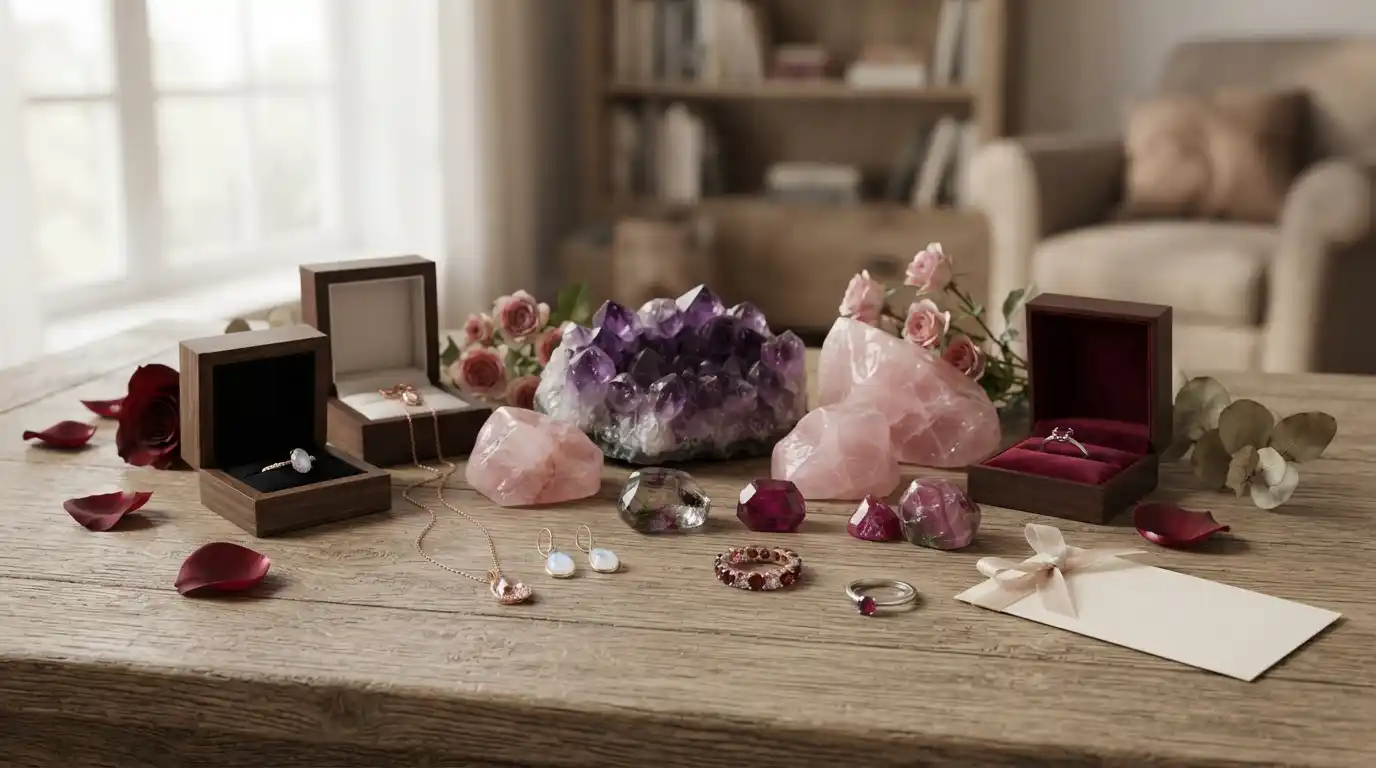
15 Romantic Crystal Gifts for Valentine’s Day for Deep Connection
Crystal gifts for Valentine’s Day can express affection through gemstone color, jewelry design, birthstones, shared memories, or a carefully chosen natural specimen. Rose quartz is the familiar romantic choice, but ruby, garnet, pink sapphire, morganite, amethyst, moonstone, rhodonite, carnelian, and other stones can feel far more personal when their appearance and gemological properties suit the person receiving them. A durable ring may call for sapphire or ruby, while a pendant can accommodate more delicate stones such as moonstone or morganite with less exposure to daily impact.
The phrase deep connection works best as a symbolic theme rather than a claim that a crystal can create romantic compatibility. No gemstone can make another person fall in love, guarantee loyalty, repair a damaged relationship, improve fertility, or produce a scientifically measured emotional bond. Jewelry becomes meaningful because of what two people associate with it, such as an anniversary, shared experience, private promise, favorite color, or the decision to communicate more openly.
Gemological accuracy matters even with a highly sentimental gift. Ruby and pink sapphire are both corundum, garnet refers to a group of minerals rather than one red stone, morganite is pink beryl, rose quartz is a translucent variety of quartz, and moonstone belongs to feldspar. Their hardness, cleavage, treatments, and maintenance requirements differ, so the most romantic choice should also be one the recipient can realistically enjoy.
15 Romantic Crystal Gifts for Valentine’s Day
- Rose quartz heart pendant
- Ruby ring
- Garnet earrings
- Pink sapphire necklace
- Morganite pendant
- Amethyst bracelet
- Moonstone earrings
- Rhodonite keepsake
- Carnelian charm
- Pink tourmaline jewelry
- Red spinel pendant
- Pearl earrings
- Couple’s birthstone necklace
- Personalized gemstone charm
- Natural crystal keepsake box
These 15 ideas range from fine jewelry to affordable polished stones and personalized keepsakes. The strongest Valentine’s Day gift is not necessarily the rarest gem. A modest stone chosen because it connects with a shared memory can carry more emotional value than an expensive gem selected without considering the recipient’s preferences.
Choosing a Valentine’s Day Crystal Gift That Feels Personal
Romantic gemstone gifting becomes easier when color and lifestyle are considered before symbolic meanings. Someone who wears deep red may prefer garnet, ruby, or spinel, while a person who likes softer pastels may gravitate toward morganite or rose quartz. Purple jewelry makes amethyst an obvious choice, and someone drawn to luminous white gems may prefer moonstone or pearl.
Jewelry habits are equally important. A person who rarely wears rings may appreciate earrings or a pendant much more. Pendants also protect softer gemstones from many of the impacts that rings experience against desks, doors, tools, kitchen surfaces, and gym equipment.
Birthstones create an additional layer of personalization. Garnet can connect with January, amethyst with February, diamond with April, ruby with July, sapphire with September, and several months have multiple recognized choices. A necklace containing both partners’ birthstones can create an intimate design without making supernatural claims about compatibility.
A gift can also refer to a shared place or moment. A garnet-colored stone may recall a winter trip, aquamarine a coastal holiday, or rose quartz a favorite soft pink color. Personal memories usually create more lasting significance than generic claims about attraction or soulmates.
Valentine’s Day Gemstone Gift Comparison
| Gift | Gemological Identity | Practical Wear | Romantic Symbolism |
|---|---|---|---|
| Rose quartz | Pink quartz | Good with care | Affection |
| Ruby | Red corundum | Excellent | Passion and commitment |
| Garnet | Mineral group | Good | Loyalty |
| Pink sapphire | Pink corundum | Excellent | Enduring affection |
| Morganite | Pink beryl | Very good | Gentleness |
| Amethyst | Violet quartz | Good | Thoughtful connection |
| Moonstone | Feldspar | Moderate | Shared phases |
| Rhodonite | Manganese silicate | Moderate | Reconciliation symbolism |
| Carnelian | Orange-red chalcedony | Good | Warmth |
| Pink tourmaline | Tourmaline group | Good | Emotional openness |
| Red spinel | Spinel | Very good | Resilience |
| Pearl | Organic gem | Delicate | Grace |
| Couple’s birthstones | Depends on gems | Varies | Shared identity |
| Gemstone charm | Depends on gem | Varies | Personal memory |
| Crystal keepsake | Depends on stone | Display use | Shared remembrance |
The romantic themes in this comparison are symbolic associations. Their genuine physical characteristics come from mineral structure, hardness, toughness, optical behavior, treatments, and craftsmanship.
Rose Quartz, Morganite, and Pink Sapphire for Soft Romantic Color
Rose quartz remains one of the most recognizable Valentine’s Day stones because its pale to medium pink color naturally fits the holiday. It is quartz with a Mohs hardness of 7, commonly appearing translucent because of microscopic inclusions and internal structural features.
Most rose quartz is polished into cabochons, beads, hearts, carvings, spheres, and smooth freeforms. Some specimens display a six-rayed star when cut in the correct orientation as a cabochon. This asterism is a genuine optical effect caused by oriented microscopic features within the stone.
Rose quartz is widely associated with unconditional love, affection, and self-respect in contemporary spiritual traditions. It can represent those ideas in a gift, but it does not scientifically attract romance, heal heartbreak, or influence another person’s feelings.
Morganite offers a more transparent and facetable pink option. It is the pink to peach variety of beryl, the same mineral species that includes emerald and aquamarine. Manganese is associated with its coloration, while commercial stones may be heated to reduce yellowish tones and produce a pinker appearance.
With a hardness of 7.5 to 8, morganite can be worn successfully in rings, earrings, and pendants. Its pale color often appears stronger in larger stones, and rose gold settings can emphasize peach or blush tones.
Pink sapphire provides the strongest durability of these three. Sapphire is corundum with a hardness of 9 and no cleavage, making it one of the best colored gemstones for jewelry worn every day.
Chromium contributes to many pink sapphire colors, which can range from very pale to intense hot pink. Heat treatment is common, while more extensive enhancements may also occur. Accurate disclosure remains important, particularly for valuable stones.
Ruby, Garnet, and Red Spinel for Deeper Valentine’s Day Color
Ruby is red corundum and shares sapphire’s Mohs hardness of 9. Its combination of rich color and outstanding durability gives it a long history in rings, pendants, earrings, and ceremonial jewelry.
Chromium is primarily responsible for ruby’s red color and can also contribute to fluorescence that enhances appearance in certain lighting. Natural rubies commonly contain inclusions, and perfectly clean stones should not automatically be assumed more natural.
Heat treatment is widespread and may improve color or clarity. Fracture filling and other enhancements can also occur. For high-value ruby jewelry, treatment disclosure has a significant effect on value.
Ruby naturally fits Valentine’s Day symbolism because red has long represented passion and love. The stone cannot create passion or guarantee fidelity, but a ruby ring can represent the seriousness of an existing commitment.
Garnet offers a more accessible route to deep red. The garnet group contains several mineral species, producing not only red but orange, green, pink, purple, and yellow stones. Common red garnets usually offer enough durability for regular jewelry wear.
A pair of garnet earrings can be especially practical because earrings receive less impact than rings. Garnet’s association with commitment or loyalty can add symbolic meaning without implying that the stone controls the relationship.
Red spinel is another excellent jewelry gemstone and was historically confused with ruby before modern mineralogy separated the two. Spinel has a Mohs hardness of about 8, no cleavage, and generally strong durability.
Fine red spinel can be vivid and lively, making it an attractive choice for someone who wants a natural red stone that differs from ruby in mineral identity and market history.
Amethyst and Moonstone for Romantic Gifts Beyond Pink and Red
Not every Valentine’s Day gift needs to be red. Amethyst offers violet color that can feel romantic without following the most obvious holiday palette.
As quartz, amethyst reaches 7 on the Mohs scale and lacks cleavage. It is widely available in attractive sizes and can be faceted into earrings, rings, bracelets, or pendants.
Strong heat can alter amethyst color, and prolonged intense light may affect some stones. Ordinary wear is generally uncomplicated when sensible care is used.
Its traditional associations with reflection and restraint can symbolize a thoughtful relationship, especially for a couple that values patience and communication. The gem does not scientifically calm emotions or prevent conflict.
Moonstone creates a softer romantic appearance through adularescence. The floating light seen in fine specimens moves across the surface as the stone is tilted, resulting from internal feldspar structures.
Moonstone has a hardness around 6 to 6.5 and cleavage, making it less suitable for careless ring wear. Earrings and pendants provide a safer Valentine’s Day format.
Symbolically, its changing light can represent the changing phases of a long relationship. That meaning comes from interpretation rather than an ability of the gemstone to influence romantic outcomes.
Rhodonite, Carnelian, and Pink Tourmaline for Less Conventional Gifts
Rhodonite is usually pink to reddish pink and often contains dark manganese oxide veining. Its appearance can be dramatic in cabochons and polished keepsakes, while hardness generally falls around 5.5 to 6.5.
Because it is softer than quartz or sapphire, rhodonite is better suited to pendants, carvings, or careful-wear jewelry than exposed everyday rings.
Contemporary traditions sometimes associate rhodonite with reconciliation or forgiveness. It cannot repair a relationship, but a couple who has worked through a difficult period might choose it to represent that experience.
Carnelian provides warm orange to reddish-orange color in microcrystalline quartz. With useful toughness and hardness around 6.5 to 7, it works well in charms, bracelets, pendants, and small carved pieces.
Its historical use in seals and engraved gems gives it a long decorative tradition. As a Valentine’s Day gift, carnelian can symbolize warmth, courage, or willingness to communicate openly.
Pink tourmaline ranges from pale blush to intense reddish pink. Tourmaline’s complex chemistry allows a remarkable variety of colors, and certain strongly saturated red to pinkish-red stones are called rubellite in the trade.
Tourmaline reaches approximately 7 to 7.5 on the Mohs scale, making it suitable for many jewelry designs. Internal fractures and inclusions should still be considered in rings intended for frequent wear.
Pearl Jewelry for a Softer Expression of Romance
Pearl offers a completely different form of gemstone beauty. Natural and cultured pearls are organic gems produced by mollusks, and their luster comes from interactions of light with nacre or related layered structures.
White, cream, pink, silver, golden, and dark pearls can all work for Valentine’s Day. Pinkish overtones are especially attractive when someone prefers subtle color rather than saturated red.
Pearls are delicate, generally around 2.5 to 4.5 on the Mohs scale. Perfume, cosmetics, hairspray, acids, abrasion, and harsh cleaners can damage their surfaces.
Earrings are often the safest romantic pearl gift because they receive little abrasion compared with rings and bracelets. A pearl necklace can also become a long-term keepsake when stored and cleaned carefully.
Pearls can symbolize patience or something precious formed gradually over time. That metaphor can fit a long relationship particularly well without suggesting that pearls exert any emotional influence.
Couple’s Birthstones and Personalized Gemstone Gifts
A couple’s birthstone necklace can combine two gemstones in one design, turning a standardized monthly tradition into something directly personal. The colors may contrast strongly or sit close together, depending on the months involved.
Durability should influence placement. Diamond, sapphire, ruby, spinel, chrysoberyl, garnet, and aquamarine can tolerate regular wear well, while opal, pearl, turquoise, and moonstone should be placed where they receive less impact.
A personalized charm offers even more flexibility. Initials, a date, coordinates of a meaningful place represented in engraving, or a tiny gemstone connected with an anniversary can give the piece emotional specificity.
The gemstone itself does not need to be rare. A modest natural garnet connected with a first trip together may carry more personal importance than a high-value stone with no shared story.
What Deep Connection Means in Gemstone Symbolism
Romantic jewelry has always carried meanings that extend beyond the physical gem. Wedding rings, heirlooms, lockets, engraved pendants, and anniversary stones become significant because people attach promises and memories to them.
A rose quartz pendant can symbolize gentleness, ruby commitment, garnet loyalty, moonstone change, and pearl patience. These interpretations do not require the gemstones to emit a force or alter human behavior.
Deep connection develops through communication, trust, shared experiences, respect, affection, and time. No mineral can guarantee these things. A gemstone can, however, become a visible reminder of them.
This approach makes Valentine’s Day symbolism more personal because the couple chooses the meaning rather than accepting a claim that a particular crystal automatically produces love.
Buying Valentine’s Day Gemstone Gifts Without Misleading Claims
Natural, synthetic, treated, and imitation stones can all appear in romantic jewelry, and the distinctions matter.
Synthetic ruby and sapphire are laboratory-grown corundum with the expected chemistry and crystal structure. They are different from red or pink glass that merely imitates ruby or sapphire. Laboratory-grown gemstones can be excellent jewelry choices when represented clearly.
Treatments are common as well. Ruby and sapphire may be heated, morganite can be heated, tourmaline may receive heat or irradiation, and pearls can be bleached or dyed depending on type and processing.
Treatment does not make a gift unromantic or unsuitable. The problem arises when an enhanced or laboratory-grown product is represented as rare untreated natural stone.
For expensive purchases, dependable gemological identification can be worthwhile. For smaller gifts, a knowledgeable seller who clearly states the gemstone, treatment, and origin category is often sufficient.
Caring for Valentine’s Day Crystal Gifts
Ruby, sapphire, spinel, garnet, quartz, morganite, and many tourmalines can generally be cleaned gently with lukewarm water, mild soap, and a soft brush when the setting and treatments allow.
Moonstone and rhodonite require more careful handling because they scratch and chip more easily. Pearl needs the gentlest care and should be kept away from perfume, cosmetics, household cleaners, and abrasive contact.
Separate storage matters because harder stones can damage softer ones. A sapphire or ruby can scratch rose quartz, moonstone, pearl, rhodonite, and many other romantic gems if jewelry moves freely together.
Regular inspection of rings and bracelets also protects the sentimental value of the gift. Worn prongs and loose settings should be repaired before the gemstone is lost.
Conclusion
Crystal gifts for Valentine’s Day can express romance through color, birthstones, craftsmanship, shared memories, and personal symbolism. Rose quartz, ruby, garnet, pink sapphire, morganite, amethyst, moonstone, rhodonite, carnelian, tourmaline, spinel, pearl, and personalized gemstone jewelry all offer different ways to mark a relationship.
No crystal can create deep connection or guarantee love. The enduring meaning comes from the people involved, while the gemstone provides a physical reminder of affection, loyalty, patience, or a shared story. Choosing accurate gem identity, practical durability, honest treatment disclosure, and a design the recipient will genuinely enjoy makes the gift far more lasting.
FAQs About Crystal Gifts for Valentine’s Day
What is the best crystal gift for Valentine’s Day?
The best choice depends on the recipient. Rose quartz is popular for soft pink color, ruby offers exceptional durability and rich red, garnet provides an accessible deep-red option, and pink sapphire combines romantic color with strong everyday wearability.
What crystal symbolizes romantic love?
Rose quartz, ruby, garnet, pink sapphire, morganite, and several other stones are used symbolically for affection, passion, loyalty, or tenderness. None has a scientifically proven ability to create romantic love.
Does rose quartz attract love?
There is no scientific evidence that rose quartz attracts a partner, changes another person’s feelings, guarantees compatibility, or repairs relationships. Its pink color and modern symbolism can still make it a meaningful representation of affection.
Is ruby a good Valentine’s Day gift?
Yes. Ruby has a rich red color, a Mohs hardness of 9, and a long history in fine jewelry. It is particularly suitable for rings and other pieces intended for frequent wear.
Is morganite suitable for everyday jewelry?
Morganite has a hardness of 7.5 to 8 and works well in many jewelry designs. Rings benefit from protective settings and sensible removal during strenuous activity, while pendants and earrings experience less impact.
Is garnet durable enough for a Valentine’s Day ring?
Many garnets have hardness around 6.5 to 7.5 and lack cleavage, making them suitable for regular jewelry with sensible care. Individual species and stone condition can affect exact durability.
Can moonstone be given as a romantic gift?
Yes. Moonstone’s floating adularescence can make it a distinctive romantic gemstone. Because the stone has cleavage and moderate hardness, pendants and earrings are generally easier to maintain than exposed rings.
Is pink sapphire more durable than rose quartz?
Yes. Pink sapphire has a Mohs hardness of 9, while rose quartz is 7. Sapphire also generally performs better under frequent ring wear, making it the stronger choice when long-term durability is a priority.
Can crystals heal relationship problems?
Gemstones do not have a scientifically established ability to resolve conflict, improve compatibility, control emotions, or repair a damaged relationship. Communication, boundaries, trust, and practical action are what influence relationship health.
Is pearl a good Valentine’s Day gift?
Yes, especially for someone who appreciates classic jewelry. Pearls are delicate, however, and should be protected from perfume, cosmetics, acids, abrasion, and harsh cleaning.
Are laboratory-grown gemstones acceptable Valentine’s Day gifts?
Yes. Laboratory-grown ruby, sapphire, diamond, and other gems can be beautiful and durable. Their artificial origin should simply be disclosed clearly rather than represented as natural geological origin.
Should I choose my partner’s birthstone for Valentine’s Day?
A birthstone can make the gift especially personal, but it is not required. Favorite color, jewelry style, shared memories, durability needs, and the stone’s appearance may be equally meaningful.
What is a romantic crystal gift for someone who does not wear jewelry?
A rose quartz heart, polished rhodonite keepsake, natural amethyst specimen, carved agate box, or another attractive mineral object can carry romantic meaning without requiring the recipient to wear it.
How can I avoid buying a fake Valentine’s Day gemstone?
Choose sellers who identify the gemstone clearly and disclose whether it is natural, laboratory-grown, treated, or imitation. For expensive ruby, sapphire, diamond, spinel, or other high-value stones, professional gemological documentation can add confidence.
How should romantic gemstone jewelry be stored?
Store pieces separately or in divided compartments so harder gemstones do not scratch softer ones. Pearls and moonstone deserve especially gentle storage, while rings should be checked periodically for loose or worn settings.