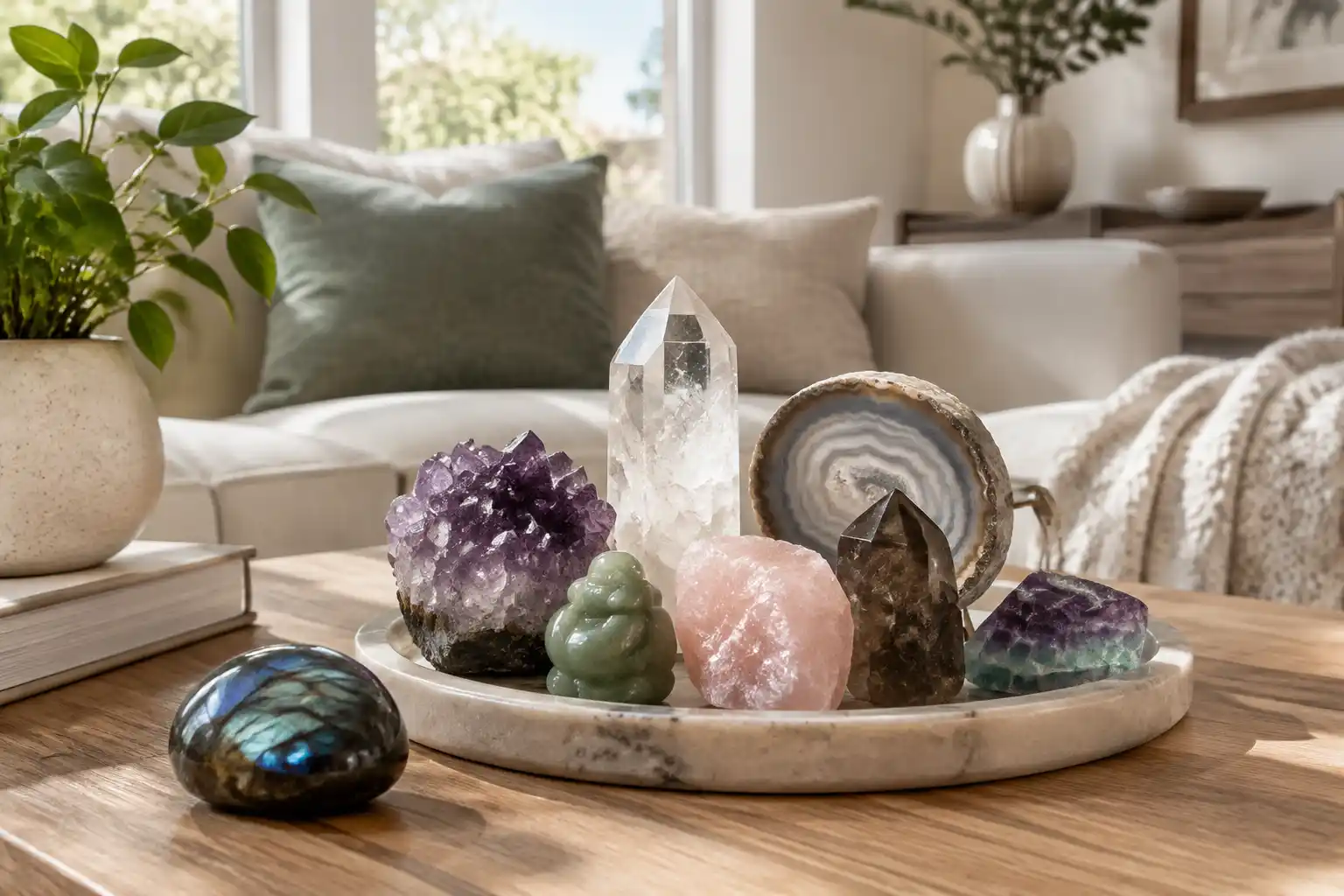
15 Welcoming Crystal Gifts for a Housewarming to Bless New Spaces
Crystal gifts for a housewarming can add color, geological character, and personal meaning to a new home without becoming another generic decorative object. Natural quartz clusters, amethyst specimens, agate bookends, jade carvings, fluorite crystals, polished labradorite, and other mineral pieces can work particularly well because they function as décor while still giving the recipient something distinctive to examine and keep. The best choice depends on the homeowner’s interior style, available space, interest in minerals, and willingness to care for more delicate specimens.
The idea of blessing a new space has a long cultural history, and gemstones can easily become part of that ceremony. Clear quartz may represent clarity, rose quartz affection, jade continuity, smoky quartz steadiness, and amethyst reflection. These meanings can be used symbolically without claiming that the stones physically cleanse a house, remove negative energy, prevent arguments, improve health, or guarantee prosperity.
Practical selection matters because different minerals behave very differently in a home. Quartz is relatively hard and easy to maintain, fluorite is soft and cleavage-prone, gypsum varieties are easily scratched and can be affected by moisture, and polished jade is exceptionally tough despite moderate hardness. A housewarming gift becomes far more successful when the mineral is both attractive and appropriate for where it will actually be displayed.
15 Welcoming Crystal Gifts for a Housewarming
- Clear quartz cluster
- Amethyst geode or crystal group
- Agate bookends
- Rose quartz decorative heart
- Smoky quartz specimen
- Black tourmaline display crystal
- Jade carving
- Citrine decorative stone
- Fluorite specimen
- Labradorite freeform
- Green aventurine bowl or tray
- Satin spar gypsum ornament
- Calcite display specimen
- Pyrite crystal cluster
- Personalized birthstone home keepsake
These 15 options include natural specimens, polished decorative pieces, and personalized gifts. Some are robust enough for ordinary household handling, while others deserve a stable shelf away from edges, moisture, children, and pets.
Matching a Housewarming Crystal Gift to the Home
A housewarming gift should feel as though it belongs in the recipient’s home rather than imposing a particular spiritual style. Minimalist interiors may suit a single clear quartz crystal, pale jade carving, or polished smoky quartz piece. A colorful home might accommodate banded agate, fluorite, labradorite, or amethyst more naturally.
Scale matters as much as color. Large agate bookends can work beautifully in a study but may overwhelm a small apartment shelf. A compact labradorite freeform or polished rose quartz object can be easier to place without demanding a dedicated display cabinet.
The recipient’s level of interest in geology should also guide the choice. A collector may prefer a natural crystal specimen showing recognizable crystal habit, inclusions, matrix, and locality information. Someone who simply wants attractive décor may prefer a polished stone, carving, bowl, or bookend that integrates easily with furniture and lighting.
Housewarming Crystal Gift Comparison
| Gift | Mineral or Gem Identity | Main Decorative Appeal | Care Level |
|---|---|---|---|
| Clear quartz | Quartz | Transparent crystal form | Easy |
| Amethyst | Violet quartz | Purple crystals | Easy to moderate |
| Agate | Chalcedony | Banded patterns | Easy |
| Rose quartz | Pink quartz | Soft translucent color | Easy |
| Smoky quartz | Brown to smoky quartz | Neutral earthy tones | Easy |
| Black tourmaline | Commonly schorl | Dark striated crystals | Moderate |
| Jade | Jadeite or nephrite | Smooth polish and toughness | Easy |
| Citrine | Yellow quartz | Warm golden color | Easy |
| Fluorite | Calcium fluoride | Cubic form and color zoning | Delicate |
| Labradorite | Feldspar | Labradorescence | Moderate |
| Aventurine | Quartz with inclusions | Soft color and sparkle | Easy |
| Satin spar gypsum | Gypsum | Silky fibrous luster | Delicate |
| Calcite | Calcium carbonate | Crystal form and color variety | Delicate |
| Pyrite | Iron sulfide | Metallic crystal faces | Moderate |
| Birthstone keepsake | Depends on gem | Personal connection | Varies |
The symbolic associations people attach to these stones are separate from their mineralogical properties. Hardness, cleavage, crystal structure, inclusions, and environmental stability determine how they should actually be displayed and maintained.
Clear Quartz, Amethyst, and Smoky Quartz for Versatile Home Décor
Clear quartz is one of the easiest mineral gifts to place in almost any interior. Rock crystal commonly forms six-sided prisms terminated by crystal faces, while clusters can show dozens of individual points growing from a shared base. Internal veils, mineral inclusions, healed fractures, and growth structures can make each specimen visually individual.
Quartz reaches 7 on the Mohs scale, making it relatively resistant to ordinary scratching. Crystal points can still chip if a specimen falls, so a stable surface is more important than the mineral’s hardness might suggest.
Clear quartz is often associated with clarity in spiritual traditions. As a housewarming gift, that idea can simply represent wishing the homeowner a clear and positive start. A quartz cluster does not scientifically purify air, cleanse a room, or amplify human intentions.
Amethyst offers the same fundamental quartz chemistry with violet coloration produced through iron-related defects and natural irradiation. Geodes and crystal groups can range from pale lilac to strongly saturated violet and may include white quartz, agate, calcite, or other associated minerals.
Large amethyst geodes can become architectural objects, while smaller crystal groups fit easily on shelves. Prolonged intense sunlight should be avoided because some amethyst can gradually lose color.
Smoky quartz brings a more understated palette of gray-brown, tea-brown, and nearly black tones. Its coloration develops from natural irradiation acting on aluminum-related defects within quartz. Very dark examples can appear almost opaque until strong light passes through thinner areas.
Smoky quartz can symbolize steadiness or grounding in a new home, but it does not physically absorb household stress or negative energy.
Agate, Rose Quartz, and Jade for Polished Housewarming Gifts
Agate is particularly suitable for functional décor because its patterned chalcedony can be cut into bookends, boxes, coasters, trays, and polished slabs. Bands may form concentric, fortification-like, parallel, or irregular patterns depending on the geological environment in which the silica developed.
Commercial agate is frequently dyed, especially when colors are unusually vivid. Bright blue, purple, pink, and green pieces may owe much of their appearance to treatment. Dyed agate can still be beautiful, but natural and enhanced color should be represented accurately.
Rose quartz works well in softer interiors. Its pink color and cloudy translucency make it suitable for hearts, bowls, small sculptures, spheres, and polished freeforms. With a Mohs hardness of 7, it is reasonably durable for household display.
Contemporary traditions connect rose quartz with love and harmony. In a housewarming gift, it may represent the wish that a home be affectionate and welcoming, but it cannot prevent family conflict or change relationships through a physical gemstone effect.
Jade offers exceptional toughness and a long tradition in carved objects. The name refers mainly to jadeite and nephrite, two different gem substances with interlocking internal structures that resist breakage remarkably well.
White, green, lavender, yellow, and other colors are possible depending on type. Treatment disclosure is especially important with jadeite because bleaching, polymer impregnation, and dyeing can substantially influence value.
A small jade carving can be one of the most durable decorative gemstone gifts available when accurately identified and well finished.
Labradorite and Fluorite for Visually Changing Displays
Labradorite is a feldspar famous for labradorescence, a shifting display of blue, green, gold, orange, or other colors that appears as the stone is moved. The effect comes from interference of light within fine internal structures rather than surface paint or an energy field.
A polished freeform works well near indirect window light where the optical effect becomes visible from different positions in the room. The stone should not be placed where it can be repeatedly knocked or rubbed against harder objects because feldspar is softer than quartz.
Fluorite offers a completely different display experience. It commonly forms cubes and can occur in purple, green, blue, yellow, colorless, and multicolored zoning. Well-formed specimens can be striking even without polishing.
Its Mohs hardness is only 4, and it has perfect octahedral cleavage. That combination means a beautiful fluorite crystal can scratch or break much more easily than quartz. It belongs on a stable shelf rather than a table where it will be handled constantly.
Fluorite is sometimes marketed as a stone that improves concentration or clears a room’s energy. Those effects are not scientifically established. The mineral’s genuine appeal lies in its crystal form, fluorescence in some specimens, color zoning, cleavage, and geological diversity.
Citrine, Aventurine, and Pyrite for Warm Housewarming Décor
Citrine introduces yellow, golden, or orange tones into a home. It is crystalline quartz and therefore has the same Mohs hardness of 7 as amethyst and clear quartz.
Much commercial citrine has been created by heating suitable amethyst or smoky quartz. The resulting color can be stable and attractive, but naturally yellow quartz and heat-treated stones should not be presented as identical rarity categories.
Its sunny appearance has encouraged associations with optimism, abundance, and prosperity. As a housewarming gift, citrine can symbolize good wishes for the homeowner’s future without implying that the stone will create financial success.
Green aventurine provides a softer color. It is quartz containing platy mineral inclusions that can create a sparkling effect called aventurescence. Green varieties commonly owe their appearance to chromium-bearing mica or related inclusions.
Aventurine can be fashioned into trays, bowls, palm stones, and small decorative objects. It is durable enough for normal display, though polished surfaces should still be protected from harder gems.
Pyrite is visually dramatic because of its metallic luster and brassy color. Iron sulfide crystals often form cubes or pyritohedra with well-defined faces, making natural specimens highly decorative.
Pyrite has historically been nicknamed fool’s gold, but it is not an imitation product. It is a distinct mineral with its own chemistry and crystallography. Some specimens can deteriorate under unsuitable humid conditions, so stable indoor storage is preferable.
Satin Spar Gypsum and Calcite for Delicate Decorative Gifts
Many decorative white fibrous objects marketed as selenite are more precisely satin spar gypsum. Gypsum has a Mohs hardness of only 2, meaning it can be scratched with a fingernail and damaged much more easily than quartz.
Its silky luster can make bowls, towers, and carved objects attractive, but it should be kept dry and handled gently. It is not suitable for a damp bathroom shelf or a place where it will be repeatedly moved and knocked.
Calcite is another common decorative mineral with enormous variety. It can occur colorless, white, yellow, orange, green, blue, pink, and other colors, and it forms numerous crystal habits.
Calcite has a hardness of only 3 and perfect cleavage, so it belongs in the delicate category. Acids can react readily with calcium carbonate, making vinegar, acidic household cleaners, and similar products inappropriate for cleaning.
Both gypsum and calcite are often described as energetic cleansing stones. Their real physical properties are much easier to demonstrate: low hardness, cleavage, distinctive crystal habits, and particular chemical behavior.
Black Tourmaline as a Dramatic Natural Mineral Specimen
Black tourmaline used decoratively is commonly schorl, an iron-rich member of the tourmaline group. Natural crystals often form elongated prisms with strong vertical striations.
The stone typically appears opaque black and can create an architectural contrast against pale shelves or neutral interiors. A natural cluster can be more visually interesting than a highly polished carving because the original growth habit remains visible.
Tourmaline generally has a hardness around 7 to 7.5, though individual specimens may contain fractures and attached matrix that require careful handling.
Black tourmaline has become strongly associated with protection in contemporary crystal traditions. A homeowner may enjoy that symbolism as a wish for safety and good boundaries, but the mineral does not create a measurable protective shield or neutralize harmful forces in a room.
Personalized Birthstone Keepsakes for a New Home
A personalized piece can connect the housewarming gift with the people living in the home rather than with the building alone. One option is a decorative keepsake incorporating the birthstones of partners, children, or other household members.
The design does not need to be elaborate. A small framed stone arrangement, engraved keepsake with a single gem, or simple birthstone ornament can be easier to display than a large mineral piece.
Different birthstones require different handling. Sapphire, ruby, spinel, garnet, and aquamarine are relatively durable, while opal, pearl, moonstone, and turquoise require more care.
A family birthstone object can symbolize that the new house is becoming a home through the people who occupy it. That personal association often lasts longer than generic claims about crystals attracting prosperity or harmony.
What Blessing a New Space Can Realistically Mean
A housewarming blessing can express hopes for safety, good health, hospitality, stability, friendship, laughter, and a sense of belonging. A gemstone can serve as a visual marker of those wishes without needing supernatural claims.
Clear quartz may represent a fresh beginning, rose quartz affection, smoky quartz steadiness, amethyst reflection, and jade continuity. These meanings come from tradition or personal interpretation.
A crystal does not prevent accidents, purify indoor air, eliminate mold, stop conflict, or protect against crime. Those concerns require practical measures appropriate to the home.
What a gemstone can do is hold memory. Years later, an agate bookend or quartz cluster may remind the homeowner of the day they moved in and the people who welcomed them. That emotional function is real even though it does not depend on invisible energy.
Buying Housewarming Crystals Without Overpaying
The first question should be mineral identity. Descriptions such as protection crystal, prosperity stone, cleansing tower, or energy geode do not identify what the object actually is.
Ask whether color is natural, dyed, heated, coated, or otherwise treated when this matters. Agate is commonly dyed, citrine may be heat-treated quartz, jade can receive significant enhancement, and decorative gypsum is often mislabeled.
Large specimens should also be examined for repairs, glued crystals, artificial coatings, and unstable bases. Repairs are not necessarily unacceptable, but they should not be hidden if they materially affect the piece.
For collectible specimens, locality information can add value when it is reliable. A clearly documented mine, district, or region is more meaningful than a dramatic origin story unsupported by evidence.
Caring for Crystal Gifts Around the Home
Quartz, agate, rose quartz, smoky quartz, citrine, and aventurine are relatively easy to maintain. Dusting with a soft brush or cloth and occasional gentle cleaning is usually enough.
Fluorite, calcite, and gypsum require more care because of their low hardness and cleavage. They should not be scrubbed with abrasive products or placed where they may be soaked or knocked over.
Pyrite benefits from reasonably dry storage, while labradorite should be protected from harder stones and abrasive surfaces. Jade is very tough but can still be scratched by diamond, sapphire, and other harder gems.
Large specimens should always sit on stable furniture capable of carrying their weight. Heavy stone bookends, geodes, and clusters should be placed where children or pets cannot pull them down.
Conclusion
Crystal gifts for a housewarming can welcome someone into a new space through genuine mineral beauty, decorative usefulness, and personal symbolism. Quartz, amethyst, agate, rose quartz, smoky quartz, tourmaline, jade, citrine, fluorite, labradorite, aventurine, gypsum, calcite, pyrite, and personalized birthstones each offer a different visual and geological character.
A gemstone cannot physically bless a house or guarantee prosperity, harmony, or protection. It can, however, become a lasting reminder of the people who helped celebrate a new beginning. Choosing accurate mineral identity, suitable durability, honest treatment information, and a design that fits the home makes the gift far more meaningful.
FAQs About Crystal Gifts for a Housewarming
What is the best crystal gift for a housewarming?
Clear quartz, amethyst, agate, jade, labradorite, and smoky quartz are versatile choices because they work well as decorative objects. The best stone depends on the recipient’s interior style, available space, and interest in natural minerals.
What crystal symbolizes a new home?
Clear quartz is often used symbolically for a fresh start, rose quartz for affection, jade for continuity, and smoky quartz for steadiness. These are symbolic associations rather than scientifically measurable effects.
Can crystals protect a house?
There is no scientific evidence that gemstones create a physical protective field around a house or prevent accidents, crime, illness, or conflict. Black tourmaline, obsidian, and other dark stones may carry protective symbolism without providing literal protection.
Are agate bookends a good housewarming gift?
Yes. Agate is durable enough for decorative use and can display attractive natural banding. Strongly colored pieces may be dyed, so buyers who care about natural color should ask about treatment.
Is an amethyst geode suitable for a living room?
Yes. Amethyst geodes can be attractive statement pieces. They should be positioned on stable furniture and kept away from prolonged intense sunlight, which may gradually affect the color of some specimens.
Is fluorite safe for everyday home décor?
Fluorite is suitable for display but requires careful placement because its hardness is only 4 and it has perfect cleavage. It can scratch or break more easily than quartz.
What is the difference between selenite and satin spar gypsum décor?
Both names are associated with gypsum, but many fibrous white decorative objects sold as selenite are more precisely satin spar gypsum. Gypsum is extremely soft at Mohs 2 and should be kept dry and handled gently.
Does citrine attract money into a new home?
There is no scientific evidence that citrine causes financial gain or attracts money. Its golden color can symbolize prosperity, optimism, or generosity without being treated as a financial tool.
Is jade a durable decorative stone?
Yes. Jadeite and nephrite are famous for toughness and work well in carvings and polished objects. Valuable jadeite should be purchased with attention to treatment because dyeing and polymer impregnation can influence value.
Can I give a mineral specimen instead of polished crystal décor?
Yes. A natural specimen can be especially meaningful for someone interested in geology or collecting. Crystal form, matrix, locality, and natural inclusions may provide more interest than a heavily processed object.
Are dyed crystals bad housewarming gifts?
Not necessarily. Dyed agate and other enhanced stones can be attractive. The important issue is honest description so the buyer does not pay a natural-rarity premium for an artificially colored product.
Where should delicate mineral specimens be displayed?
Place them on stable shelves away from edges, moisture, heavy vibration, pets, and young children. Fluorite, calcite, gypsum, and fragile crystal clusters deserve particularly secure placement.
Do crystals cleanse negative energy from a home?
Claims that crystals physically remove negative energy are not scientifically established. A homeowner may use them symbolically during a housewarming ritual, but their demonstrated properties are mineralogical rather than supernatural.
What housewarming crystal works for someone who prefers minimalist décor?
A single clear quartz crystal, smoky quartz piece, polished jade carving, or small labradorite freeform can provide visual interest without making the space feel crowded.
How should housewarming crystals be cleaned?
Cleaning depends on the mineral. Quartz varieties tolerate gentle soap-and-water cleaning reasonably well, while gypsum, calcite, fluorite, and some treated stones need more cautious methods. Identifying the mineral first is the safest approach.