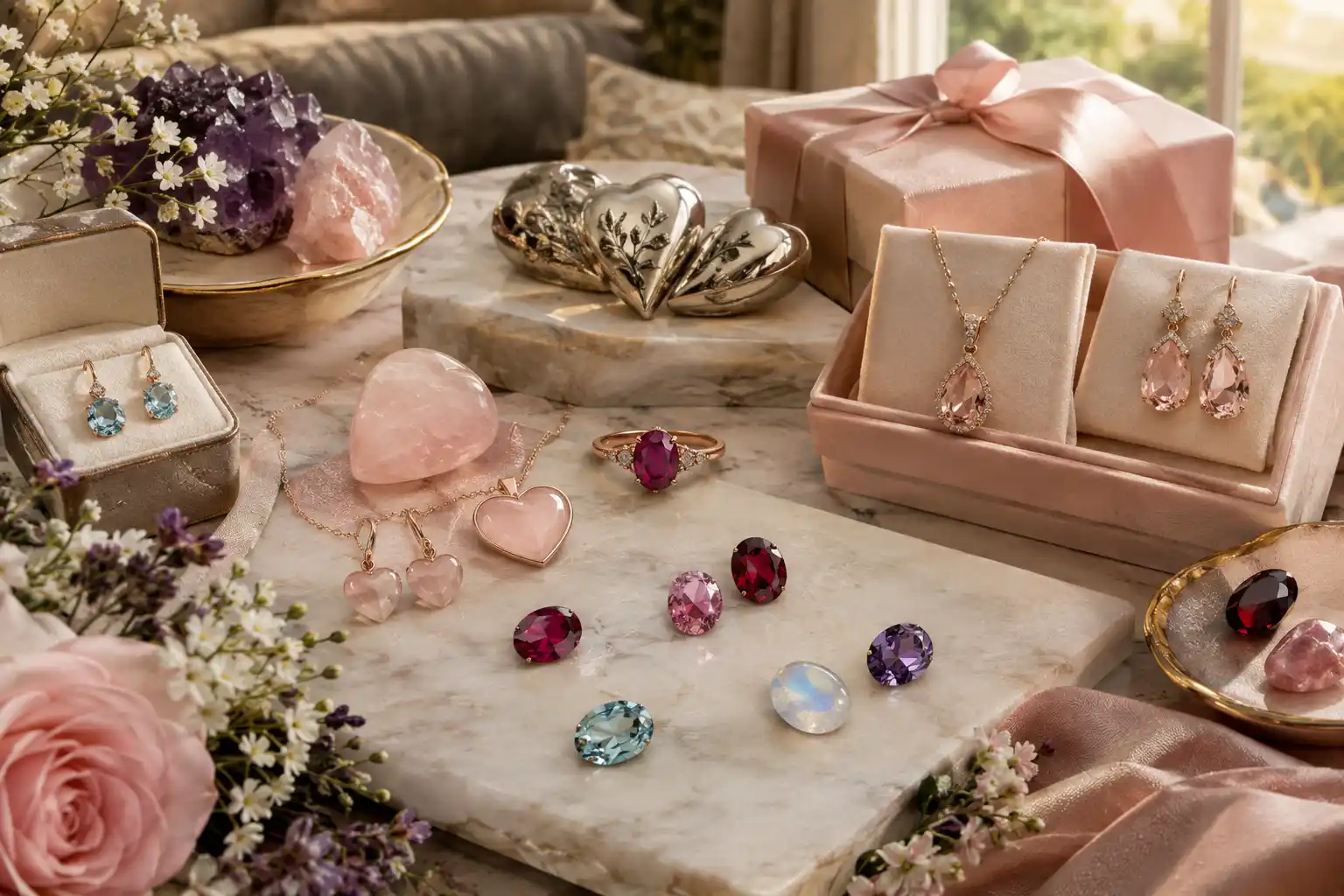
16 Loving Crystal Gifts for a Partner to Strengthen Your Bond
Crystal gifts for a partner can become lasting reminders of affection, shared experiences, trust, and the milestones that shape a relationship. Rose quartz is the familiar romantic choice, but ruby, sapphire, garnet, aquamarine, moonstone, morganite, spinel, amethyst, tourmaline, jade, and personalized birthstones can all feel more meaningful when their color, durability, and story genuinely fit the person receiving them. A partner who wears jewelry daily may appreciate sapphire or spinel, while someone who prefers decorative objects may value an agate keepsake box, natural quartz specimen, or paired mineral pieces.
The phrase strengthen your bond works best as a symbolic idea rather than a claim that a gemstone can change a relationship. No crystal can guarantee loyalty, create compatibility, repair trust, force affection, improve sexual chemistry, or make disagreements disappear. Relationships become stronger through communication, respect, reliability, shared experiences, boundaries, and the decisions both people make. A gemstone can represent those values and accumulate meaning as the relationship develops.
Gemological qualities deserve equal attention. Ruby and sapphire are highly durable corundum at Mohs 9, spinel is strong at about 8, morganite reaches 7.5 to 8, and rose quartz is softer at 7. Moonstone has cleavage, pearl is delicate, and opal requires more careful wear. Choosing a stone that suits the recipient’s habits makes the gift more likely to remain beautiful for years instead of becoming a fragile object that stays hidden in a drawer.
16 Loving Crystal Gifts for a Partner
- Rose quartz heart pendant
- Ruby ring
- Pink sapphire necklace
- Garnet earrings
- Morganite pendant
- Aquamarine bracelet
- Moonstone jewelry
- Amethyst keepsake
- Pink tourmaline charm
- Red spinel ring
- Jade pendant
- Pearl earrings
- Clear quartz paired keepsake
- Couple’s birthstone necklace
- Personalized gemstone charm
- Paired mineral specimens
These 16 ideas cover romantic jewelry, personalized keepsakes, natural mineral specimens, and symbolic gifts. The best option depends on the partner’s taste, everyday routine, jewelry preferences, and the reason the stone connects with your relationship.
Choosing a Crystal Gift That Actually Fits Your Partner
A meaningful partner gift begins with the person rather than the gemstone chart. Favorite color, preferred metal, lifestyle, ring size, birth month, and the kind of jewelry already worn are more useful clues than generalized statements about crystal energy. Someone who favors understated blue jewelry may genuinely enjoy aquamarine or sapphire, while a person drawn to blush tones may prefer morganite or pink sapphire.
Shared memories can create an even stronger reason for choosing a particular stone. Aquamarine may recall an important trip to the coast, garnet may connect with a winter anniversary, and a quartz specimen from a meaningful region may carry more emotional value than a rare gemstone selected solely because it was expensive.
The form of the gift also matters. Rings receive more impact and abrasion than pendants or earrings, so durability becomes especially important. Moonstone, opal, pearl, and softer gems often work better in earrings or necklaces than in exposed rings worn every day.
Comparing Romantic Gemstone Gifts for a Partner
| Gift | Gemological Identity | Everyday Practicality | Symbolic Theme |
|---|---|---|---|
| Rose quartz | Pink quartz | Good with care | Affection |
| Ruby | Red corundum | Excellent | Passion and commitment |
| Pink sapphire | Pink corundum | Excellent | Enduring love |
| Garnet | Mineral group | Good | Loyalty |
| Morganite | Pink beryl | Very good | Gentleness |
| Aquamarine | Blue beryl | Very good | Communication |
| Moonstone | Feldspar | Moderate | Shared change |
| Amethyst | Violet quartz | Good | Reflection |
| Pink tourmaline | Tourmaline group | Good | Openness |
| Red spinel | Spinel | Very good | Resilience |
| Jade | Jadeite or nephrite | Very tough | Continuity |
| Pearl | Organic gem | Delicate | Grace |
| Clear quartz | Crystalline quartz | Good | Clarity symbolism |
| Birthstone jewelry | Depends on gemstone | Varies | Personal identity |
| Gemstone charm | Depends on gemstone | Varies | Shared memory |
| Mineral pair | Depends on minerals | Display use | Connection |
The symbolic themes describe meanings people may choose to attach to the gifts. The actual physical behavior of each stone comes from hardness, toughness, cleavage, inclusions, treatment, and crystal structure.
Rose Quartz, Morganite, and Pink Sapphire for Romantic Color
Rose quartz remains a popular relationship stone because its soft pink color naturally fits romantic jewelry and keepsakes. It is a variety of quartz with a Mohs hardness of 7 and typically appears translucent because of microscopic inclusions and structural features.
Most rose quartz is fashioned into cabochons, hearts, beads, spheres, or polished freeforms rather than highly transparent faceted gems. Some stones show a six-rayed star when cut correctly as cabochons, an optical effect caused by oriented microscopic inclusions.
Modern crystal traditions often describe rose quartz as a stone of unconditional love. It can represent affection and kindness symbolically, but it cannot make a partner love more deeply, repair emotional wounds, guarantee commitment, or change another person’s feelings.
Morganite provides a more transparent alternative. It is the pink to peach variety of beryl and shares its mineral species with aquamarine and emerald. Manganese contributes to its pink coloration, while heat treatment may be used to reduce yellowish components and create a purer pink appearance.
Morganite reaches 7.5 to 8 on the Mohs scale and works well in pendants, earrings, and rings when protected from severe impact. Larger stones are relatively accessible and often show color better than small gems, making morganite appealing for statement jewelry.
Pink sapphire offers the greatest durability of these three. Sapphire is corundum with a hardness of 9 and no cleavage. Chromium is commonly involved in pink coloration, which can range from pale blush to vivid hot pink.
Heat treatment is common in sapphire, while other enhancement methods may also occur. A treated stone can still make an excellent partner gift when treatment is disclosed accurately.
Ruby, Garnet, and Red Spinel for Deeper Romantic Symbolism
Ruby is red corundum and one of the strongest natural gemstones for jewelry. Its hardness of 9, lack of cleavage, and long history in fine jewelry make it particularly suitable for rings intended to be worn frequently.
Chromium is primarily responsible for ruby’s red color and can also produce fluorescence that intensifies appearance under certain lighting. Natural rubies often contain inclusions, and treatment is common. Heat treatment may improve color or clarity, while fracture filling and other processes can have a greater effect on durability and value.
Ruby’s association with passion makes it an obvious partner gift, but its real appeal lies in color, durability, rarity, and craftsmanship. The stone does not generate passion or control romantic attraction.
Garnet offers a wider color range than the familiar deep red suggests. The garnet group includes red, orange, green, pink, purple, and yellow stones. Many garnets fall around 6.5 to 7.5 on the Mohs scale and lack cleavage.
A garnet pendant or pair of earrings can represent loyalty and commitment, particularly in a long-standing relationship. Its generally strong jewelry performance makes it practical as well as symbolic.
Red spinel provides another durable option at around Mohs 8. Historically, fine red spinel was sometimes mistaken for ruby because both can occur in similar colors and geological deposits. Modern gemology recognizes spinel as a separate mineral species.
Fine spinel can display brilliant red, pinkish red, or reddish pink and generally has good toughness. For a partner who values unusual natural gemstones, spinel can feel more individual than a conventional ruby gift.
Aquamarine, Amethyst, and Moonstone for Softer Relationship Themes
Aquamarine is blue to greenish-blue beryl with a hardness of 7.5 to 8. Iron contributes to its coloration, and heat treatment is widely used to reduce greener or yellowish components and create a cleaner blue.
Its calm appearance often leads to symbolic associations with communication and understanding. A partner gift can use that idea to represent the importance of listening and speaking honestly. The stone does not physiologically calm emotions or prevent arguments.
Amethyst is violet crystalline quartz with a Mohs hardness of 7 and no cleavage. It ranges from pale lilac to strong purple and may show natural color zoning.
For a relationship, amethyst can symbolize reflection and the ability to think before reacting. That meaning becomes especially personal for couples who have learned to communicate more thoughtfully over time.
Moonstone provides a different visual effect through adularescence, a floating light produced by internal feldspar structures. Fine stones may show a blue or white sheen that moves across the surface.
Its hardness is around 6 to 6.5, and cleavage makes it more vulnerable to impact. Earrings and pendants are therefore often safer than exposed everyday rings.
Moonstone can symbolize the way relationships change through different phases without implying that the gemstone controls those changes.
Pink Tourmaline, Jade, and Pearl for Distinctive Partner Gifts
Pink tourmaline ranges from pale blush to strong reddish pink, and some highly saturated red to pinkish-red stones are described as rubellite. Tourmaline generally reaches 7 to 7.5 on the Mohs scale and can work well in jewelry.
Individual stones may contain liquid inclusions, fractures, or internal tubes, so structural condition matters in rings. Heating and irradiation can be used to alter some colors.
Tourmaline’s wide color range makes it easy to match with a partner’s style. A pink stone may symbolize emotional openness, but it does not cause emotional honesty or improve communication automatically.
Jade creates an entirely different kind of gift. The term principally refers to jadeite and nephrite, both prized for toughness and smooth polish. Jadeite generally reaches about 6.5 to 7 on the Mohs scale, while nephrite is somewhat softer but exceptionally tough.
Treatment matters greatly for valuable jadeite because bleaching, polymer impregnation, and dyeing can change both appearance and value. A jade pendant can symbolize continuity, family, or stability when represented accurately.
Pearl offers a softer and more traditional look. Natural and cultured pearls are organic gems formed within mollusks. Their nacreous luster creates an appearance unlike any faceted mineral gemstone.
Pearl is relatively delicate, typically around 2.5 to 4.5 on the Mohs scale. Earrings and necklaces are more practical than rings because perfume, cosmetics, acids, and abrasion can damage the surface.
A pearl gift can symbolize patience or something precious developed gradually over time, a fitting metaphor for a mature relationship.
Birthstones and Personalized Gemstone Gifts for Couples
Birthstone jewelry can make a partner gift immediately personal because the stones represent the two people rather than a generic relationship concept. A necklace can combine both birthstones, or each partner can wear the other’s stone.
Different birthstones have very different durability. Diamond, sapphire, ruby, spinel, chrysoberyl, aquamarine, and many garnets withstand regular wear well. Pearl, opal, moonstone, and turquoise need more thoughtful protection.
A pendant is usually an excellent format when combining two stones with different hardness levels because it receives less impact than a ring.
Personalization can extend beyond birthstones. Engraved initials, an anniversary date, a place name, or a gemstone connected with a shared memory can create more significance than simply choosing the most expensive gem.
Laboratory-grown gemstones can also be meaningful. Synthetic sapphire, ruby, or diamond can offer excellent durability and color when their artificial origin is disclosed clearly.
Paired Mineral Specimens for Partners Who Love Natural Objects
Not every romantic gemstone gift needs to be jewelry. Two mineral specimens from the same locality can create an unusually personal pair for partners who enjoy geology or natural objects.
Quartz crystals from the same pocket, two pieces of agate from one nodule, or specimens collected from the same geological region can represent connection through shared origin. Their pairing is factual and geological rather than mystical.
Natural specimens can also preserve crystal habit, matrix, associated minerals, inclusions, and growth structures that disappear when a stone is faceted or polished.
For collectors, reliable locality information may matter more than metaphysical meaning. A specimen with genuine provenance can become increasingly interesting as the couple learns more about the geological setting in which it formed.
What Strengthening a Bond Can Realistically Mean
A stronger relationship does not come from wearing two compatible crystals. It develops through repeated behavior, including listening, honesty, reliability, affection, compromise, boundaries, and the willingness to address problems rather than ignore them.
Gemstone symbolism can represent these behaviors. Sapphire may stand for loyalty, aquamarine for clear communication, garnet for commitment, rose quartz for kindness, and moonstone for adaptability.
The important distinction is that the stone serves as a reminder rather than a cause. A sapphire ring cannot make a person faithful, but it can represent the value a couple places on faithfulness.
This interpretation also allows the meaning to evolve. A gemstone first given during a new relationship may later become connected with moving in together, marriage, travel, children, career changes, or other experiences that give the object a much richer personal history.
Buying a Crystal Gift for a Partner Without Overpaying
Start with accurate identity. Romantic marketing terms such as soulmate crystal, eternal love stone, attraction gem, or heart-healing crystal do not identify a gemstone.
Natural, laboratory-grown, treated, and imitation stones belong to different categories. Laboratory-grown ruby is corundum produced artificially, while red glass that resembles ruby is an imitation. Both can be attractive, but they should not be represented as the same thing.
Treatments are common. Sapphire and ruby may be heated, morganite may be heated, tourmaline can be irradiated or heated, jadeite may be impregnated or dyed, and pearls can be bleached or colored.
The existence of treatment does not automatically make a gift undesirable. The important issues are disclosure, permanence, durability, and appropriate pricing.
For expensive stones, independent gemological documentation can be useful when natural origin, treatment status, or color origin significantly affects value.
Caring for Romantic Gemstone Gifts
Ruby, sapphire, spinel, garnet, quartz, aquamarine, and many tourmalines can generally tolerate gentle cleaning with lukewarm water, mild soap, and a soft brush when the setting and treatment permit.
Morganite is reasonably durable but should still be protected from hard impact. Moonstone needs more care because of cleavage, while pearl should be kept away from perfume, cosmetics, acids, and abrasive cleaners.
Jade is exceptionally tough but can still be scratched by harder gems. Separate storage prevents diamond, sapphire, and other hard stones from damaging quartz, feldspar, pearl, and softer jewelry.
Rings and bracelets also benefit from periodic setting inspection. A loose prong or worn bezel can put a sentimental center stone at risk even when the gemstone itself is durable.
Conclusion
Crystal gifts for a partner can express affection through gemstone color, shared history, birthstones, natural specimens, jewelry, and personal symbolism. Rose quartz, ruby, sapphire, garnet, morganite, aquamarine, moonstone, amethyst, tourmaline, spinel, jade, pearl, quartz, and personalized gemstones each offer a different combination of beauty, durability, and meaning.
No gemstone can strengthen a relationship automatically. The bond develops through what two people consistently do for one another, while the stone becomes a physical reminder of those choices. Accurate gem identity, honest treatment disclosure, appropriate durability, and a personal reason for the gift make that reminder far more meaningful.
FAQs About Crystal Gifts for a Partner
What is the best crystal gift for a partner?
The best choice depends on the person’s taste and lifestyle. Sapphire and ruby are excellent for durable jewelry, rose quartz suits softer symbolic keepsakes, morganite offers elegant pink color, and paired mineral specimens work well for someone who prefers natural objects.
What crystal symbolizes a strong relationship?
Sapphire, garnet, rose quartz, aquamarine, jade, and several other gemstones are commonly used symbolically for loyalty, affection, communication, continuity, or commitment. These meanings are personal rather than scientifically produced by the stones.
Can crystals strengthen a relationship?
There is no scientific evidence that gemstones improve compatibility, create loyalty, increase affection, or resolve conflict. They can serve as reminders of values and shared memories within an existing relationship.
Is rose quartz a good gift for a partner?
Yes. Rose quartz offers soft pink color, a Mohs hardness of 7, and strong cultural associations with affection. It works well in pendants, hearts, cabochons, and polished keepsakes.
Is sapphire appropriate for romantic jewelry?
Yes. Sapphire is exceptionally durable at Mohs 9 and has longstanding associations with loyalty and commitment. It is suitable for rings, earrings, bracelets, and pendants intended for frequent wear.
Is morganite durable enough for a partner’s ring?
Morganite has a hardness of 7.5 to 8 and can work well in rings with sensible care. It is softer than sapphire and diamond, so protective settings and removal during strenuous activities improve longevity.
What gemstone symbolizes communication in a relationship?
Aquamarine and other blue stones are frequently used symbolically for calm communication. They do not physically improve communication, but they can represent the importance of listening and speaking honestly.
Is pearl a romantic gemstone gift?
Yes. Pearls can symbolize grace, patience, and something valuable that develops over time. They are delicate, so earrings and necklaces are generally more practical than everyday rings.
Are matching birthstones a good couple’s gift?
Yes. Combining both partners’ birthstones makes the jewelry directly personal. The design should take each stone’s durability into account, particularly if one is much softer than the other.
Are laboratory-grown gemstones meaningful as partner gifts?
Yes. Laboratory-grown sapphire, ruby, diamond, and other gems can be beautiful and durable. Their artificial origin should simply be disclosed clearly rather than represented as natural geological origin.
Can gemstones heal emotional wounds in a relationship?
Gemstones do not have established medical or psychological abilities to heal emotional trauma or repair trust. A stone can symbolize reconciliation or growth, but actual healing depends on people, time, communication, and appropriate support.
Is red spinel a good alternative to ruby?
Yes. Red spinel has a hardness around 8, good toughness, and can display vivid natural color. It is a separate mineral species with its own history and is well suited to fine jewelry.
What crystal gift works for a partner who does not wear jewelry?
A natural quartz specimen, agate keepsake box, jade carving, paired mineral specimens, or another decorative geological object can be meaningful without requiring jewelry wear.
Do expensive gemstones make better romantic gifts?
Not necessarily. A modest gem connected with a shared memory can have more emotional value than a rare stone chosen only for price. Craftsmanship, authenticity, and personal relevance matter more than cost alone.
How should partner gemstone jewelry be stored?
Store pieces separately or in divided compartments so harder stones do not scratch softer ones. Pearls, moonstone, quartz, jade, and other softer gems should especially be kept away from diamond and sapphire.
What makes a gemstone gift strengthen a bond symbolically?
A stone becomes meaningful when it is connected with a promise, memory, shared value, or important stage in the relationship. Its symbolic strength comes from what the couple associates with it rather than from an invisible force inside the gem.