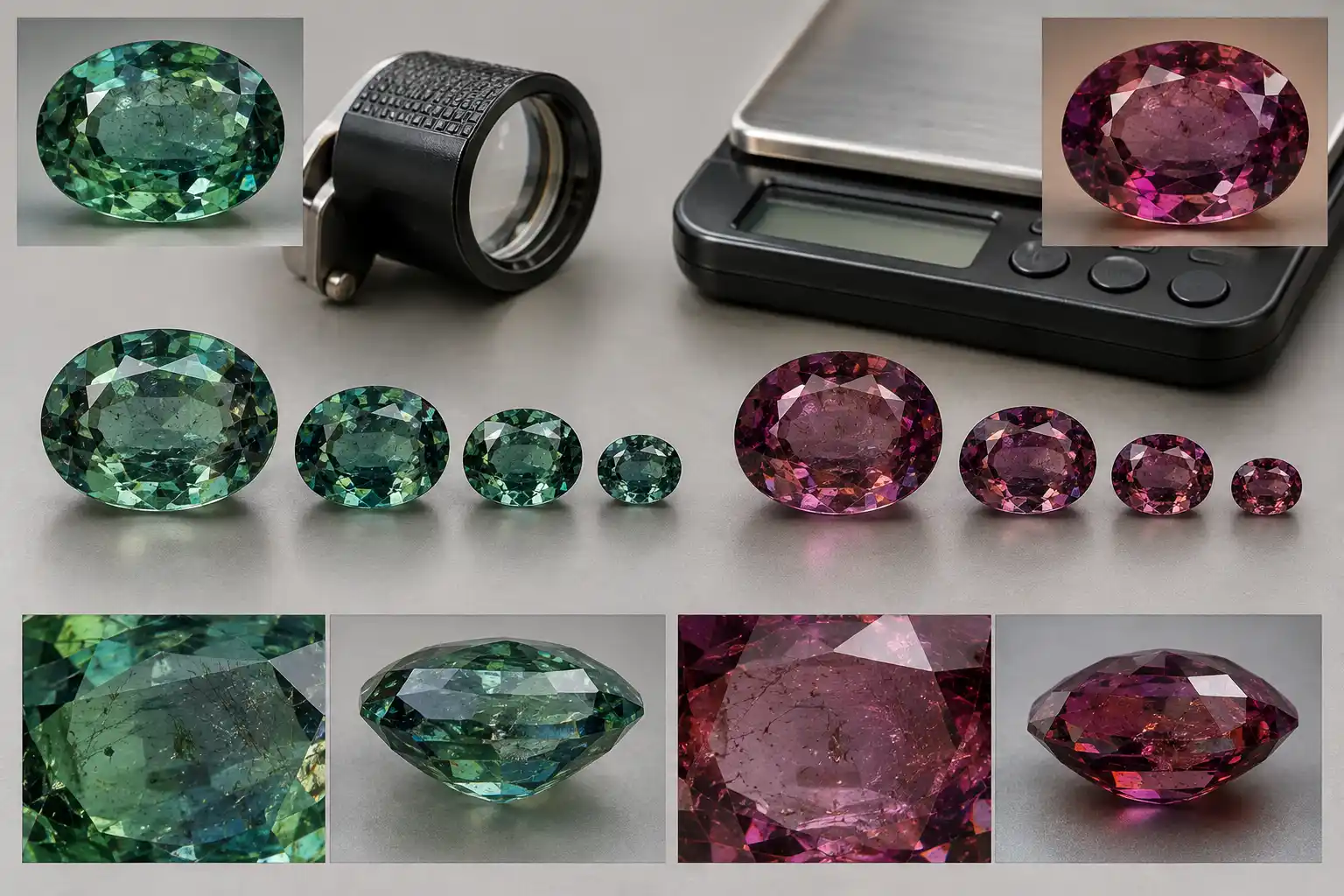
Alexandrite Price Per Carat: 10 Key Factors Driving Its Value
Alexandrite price per carat varies more dramatically than the price of many familiar colored gemstones because the market is not paying for a single feature. Natural origin, strength of color change, quality of the two principal colors, carat weight, clarity, cut, transparency, geographic provenance, rarity, and laboratory documentation can all alter value substantially. A small included natural alexandrite with a weak brownish color shift may trade for hundreds to a few thousand dollars per carat, while fine stones with a strong green-to-red change can reach many thousands or tens of thousands of dollars per carat. Exceptional large stones with outstanding color change can rise far above ordinary commercial examples.
The crucial point is that alexandrite is not expensive merely because it changes color. Fine natural alexandrite is a chromium-bearing variety of chrysoberyl, BeAl₂O₄, and the most desirable stones show a pronounced change from green or bluish green in daylight-like illumination to red, purplish red, or raspberry tones under warmer illumination. Stones that remain grayish, brownish, olive, or muddy through either lighting condition generally command far less, even when the color change is technically visible.
Size magnifies these differences. Natural alexandrite above one carat is much scarcer than small stones, and clean gems with strong color change become increasingly difficult to find as weight rises. Price per carat therefore tends to increase rather than remain constant as stones cross important size thresholds. A two-carat fine alexandrite may be worth much more than twice the total value of a comparable one-carat gem.
10 Key Factors That Drive Alexandrite Price Per Carat
- Natural versus laboratory-grown origin
- Strength and completeness of color change
- Quality of the daylight color
- Quality of the warm-light color
- Carat weight and rarity at larger sizes
- Clarity and transparency
- Cut quality and face-up appearance
- Geographic origin and documented provenance
- Treatment status and authenticity
- Laboratory report and overall market confidence
These factors interact rather than operating independently. A large alexandrite is not automatically expensive if its color shift is weak, while a smaller stone with vivid complementary colors and excellent transparency may command a much higher price per carat than a heavier but unattractive gem.
The Price Range for Natural Alexandrite
There is no single universal price for alexandrite because natural stones vary tremendously in quality. Broad retail-style ranges can nevertheless help buyers understand how quickly value rises as color change, size, and overall quality improve.
| Natural Alexandrite Quality | Approximate Price Per Carat | Typical Characteristics |
|---|---|---|
| Commercial quality | $500 to $2,500 | Weak or incomplete change, visible inclusions, gray/brown modifiers |
| Good small stones | $2,000 to $8,000 | Noticeable change, reasonable color, generally under 1 carat |
| Fine quality around 1 carat | $8,000 to $20,000+ | Strong change, attractive green and red tones, good transparency |
| Fine 1 to 2 carat stones | $12,000 to $30,000+ | Stronger rarity premium with excellent color and clarity |
| Exceptional larger stones | $25,000 to $50,000+ | Strong to near-complete change, fine color, substantial size |
| Museum-level or extraordinary gems | Can exceed $50,000 per carat substantially | Very rare size, exceptional colors, provenance, and quality |
These ranges should be treated as market orientation rather than fixed tariffs. Alexandrite is sufficiently rare that two stones of identical weight can be separated by several multiples in value. Dealer inventory, geographic market, certification, origin, mounting, and collector demand also influence actual selling prices.
The Price of a finished ring should not be confused with the stone’s per-carat value. Metal, side diamonds, craftsmanship, antique provenance, designer branding, and retailer margins can all raise the final jewelry price substantially.
1. Natural Alexandrite Commands a Major Premium Over Synthetic Stones
The first question in any alexandrite valuation is whether the stone is natural chrysoberyl or laboratory-grown alexandrite. Natural alexandrite formed geologically under uncommon conditions that allowed chromium to enter chrysoberyl while avoiding enough iron to suppress the desired color change. This unusual chemistry contributes greatly to its rarity.
Synthetic alexandrite can be produced in laboratories using methods such as flux growth or crystal-pulling techniques. Properly manufactured synthetic alexandrite has essentially the same chemical composition and crystal structure as natural alexandrite but does not have natural geological origin.
A laboratory-grown stone can display an excellent color change and attractive clarity while costing a fraction of a comparable fine natural gem. It may therefore be an appealing jewelry choice, but it belongs to a completely different rarity category.
Another complication is color-change synthetic corundum, which has historically been sold or informally described as alexandrite even though it is not chrysoberyl. Purple-to-reddish synthetic sapphire can imitate the general effect but should be identified as synthetic corundum rather than synthetic alexandrite.
For an expensive purchase, verifying species and origin is fundamental. Paying natural-alexandrite prices for laboratory-grown alexandrite or color-change synthetic sapphire creates a much larger valuation error than small differences in clarity or cut.
2. Strength of Color Change Is One of the Biggest Value Drivers
The alexandrite effect occurs because chromium-related absorption interacts differently with light sources having different spectral distributions. Under daylight or daylight-equivalent illumination, fine alexandrite may appear green or bluish green. Under a warm light source rich in longer wavelengths, the same gem can appear red, purplish red, raspberry, or reddish purple.
The most valuable stones show a strong and obvious transformation across most of the visible face. A stone that changes only around the edges or shifts from olive green to brownish red will generally be less valuable.
Color change is sometimes discussed as a percentage, but buyers should be cautious about treating percentage estimates as a universally standardized grading system. Two observers may disagree about whether a stone changes 70, 80, or 90 percent. Hue quality and visual attractiveness matter alongside apparent completeness.
A near-complete shift from attractive bluish green to vivid purplish red can be far more valuable than an equally complete change between gray-green and muddy brown-purple.
Lighting also needs to be controlled. Different LEDs produce very different spectra, so a warm LED may not reproduce exactly what an incandescent lamp shows. Serious evaluation should compare the stone under consistent daylight-equivalent and warm-light conditions.
3. Daylight Color Strongly Influences Alexandrite Value
A fine daylight appearance is generally green, bluish green, or sometimes a slightly yellowish green that remains lively and attractive. Strong gray, brown, or muddy olive modifiers reduce value because they make the stone look less vivid even before the color change is considered.
Saturation must also be balanced. A stone can be too dark. Extremely dark alexandrite may contain strong color but transmit too little light through the center, making the gem appear nearly black in some conditions.
At the other extreme, very pale alexandrite may have good transparency but insufficient saturation to produce an impressive change. Fine stones balance tone and saturation so the green remains recognizable and lively.
The daylight color is particularly important because many people spend much of the day under natural or daylight-like illumination. A buyer should therefore evaluate whether the stone is attractive in its green phase independently of its rarity.
4. Warm-Light Red and Purple Colors Affect The Price
The second half of the alexandrite effect is equally important. Fine stones may become red, purplish red, reddish purple, or raspberry under warm illumination.
A strong red component is generally highly desirable because it produces a dramatic contrast with the daylight green. Stones that shift mainly from greenish brown to brownish purple can show genuine color change but rarely command the same premium.
Purplish red is common and can be highly attractive when saturation is strong. The exact preferred balance varies among collectors, but clean, distinct hues normally outperform muddy mixtures.
The strongest alexandrites create a memorable before-and-after impression. A buyer should not need to persuade themselves that a change exists. When the transformation is obvious at first glance under controlled lighting, that is usually a positive value signal.
5. Carat Weight Creates a Steep Rarity Premium
Alexandrite becomes increasingly rare as size rises, particularly when strong color change and good transparency are retained. Small melee-size stones are available more regularly, while fine gems around one carat already belong to a much tighter market.
Above one carat, price per carat can increase sharply. Fine stones above two carats are significantly scarcer, and clean examples with excellent green-to-red change become collector-level gems.
This means price is not linear. If one fine one-carat alexandrite is worth $12,000 per carat, a comparable two-carat stone should not automatically be expected to cost only $24,000 total. The larger stone may command a significantly higher per-carat rate because the probability of finding that combination of size and quality is lower.
Cutters also make difficult decisions when working with expensive rough. Retaining weight can sometimes compromise ideal proportions, so large natural alexandrite may be cut somewhat deep or asymmetrically. Buyers need to decide whether rarity justifies the compromise.
6. Clarity and Transparency Matter, but Color Usually Comes First
Alexandrite can contain inclusions such as crystals, needles, fingerprints, healed fractures, and growth features. Natural inclusions can support identification, but heavily included stones may lose transparency and brightness.
Eye-clean stones are more desirable, particularly above one carat. However, alexandrite should not be evaluated with the expectation that every valuable gem will look as clean as fine aquamarine or topaz.
A moderately included stone with exceptional color change may be worth more than a very clean stone showing weak or unattractive colors. This is one reason colored-gem valuation differs from simplistic clarity-first buying.
Surface-reaching fractures deserve special attention because they can affect durability and may be associated with filling or other enhancement. Alexandrite is chrysoberyl, which has a Mohs hardness of 8.5 and generally good toughness, but an individual fractured stone can still be vulnerable.
7. Cut Quality Controls Brightness and Visible Color Change
A skilled cutter must balance weight retention, brightness, pleochroism, color change, and rough shape. Alexandrite can be pleochroic, meaning it may display different colors in different crystallographic directions even under one lighting condition. This is separate from the alexandrite color-change effect, which occurs when the illumination changes.
Good orientation can maximize attractive face-up color in both lighting environments. Poor orientation may leave a stone overly dark, strongly gray, or uneven.
Windowing also matters. A large transparent area through the center where the viewer seems to see straight through the stone usually indicates poor proportions and reduces visual richness.
Extinction, where sections appear excessively dark, can also reduce beauty. Some extinction is normal in faceted colored stones, but extensive black areas can suppress both apparent color and brilliance.
Symmetry, polish, and facet junctions matter as well. Because natural alexandrite rough is valuable, cutters sometimes retain extra weight instead of pursuing ideal proportions. Buyers should judge whether the finished appearance justifies that decision.
8. Geographic Origin Can Add a Provenance Premium
Alexandrite was famously associated with deposits in Russia’s Ural Mountains, and fine historical Russian stones can carry substantial collector prestige. They are traditionally prized for strong green-to-red color change, although actual quality varies and geographic origin should never replace direct evaluation of the stone.
Brazil, Sri Lanka, East Africa, and other regions have also produced alexandrite. Fine stones can come from several sources, and an unattractive stone does not become excellent simply because a prestigious origin is claimed.
Reliable origin determination can be difficult. Geographic origin should be supported by a qualified gemological laboratory when a seller is charging a meaningful premium for it.
Provenance can matter even more for documented antique stones, historically important jewelry, or specimens with a traceable collecting history. In those cases, market value includes more than gem quality alone.
9. Treatments Are Uncommon but Still Need Verification
Fine alexandrite is generally valued for natural color, and routine treatment is much less central to the market than it is for sapphire, ruby, emerald, or blue topaz.
That does not mean treatment questions can be ignored. Surface-reaching fractures may be filled in some gems, and unusual treatments or composite products can appear in the wider marketplace.
Imitations are a more important practical concern. Color-change synthetic sapphire, synthetic alexandrite, glass, assembled stones, and other products may resemble aspects of natural alexandrite.
A seller should clearly state whether the gemstone is natural alexandrite, laboratory-grown alexandrite, another color-change gemstone, or an imitation. At high prices, verbal assurance is not enough.
10. Laboratory Documentation Can Increase Buyer Confidence
A respected gemological report can verify that a stone is natural chrysoberyl variety alexandrite and may address treatment. Depending on laboratory capability and the specimen, origin opinions may also be available.
The report does not create quality. A dull, weak-changing natural alexandrite remains a lower-quality stone even when certified. What the document does is reduce uncertainty around identity and origin category.
Documentation becomes more important as value rises. A buyer considering a small inexpensive stone may accept a knowledgeable seller’s description, but a five-figure natural alexandrite purchase deserves much stronger verification.
The report number, stone weight, dimensions, and identifying features should correspond to the actual gem being purchased.
Natural Alexandrite Versus Synthetic Alexandrite Value
Synthetic alexandrite can be beautiful, durable, and technically sophisticated. It is also far more available than fine natural alexandrite, which is why prices differ so dramatically.
| Feature | Natural Alexandrite | Synthetic Alexandrite |
|---|---|---|
| Origin | Geological | Laboratory-grown |
| Mineral identity | Chrysoberyl | Chrysoberyl when true synthetic alexandrite |
| Color change | Weak to exceptional | Can be very strong |
| Availability | Rare | More available |
| Large clean stones | Very rare | Easier to produce |
| Collector premium | Potentially very high | Much lower |
| Main value driver | Natural rarity plus quality | Manufacturing quality and appearance |
Buyers should also distinguish synthetic alexandrite from color-change synthetic corundum. Both can be attractive, but they are not the same gem species.
How to Compare Two Alexandrites of the Same Carat Weight
When two stones weigh one carat, begin by comparing their daylight and warm-light appearances side by side under identical illumination. Ignore the price tags initially and determine which gem shows the cleaner, more complete, and more attractive transformation.
Next examine transparency and inclusions with the unaided eye before using magnification. A gem that remains lively despite small inclusions may outperform a perfectly clean but weakly colored stone.
Then inspect cut. Look for a large transparent window, excessive darkness, uneven shape, poor polish, or a very deep pavilion that adds hidden weight without improving face-up size.
Only after evaluating these visible qualities should origin and documentation premiums be considered. A prestigious locality can add collector appeal, but it should not compensate for poor color change.
Is Alexandrite Worth Buying as an Investment?
Natural fine alexandrite is genuinely rare, particularly in larger sizes, but rarity alone does not make every purchase a reliable investment. Retail and resale markets have different price structures, and dealer margins, auction conditions, certification, liquidity, and buyer demand affect what a stone can actually be sold for later.
A weak-changing included alexandrite purchased at an inflated retail price should not be expected to appreciate simply because the mineral is rare.
Collectors generally focus on stones with qualities that remain scarce: excellent color change, attractive hues, significant size, good transparency, strong cut, natural origin, and reliable documentation.
A buyer who also enjoys the gemstone aesthetically is in a stronger position because the stone has personal value even if future resale does not meet expectations.
Caring for an Expensive Alexandrite
Alexandrite’s hardness of 8.5 makes it highly resistant to everyday scratching and suitable for rings, earrings, pendants, and bracelets. It generally has good toughness, which contributes to its reputation as a practical fine gemstone.
Ordinary cleaning can usually be done with lukewarm water, mild soap, and a soft brush when the setting and any treatments permit. Fracture-filled or otherwise unusual stones may require different care.
Even a hard gemstone should be protected from severe impact. Ring settings should be checked periodically, particularly when the stone is valuable enough that replacement would be difficult.
Separate storage prevents harder gems such as diamond from scratching alexandrite and keeps the alexandrite itself from damaging softer jewelry.
Conclusion
Alexandrite price per carat is driven primarily by natural origin, color-change strength, quality of both color states, carat weight, clarity, cut, provenance, treatment status, and laboratory confidence. Small commercial natural stones may cost hundreds to a few thousand dollars per carat, while fine one-carat and larger gems can rise into the thousands or tens of thousands per carat. Exceptional large alexandrites occupy an even more specialized collector market.
The highest price should never be justified by the alexandrite name alone. A valuable stone needs a convincing combination of rarity and visible beauty. Buyers who compare both lighting states, verify natural origin, inspect transparency and cut, and obtain appropriate documentation are much better positioned to understand why one alexandrite commands several times the price of another.
FAQs About Alexandrite Price Per Carat
How much does natural alexandrite cost per carat?
Natural alexandrite can range from hundreds of dollars per carat for commercial stones with weak color change to many thousands or tens of thousands per carat for fine gems. Exceptional large stones with outstanding green-to-red change can exceed those ranges substantially.
Why is alexandrite so expensive?
Fine natural alexandrite is rare because it requires an unusual combination of geological conditions and chromium-bearing chrysoberyl chemistry. Large transparent stones with strong, attractive color change are particularly scarce.
Does alexandrite become more expensive above one carat?
Usually yes when quality remains high. Natural alexandrite becomes significantly scarcer as size rises, so price per carat often increases at larger weight thresholds rather than remaining constant.
Is Russian alexandrite always the most expensive?
Documented Russian origin can add collector prestige, especially for fine historical stones, but origin alone does not guarantee quality. A weak-changing Russian stone may be less valuable than an exceptional gem from another source.
Is synthetic alexandrite valuable?
Synthetic alexandrite can be beautiful and durable but is generally worth far less than comparable fine natural alexandrite because laboratory production removes much of the geological rarity premium.
What color change makes alexandrite most valuable?
Strong changes from attractive green or bluish green under daylight-like illumination to vivid red, purplish red, or raspberry under warmer light are generally the most desirable. Muddy brown or gray modifiers typically lower value.
Does clarity matter more than color in alexandrite?
Usually not. Clarity influences value, but a slightly included stone with exceptional color change can be more valuable than a very clean gem with weak or unattractive colors.
Can alexandrite cost more than diamond?
Fine alexandrite can command very high per-carat prices, especially at larger sizes with exceptional color change. Whether it costs more than a diamond depends entirely on the quality, size, rarity, and type of diamond being compared.
Do treated alexandrites cost less?
Treatment can affect value depending on the type and extent. Natural untreated color is generally preferred in the fine alexandrite market, while filled or otherwise significantly altered stones may trade at lower prices than comparable untreated gems.
Should expensive alexandrite have a laboratory report?
For high-value natural alexandrite, independent gemological documentation is highly advisable. It helps verify mineral identity, natural versus laboratory-grown origin, and treatment status, reducing one of the biggest risks in an expensive purchase.