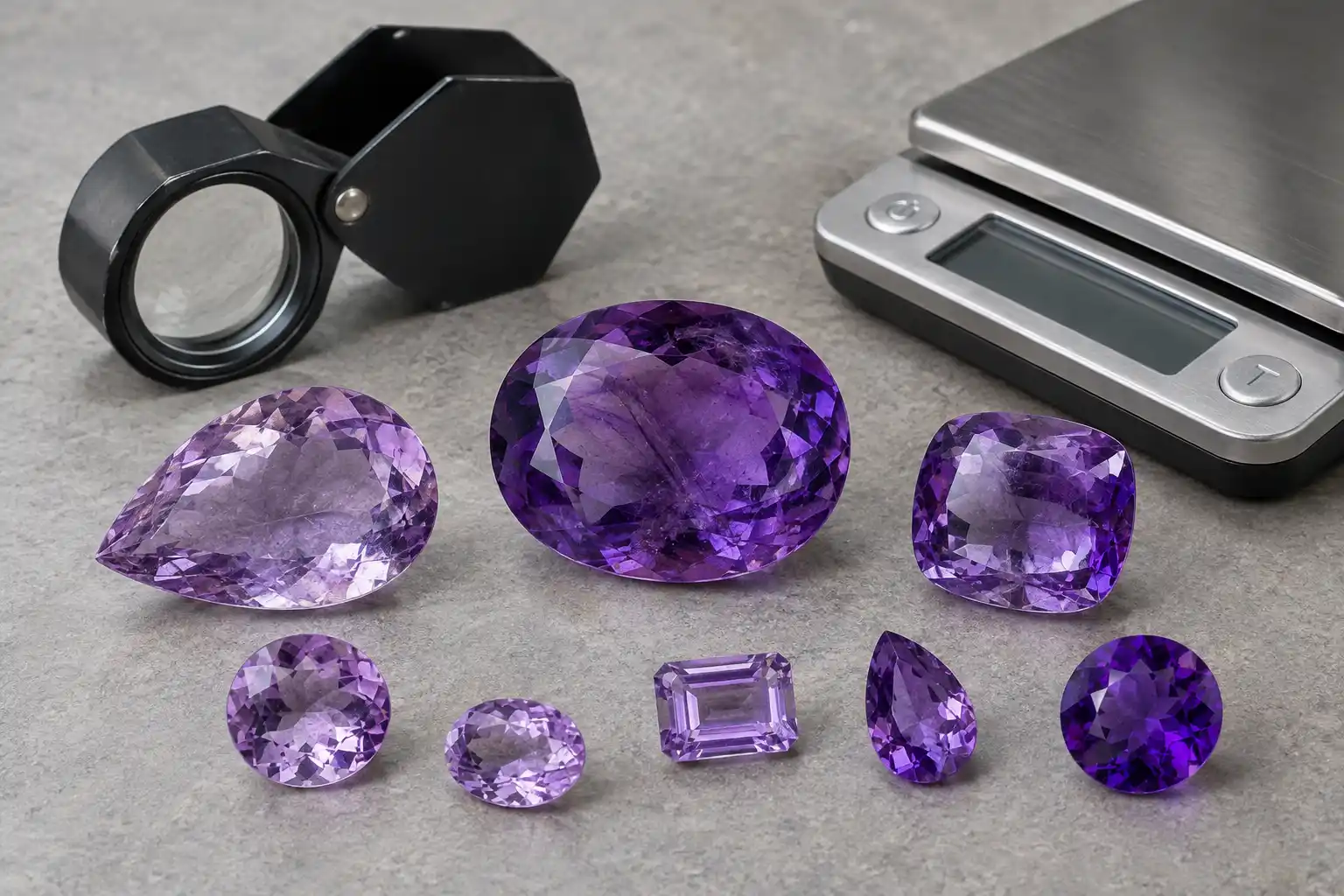
Amethyst Price Per Carat: 8 Key Value Factors & Pricing Guide
Amethyst price per carat is usually far more accessible than the price of ruby, sapphire, emerald, or alexandrite because gem-quality amethyst occurs in comparatively large crystals and sizable clean stones are readily available. Commercial pale or unevenly colored amethyst may sell for only a few dollars per carat, while attractive jewelry-quality gems commonly move into higher single-digit or low double-digit ranges. Fine stones with rich purple color, desirable red or blue secondary flashes, strong transparency, excellent cutting, and minimal zoning may reach several tens of dollars per carat, with exceptional craftsmanship, unusual provenance, or collector appeal pushing individual stones higher.
Color is the main driver of amethyst value. A deeply saturated purple gem with enough brightness to remain lively usually commands more than a very pale stone, even when both are equally clean. The best amethyst should not be so dark that large areas appear black, nor should its color be concentrated only around the edges or in obvious uneven bands. Clarity matters, but eye-clean amethyst is sufficiently available that distracting inclusions generally reduce value rather than being tolerated as readily as they are in rarer stones such as emerald.
Amethyst is the purple variety of crystalline quartz, SiO₂, with a Mohs hardness of 7 and no cleavage. Its purple color involves iron-related defects and natural irradiation within the quartz crystal structure. Because large crystals occur naturally, carat weight alone does not create an automatic steep premium. A beautifully colored 15-carat stone may cost much less per carat than a one-carat ruby, while a small amethyst with exceptional saturation and cutting may still have a higher per-carat value than a much larger pale stone.
8 Key Factors That Determine Amethyst Price Per Carat
- Purple hue and overall color attractiveness
- Saturation and tone
- Color zoning and consistency
- Clarity and transparency
- Cut quality and face-up brilliance
- Carat weight and usable size
- Geographic origin and provenance
- Treatment, natural versus synthetic origin, and market confidence
These eight factors work together. A large amethyst with weak color and poor cutting can be worth much less than a smaller gem displaying rich purple, excellent transparency, attractive flashes of secondary color, and strong brilliance.
Typical Amethyst Price Per Carat
Amethyst does not have a universal fixed price chart, and retail prices vary according to seller, cutting quality, origin claims, jewelry branding, and local market. Broad loose-gem ranges can still help buyers understand where ordinary and fine material generally sit.
| Amethyst Quality | Approximate Price Per Carat | Typical Appearance |
|---|---|---|
| Commercial quality | $2 to $5 | Pale, grayish, visibly zoned, ordinary cut |
| Good jewelry quality | $5 to $15 | Medium purple, clean appearance, competent cut |
| Fine quality | $15 to $30 | Rich purple, good saturation, eye-clean, attractive brilliance |
| Exceptional quality | $25 to $50+ | Strong saturated purple, attractive secondary flashes, excellent cut |
| Specialty or collector pieces | Highly variable | Exceptional provenance, carving, unusual crystals, premium craftsmanship |
These are orientation ranges rather than a formal tariff. Finished jewelry can cost much more because metal, labor, side stones, brand positioning, design, and retail margins are added to the value of the amethyst itself.
Large amethyst also behaves differently from many rarer gems. A jump from two carats to ten carats does not necessarily multiply the per-carat price because crystals capable of producing large stones are available. Quality of color remains more important than size until the stone becomes unusually large, unusually fine, or collectible for another reason.
1. Purple Hue Is the Foundation of Amethyst Value
Amethyst ranges from very pale lilac through medium violet and strongly saturated purple. Fine stones often display a balanced purple with flashes of red, blue, or both depending on the individual gem and lighting.
Gray or brown modifiers generally reduce visual appeal when they make the stone look dull. A pale but clean lilac amethyst can still be attractive, particularly in delicate jewelry, but it usually commands less per carat than a richly saturated purple stone of comparable cut and clarity.
Some trade descriptions use terms such as Siberian quality to describe especially fine color. Such terminology should not automatically be interpreted as proof of Russian geographic origin. In modern trade usage, a color descriptor may refer to appearance rather than documented locality.
The strongest value comes from what can actually be seen face-up. A prestigious color name should not compensate for weak saturation or excessive darkness.
2. Saturation and Tone Must Work Together
Saturation describes the strength of the purple color, while tone describes how light or dark the gemstone appears. Fine amethyst needs enough saturation to look unmistakably purple without becoming so dark that brilliance disappears.
Very pale amethyst can appear washed out, particularly in small stones. Conversely, extremely dark amethyst may look nearly black in normal indoor lighting even when the underlying color is technically strong.
Medium to moderately dark tone often provides the most attractive balance. Light can still return through the crown, while the body color remains rich.
Cutting influences this balance. A deep pavilion can intensify an already dark stone, while a shallow cut may make a pale stone look even lighter. Two gems from similar rough can therefore show noticeably different face-up color after cutting.
3. Color Zoning Can Raise or Lower The Price
Natural amethyst often displays color zoning because the concentration of color-producing defects is not uniform throughout the crystal. Purple may occur in bands, patches, triangular sectors, or zones of different saturation.
Some zoning is normal and may be difficult to see once a stone is well cut. Strong zoning becomes a quality issue when large pale and dark areas remain obvious through the face of the finished gem.
Cutters orient rough carefully to place the richest color where it contributes most effectively to the face-up appearance. This can require removing more rough than a simple weight-retention strategy would suggest.
A smaller stone with evenly distributed rich color can therefore be worth more per carat than a heavier gem containing an obvious pale center or patchy purple edges.
Color zoning should not automatically be treated as proof of poor quality. In natural crystals and collector specimens, visible zoning can be geologically interesting. For a faceted jewelry gem, however, visual uniformity is usually preferred.
4. Clarity and Transparency Affect Fine Amethyst Value
Amethyst can occur with excellent transparency, which means the market generally expects attractive faceted gems to look clean to the unaided eye. Small internal features visible only under magnification usually matter less than inclusions that interrupt brilliance face-up.
Typical natural features may include fluid inclusions, healed fractures, growth structures, mineral crystals, and internal veils. These can support natural origin but become value-reducing when they are large or centrally located.
Surface-reaching fractures deserve additional attention because they may weaken an otherwise durable quartz gem. Amethyst has a hardness of 7 and lacks cleavage, but it can still chip or fracture under a sufficiently strong blow.
Eye-clean clarity combined with good transparency allows color and cutting to dominate visually. This is generally preferred for fine faceted stones.
Collector crystals are judged differently. A natural amethyst specimen may be desirable because of crystal habit, matrix, zoning, phantoms, associated minerals, or locality even when it would never produce a clean faceted gemstone.
5. Cut Quality Can Create or Destroy Visual Value
Amethyst is available in enough sizes that buyers do not need to accept severe cutting compromises simply to retain weight. Good faceting should distribute color effectively, return light across the face, and avoid a large transparent window in the center.
Windowing occurs when pavilion angles are too shallow, allowing the viewer to see through the gemstone instead of receiving strong internal light return. A large window can make even richly colored rough look weak after cutting.
Extinction creates dark areas that return little visible light. Some extinction is normal, especially in deep colors, but broad black zones make the stone appear lifeless.
Symmetry and polish also matter. Crisp facet junctions, even outlines, and a smooth polish contribute to brilliance and professional appearance.
Designer or precision-cut amethyst may cost substantially more than mass-produced stones even when the raw gem quality is similar. In such cases, part of The Price reflects skilled labor, low-yield cutting, and artistic design rather than rarity of the quartz alone.
6. Carat Weight Does Not Create a Simple Scarcity Premium
One of the biggest misunderstandings about amethyst is the assumption that every increase in size should produce a much higher price per carat.
Large amethyst crystals occur naturally, and sizable faceted stones are far more available than large ruby, sapphire, alexandrite, or emerald. For ordinary material, The Price per carat may remain relatively stable or increase only modestly as size grows.
This makes amethyst attractive for statement jewelry. Ten, twenty, or even larger carat gems can be visually impressive without requiring the enormous budgets associated with equally large examples of rarer gemstones.
Large stones do gain additional value when they combine exceptional color, excellent transparency, uniform saturation, and fine cutting. The challenge is maintaining all those qualities as size increases.
Face-up dimensions should also be considered. A very deep stone can carry extra carat weight below the setting while appearing smaller than a better-proportioned gem of lower weight.
7. Geographic Origin Can Influence Desirability, but Quality Comes First
Amethyst has been mined in Brazil, Uruguay, Zambia, Bolivia, Russia, and numerous other regions. Different deposits can produce characteristic tendencies in crystal size, saturation, zoning, inclusions, and associated minerals, although appearance alone is not always sufficient to establish origin.
Brazil is a major source and produces enormous quantities ranging from pale commercial material to fine crystals. Uruguay is known for strongly saturated amethyst, including dark crystals in geodes. Zambia has produced fine transparent material that can show rich purple and attractive secondary colors.
Historical Russian amethyst has a prestigious reputation, but claims of Russian or Siberian origin should not be accepted solely because a stone displays fine color.
For ordinary jewelry, geographic origin generally matters less than visible quality. A beautiful well-cut amethyst from one region should not automatically be priced below an inferior stone from a more prestigious locality.
Provenance can become more important for mineral specimens, historical jewelry, and crystals from famous mines or documented old collections.
8. Treatments, Synthetic Amethyst, and Accurate Disclosure Affect Value
Heating can alter amethyst color. Depending on the original crystal and geological source, heat may produce yellow, orange, brownish, greenish, or colorless results rather than deeper purple. Much commercial citrine is created by heating suitable amethyst.
Irradiation can also influence color in quartz, although treatment history is not always simple to determine from appearance alone.
Synthetic amethyst is commonly grown by hydrothermal methods. It has the chemical composition and crystal structure of quartz but laboratory origin. High-quality synthetic amethyst can look extremely clean and richly colored, sometimes making visual separation from natural stone difficult without gemological examination.
Synthetic amethyst is useful for affordable jewelry but should not be sold as naturally mined material. Because natural amethyst itself is relatively available, natural versus synthetic origin may create a smaller absolute price difference than in rare gems, but disclosure remains important.
Glass and other purple simulants can imitate amethyst as well. Color alone is not sufficient for reliable identification.
Natural Amethyst Versus Synthetic Amethyst
| Feature | Natural Amethyst | Synthetic Amethyst |
|---|---|---|
| Origin | Geological | Laboratory-grown |
| Composition | Quartz, SiO₂ | Quartz, SiO₂ |
| Hardness | 7 | 7 |
| Color | Pale lilac to deep purple | Can be highly uniform and saturated |
| Inclusions | Natural growth and fluid features may occur | Synthetic growth features may occur |
| Availability | Abundant | Readily produced |
| Collector value | Higher when quality and provenance are desirable | Usually lower |
| Identification | May require testing in fine clean stones | May require advanced examination |
The existence of synthetic amethyst is another reason unusually perfect color and clarity should not be treated automatically as evidence of exceptional natural quality.
How to Compare Two Amethysts Before Buying
Begin by viewing both stones against a neutral background under the same lighting. Compare hue, tone, saturation, and color distribution before looking at carat weight.
Next examine the center for windowing and the darker areas for excessive extinction. Rotate the gems gently and see whether brilliance remains balanced across most of the face.
Then inspect clarity without magnification. If one stone has an obvious central fracture while the other appears clean, that difference is likely to matter more in normal wear than microscopic inclusions visible only through a loupe.
Finally, compare dimensions rather than weight alone. A well-proportioned four-carat amethyst can look larger face-up than a deep five-carat stone carrying unnecessary weight beneath the girdle.
This method prevents the buyer from choosing simply by carat size or an impressive trade description.
Is Darker Amethyst Always More Valuable?
No. Darker color helps only until the stone begins losing brightness. Fine amethyst should look richly purple while still reflecting enough light to appear lively.
Very dark stones can show large extinction areas, particularly in low indoor lighting. A slightly lighter stone with stronger brilliance can therefore be more attractive and more valuable.
The same principle applies to pale amethyst. A lighter lavender gem may be beautiful, but pale saturation generally lowers market value unless the color is sought for a particular design or collector niche.
Balance matters more than darkness alone.
Does Amethyst Hold Its Value?
Amethyst is beautiful and durable, but its relatively abundant supply means ordinary stones should not be treated as guaranteed financial investments. Retail jewelry prices also include design, metal, labor, brand, and seller margin that may not be recovered in resale.
Exceptional amethyst can have collector appeal when it combines outstanding color, precision cutting, important provenance, unusual crystal form, or historical significance.
For most buyers, the strongest reason to purchase amethyst is aesthetic value rather than an expectation of rapid financial appreciation.
Its affordability can actually be an advantage. Buyers can obtain saturated natural color in substantial sizes without paying the rarity premium demanded by many other gemstones.
Amethyst Durability and Long-Term Jewelry Value
Quartz has a Mohs hardness of 7, which makes amethyst durable enough for earrings, pendants, necklaces, bracelets, and carefully worn rings. It has no cleavage but can fracture under strong impact.
Daily rings should be removed during activities involving hard surfaces, tools, heavy lifting, or repeated knocks. Facet edges can abrade over many years even though quartz is reasonably scratch resistant.
Strong heat should be avoided because it may permanently alter color. Long exposure to intense sunlight may also affect some amethyst.
Gentle cleaning with mild soap, lukewarm water, and a soft brush is generally sufficient. Ultrasonic cleaning should be approached cautiously when significant fractures or unusual treatments are present.
Separate storage prevents harder stones such as sapphire, topaz, and diamond from scratching the quartz surface.
Conclusion
Amethyst price per carat depends primarily on color, saturation, tone, zoning, clarity, cut, size, origin, and treatment or synthetic status. Common stones may cost only a few dollars per carat, while fine eye-clean amethyst with rich purple color and excellent cutting can reach several tens of dollars per carat or more in specialty markets.
The highest-quality purchase is not automatically the darkest or largest stone. A well-balanced amethyst should combine attractive purple color with sufficient brightness, minimal distracting zoning, strong transparency, and a cut that displays the gem effectively. Because large amethyst is relatively available, buyers can focus more heavily on beauty and craftsmanship rather than chasing carat weight alone.
FAQs About Amethyst Price Per Carat
How much does amethyst cost per carat?
Commercial natural amethyst may cost only a few dollars per carat, while good jewelry-quality stones often move into higher single-digit or low double-digit ranges. Fine saturated stones with excellent cutting can reach several tens of dollars per carat or more.
Why is amethyst less expensive than ruby or sapphire?
Gem-quality amethyst occurs in comparatively large crystals and is mined from several important deposits around the world. Its greater availability reduces the scarcity premium seen in fine ruby, sapphire, alexandrite, and emerald.
What color amethyst is most valuable?
Richly saturated purple with good brightness is generally preferred. Attractive red or blue secondary flashes may increase appeal, while excessive gray, brown, pale color, or near-black darkness usually lowers value.
Is dark purple amethyst always expensive?
No. A stone can become too dark and show extensive extinction. Fine amethyst needs strong saturation while still returning enough light to appear lively.
Does larger amethyst cost more per carat?
Not necessarily. Large quartz crystals are relatively available, so the per-carat price does not always rise steeply with size. Large stones command stronger premiums when exceptional color, clarity, and cutting remain intact.
Is Uruguayan amethyst more valuable than Brazilian amethyst?
Uruguayan amethyst is known for strongly saturated color, while Brazil produces a huge range of qualities. Origin can influence demand, but an individual stone should be valued primarily by its visible color, clarity, and cut.
Is synthetic amethyst cheaper than natural amethyst?
Usually yes. Hydrothermal synthetic amethyst can be highly attractive and chemically equivalent to quartz, but its laboratory origin removes the geological rarity associated with natural stones.
Can amethyst be treated?
Yes. Heating can alter amethyst color dramatically, sometimes producing yellow, orange, greenish, brownish, or colorless quartz. Irradiation can also affect coloration in some quartz.
Is amethyst a good investment gemstone?
Ordinary amethyst should not be treated as a guaranteed investment because supply is relatively abundant. Exceptional provenance, precision cutting, rare specimens, or historically important pieces can have stronger collector appeal.
Does clarity affect amethyst price?
Yes. Eye-clean faceted stones are preferred because clean amethyst is available. Large visible fractures, cloudy areas, or distracting central inclusions generally reduce value.
Is amethyst durable enough for a ring?
Amethyst has a Mohs hardness of 7 and no cleavage, so it can work well in rings with sensible care. It should still be protected from strong impact and harder gemstones.
Why do precision-cut amethysts cost more?
Precision cutting requires additional labor, skill, and rough loss. Better proportions can also improve brilliance, symmetry, color distribution, and face-up appearance, so part of The Price reflects craftsmanship rather than raw amethyst rarity alone.