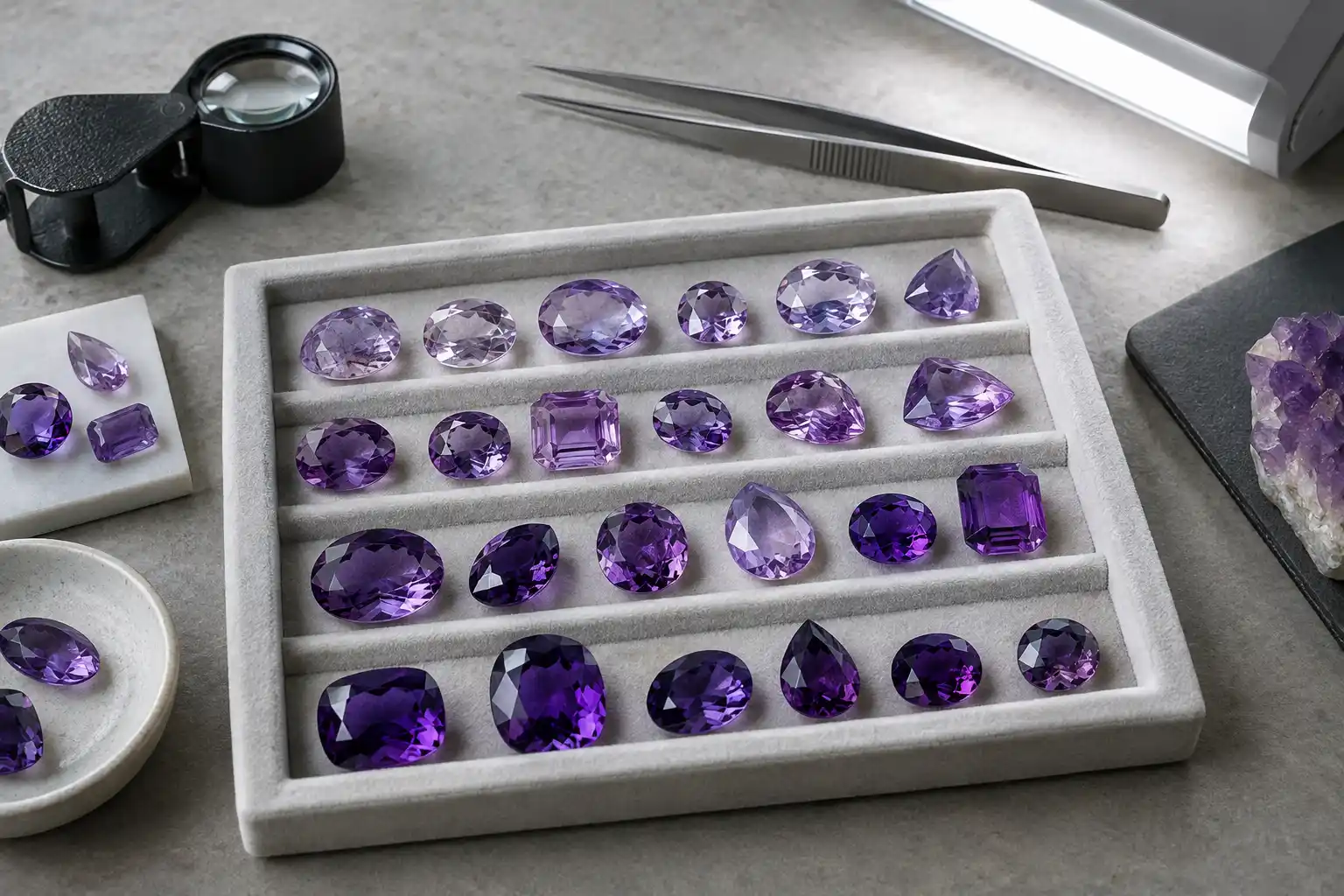
Amethyst Quality Grading: 9 Key Standards for Color & Purity
Amethyst quality grading is driven primarily by color. Fine stones combine a strong attractive purple hue, good saturation, a tone that is rich without becoming excessively dark, limited distracting color zoning, eye-clean transparency, and a cut that distributes color evenly across the face. Because clean quartz is relatively available, visible inclusions usually lower the quality of faceted amethyst more strongly than they might in gemstones where inclusions are expected.
There is no single internationally standardized amethyst grading system equivalent to the formal diamond color and clarity scales. Labels such as AAA, AAAA, premium, Siberian, royal, deep purple, and super fine may be used differently by individual sellers. They should therefore be treated as commercial descriptions rather than universal gemological grades. A buyer gets a more reliable result by evaluating hue, saturation, tone, zoning, transparency, inclusions, cut, size, treatment, and origin individually.
Amethyst is purple crystalline quartz, SiO₂, with a Mohs hardness of 7 and no cleavage. Its coloration is associated with iron-related defects combined with natural irradiation. The color may occur unevenly within the original crystal, which is why zoning is so important during cutting and grading. A technically flawless stone can still rank below a slightly included gem if its purple is weak, gray, or poorly distributed.
9 Key Standards for Amethyst Quality Grading
- Confirm natural amethyst identity
- Evaluate the basic purple hue
- Judge saturation strength
- Assess tone and darkness
- Examine color zoning and uniformity
- Grade clarity, transparency, and inclusions
- Evaluate cut quality and brilliance
- Consider carat weight, dimensions, and origin
- Check treatments, synthetic origin, and overall market confidence
These nine standards provide a practical framework rather than a formal universal laboratory grade. The final judgment should consider how the gemstone looks as a whole instead of rewarding one excellent characteristic while ignoring major weaknesses elsewhere.
Standard 1: Confirm That the Gem Is Natural Amethyst
Before assigning a quality grade, establish that the gem is actually quartz and determine whether it is natural or synthetic.
Natural amethyst formed geologically and obtained its purple color through iron-related structural defects and natural irradiation. Synthetic amethyst is commonly produced hydrothermally and can share the same chemical composition, crystal structure, refractive properties, and hardness as natural quartz.
This similarity can make high-quality synthetics difficult to identify using appearance alone. Synthetic stones may be extremely clean and uniformly colored, qualities that inexperienced buyers can mistake for evidence of exceptional natural quality.
Glass can also imitate amethyst, and purple synthetic gemstones of other species may be sold under confusing descriptions.
Basic gemological testing can separate quartz from many substitutes, but natural versus synthetic amethyst may require careful microscopic examination and, in challenging cases, advanced testing.
Quality grading should begin only after this identity question has been addressed. A flawless laboratory-grown stone can be visually excellent, but its natural-rarity category differs from mined amethyst.
Standard 2: Evaluate the Basic Purple Hue
Hue describes the fundamental color family observed in the stone. Amethyst can range from reddish purple through balanced purple to bluish purple.
A vivid, rich purple is generally most desirable in the mainstream market. Attractive flashes of red or blue may increase visual complexity, particularly when the secondary color does not overpower the fundamental purple identity.
Gray reduces saturation visually and often makes the gem look dull. Brownish modifiers can also lower desirability when they become obvious.
Pale lavender amethyst has its own aesthetic market and can look elegant in delicate jewelry, but it usually grades below intensely colored fine amethyst when all other characteristics are equal.
Trade names should not replace observation. A stone described as royal purple or Siberian quality should still be judged under controlled lighting for its actual hue.
Standard 3: Judge Saturation Strength
Saturation describes how strong or vivid the color appears. Weakly saturated amethyst looks pale or washed out, even when its hue is unmistakably purple.
Fine amethyst generally benefits from strong saturation because the richness of purple is the feature buyers notice first.
However, saturation cannot be judged without tone. A highly saturated but extremely dark gem can appear black through much of the face, reducing brilliance and making the color difficult to appreciate.
The ideal balance is usually enough saturation to create a rich visual impression while preserving light return.
Lighting affects saturation considerably. Bright jewelry-counter lights can make pale gems look stronger than they will in an ordinary home or office. High-quality grading should therefore consider several realistic lighting environments rather than the most flattering source available.
Standard 4: Assess Tone and Avoid Excessive Darkness
Tone measures the relative lightness or darkness of a gemstone. Amethyst may range from extremely light lilac through medium purple to very dark violet.
Medium to moderately dark tone often produces the best balance for fine faceted stones. There is enough depth to create a luxurious purple appearance without losing most of the internal light return.
Very light stones generally receive lower grades because purple saturation is weak. Very dark stones can also be downgraded when large portions of the gem appear black.
This issue becomes particularly important in larger stones. A deep ten-carat amethyst can appear much darker than a smaller stone cut from similar rough because light must travel through more colored quartz.
Cut proportions also modify tone. A deep pavilion may intensify darkness, while a shallow cut may reduce apparent saturation.
The grader should therefore judge the finished face-up gem rather than assuming that darker rough always produces higher quality.
Standard 5: Examine Color Zoning and Uniformity
Color zoning is common in natural amethyst. Purple may occur in bands, angular sectors, patches, or concentrated areas separated by much paler quartz.
Zoning can be valuable in mineral specimens because it reveals aspects of crystal growth. In faceted jewelry stones, however, strongly visible zoning usually reduces quality.
A skilled cutter tries to orient the rough so color appears as evenly as possible through the crown. This can mean sacrificing weight to remove pale regions or position strongly colored zones at effective angles.
Minor zoning that becomes invisible in normal face-up viewing has little practical effect on quality. Large pale windows, obvious dark patches, or half-purple and half-colorless appearances are more significant.
A useful grading test is to examine the stone face-up, then tilt it slowly. If dramatic zoning appears only at extreme angles, it matters less than zoning visible immediately in normal viewing.
Standard 6: Grade Clarity, Transparency, and Inclusions
Fine faceted amethyst is normally expected to be transparent and eye-clean because clean rough is sufficiently available.
Natural inclusions may include fluid features, two-phase or three-phase inclusions, healed fractures, mineral crystals, growth structures, and internal veils. Small inclusions visible only under magnification may have little effect on quality.
Large central inclusions, obvious fractures, or clouds that interrupt transparency reduce brilliance and usually lower the grade.
Surface-reaching fractures deserve additional attention because they can affect structural durability. Quartz is reasonably tough and lacks cleavage, but a significantly fractured stone may still be vulnerable.
Clarity also interacts with color. A slight inclusion may be difficult to notice in a richly saturated stone, while the same feature can stand out strongly in pale amethyst.
Collector crystals should be evaluated differently from faceted stones. In a mineral specimen, inclusions, phantoms, zoning, matrix, and associated minerals may increase scientific or aesthetic interest instead of lowering quality.
A Practical Amethyst Clarity Framework
| Clarity Appearance | Practical Quality Interpretation |
|---|---|
| Eye-clean, transparent | Fine clarity |
| Tiny inclusions visible only under magnification | Very good |
| Minor visible inclusions that do not dominate | Good |
| Obvious central inclusions or veils | Commercial |
| Heavy fractures or significant cloudiness | Lower faceting quality |
This framework is descriptive rather than an official laboratory system. It helps buyers compare stones using normal visual impact rather than arbitrary seller labels.
Standard 7: Evaluate Cut Quality and Brilliance
A strong cut should return light across the face while presenting the best possible color. Because amethyst rough is relatively available, severe cutting compromises are difficult to justify in ordinary jewelry stones.
Windowing is one of the most common problems. If pavilion angles are too shallow, the center may appear transparent and the viewer can see through the gem. This weakens apparent color and makes the stone look less lively.
Extinction produces dark areas where little visible light returns. Some extinction is normal, but extensive black zones reduce beauty, especially in already dark amethyst.
Symmetry should also be examined. Ovals should have balanced outlines, cushions should not look badly distorted, and facet junctions should meet cleanly in well-cut gems.
Polish affects surface brightness. Scratches, pits, or poorly polished facets reduce visual quality even when the rough itself was excellent.
Precision-cut stones may receive a premium because better angles, symmetry, and design can reveal far more beauty than standard mass-produced cutting.
Standard 8: Consider Carat Weight, Face-Up Size, and Origin
Amethyst can occur in large crystals, so size is not automatically a quality grade. A twenty-carat stone may be lower quality than a three-carat gem if its color is weak, zoning is obvious, or the cut is poor.
Weight should therefore be evaluated alongside dimensions. A deep-cut stone may retain substantial weight below the girdle while presenting a surprisingly small face-up area.
Large fine amethyst becomes more impressive when rich saturation, eye-clean clarity, and even color continue throughout the gem. Those combinations are less common than merely finding large purple quartz.
Geographic origin can add interest. Brazil, Uruguay, Zambia, Russia, and other regions have produced important amethyst. Uruguayan material is often strongly saturated, while Zambia has produced notable transparent deep-purple stones.
Origin should not automatically determine grade. A fine stone from a less fashionable locality can outperform a poorly colored stone from a famous deposit.
For mineral specimens, reliable locality can contribute strongly to collector value because crystal habit and mine provenance may be central to why the specimen is desirable.
Standard 9: Check Treatments and Synthetic Origin Before Final Grading
Heat can alter the color of amethyst dramatically. Depending on the stone, heating may produce yellow, orange, brownish, greenish, or colorless quartz.
Much commercial citrine has been created through heating suitable amethyst, which demonstrates how strongly quartz color can respond to temperature.
Irradiation can influence color in certain quartz as well. Treatment history is not always obvious from routine viewing, and some effects depend on geological origin and defect structure.
Synthetic hydrothermal amethyst represents another important category. It can show excellent purple color and exceptional clarity but should not be graded as natural mined amethyst for rarity or provenance.
Some sellers use letter systems such as A, AA, AAA, or AAAA. These are not internationally standardized grades. One seller’s AAA can look like another seller’s ordinary commercial stone.
A final quality judgment should therefore rely on observable properties and accurate identity rather than a promotional grade printed on a tag.
Amethyst Color Quality at a Glance
| Color Characteristic | Higher-Quality Tendency | Lower-Quality Tendency |
|---|---|---|
| Hue | Rich balanced purple, attractive red or blue flashes | Grayish, brownish, weak purple |
| Saturation | Strong and vivid | Pale or washed out |
| Tone | Medium to moderately dark | Extremely pale or nearly black |
| Zoning | Minimal face-up zoning | Obvious patchy or banded color |
| Brightness | Lively across most of the face | Large dark or transparent areas |
The best stones achieve balance. Maximum darkness is not the goal, and maximum saturation is useful only when the gemstone remains bright enough to display it.
What Does “Siberian Amethyst” Mean?
Historically, fine Russian amethyst achieved a strong reputation, and the term Siberian became associated with particularly desirable color.
In the modern market, however, Siberian or Siberian quality may sometimes be used as a color description rather than a verified geographic origin. Buyers should therefore distinguish a trade-quality term from a documented locality claim.
A seller charging a substantial provenance premium should be able to support origin rather than relying solely on the word Siberian.
For most modern jewelry purchases, visible color quality matters more than the romantic appeal of a geographic label.
Is Deep Purple Always the Highest Grade?
Deep purple is desirable when the stone remains lively. Once tone becomes too dark, broad areas can appear black and mask both color and brilliance.
A slightly lighter gem with excellent saturation and strong light return can grade higher than a darker stone that looks closed or dull.
This is why judging amethyst under ordinary indoor lighting is useful. A stone that looks spectacular only under extremely bright illumination may appear too dark in everyday wear.
The best color should remain clearly purple in more than one realistic lighting environment.
Natural Amethyst Inclusions and Synthetic Identification
Natural and synthetic amethyst can overlap strongly in visual appearance, so inclusions become important in gemological identification.
Natural stones may show characteristic growth features, fluid inclusions, and other internal structures related to geological formation. Synthetic hydrothermal amethyst may display different growth structures, seed-related features, or inclusion patterns associated with laboratory production.
No single inclusion should be treated as universal proof. Clean specimens can be especially challenging, which is why professional testing may be warranted when natural origin carries a meaningful price premium.
For ordinary modestly priced jewelry, full laboratory documentation is not always necessary. Accurate seller disclosure is still expected.
Amethyst Specimen Quality Versus Faceted-Gem Quality
A fine mineral specimen is not graded according to the same rules as a loose faceted gem. In a specimen, crystal shape, termination quality, matrix, associated minerals, crystal grouping, zoning, aesthetics, and locality can all matter.
A specimen may contain fractures or inclusions that would make it unsuitable for cutting yet still be highly collectible because the natural crystal form is exceptional.
Amethyst geodes introduce another category. Buyers may value crystal color, size of individual points, overall cavity shape, contrast with agate or calcite, structural condition, and natural versus repaired sections.
Keeping these categories separate prevents a grading system designed for transparent faceted jewelry from being applied incorrectly to geological specimens.
Amethyst Durability as Part of Overall Quality
Amethyst has a Mohs hardness of 7 and no cleavage, giving it useful durability for many types of jewelry. Rings can be worn successfully but require more care than sapphire or diamond.
A stone with a thin girdle, sharp exposed point, or significant surface-reaching fracture is more vulnerable regardless of its nominal hardness.
Heat should be avoided because it can alter purple color permanently. Prolonged strong sunlight may also affect some stones.
Cleaning with lukewarm water, mild soap, and a soft brush is generally suitable for intact untreated stones. Highly fractured gems require more cautious handling.
Separate storage protects the surface from harder stones such as topaz, corundum, and diamond.
Common Amethyst Grading Mistakes
One common mistake is ranking stones only by darkness. Rich purple is desirable, but black-looking extinction lowers visual quality.
Another is ignoring zoning. A stone may look strong from one angle but reveal a large pale center when viewed face-up.
Clarity can also be misunderstood. Because eye-clean amethyst is available, large visible inclusions should not receive the same tolerance they might in emerald.
Large size is another source of overgrading. A twenty-carat pale stone is not automatically finer than a three-carat saturated gem.
Finally, seller labels such as AAAA should never replace inspection. Without a universal standard behind the letters, the actual stone must justify the description.
A Practical Overall Amethyst Quality Framework
| Quality Level | Typical Characteristics |
|---|---|
| Exceptional | Rich vivid purple, balanced tone, minimal zoning, eye-clean transparency, excellent cut |
| Fine | Strong purple, good brightness, minor zoning or tiny inclusions, strong cut |
| Good | Medium purple, reasonably clean, some visible zoning or cut compromise |
| Commercial | Pale or overly dark color, obvious zoning, visible inclusions, ordinary cut |
| Low | Weak color, heavy fractures, poor transparency, severe windowing or damage |
This framework is not an official global scale. It provides a consistent way to compare stones using the features that actually control visual quality.
Conclusion
Amethyst quality grading should begin with identity and then concentrate on hue, saturation, tone, zoning, clarity, cut, size, origin, and treatment. Fine amethyst is richly purple without becoming black, transparent enough to return light well, relatively free of distracting zoning, and cut to display both color and brilliance.
The absence of a universal AAA-style grading system makes direct observation particularly important. Buyers who evaluate a stone under realistic lighting, compare color distribution, inspect face-up clarity, and judge cut quality are better equipped to recognize genuinely fine amethyst than buyers relying on promotional labels alone.
FAQs About Amethyst Quality Grading
What is the most important quality factor in amethyst?
Color is generally the most important factor. Fine amethyst should show attractive rich purple with strong saturation and enough brightness to avoid a black or dull appearance.
What is the best amethyst color?
Strong balanced purple with attractive red or blue secondary flashes is commonly preferred. Excessive gray, brown, very pale color, or overly dark tone generally reduces quality.
Is AAAA amethyst an official grade?
No. AAA, AAAA, premium, and similar labels are seller-defined commercial terms rather than internationally standardized gemological grades.
Should high-quality amethyst be eye-clean?
Yes, fine faceted amethyst is generally expected to appear clean to the unaided eye because transparent clean quartz is relatively available. Small inclusions visible only under magnification may be acceptable.
Is darker amethyst better?
Only to a point. Rich color is desirable, but excessively dark stones can show black extinction and lose brilliance. A slightly lighter but livelier stone may grade higher.
Does color zoning lower amethyst quality?
Strong visible zoning usually lowers the quality of a faceted gem. Minor zoning that cannot be seen face-up has much less effect. In mineral specimens, natural zoning can actually add geological interest.
Does carat size determine amethyst grade?
No. Large amethyst is relatively available, so size alone does not establish quality. Color, clarity, zoning, and cut remain more important.
Is Uruguayan amethyst automatically higher quality?
No. Uruguay is known for richly saturated amethyst, but individual stones still vary. Quality should be judged from the actual gem rather than locality alone.
What does Siberian amethyst mean?
Historically, the term relates to highly regarded Russian material, but in modern trade it may also describe a desirable color style. It should not automatically be treated as proof of Russian origin.
Can amethyst be synthetic?
Yes. Hydrothermal synthetic amethyst has the composition and crystal structure of quartz but laboratory origin. Fine synthetics can look extremely similar to natural stones.
Can amethyst be heat treated?
Yes. Heating can alter purple amethyst to yellow, orange, brownish, greenish, or colorless quartz depending on the original stone and its internal defect structure.
What inclusions occur in natural amethyst?
Natural amethyst may contain fluid inclusions, healed fractures, mineral crystals, veils, and growth features. The exact inclusion scene varies according to deposit and crystal history.
Is a perfectly clean amethyst necessarily synthetic?
No. Natural amethyst can be extremely clean. Exceptional clarity alone does not prove synthetic origin, so identification requires multiple gemological observations.
What makes an amethyst cut high quality?
A high-quality cut should minimize windowing and excessive extinction, maintain good symmetry, show strong polish, and distribute color attractively across the face.
Is amethyst durable enough for daily jewelry?
Amethyst is reasonably durable at Mohs 7 and has no cleavage. It works well in many jewelry types, although rings should be protected from severe impacts and harder gemstones.
Does origin affect amethyst quality?
Origin can influence typical color tendencies, zoning, and collector interest, but it is not a substitute for evaluating the individual stone. Fine amethyst can come from several geographic regions.
How should I compare two amethysts?
Compare them under the same lighting for hue, saturation, tone, zoning, face-up clarity, brilliance, cut proportions, and dimensions. Carat weight and seller grade should be considered only after visible quality.
Can a pale amethyst still be high quality?
A pale stone can be clean, beautifully cut, and attractive, especially when lavender color is desired. Within conventional fine-amethyst grading, however, stronger saturation usually receives a higher color grade.
What makes an amethyst exceptional?
Exceptional amethyst combines rich purple color, strong but balanced saturation, a lively medium to moderately dark tone, minimal distracting zoning, eye-clean transparency, excellent polish, and a cut that distributes color evenly.