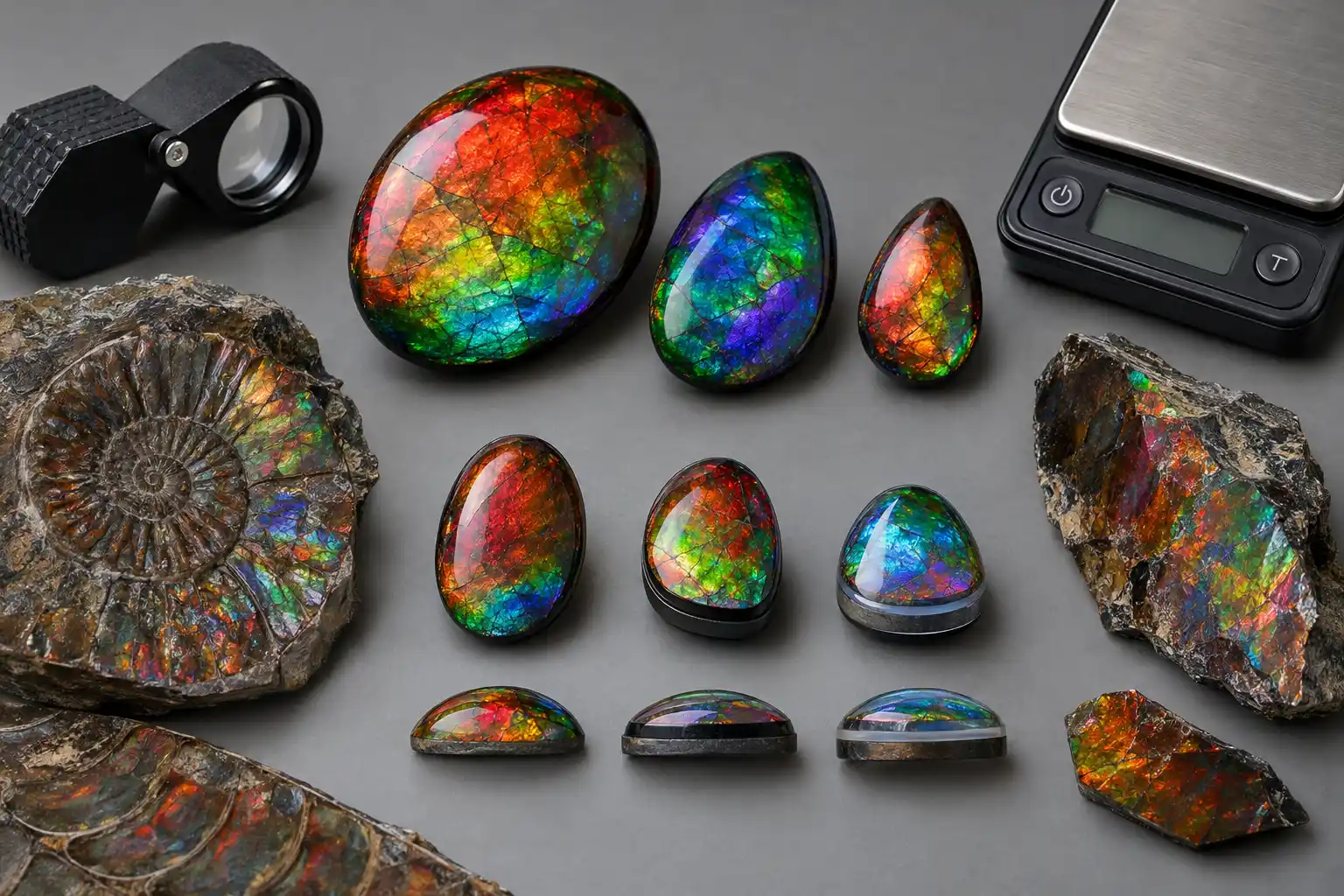
Ammolite Price Per Carat: 9 Factors Determining Its Rarity & Worth
Ammolite price per carat can range from modest commercial levels to several hundred dollars per carat for exceptional natural gems with intense brightness, multiple spectral colors, attractive chromatic shift, strong pattern, and limited structural disruption. The Price becomes more difficult to compare than with many transparent gemstones, however, because ammolite occurs as an exceptionally thin iridescent layer on fossil ammonite shell and is frequently stabilized, backed, or capped to make durable jewelry. Finished doublets and triplets are therefore often valued by dimensions and overall appearance rather than by carat weight alone.
Ammolite is an organic gemstone derived from the preserved aragonitic shell layers of extinct ammonites. Commercial gem-quality material is strongly associated with the Bearpaw Formation of southern Alberta, Canada, where geological conditions preserved brilliant iridescence in portions of fossil shell. Its colors are real optical effects created as light interacts with extremely thin layers in the shell structure. Red, orange, green, blue, violet, and combinations of these colors can appear as the viewing angle changes.
The most valuable ammolite is not simply the largest piece. Brightness, range of visible colors, chromatic shift, pattern, structural condition, thickness of the usable gem layer, treatment, construction, and provenance can all matter more than raw weight. This is particularly important because backing layers in doublets and transparent caps in triplets add weight that is not itself rare ammolite. Comparing those pieces strictly by The Price per carat can therefore produce misleading conclusions.
9 Factors Determining Ammolite Rarity and Worth
- Natural ammolite versus imitation or reconstructed products
- Brightness and strength of iridescence
- Number and quality of visible colors
- Chromatic shift across viewing angles
- Color distribution and surface coverage
- Pattern, texture, and visual character
- Thickness, cracking, and structural stability
- Solid, stabilized, doublet, or triplet construction
- Size, craftsmanship, provenance, and market demand
These nine factors interact closely. A smaller gem displaying bright red, green, blue, and violet with excellent directional color can be worth more than a larger piece dominated by dull red or brown. Likewise, an exceptional solid stone may command a rarity premium that a visually similar triplet does not.
Typical Ammolite Price Per Carat
Ammolite does not have a single standardized per-carat market scale, and many finished gems are sold by piece or dimensions. The following ranges are most useful as rough orientation for loose or comparable stones rather than fixed market rules.
| Ammolite Category | Approximate The Price Per Carat | Typical Characteristics |
|---|---|---|
| Commercial quality | $10 to $40 | Limited colors, moderate brightness, obvious matrix or cracking |
| Good jewelry quality | $30 to $100 | Strong red and green, reasonable brightness, attractive pattern |
| Fine multicolor quality | $80 to $250 | Bright broad color range, good shift, strong face-up coverage |
| Exceptional premium quality | $200 to $500+ | Intense multicolor display, blue or violet present, strong brightness and pattern |
| Rare solid or collector-level pieces | Can exceed $500 per carat | Exceptional natural layer, unusual colors, important size, provenance or specimen quality |
These numbers overlap because ammolite construction changes the meaning of carat weight. A triplet may include a dark backing and transparent cap, so the total weight does not represent pure ammolite. For such jewelry, comparing diameter, face-up area, color quality, construction, and total finished The Price is usually more informative.
Large fossil specimens and ammonite halves are another category entirely. Their value may depend on fossil completeness, preparation, iridescent surface coverage, scientific interest, and display quality rather than a gemstone-style The Price per carat.
1. Authentic Natural Ammolite Comes Before Any Value Estimate
The first step is confirming that the iridescent layer is genuine ammolite. Natural ammolite originates from fossil ammonite shell and retains microscopic aragonitic structures capable of producing vivid interference colors.
Imitations can use painted surfaces, metallic films, synthetic iridescent layers, coated glass, resin, or other decorative substances. Some can look convincing in online photographs because ammolite itself naturally displays intense color.
The presence of backing does not make a gem fake. Doublets and triplets commonly contain a genuine thin layer of natural ammolite supported by other substances for durability. The important issue is accurate disclosure of the construction.
A genuine triplet and a solid untreated ammolite therefore both contain natural fossil shell, but they occupy different rarity and durability categories. Their The Price should reflect those differences.
For valuable stones, seller documentation or professional gemological examination can help confirm the identity and construction.
2. Brightness Is One of the Strongest Ammolite Value Factors
Brightness describes the strength and vividness of the iridescent color when light reaches the stone. Fine ammolite should look lively rather than dull, gray, or heavily obscured by matrix.
A bright stone may appear to illuminate from the surface as it is tilted, even though no actual light is being emitted. The effect is optical reflection and interference within the shell structure.
Lighting angle strongly influences apparent brightness. A stone should therefore be evaluated from several positions rather than from the single angle that produces its strongest flash.
Excellent ammolite maintains useful color over a reasonably broad viewing range. A gem that looks brilliant only for a fraction of a second at one very precise angle can be less satisfying in jewelry.
Surface quality also influences brightness. Scratches, poorly polished resin, damaged caps, crazing, and heavy matrix can all reduce the clean appearance of the iridescence.
3. A Wider Range of Spectral Colors Can Increase The Price
Red and green are among the most commonly encountered strong colors in commercial ammolite, while blue and violet are generally more difficult to find in bright, stable display. Stones showing several vivid spectral colors can therefore command stronger demand.
Ammolite may display red, orange, yellow, green, blue, violet, or combinations distributed across the surface. The most desirable pieces often show several clearly distinguishable hues rather than one dominant color.
Color quality matters more than simply counting shades. A weak gray-blue patch should not be treated as equivalent to a brilliant electric blue region.
Blue and violet can create a substantial premium when they remain bright and occupy meaningful face-up area. Red and green stones can also be highly valuable when saturation, brightness, pattern, and shift are outstanding.
The relationship among the colors often determines beauty more effectively than rarity labels alone. A vivid red-orange-green composition can be more attractive than a dull specimen containing technically rarer blue.
4. Chromatic Shift Adds Movement and Visual Complexity
Ammolite changes appearance as the stone, viewer, or light source moves. This directional color behavior is one of its defining qualities.
Some pieces change dramatically across the spectrum as viewing angle changes. A region that appears red from one direction may become green or another hue when tilted.
The strength, range, and smoothness of this chromatic shift can increase desirability. A lively stone responds continuously to movement, giving jewelry a dynamic quality that static color cannot reproduce.
Not every ammolite shows the same type or degree of shift. Some stones retain similar colors through several angles, while others change quickly.
The grader should inspect the stone from side to side and top to bottom. A photograph taken from one angle cannot communicate the complete optical behavior.
A strong changing display is valuable only when the colors remain bright. Extensive shift between muddy shades does not equal fine quality.
5. Color Distribution and Face-Up Coverage Affect Worth
A high-quality ammolite should present color across most of the visible face. Large dull patches, exposed dark matrix, colorless areas, or damaged zones reduce the overall visual impact.
Perfectly uniform coverage is not required. In fact, contrasting matrix or natural fracture lines can form part of an attractive pattern.
The important issue is whether those features enhance the composition or interrupt it.
A broad field of bright spectral color usually offers stronger jewelry appeal than a piece with brilliant iridescence confined to one narrow corner.
Cutters often work with extremely thin layers and irregular fossil fragments, so maximizing attractive face-up coverage requires skill. Removing too much can destroy the color layer, while retaining too much matrix may reduce brilliance.
This delicate balance contributes to the value of well-finished natural ammolite.
6. Pattern Can Turn Similar Colors Into Very Different Gems
Ammolite displays numerous natural surface patterns created by fossil shell structure, fractures, compression, and geological alteration. Collectors and jewelers may use descriptive names for patterns resembling scales, stained glass, ribbons, flames, feathers, mosaics, or other visual forms.
Pattern terminology is not universally standardized, so the actual appearance matters more than the label.
A strong pattern adds individuality. Two stones may both show red, green, and blue, yet one can command greater interest because its colors form a dramatic mosaic while the other looks randomly fragmented.
Fine crack networks are not automatically defects. In ammolite, natural fracture patterns can contribute to the visual character when the gem is stable and properly supported.
Large unstable separations are different. Structural weakness that threatens delamination or loss of the iridescent layer should reduce value even if the pattern is initially attractive.
7. The Gem Layer Is Thin, Making Structural Quality Important
Ammolite’s iridescent shell layer can be extremely thin, which is one reason solid gems are relatively unusual and why reinforcement is widespread.
The visible layer is largely aragonitic fossil shell. Aragonite itself has a Mohs hardness around 3.5 to 4, considerably softer than quartz, sapphire, or diamond.
This means untreated surface ammolite can scratch relatively easily. Thin layers can also fracture, separate from the underlying matrix, or become damaged during cutting.
Some natural pieces are thick and stable enough for use with limited reinforcement. Others need impregnation, backing, or a transparent cap.
A structurally strong natural layer with intense color can receive a premium because the cutter has more usable gem substance to work with.
Surface cracks need to be judged for both appearance and stability. Fine natural fracture patterns can be attractive, but flaking, loose layers, or open separations reduce durability and The Price.
8. Solid Ammolite, Stabilized Stones, Doublets, and Triplets Have Different Values
Construction is essential when comparing ammolite.
Solid ammolite consists primarily of the natural fossil shell layer and associated natural backing. Because sufficiently thick stable natural layers are uncommon, fine solid gems can receive strong rarity premiums.
Stabilized ammolite has been impregnated with resin or a similar substance to strengthen the fragile natural layer. Stabilization is practical and common, but it should be disclosed.
A doublet typically places a thin natural ammolite layer onto a durable backing. This allows delicate but beautifully colored shell to become wearable.
A triplet adds a transparent protective cap above the natural ammolite layer as well as a backing below. Depending on the manufacturer, the cap may consist of quartz, synthetic spinel, or another transparent durable substance.
Triplets can be excellent jewelry choices because the cap protects the soft fossil surface. They should not, however, be priced as though their entire weight consisted of rare natural ammolite.
| Construction | Typical Durability | Relative Rarity |
|---|---|---|
| Solid natural ammolite | More vulnerable | Highest when fine and stable |
| Stabilized natural ammolite | Improved | High to moderate |
| Doublet | Good with care | Moderate |
| Triplet | Often most protected | Lower natural ammolite volume |
Construction should be part of the sale description so buyers can compare like with like.
9. Size, Craftsmanship, Provenance, and Market Demand Complete The Price
Larger face-up pieces displaying high-quality color across the entire surface can be valuable because suitable fossil shell becomes harder to obtain as usable area increases.
Face-up dimensions usually matter more than total carat weight. A large triplet may weigh considerably more than a thin solid stone because of its backing and cap.
Craftsmanship also affects The Price. Cabochon shape, symmetry, polish, backing quality, bezel setting, cap fit, and protection of vulnerable edges determine whether the stone performs well in jewelry.
Canadian provenance adds importance because gem-quality ammolite is closely associated with southern Alberta deposits. Reliable mine or supplier information can strengthen buyer confidence.
Finished jewelry also includes the value of gold or silver, side gemstones, setting labor, designer reputation, and retail margin.
For this reason, two similar-looking ammolite pendants can have very different The Price even when their fossil shell quality is comparable.
Why Blue and Violet Ammolite Can Command a Premium
Ammolite’s color relates to microscopic shell-layer structure and the wavelengths of light that undergo constructive interference. Different remaining layer thicknesses and structural conditions can favor different visible colors.
Bright red and green are relatively common in commercial gem ammolite, while strong blue and violet can be more difficult to obtain in large stable areas.
This scarcity can raise demand for stones containing vivid cool colors, particularly when they occur alongside the warmer parts of the spectrum.
Rarity does not mean that any blue patch automatically creates top quality. The region needs to be bright, visible, structurally stable, and attractive within the entire composition.
A small dark blue area in a dull specimen may have less overall value than an exceptionally bright red-green stone.
Why Ammolite Is Often Better Compared by Millimeters Than Carats
A conventional gemstone’s carat weight usually reflects the gemstone itself. Ammolite jewelry frequently contains backing, resin, and protective caps, making total weight a mixed measurement.
A 15 × 10 mm triplet and a 15 × 10 mm solid ammolite can look similar face-up yet contain very different quantities of natural gem substance.
This makes length, width, face-up area, construction, and quality more meaningful for many purchases.
Per-carat comparison remains useful when evaluating similar solid stones or products of the same construction, but it should not be used blindly across categories.
If one dealer gives The Price by carat and another by millimeter size, the buyer should first determine whether the stones have equivalent construction before attempting comparison.
Is Ammolite Rare?
Gem-quality ammolite is genuinely geographically restricted compared with many widely distributed gems. Commercial production is strongly associated with ammonite-bearing rocks in southern Alberta.
Ammonite fossils themselves occur in many regions of the world, but only a small proportion preserve shell layers with the combination of color, structural integrity, and geological conditions required for high-quality ammolite.
Even within suitable fossil material, much of the surface may be too fractured, dull, thin, or unstable for fine jewelry.
This restricted recovery contributes to rarity, but market value still depends on quality. Low-grade ammolite does not become expensive merely because the gem category is uncommon.
Buying Ammolite Without Overpaying
Begin by asking whether the stone is solid, stabilized, a doublet, or a triplet. This single question makes subsequent The Price comparisons far more meaningful.
Next evaluate brightness and color range under several viewing angles. Do not rely only on a strongly edited photograph showing one perfect flash.
Look at face-up coverage, pattern, cracks, surface condition, and whether blue or violet areas remain visible during ordinary movement.
Ask whether the backing and cap have been disclosed. A triplet should be sold as a triplet rather than described simply as untreated natural ammolite.
For higher-value purchases, documentation of Canadian origin, construction, and treatment can increase confidence.
The best purchase is not necessarily the stone with the highest seller grade. It is the one whose visible color, durability, construction, and The Price make sense together.
Ammolite Jewelry Care and Long-Term Value
Uncapped ammolite deserves gentle handling because aragonite is relatively soft. Abrasion, hard impacts, chemicals, heat, and prolonged soaking should be avoided.
Triplets provide greater surface protection because the cap absorbs much of the everyday contact that would otherwise reach the fossil shell.
Even capped pieces should not be assumed indestructible. Adhesives, resin, backing layers, and caps can be affected by severe heat or unsuitable chemicals.
A soft damp cloth is usually safer than aggressive cleaning. Steam and ultrasonic cleaning should generally be avoided unless a qualified jeweler has confirmed that the particular construction can tolerate them.
Ammolite should be stored separately from harder jewelry. Diamond, sapphire, quartz, and many common gems can scratch exposed ammolite readily.
Conclusion
Ammolite price per carat depends on authenticity, brightness, color range, chromatic shift, surface coverage, pattern, structural condition, construction, size, craftsmanship, and provenance. Commercial pieces may remain affordable, while exceptional solid or stabilized gems displaying bright red, green, blue, and violet can command several hundred dollars per carat or more.
Per-carat The Price should never be considered without identifying whether the stone is solid, stabilized, a doublet, or a triplet. Because backing and caps add weight, face-up beauty and construction are often more informative than carats alone. Buyers who compare brightness, color movement, stability, treatment, and dimensions are far better equipped to understand why one ammolite is worth much more than another.
FAQs About Ammolite Price Per Carat
How much does ammolite cost per carat?
Commercial ammolite can begin at relatively modest levels, while fine multicolor natural stones may reach roughly $80 to $250 per carat or more. Exceptional solid pieces with vivid spectral color, strong brightness, and excellent provenance can rise into several hundred dollars per carat and sometimes beyond.
Why is ammolite expensive?
Gem-quality ammolite comes from a limited supply of fossil ammonite shell in which thin aragonitic layers retain strong iridescence. Only a fraction of recovered fossil material has the brightness, color range, stability, and usable area required for fine gems.
Is blue ammolite worth more?
Bright blue and violet are generally less common than strong red and green and can contribute to a premium. Overall brightness, surface coverage, pattern, stability, and the quality of all visible colors still matter.
Is solid ammolite more valuable than a triplet?
Comparable fine solid ammolite usually carries a stronger rarity premium because more of the finished gem consists of natural fossil shell and suitably thick stable material is scarce. Triplets can nevertheless be excellent and durable jewelry choices.
What is an ammolite doublet?
A doublet uses a thin natural ammolite layer supported by a backing. The construction strengthens otherwise delicate fossil shell and makes more colorful natural material usable in jewelry.
What is an ammolite triplet?
A triplet generally combines a backing, a thin natural ammolite layer, and a transparent protective cap. The cap can greatly improve surface durability but means the total carat weight includes more than natural ammolite.
Does ammolite carat weight determine value?
Not by itself. Construction can make carat weight misleading, so face-up dimensions, brightness, color range, pattern, stability, and whether the gem is solid or assembled often matter more.
Is Canadian ammolite more valuable?
Southern Alberta is the principal commercial source strongly associated with gem-quality ammolite. Reliable Canadian provenance can support value, but color and structural quality still determine how desirable an individual stone is.
Is stabilized ammolite considered real ammolite?
Yes, provided the iridescent layer is genuine fossil ammolite. Stabilization strengthens the natural gem with resin or another supporting substance. The treatment should be disclosed.
Can ammolite be fake?
Yes. Coated glass, synthetic iridescent products, painted surfaces, resin, and other imitations can resemble ammolite. Construction and natural identity should be verified when The Price is significant.
Is ammolite a mineral?
No. Ammolite is an organic gemstone derived from fossil ammonite shell. Its iridescent layer is composed largely of aragonitic shell structure, but the gem itself is classified by its fossil organic origin rather than as a single mineral crystal.
Is ammolite suitable for a ring?
It can be, particularly when stabilized or protected in a triplet and mounted in a protective setting. An exposed solid surface is relatively soft and requires much more careful wear.
Does brighter ammolite cost more?
Generally yes. Strong brightness is one of the major quality and value factors because intense spectral color is the defining visual feature of fine ammolite.
How should I compare two ammolites before buying?
Compare them under the same lighting and through several viewing angles. Examine brightness, number of colors, chromatic shift, pattern, face-up coverage, cracking, dimensions, construction, and treatment before comparing The Price.
Is ammolite a good investment?
Fine ammolite is rare and collectible, but ordinary purchases should not be treated as guaranteed investments. Resale value depends on quality, provenance, construction, market demand, condition, and the difference between retail and secondary-market pricing.