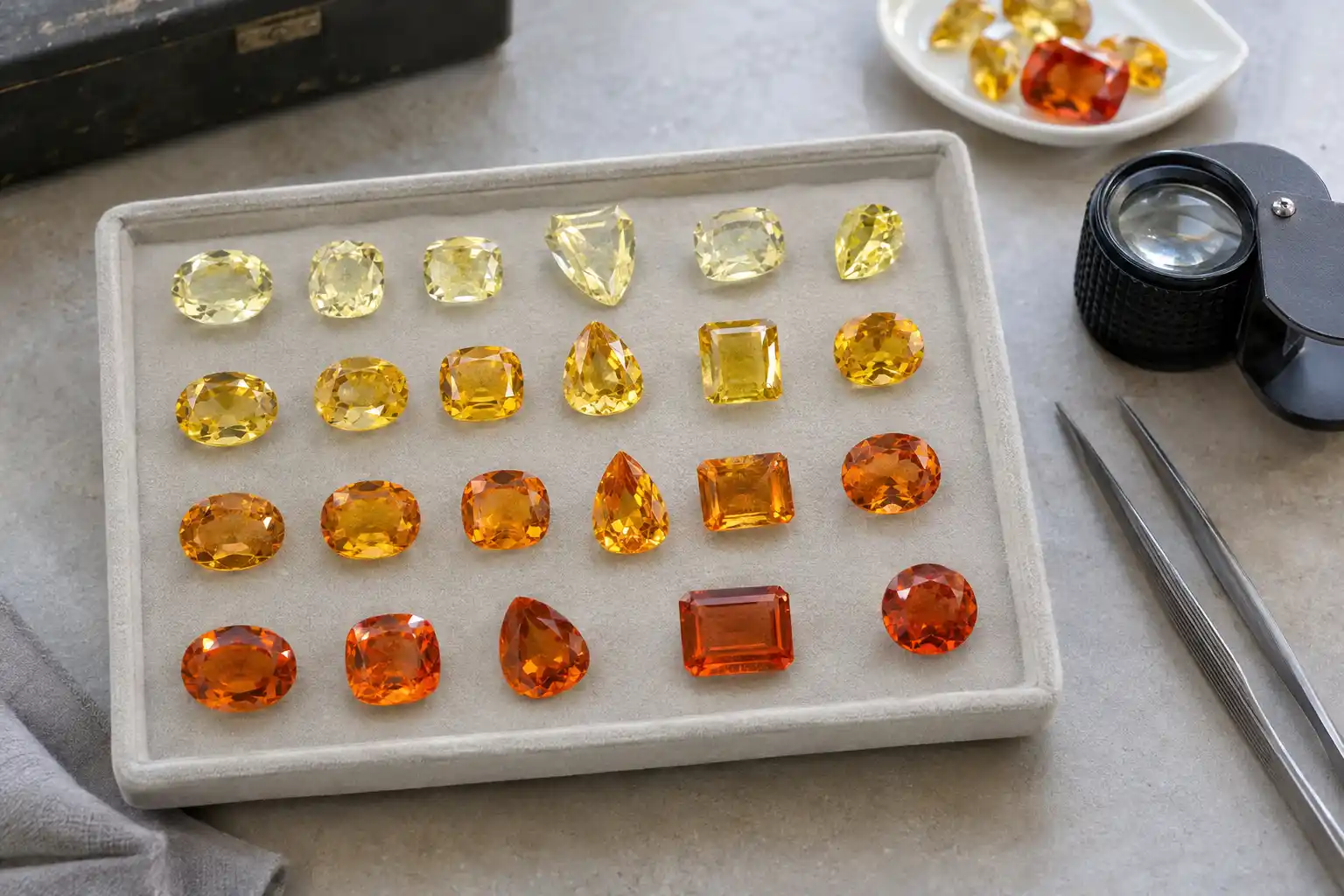
Citrine Quality Grading: 9 Ways to Evaluate Color & Clarity
Citrine quality grading should begin with color, but the process cannot stop at deciding whether a stone looks yellow or orange. Fine citrine combines an attractive hue with strong but balanced saturation, enough brightness to remain lively, limited distracting zoning, eye-clean transparency, efficient cutting, and accurate disclosure of treatment and origin. Because quartz is relatively abundant, buyers can be selective about clarity and cutting rather than accepting major imperfections simply to obtain a large gemstone.
An additional grading challenge comes from the commercial supply. Naturally colored citrine is less common than the volume of citrine jewelry might imply, because much orange and reddish-orange quartz is created by heating amethyst. Synthetic quartz and other treated yellow quartz can also appear in the market. A quality assessment should therefore distinguish visual quality from rarity. A heat-treated stone can be visually excellent, while a naturally colored stone can be geologically rarer without necessarily being more attractive.
Citrine is the yellow to orange variety of crystalline quartz, SiO₂, with a Mohs hardness of 7 and no cleavage. Its colors involve iron-related defects and color centers in the quartz structure, with natural geological processes, heating, and irradiation capable of producing different appearances. No single globally standardized AAA or AAAA system governs citrine, so seller-defined grades should always be replaced by direct examination of hue, saturation, tone, zoning, clarity, cut, size, treatment, and natural identity.
9 Ways to Evaluate Citrine Color and Clarity
- Confirm quartz identity and natural versus synthetic origin
- Evaluate the fundamental yellow to orange hue
- Judge saturation and color strength
- Assess tone and brightness
- Examine color zoning and distribution
- Grade transparency, clarity, and inclusions
- Evaluate cut quality, windowing, and extinction
- Consider carat weight, dimensions, and provenance
- Assess treatment history and overall market rarity
These nine standards provide a practical grading framework rather than a universal laboratory scale. An exceptional stone should succeed across most of them instead of relying on one impressive characteristic, such as unusually dark color or very large size.
Confirm Quartz Identity Before Assigning Citrine Quality
A yellow transparent gemstone is not necessarily citrine. Yellow sapphire, golden beryl, topaz, glass, synthetic spinel, and several other substances can overlap in appearance.
Gemological properties such as refractive index, birefringence, specific gravity, optic character, inclusions, and spectroscopy can distinguish quartz from these alternatives. Once quartz identity is confirmed, the next question is whether the crystal is natural or laboratory-grown.
Synthetic quartz is commonly produced hydrothermally and can be grown with yellow, orange, or other coloration. Because laboratory-grown quartz shares the essential chemistry and structure of natural quartz, natural versus synthetic separation can be more challenging than distinguishing citrine from glass.
For an ordinary modestly priced stone, extensive laboratory testing may not be economically necessary. For an expensive gem sold specifically as rare untreated natural citrine, reliable identification becomes far more important.
Visual quality and geological rarity should then be graded separately so a beautiful treated or synthetic stone is not incorrectly represented as naturally rare.
Hue Defines the Basic Citrine Appearance
Citrine can range from pale lemon yellow through golden yellow, honey, amber-like orange, brownish orange, and reddish orange. Each hue can be attractive, but mainstream fine-quality grading generally favors warm color that remains clearly saturated and transparent.
Golden yellow provides the classic citrine appearance. Orange can increase visual richness, while reddish-orange stones are often described with Madeira-style terminology.
Brown is more complicated. A slight brown component can create an appealing honey or cognac appearance, but heavy muddy brown usually reduces brightness and makes the stone look less lively.
Greenish yellow is less typical for the classic citrine market and may attract different preferences. The important question is whether the hue appears clean and intentional rather than gray, muddy, or uneven.
Trade names should not substitute for direct color evaluation. Madeira, lemon, golden, and honey are descriptive market terms rather than universally standardized grades.
Saturation Separates Fine Citrine From Washed-Out Quartz
Saturation describes the strength of the color. Very pale citrine may look almost colorless, especially in small stones, while fine gems display enough yellow or orange to remain obvious from normal viewing distance.
Strong saturation generally increases quality until the stone becomes so dark that brightness suffers. The ideal level therefore depends on tone and cutting rather than on color strength alone.
A richly golden stone with strong light return can be exceptional, while a darker burnt-orange gem may appear heavy if large sections remain black or brown under ordinary lighting.
Lighting should remain consistent during grading. Warm display lamps can intensify yellow and orange dramatically, making a stone appear more saturated than it will in daylight.
A fine gem should remain attractive under several realistic light sources without relying entirely on the most flattering illumination.
Tone Determines Whether Rich Color Looks Lively or Overly Dark
Tone measures how light or dark the citrine appears. Pale stones can lack visual impact, while excessively dark stones may lose transparency and brilliance.
Medium-light through medium-dark tone can work well depending on hue. Golden yellow often looks attractive at a lighter tone than reddish-orange because the latter can tolerate greater depth before becoming washed out.
Cut depth strongly influences apparent tone. A deep pavilion can make the center look substantially darker than the edges, while a shallow pavilion may create a pale transparent window.
The grader should therefore judge the face-up stone rather than evaluating color through the side, where greater path length can make almost any colored quartz look stronger.
Brightness should remain visible throughout most of the crown. A fine citrine should look colored and luminous at the same time rather than simply dark.
Color Zoning Can Reveal Both Natural Growth and Treatment History
Quartz commonly develops color unevenly during crystal growth, so citrine may display bands, sectors, patches, or gradual transitions between stronger and weaker color.
Minor zoning can be invisible after skilled cutting and has little effect on quality. Strong pale areas, sharply different orange sections, or an obvious colorless center can make a faceted gem look unbalanced.
Heat-treated amethyst can retain zoning related to the original purple crystal, and some commercially heated specimens show intense orange concentrations in specific growth areas. Such patterns do not by themselves prove treatment, but they can contribute to the overall gemological assessment.
Naturally colored citrine may also show zoning, so a single pattern should never be treated as a definitive origin test.
For faceted jewelry, the grading question is primarily whether the zoning distracts from the face-up appearance. In mineral specimens, visible zoning can instead add geological interest.
Fine Faceted Citrine Should Usually Be Eye-Clean
Because quartz commonly forms clean transparent crystals, high-quality faceted citrine is normally expected to appear free of obvious inclusions to the unaided eye.
Natural features can include fluid inclusions, mineral crystals, veils, healed fractures, growth structures, and internal stress features. Tiny inclusions seen only under magnification may have little effect on grade.
Large central fractures, dense clouds, or obvious crystals reduce transparency and interrupt light return. Surface-reaching fractures may also weaken the stone structurally.
A slightly included stone can still be attractive, particularly when it has exceptional natural color or provenance, but ordinary commercial citrine is abundant enough that buyers do not usually need to accept severe clarity problems.
Specimen-grade crystals should be evaluated differently. Natural terminations, phantoms, smoky transitions, associated minerals, matrix, and locality can make an included crystal highly collectible even though it would rank poorly as faceting rough.
A Practical Citrine Clarity Framework
| Face-Up Appearance | Practical Quality Interpretation |
|---|---|
| Eye-clean with excellent transparency | Fine to exceptional |
| Minor inclusions visible only under magnification | Very good |
| Small visible inclusions with limited brilliance loss | Good |
| Obvious fractures, veils, or clouds | Commercial |
| Heavy inclusions or structural weakness | Lower faceting quality |
This framework is descriptive rather than an official industry standard. Its purpose is to evaluate the visible gemstone consistently rather than attaching unexplained seller-defined letters.
Cut Quality Controls Brilliance and Color Distribution
A well-cut citrine should return light across most of its face while displaying color evenly. Quartz rough is available in large sizes, so major cutting compromises are difficult to justify in ordinary jewelry.
Windowing is one of the most common problems. A shallow pavilion can create a transparent center through which the background is visible, reducing both brilliance and apparent saturation.
Extinction produces the opposite effect, with broad dark areas returning very little light. Dark orange stones are particularly susceptible to looking closed when depth and tone combine badly.
Symmetry, polish, and facet junctions further influence grade. Uneven outlines or poorly polished surfaces reduce visual precision, while crisp facets help the stone look brighter and more refined.
Precision cuts can produce extraordinary optical performance from quartz. Concave facets, fantasy designs, and custom geometric patterns may command strong craftsmanship premiums even when the raw crystal itself was inexpensive.
Carat Weight Is a Secondary Quality Factor in Citrine
Large citrine is readily available compared with large ruby, sapphire, alexandrite, or emerald. Carat weight therefore does not define quality.
A twenty-carat pale gem with a large window can be much lower grade than a six-carat saturated stone with excellent cutting.
Large size becomes impressive only when color, clarity, zoning, and proportions remain fine over the entire gemstone. Maintaining even saturation and strong brilliance across a very large face can still require unusually suitable rough and skilled cutting.
Face-up dimensions should be compared with weight because a deep stone may carry several hidden carats below the setting. Efficient cutting provides more visible size for the same weight.
In practical grading, size strengthens an already fine stone rather than compensating for weak quality.
Natural Citrine and Heat-Treated Amethyst Need Separate Rarity Assessments
Heat treatment is one of the most important issues in citrine grading because a large share of commercial orange quartz began as amethyst.
Heating alters color centers within the quartz and can create yellow, orange, reddish-orange, or brownish-orange appearances. The exact response depends on the original crystal’s impurity and defect structure.
Heat-treated amethyst can receive an excellent visual grade when its color, clarity, and cutting are outstanding. What changes is the rarity and disclosure category.
Naturally colored citrine can command collector interest because it is less common, particularly when the color is strong and the provenance credible.
The challenge is that treatment history is not always obvious from appearance alone. Expensive premiums for purportedly untreated natural citrine should therefore be supported by more than a seller’s color description.
Understanding Madeira, Lemon, and Golden Citrine Labels
Madeira citrine generally refers to richly saturated orange to reddish-orange quartz. Lemon citrine usually describes a lighter, brighter yellow, while golden citrine implies warm yellow to orange-yellow.
These terms can help buyers communicate color preferences but should not be mistaken for formal quality grades.
A Madeira-labeled stone can be too dark, poorly cut, or strongly zoned. A lemon-yellow stone can be beautifully transparent and precision cut even if its hue carries a lower conventional saturation premium.
Color labels also do not establish treatment. Deep orange quartz is commonly produced through heating, while lighter yellow quartz can be natural, treated, or synthetic.
The grade should therefore come from actual hue, tone, saturation, clarity, cut, and disclosure rather than from the trade name.
Geographic Origin and Provenance Matter Most for Collectors
Quartz is mined in many regions, and yellow to orange varieties occur or are produced from rough associated with Brazil, Bolivia, Madagascar, Zambia, Russia, and other areas.
For ordinary faceted citrine, origin usually has less impact on quality than color, treatment status, clarity, and cutting.
Provenance becomes more important for natural crystals, historic specimens, notable mines, unusual associations, and documented old collections. A crystal with natural form and reliable locality may be valuable even if it contains inclusions or zoning that would reduce a faceted stone’s grade.
Origin claims for loose faceted quartz should be approached cautiously when they are inferred from color alone. Several deposits can produce overlapping appearances, and treatment can reduce visual distinctions further.
Common Citrine Grading Mistakes
One frequent mistake is assuming that the darkest orange stone is automatically the finest. Excessive darkness can suppress brilliance and make the gem appear brown rather than richly golden.
Another is treating Madeira as an official grade or proof of untreated origin. It is a trade color description and often appears on commercially heated quartz.
Buyers also overvalue carat size because large citrine looks impressive in a display. Quartz can grow into large clean crystals, so substantial weight is not evidence of exceptional rarity.
Clarity can be misunderstood as well. Fine faceted citrine should generally be eye-clean, but microscopic perfection does not outweigh better color and cutting.
Finally, natural versus treated status should not be confused with visual beauty. A treated stone can be visually exceptional, while a natural stone can be pale and poorly cut. Quality and rarity are related but separate evaluations.
A Practical Overall Citrine Quality Framework
| Quality Level | Typical Characteristics |
|---|---|
| Exceptional | Rich clean color, balanced tone, eye-clean transparency, minimal zoning, excellent cut |
| Fine | Strong golden to orange color, high clarity, good brilliance, minor zoning |
| Good | Medium color, clean appearance, competent cutting, some zoning |
| Commercial | Pale or muddy color, noticeable zoning, windowing or visible inclusions |
| Low | Weak color, poor transparency, severe fractures, poor cutting or significant damage |
This framework is intended as a transparent comparison tool rather than an official universal grading system.
Citrine Durability Should Support the Intended Jewelry Use
Citrine has a Mohs hardness of 7 and lacks cleavage, making it a practical gemstone for many jewelry types. Pendants, earrings, bracelets, and carefully worn rings can perform well for years.
Hardness does not prevent all damage. Strong impact can chip facet edges, and significant fractures can reduce toughness.
High heat should be avoided because quartz color can change permanently. Prolonged intense sunlight may also affect some specimens, particularly depending on their color mechanism and treatment history.
Gentle cleaning with mild soap, lukewarm water, and a soft brush is normally appropriate for intact stones. Separate storage protects citrine from harder gemstones and prevents it from scratching softer ones.
Conclusion
Citrine quality grading should consider quartz identity, natural versus synthetic origin, hue, saturation, tone, zoning, clarity, cut, size, provenance, and treatment history. Fine citrine looks richly colored without becoming muddy or excessively dark, remains transparent and eye-clean, and uses an efficient cut to display warmth and brilliance across the entire face.
The absence of a standardized AAA system makes direct evaluation especially important. Buyers who separate visual quality from rarity can recognize both a beautifully cut heat-treated stone and a genuinely scarce naturally colored gem without confusing the two. That approach provides a much more accurate picture of citrine quality than relying on size, darkness, or a trade name alone.
FAQs About Citrine Quality Grading
What is the most important citrine quality factor?
Color is generally the most important visible factor. Fine citrine should show attractive yellow, golden, or orange color with good saturation while remaining bright enough to look lively.
What is the best citrine color?
Rich golden yellow through saturated orange can all be considered fine when the color remains clean and bright. Reddish-orange Madeira-style stones are popular, while naturally colored golden stones can attract collector interest.
Should high-quality citrine be eye-clean?
Yes. Clean transparent quartz is widely available, so fine faceted citrine is normally expected to look free of obvious inclusions without magnification.
Is darker citrine always higher grade?
No. Strong saturation is desirable, but excessive darkness can create broad extinction and muddy brown appearance. A lighter golden stone with stronger brilliance can grade higher.
Is Madeira citrine an official grade?
No. Madeira is a trade color description generally referring to rich orange or reddish-orange quartz. It does not guarantee top quality, natural origin, or untreated status.
Is most Madeira citrine heat treated?
Much deep orange commercial citrine is produced by heating amethyst, so Madeira-style color should not automatically be assumed natural and untreated.
Can natural citrine be pale?
Yes. Naturally colored citrine is often lighter yellow, smoky yellow, golden, or brownish yellow. Pale color can be geologically natural even if it receives a lower mainstream color grade.
Does color zoning lower citrine quality?
Obvious face-up zoning generally lowers the grade of faceted stones when it creates pale or dark patches. Minor zoning that is hidden by good cutting has much less effect.
Does carat weight determine citrine quality?
No. Large quartz crystals are common enough that size alone does not establish quality. Color, clarity, cut, and treatment are much more important.
Can citrine be synthetic?
Yes. Laboratory-grown quartz can be produced in yellow and orange colors. Synthetic origin should be disclosed because it carries a different rarity profile from naturally mined quartz.
Can heat-treated citrine still be high quality?
Yes. Heat-treated quartz can have excellent color, transparency, and cutting. Treatment changes the rarity and disclosure category rather than automatically making the finished stone visually poor.
What inclusions occur in natural citrine?
Natural quartz may contain fluid inclusions, mineral crystals, healed fractures, veils, growth features, and other geological structures. Their effect on grade depends on visibility and durability.
Why is cut important in citrine?
Cut determines brilliance, face-up size, and color distribution. Poor proportions can create windowing or extinction, while precision cutting can make even moderately priced quartz look exceptional.
Are AAA citrine grades standardized?
No. AAA, AAAA, premium, and similar labels vary among sellers. A stone should be assessed directly for color, clarity, zoning, cut, size, and treatment.
Does untreated citrine automatically grade higher?
Not visually. An untreated stone can be pale or poorly cut, while a treated stone can be beautiful. Untreated status may add rarity value when reliably established, but visual quality still requires separate grading.
How should citrine be examined before buying?
View it under neutral and ordinary indoor lighting, compare hue and saturation, inspect zoning and clarity, look for a central window or broad extinction, compare dimensions with weight, and ask about treatment and natural versus synthetic origin.
Is citrine suitable for everyday jewelry?
Yes. Quartz hardness of 7 and lack of cleavage make citrine practical for regular wear with reasonable care, although rings should still be protected from hard impact.
What makes citrine exceptional?
Exceptional citrine combines attractive saturated color, balanced tone, minimal zoning, eye-clean transparency, excellent polish, efficient proportions, strong brilliance, accurate treatment disclosure, and, where relevant, compelling natural provenance.