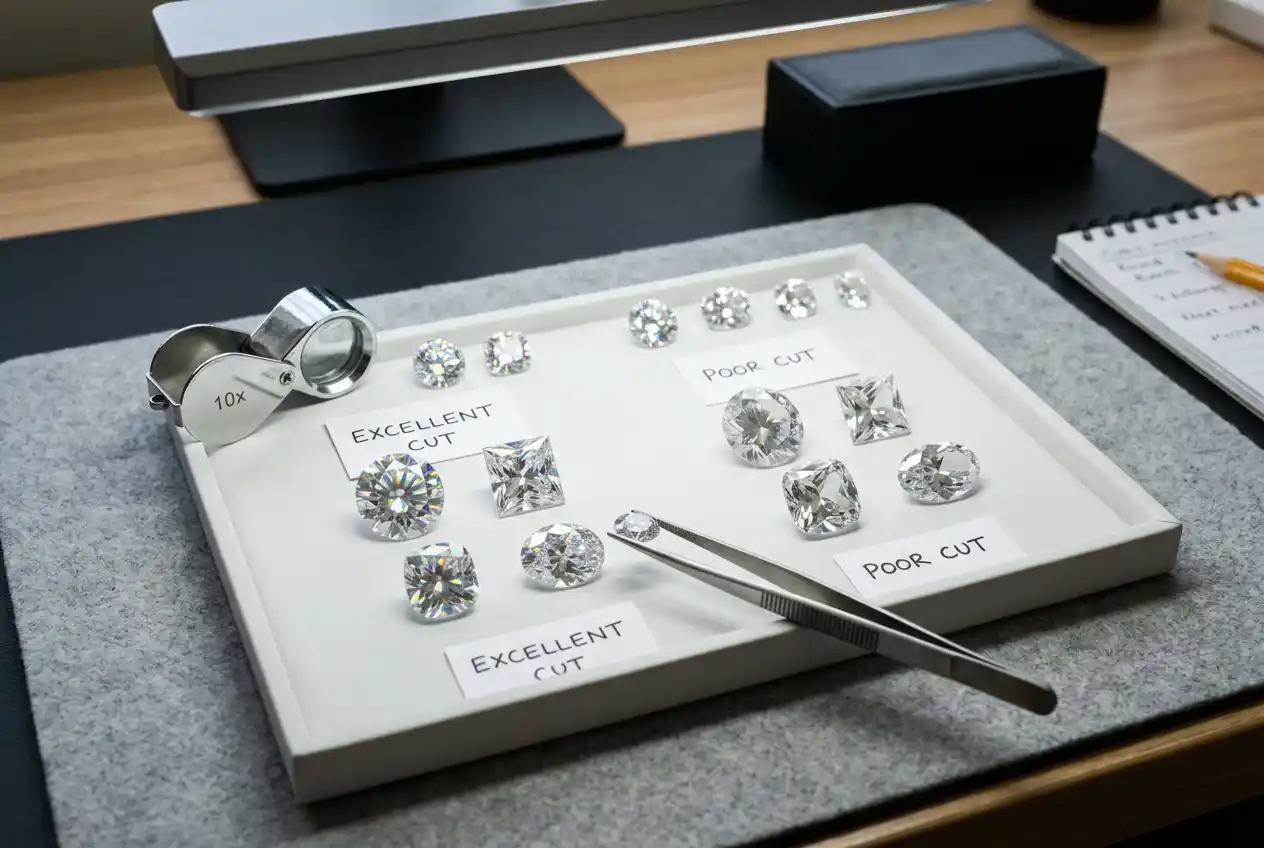
Cubic Zirconia Quality Grading: 9 Key Signs of High-Grade Brilliance
Cubic zirconia quality grading should focus primarily on cut precision, polish, color neutrality, transparency, manufacturing cleanliness, proportions, symmetry, surface condition, and disclosure of coatings or specialty treatments. Because jewelry-grade CZ is laboratory-produced in substantial quantities, extremely clean crystals and large sizes are readily available. A high-quality stone therefore earns its grade through optical performance and manufacturing consistency rather than through geological rarity.
CZ is stabilized cubic zirconium dioxide, ZrO₂, and it is fundamentally different from both natural zircon and diamond. Its refractive index is high enough to produce strong brilliance, while its dispersion exceeds that of diamond and can create noticeable rainbow flashes. Its Mohs hardness of roughly 8 to 8.5 provides useful jewelry durability, although repeated daily wear can eventually round facet junctions or create fine scratches that are less likely to develop quickly on diamond.
There is no single internationally standardized AAA, AAAAA, 5A, or similar grading system for cubic zirconia. Sellers commonly use such terms, but definitions differ widely. One company’s 5A stone may not match another company’s equivalent label. A useful quality assessment therefore needs to examine the actual gemstone rather than relying on a marketing grade printed on a package.
9 Key Signs of High-Grade Cubic Zirconia Brilliance
- Precise facet proportions and strong light return
- Excellent symmetry and centered cutting
- Smooth high-quality polish
- Neutral or intentionally controlled color
- Eye-clean to highly clean transparency
- Minimal windowing and excessive extinction
- Crisp facet edges and strong surface condition
- Consistent manufacturing, calibration, and matching
- Accurate disclosure of coatings, color treatments, and product identity
These nine standards are especially useful because size alone tells very little about CZ quality. A large poorly cut stone can look flat and glassy, while a smaller precision-cut stone can appear dramatically brighter and more refined.
Cut Precision Is the Foundation of High-Grade CZ
A high-quality cubic zirconia should be cut with proportions that allow light entering through the crown to reflect internally and return toward the viewer rather than leaking through the pavilion.
CZ has useful refractive properties, but those properties cannot compensate completely for bad geometry. An overly shallow pavilion can create a large transparent window, while excessive depth may add hidden weight and produce dark or lifeless areas.
Round brilliant stones should show balanced facet arrangement, a centered table, even girdle, properly aligned pavilion facets, and a culet positioned on the optical center. Fancy shapes require equivalent care even though their facet patterns differ.
Precision-cut CZ often looks more refined because light return is more organized. The stone develops stronger scintillation as it moves, while lower-grade mass-produced examples may appear bright only around the outer edge or show uneven dark regions.
Since rough CZ is inexpensive, major proportion problems are difficult to justify in a premium-quality stone.
Symmetry Should Be Obvious From the Face-Up View
Symmetry involves more than whether a stone looks approximately round or oval. Facet junctions should align, opposite sides should correspond, and the overall outline should remain balanced.
An oval CZ should not have visibly different shoulders unless the design intentionally calls for asymmetry. A princess cut should have centered corners and a balanced square outline, while an emerald cut should show parallel steps that remain visually organized.
Poor symmetry disrupts light return and can make a stone look less expensive even when the crystal itself is perfectly clean.
Girdle consistency also matters. Extremely thin areas are more vulnerable to chipping, while unnecessarily thick sections can add weight without contributing to appearance.
Matched stones for earrings or multi-stone jewelry require an additional level of symmetry because differences become immediately obvious when two gems sit next to each other.
Polish Controls Surface Brilliance
Even perfectly designed facets cannot perform well when the surface is poorly polished. Fine CZ should have smooth, reflective facets without obvious scratches, pits, polishing lines, burns, or hazy areas.
Poor polish scatters light at the surface instead of allowing it to enter and exit cleanly. The result can make a clear crystal look cloudy or greasy.
Facet junctions should remain crisp rather than rounded. This becomes particularly important with used CZ because repeated abrasion can soften facet edges and reduce the sharp appearance seen in a new stone.
Magnification can reveal surface wear that is difficult to detect at normal viewing distance. Fine scratches may not matter individually, but widespread abrasion across the crown lowers overall brilliance.
A premium quality grade should therefore describe both the original cutting workmanship and the current condition of the stone.
Colorless CZ Should Look Neutral Rather Than Yellow or Gray
Colorless cubic zirconia can be manufactured with a highly neutral appearance, so obvious yellow, brown, or gray tint is generally undesirable when the stone is intended to imitate a colorless diamond.
Unlike natural diamond, where extremely colorless stones become progressively rarer, high-color CZ does not depend on geological scarcity. Neutral color should therefore be considered a manufacturing quality feature rather than a rare natural trait.
Some stones are intentionally produced in warmer tones to imitate lower-color diamonds, champagne gems, or antique-style jewelry. Such color should not be penalized when it is deliberate and accurately described.
Colored CZ follows a different grading logic. Blue, pink, green, purple, red, yellow, orange, and other hues should be evaluated for saturation, evenness, stability, and whether the color extends through the crystal or results from a surface coating.
The quality question is consistency and intent rather than conformity to one universal colorless standard.
High Clarity Is Expected in Good Cubic Zirconia
Laboratory manufacturing can produce CZ with exceptional transparency, so high-grade stones should generally be eye-clean and often appear extremely clean even under magnification.
Visible bubbles, internal particles, strain features, cloudy zones, cracks, or other growth defects lower quality because cleaner alternatives are widely available.
The clarity philosophy differs sharply from natural gemstones. An inclusion-free CZ does not receive a major rarity premium because clean material can be manufactured deliberately.
Surface defects can be more important than internal features in worn jewelry. Oils, soap residue, scratches, chips, and abraded facet edges can all reduce apparent clarity and brilliance even when the crystal interior is flawless.
Cleaning the stone before grading is therefore essential. A film of hand lotion can make excellent CZ appear dull enough to be mistaken for a lower-quality product.
Windowing and Extinction Reveal Proportion Problems Quickly
Windowing appears as a transparent or watery area, usually near the center, where the viewer can see through the stone rather than receiving bright returned light. It usually indicates pavilion angles that are too shallow for the gemstone’s optical properties.
Excessive extinction produces large dark regions that remain black or dull through ordinary movement. Some contrast is necessary for scintillation, but extensive black areas make a stone look lifeless.
Both problems can occur even in perfectly clear CZ because they arise primarily from cutting rather than crystal quality.
The easiest test is to rotate the clean stone under neutral lighting. A high-quality cut should show changing areas of brightness and darkness across the face without a persistent central window or broad dead zone.
Fancy cuts naturally have different light patterns from rounds, so they should be compared with well-cut stones of the same shape rather than forced into one visual standard.
Dispersion Should Look Lively Without Overwhelming the Stone
CZ has strong dispersion and can show prominent rainbow flashes. This is sometimes called fire in jewelry descriptions.
The effect can be striking when the stone is cut well. Crisp flashes of red, orange, green, blue, and violet may appear as it moves under point-source lighting.
Very large CZ can produce particularly obvious dispersion because the facets are larger and spectral flashes are easier to separate visually.
Some buyers love this effect, while others prefer the different balance of white brilliance and fire associated with diamond. Quality grading should not penalize CZ simply for displaying its natural optical character.
The more useful question is whether the dispersion appears crisp and dynamic or whether poor cutting creates a chaotic, glassy appearance with weak white-light return.
Facet Edges and Girdle Condition Reveal Wear
New high-quality CZ should show sharp facet junctions and a clean girdle. Since its hardness is lower than diamond’s, daily-worn stones can gradually develop abrasion.
Facet-edge wear may first appear as tiny whitish lines where two polished surfaces meet. Over time, these lines can broaden and make the entire crown look softer.
Chips may occur around exposed corners, girdles, or culets after impact. Princess cuts, marquises, pears, and other shapes with pointed areas deserve particularly close inspection.
A worn CZ can still be structurally usable, but its quality grade should reflect current condition rather than the theoretical quality it had when new.
Because replacement stones are inexpensive, severe abrasion often leads owners to replace the CZ instead of paying for extensive repolishing.
Manufacturing Consistency Matters in Multi-Stone Jewelry
Quality differences become especially obvious when CZ is used in tennis bracelets, eternity bands, pavé, halo settings, and matched earrings.
Stones should match for color, diameter, depth, cut style, table size, brilliance, and polish. One cloudy or yellowish CZ can stand out immediately among otherwise uniform stones.
Calibrated production is therefore an important manufacturing skill. High-quality suppliers maintain tight tolerances so stones can be replaced without redesigning the setting.
Matched pairs deserve similar attention. Two oval or pear-shaped CZ stones may have the same carat weight but look mismatched if their proportions or facet patterns differ.
For multi-stone jewelry, consistency can contribute more to perceived quality than microscopic differences in an individual stone.
A Practical Cubic Zirconia Quality Comparison
| Quality Characteristic | High-Grade CZ | Lower-Grade CZ |
|---|---|---|
| Cut | Balanced proportions, strong light return | Windowing, dead zones, excessive depth |
| Symmetry | Even and centered | Crooked or mismatched |
| Polish | Smooth, reflective facets | Scratches, haze, polishing lines |
| Color | Neutral or intentionally consistent | Unwanted tint or uneven coating |
| Clarity | Eye-clean to highly clean | Visible bubbles, clouds or defects |
| Facet edges | Crisp | Rounded or abraded |
| Calibration | Consistent dimensions | Variable sizing |
| Treatment disclosure | Clear and accurate | Uncertain or misleading |
This comparison provides more useful information than a seller-defined AAAAA label because every characteristic can be inspected directly.
Coated Cubic Zirconia Needs a Separate Surface Assessment
Some CZ receives thin-film or other surface coatings that modify color or produce unusual iridescent appearances. The underlying stone can remain high quality while the coating becomes the most vulnerable part of the product.
Surface color should therefore be inspected for scratches, patchiness, edge wear, or areas where the finish has been removed.
Cleaning methods that are safe for uncoated CZ may not be appropriate for every coating. Abrasives and harsh chemicals can damage certain specialty finishes.
A coated stone should be graded for both underlying CZ craftsmanship and present coating condition. A beautifully cut stone with a badly worn coating does not belong in the same final quality category as a new evenly finished example.
Disclosure matters because buyers should know whether the hue is integral to the crystal or applied at the surface.
Cubic Zirconia Versus Diamond During Quality Assessment
CZ and diamond should not be graded through identical assumptions because they are different substances.
Diamond has a Mohs hardness of 10, higher refractive index, different dispersion, much lower density, very high thermal conductivity, and a natural or laboratory-grown carbon crystal structure. CZ has lower hardness, stronger dispersion, higher density, and zirconium dioxide chemistry.
High-quality CZ can appear extremely bright, especially when clean and precision cut, but it does not become diamond because its optical performance is excellent.
The correct grading question is whether a CZ is well made within its own gem category rather than how successfully it could be misrepresented as another gemstone.
Cubic Zirconia Versus Natural Zircon During Grading
Natural zircon can be transparent and highly dispersive, which sometimes leads to confusion with CZ despite the two substances having different origins and chemistry.
Zircon is zirconium silicate and can occur naturally in a range of colors. It may show strong double refraction in certain orientations and can have significant geological age.
Cubic zirconia is manufactured stabilized zirconium dioxide and is singly refractive in its ideal cubic form.
A seller using zircon and cubic zirconia interchangeably is not using gemological terminology correctly. Quality grading begins with accurate identity, so this distinction should be established before value or durability is discussed.
Size Is Not a Quality Grade
Large CZ can be produced efficiently, so a ten-carat stone should not automatically receive a higher quality rating than a two-carat stone.
In fact, poor cutting becomes easier to notice as size increases. Large facets expose symmetry errors, windows, polish marks, and unwanted color much more clearly.
A large stone earns a premium quality grade only when proportions remain balanced and the face-up appearance stays bright and symmetrical.
Millimeter dimensions are particularly useful because CZ’s high density makes carat weight difficult to compare directly with diamond. A buyer seeking a particular visual size should therefore use measurements rather than weight alone.
Common Cubic Zirconia Grading Mistakes
One of the most common mistakes is assuming that more rainbow fire automatically means better quality. Strong dispersion is natural to CZ, but the best stones also need balanced white-light return, symmetry, and crisp scintillation.
Another mistake is using seller labels such as 5A as though they were internationally standardized. Without a clear definition, the label communicates less than direct inspection of cut, polish, color, and clarity.
Buyers may also confuse a dirty stone with a poor-quality one. Oils and soap can coat CZ readily and suppress brilliance, so cleaning should occur before grading.
Finally, extremely large size can distract from workmanship. A huge stone with a central window and worn facet edges remains lower quality than a smaller precision-cut CZ with stronger optical performance.
Cubic Zirconia Durability as Part of Final Quality
CZ’s hardness around 8 to 8.5 makes it suitable for rings, earrings, pendants, bracelets, and other jewelry. It withstands normal wear reasonably well but will eventually show more abrasion than diamond.
Impact can chip exposed edges and points. Protective settings are particularly helpful for large stones and pointed fancy shapes.
Routine cleaning with mild soap, lukewarm water, and a soft brush is generally suitable for uncoated CZ. Coated stones should be cleaned according to the specific finish because aggressive methods can damage the surface treatment.
Separate storage prevents diamond, sapphire, and other harder gems from scratching CZ and helps preserve the crisp facet edges associated with a high-quality appearance.
Conclusion
Cubic zirconia quality grading should focus on cut precision, symmetry, polish, color consistency, clarity, windowing, extinction, facet condition, calibration, and honest treatment disclosure. High-grade CZ is not valuable because it is geologically rare. It is valuable within its category because careful manufacturing and cutting produce strong brilliance, crisp dispersion, reliable matching, and an attractive finished appearance.
The absence of a universal AAA or 5A grading system makes direct inspection particularly important. A clean precision-cut stone with sharp facets and balanced proportions can easily outperform a much larger CZ carrying an impressive marketing grade. Buyers who judge what the stone actually does with light will get a much clearer picture of quality.
FAQs About Cubic Zirconia Quality Grading
What is the most important quality factor in cubic zirconia?
Cut quality is usually the most important factor because CZ can already be manufactured with excellent clarity. Proper proportions, symmetry, polish, and facet alignment determine how effectively the stone returns light.
Is 5A cubic zirconia an official grade?
No. 5A, AAAAA, AAA, and similar systems are commercial labels defined by individual sellers or manufacturers. There is no single universally enforced international CZ grading scale behind them.
Should high-quality CZ be flawless?
High-grade CZ should normally appear eye-clean because clean laboratory-grown crystal is readily available. Visible bubbles, clouds, cracks, or manufacturing defects lower quality.
Does cubic zirconia have more fire than diamond?
CZ has higher dispersion than diamond and can show stronger rainbow flashes. The two gemstones have different refractive behavior, density, hardness, and contrast, so their overall appearance is not identical.
How can I tell whether CZ is well cut?
Look for a symmetrical outline, crisp facet junctions, strong light return, minimal central windowing, controlled dark contrast, smooth polish, and an even girdle.
Does larger cubic zirconia mean higher quality?
No. Large CZ is easy to manufacture relative to large natural gemstones. Size affects total Price but does not determine cut, clarity, polish, or optical quality.
Why does some CZ look cloudy?
Cloudiness can come from surface oil, soap residue, scratches, abrasion, poor polish, or internal manufacturing defects. Cleaning the stone first helps distinguish dirt from actual quality problems.
Does CZ become dull with age?
It can lose apparent brilliance as the surface accumulates scratches, facet-edge wear, oil, and residue. Proper cleaning and storage slow this process considerably.
Is cubic zirconia harder than quartz?
Yes. CZ is generally around 8 to 8.5 on the Mohs scale, while quartz is 7. CZ remains softer than sapphire at 9 and diamond at 10.
Is cubic zirconia the same as zircon?
No. Cubic zirconia is laboratory-produced stabilized zirconium dioxide, while zircon is a natural zirconium silicate mineral with different physical and optical properties.
Can CZ have a color grade?
Colorless CZ can be compared for neutrality, and colored CZ can be judged for hue, saturation, evenness, and stability. Seller color grades should not be assumed to use the same standardized system as diamond.
Are colored cubic zirconia stones lower quality?
No. Colored CZ is simply a different product category. High-quality colored stones should have attractive, even color, good cutting, high clarity, and accurate disclosure of whether the hue is integral or surface coated.
Do coatings affect CZ quality?
Yes. Coatings can create attractive specialty colors but may scratch or wear. Final quality should consider both the underlying cut and the present condition of the coating.
Why are precision-cut CZ stones better?
Precision cutting improves proportion, symmetry, polish, light return, scintillation, and face-up appearance. The labor can be worth more than the raw CZ crystal itself.
Can worn cubic zirconia be repolished?
It can sometimes be repolished or recut, but replacement is often more economical because loose CZ is inexpensive. Custom or sentimental stones may justify repair.
How should cubic zirconia be cleaned?
Uncoated CZ can usually be cleaned with lukewarm water, mild soap, and a soft brush. Coated stones require gentler care appropriate to their specific surface treatment.
Does high-quality CZ look exactly like diamond?
It can resemble diamond closely to an untrained eye, but the two have different dispersion, density, hardness, thermal behavior, refractive properties, and visual character. Gemological testing separates them readily.
What makes cubic zirconia high grade?
High-grade CZ combines precise proportions, strong symmetry, excellent polish, neutral or intentional color, high transparency, minimal windowing, crisp facet edges, consistent calibration, and accurate treatment disclosure.