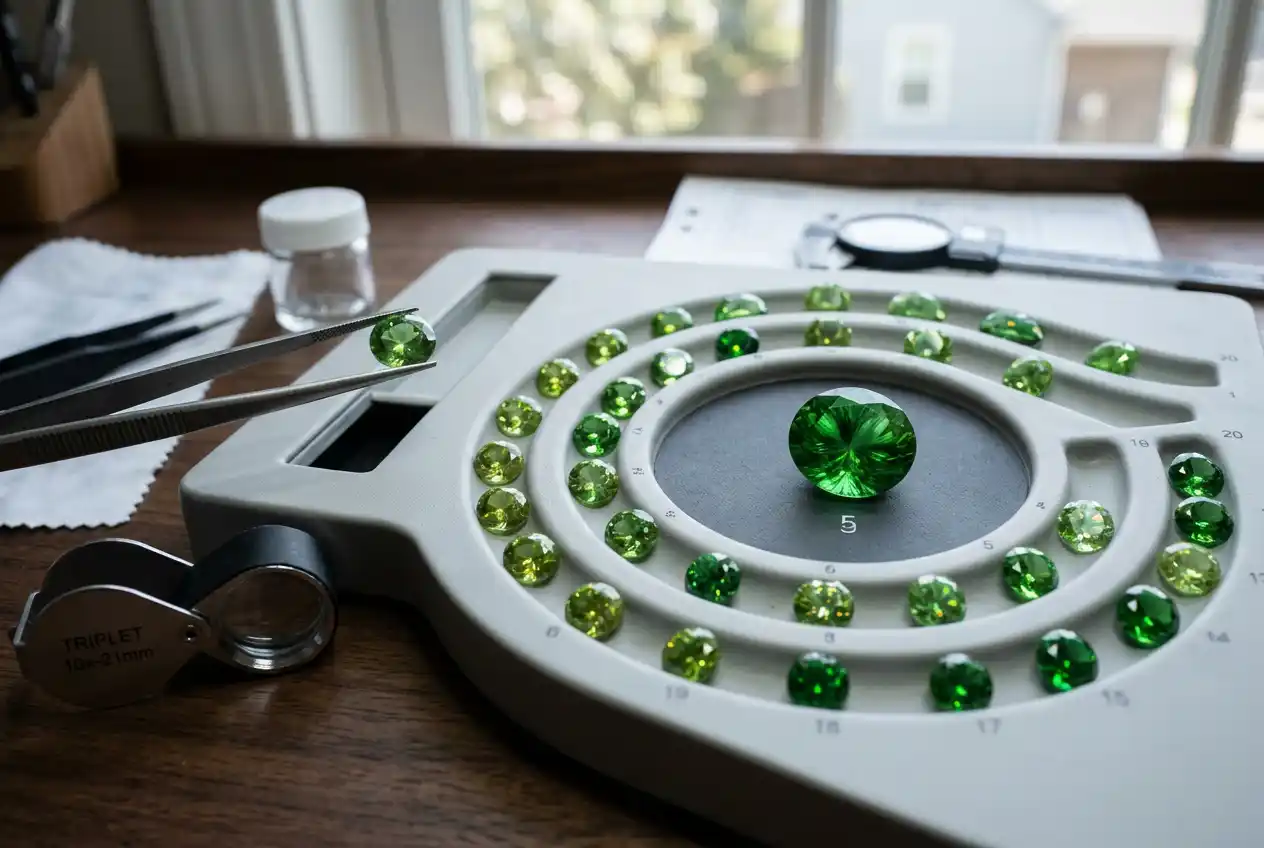
Demantoid Garnet Quality Grading: 8 Essential Tests for Value
Demantoid garnet quality grading should begin with confirming that the stone is green andradite, then move through color, tone, dispersion, clarity, inclusions, cutting, size, treatment, and provenance. Fine demantoid is unusual because conventional clarity rules do not always apply in the expected way. A clean transparent stone is desirable, yet an attractive horsetail inclusion can increase collector interest, particularly when the stone is associated with classic Russian production.
The gemstone’s optical performance is equally distinctive. Demantoid combines strong green body color with dispersion greater than diamond’s, so a well-cut stone can show vivid flashes of spectral color. The challenge is that deep green body color can mask some of this fire. Fine grading therefore requires a balance between richness of hue and enough brightness for the stone’s famous dispersion to remain visible.
Demantoid is the green variety of andradite garnet, Ca₃Fe₂(SiO₄)₃. Chromium contributes importantly to desirable green coloration, while iron is fundamental to the andradite structure and helps shape the gem’s overall color and optical behavior. Because no universal AAA or similar grading scale governs the entire demantoid market, the most reliable method is to evaluate the individual stone characteristic by characteristic.
8 Essential Tests for Demantoid Garnet Value
- Confirm natural andradite garnet identity
- Grade green hue and saturation
- Evaluate tone and face-up brightness
- Assess dispersion, brilliance, and scintillation
- Examine clarity and inclusion character
- Judge cut quality and face-up proportions
- Consider carat weight, dimensions, and rarity
- Evaluate origin, treatment, provenance, and condition
These eight tests provide a more meaningful quality framework than a seller-defined letter grade. They also reflect the unusual way demantoid is valued, where an inclusion may sometimes enhance desirability while a perfectly clean but dull stone can still rank below a more visually exciting gem.
Confirm Natural Andradite Garnet Identity Before Grading
Demantoid belongs to the andradite garnet species and should not be confused with other green garnets simply because their colors overlap. Tsavorite, for example, belongs to the grossular garnet species and has different chemistry and optical characteristics.
Andradite has a relatively high refractive index and high dispersion, both of which contribute to demantoid’s brilliance and fire. Garnet is singly refractive, which also helps separate it from many doubly refractive green gemstones.
Professional identification may involve refractive index, specific gravity, spectroscopy, microscopy, and other gemological observations. Natural inclusions can provide additional clues, particularly in stones suspected of classic Russian origin.
Green glass and other gemstone substitutes can mimic part of the visual appearance but lack the full combination of demantoid’s physical and optical properties.
Quality grading should therefore begin only after identity has been established. A vivid green stone cannot receive a demantoid rarity premium simply because its color looks convincing.
Green Hue and Saturation Form the Core of Demantoid Quality
Demantoid ranges from yellowish green through medium green to deeper saturated green. The finest stones generally display a rich and attractive green with enough saturation to look distinctive while avoiding muddy yellow-brown modifiers.
Some yellow component is common and can actually support a lively appearance. Stones that are slightly lighter or more yellowish may display exceptional fire because the body color absorbs less light.
Deeper green stones often command the strongest color premiums, especially when chromium contributes to a more vivid appearance. However, richness should not be confused with maximum darkness.
The grader should judge hue under neutral daylight-equivalent illumination and then check the stone under ordinary indoor light. A fine demantoid should remain recognizably green rather than becoming nearly black or brown away from strong lighting.
Color should also be evaluated across the entire face. Uneven dark patches caused by extinction can make a richly colored stone look lower quality even when the underlying body color is excellent.
Tone Determines Whether Green Color and Fire Remain in Balance
Tone is the relative lightness or darkness of the stone. In demantoid, it determines how much of the gem’s dispersion can be seen through its green body color.
A lighter medium-green stone may show abundant flashes of red, orange, yellow, and blue. A darker green gem can deliver stronger color but suppress some of these flashes.
Neither characteristic should be graded in isolation. The finest overall quality often comes from a tone that allows both green saturation and optical liveliness to coexist.
Deep pavilion proportions can make tone look darker, while shallow cutting can create a pale window in the center. This means tone should be graded from the face-up position rather than through the side of the stone.
A high-quality gem should not depend on extremely bright lighting to remain lively. If large areas stay black under ordinary conditions, excessive darkness or poor cutting may be limiting performance.
Dispersion Should Be Visible Without Overwhelming the Green Body Color
Demantoid’s high dispersion is one of its defining optical features. White light can separate into spectral colors as it travels through well-cut facets, producing flashes that resemble the fire associated with diamond.
The effect is strongest when the stone has adequate transparency and effective pavilion angles. A poorly cut gem may possess the same physical dispersion coefficient yet show very little visible fire.
Point-source lighting often reveals dispersion better than broad diffuse illumination. The grader should therefore examine the stone under more than one type of light.
Fire should appear crisp rather than being confused with random reflections from surface scratches or surrounding colored objects.
A fine demantoid still needs to look green overall. Excessive attention to dispersion should not turn the grading process into a search for the palest possible stone simply because spectral flashes are easier to see. Quality comes from the interaction of green color, brilliance, and fire.
Clarity Grading Must Distinguish Valuable Inclusions From Damaging Ones
Demantoid may contain crystals, fibers, fractures, veils, and other inclusions. Conventional faceted-gem grading normally favors greater transparency, and clean stones can command strong premiums when color and size are also fine.
The famous exception is the horsetail inclusion. Classic examples consist of curved or radiating fibrous structures that can resemble the tail of a horse when viewed under magnification.
A graceful horsetail can add substantial collector interest because of its association with classic demantoid, particularly Russian material. Such a feature can make a moderately included gem more desirable than a cleaner stone lacking comparable provenance interest.
Random inclusions do not receive the same treatment. Large fractures, dark crystals, dense clouds, or surface-reaching breaks that interfere with brilliance generally lower the grade.
Clarity should therefore consider the type, position, visibility, and significance of each inclusion rather than simply counting them.
A Practical Demantoid Clarity Framework
| Clarity Appearance | Practical Interpretation |
|---|---|
| Eye-clean with high transparency | Fine to exceptional conventional clarity |
| Minor inclusions visible under magnification | Very good |
| Attractive horsetail with limited effect on brilliance | Potentially fine collector quality |
| Obvious random inclusions or fractures | Commercial to good, depending on severity |
| Heavy clouding or structural fractures | Lower faceting quality |
This framework is descriptive rather than an official universal scale. It highlights why demantoid clarity cannot be judged with the same assumptions applied to ordinary included gemstones.
Horsetail Inclusions Need Careful Interpretation
Horsetails are among the most famous inclusions in colored gemstones and are especially associated with classic Russian demantoid. Their curved fibrous appearance can be visually striking under magnification and may enhance collector value.
The finest examples are well defined but positioned so they do not make the entire stone look cloudy. A feature located off-center or beneath a facet can remain fascinating under a loupe while leaving the face-up appearance lively.
The presence of a horsetail does not automatically prove Russian origin. Similar fibrous structures can occur in demantoid from other localities, so origin attribution should use additional gemological evidence and provenance when value depends heavily on locality.
A seller should also avoid using the term horsetail for any random needle inclusion. The characteristic arrangement and appearance matter.
Cut Quality Determines Whether Demantoid Shows Both Brilliance and Fire
The cutter’s challenge is to preserve rare weight while maximizing light return. Fine rough may be small or irregular, so perfect symmetry can be difficult to achieve without sacrificing economically important carat weight.
Moderate compromise may be acceptable in a rare stone, especially when a slight asymmetry preserves exceptional color or allows the final gem to stay above an important weight threshold.
Severe windowing should still lower the grade because it creates a transparent central area and weakens both color and fire. Excessive depth can add hidden weight while increasing extinction.
Polish deserves close inspection because demantoid’s high luster is part of its appeal. Scratches, abrasions, pits, and rounded facet junctions reduce the sharp optical performance expected from a fine gem.
Round cuts often display dispersion particularly effectively, but ovals, cushions, and other shapes can also be excellent when proportions are balanced.
Size Is a Major Rarity Factor Only When Quality Remains Strong
Most faceted demantoid is relatively small. Stones approaching or exceeding one carat become more important, while fine examples above two or three carats are particularly scarce.
A larger stone should not automatically receive a higher quality grade. Size is a rarity factor rather than a substitute for color, brilliance, and transparency.
A two-carat dark olive stone with poor cut can be less desirable than a 0.80-carat vivid green gem with exceptional fire.
Face-up dimensions should also accompany weight because overly deep cutting can preserve carats without increasing visible size.
At the highest quality level, substantial weight adds a major premium precisely because maintaining vivid green, good clarity, and strong dispersion at larger sizes is so difficult.
Russian, Namibian, and Other Demantoid Sources Can Look Different
Russia remains the historically prestigious source, particularly because of the classic Ural deposits and their association with fine color and horsetail inclusions.
Namibia has also produced important demantoid, including bright yellowish-green to green stones that can be very clean and show excellent dispersion. Madagascar, Iran, Italy, and additional localities have produced demantoid with their own inclusion and color characteristics.
No origin should be assigned quality automatically. A fine non-Russian stone can easily outperform a mediocre Russian gem visually.
Origin becomes most significant when a buyer is paying a collector premium for documented locality, historic production, or a characteristic inclusion scene.
Laboratory testing and reliable provenance can be useful for exceptional purchases, especially when seller claims materially affect value.
Treatment Status Should Be Considered in High-End Grading
Demantoid is not associated with widespread routine enhancement on the scale seen in corundum, but heat treatment has been reported, particularly for certain Russian stones.
The treatment can reduce unwanted brownish components and improve apparent green color. In some instances, determining treatment conclusively can be difficult.
A heated demantoid can still be beautiful and valuable. The distinction matters most for collectors who are specifically seeking natural untreated color.
When a seller charges a substantial premium for untreated status, documentation should support the claim where possible rather than relying on assumption.
Treatment should therefore be recorded separately from visual grade, just as origin and provenance should be.
Demantoid Hardness and Structural Condition Influence Final Quality
Demantoid is around 6.5 to 7 on the Mohs scale, giving it moderate durability but less scratch resistance than sapphire, spinel, or diamond.
Surface condition matters because worn facet edges can reduce brilliance and make a rare stone look less crisp. Chips around the girdle can also create setting risks.
Inclusions need to be examined for structural significance. A beautiful internal horsetail may have little effect on durability, while an open fracture reaching the surface can create a genuine weakness.
Rings should use settings that protect vulnerable edges, particularly for larger expensive stones. Earrings and pendants place less mechanical stress on the gem.
A final quality grade should therefore account for both optical beauty and whether the stone is structurally suitable for its intended jewelry use.
A Practical Overall Demantoid Quality Framework
| Quality Level | Typical Characteristics |
|---|---|
| Exceptional | Vivid green, excellent brilliance, strong fire, fine size, high transparency or attractive collector inclusions, superb cut |
| Fine | Strong green, good dispersion, limited distracting inclusions, good proportions |
| Good | Attractive green or yellow-green, moderate inclusions, competent cut |
| Commercial | Pale, olive or dark color, obvious inclusions, windowing or weak brilliance |
| Lower quality | Muddy color, heavy fractures, poor transparency, major damage or poor cutting |
The framework is descriptive rather than a universally recognized laboratory scale. It is useful because the grade can be explained directly through the stone’s observable features.
Common Demantoid Grading Mistakes
A frequent mistake is assuming that the deepest green stone is automatically the finest. Deep color can be desirable, but excessive darkness may suppress the dispersion that makes demantoid exceptional.
Another mistake is treating every inclusion as negative. Characteristic horsetails can increase collector appeal when they are attractive and appropriately positioned.
The opposite error also occurs when any fibrous inclusion is automatically labeled a valuable Russian horsetail. Origin and inclusion interpretation need more care.
Carat weight can also distract buyers. Large stones are scarce, but size does not erase weaknesses in color, cut, or transparency.
Finally, seller-defined AAA grades should not replace direct assessment because there is no universal system defining what those letters mean for demantoid.
Conclusion
Demantoid garnet quality grading requires a balance of natural identity, green color, tone, dispersion, clarity, inclusion character, cut, carat weight, provenance, treatment, and condition. The finest stones remain vividly green while allowing enough light return for their unusually strong spectral fire to remain visible.
What makes demantoid particularly interesting is that conventional gemstone rules do not always apply mechanically. A lighter stone can outperform a darker one because of superior fire, and a distinctive horsetail can increase value rather than decrease it. Evaluating these characteristics together gives a far more reliable picture of quality than relying on size, darkness, or a commercial letter grade alone.
FAQs About Demantoid Garnet Quality Grading
What is the most important demantoid quality factor?
Green color is the most important visible factor, but it should be balanced with brightness and dispersion. A richly green stone that becomes too dark can lose much of the fire that distinguishes demantoid.
What color is the best demantoid?
Vivid medium to strong green is generally preferred, especially when yellow or brown modifiers are limited. The stone should still remain bright enough to show brilliance and spectral fire.
Should fine demantoid be eye-clean?
Eye-clean stones are desirable, but demantoid has an important exception because attractive horsetail inclusions can add collector value. Random fractures and clouds still reduce quality.
What is a horsetail inclusion?
A horsetail is a curved or radiating fibrous inclusion scene associated especially with classic demantoid. Under magnification, the fibers can resemble a horse’s tail.
Does a horsetail prove a demantoid is Russian?
No. It can support a Russian-origin interpretation, but similar fibrous structures have been found in demantoid from other sources. Origin should be based on additional evidence when important.
Why does demantoid show so much fire?
Demantoid has unusually high dispersion, which separates white light into spectral colors. Fine cutting and sufficient transparency allow those flashes to become visible.
Can a pale demantoid be high quality?
Yes. A somewhat lighter stone may display exceptional dispersion and brilliance. The grading decision should balance body color with fire rather than rewarding darkness alone.
Does demantoid size strongly affect quality?
Size affects rarity rather than visual quality by itself. Fine gems above one carat become much scarcer, and larger stones receive substantial premiums when color, clarity, and cutting remain strong.
Is Russian demantoid always better?
No. Russian origin carries historical prestige, but excellent stones also come from Namibia, Madagascar, Iran, Italy, and other sources. The individual stone’s visible quality should remain central.
Is demantoid commonly treated?
Treatment is less central than in many other colored gemstones, but some stones may be heated to improve color. High-value purchases should include accurate treatment disclosure when known.
Is demantoid the same as green grossular garnet?
No. Demantoid is green andradite, while tsavorite is green grossular. Their chemistry, optical properties, inclusions, and market characteristics differ.
What causes demantoid’s green color?
Chromium contributes importantly to the desirable green coloration, while iron is fundamental to andradite and influences the overall color and optical behavior.
How hard is demantoid garnet?
Demantoid is approximately 6.5 to 7 on the Mohs scale. It is wearable in jewelry but requires more protection from abrasion than sapphire, spinel, or diamond.
How should demantoid be examined before buying?
Compare color under neutral lighting, inspect fire under point-source illumination, evaluate clarity and inclusion type, check for windowing and extinction, compare dimensions with weight, and review origin and treatment documentation if those claims affect value.
Are AAA demantoid grades standardized?
No. AAA and similar labels vary by seller. A meaningful grade should explain hue, saturation, tone, dispersion, clarity, cut, size, provenance, and condition.
What makes a demantoid exceptional?
Exceptional demantoid combines vivid green color, strong light return, visible spectral fire, useful size, high transparency or an attractive collector-quality horsetail, excellent cutting, strong condition, and credible provenance.