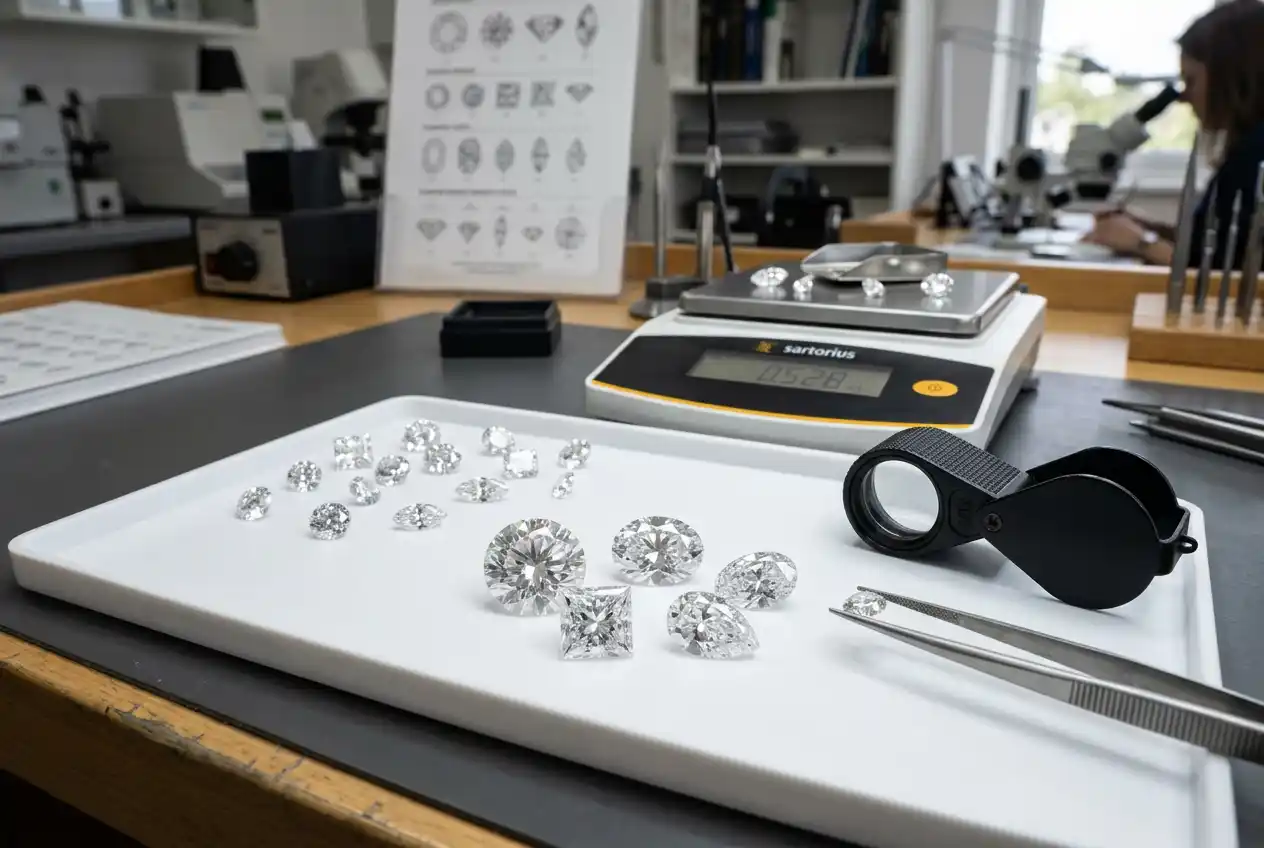
Diamond Quality Grading: 10 Essential Rules to Rate Cut & Clarity
Diamond quality grading is built around carat weight, color, clarity, and cut, but a reliable assessment requires more than memorizing the 4Cs. Two diamonds with the same headline grades can perform differently because their proportions, inclusion locations, fluorescence, symmetry, polish, shape, and origin are not identical. A grading report therefore provides a framework for comparison, while the actual stone reveals how those characteristics interact visually.
Cut deserves particular attention because it determines how efficiently a faceted diamond returns light. Clarity also needs careful interpretation because the difference between two laboratory grades may be invisible without magnification, while one poorly positioned inclusion can affect appearance more strongly than several smaller inclusions elsewhere. The highest numerical grade is not automatically the best purchasing decision when a lower grade offers essentially the same face-up appearance.
Diamond is crystalline carbon with a Mohs hardness of 10 and very high refractive properties. It also has perfect octahedral cleavage, so extreme hardness does not make it impossible to chip or split. Quality grading should therefore consider not only beauty and rarity but also structural features, treatments, natural versus laboratory-grown origin, and the condition of the polished stone.
10 Essential Rules for Diamond Quality Grading
- Confirm natural, laboratory-grown, or treated identity
- Record accurate carat weight and physical dimensions
- Grade color under standardized conditions
- Grade clarity by inclusion type, size, location, relief, and number
- Evaluate cut quality and light return
- Check proportions, symmetry, and polish
- Assess fluorescence and transparency
- Judge shape-specific performance and face-up spread
- Review treatments, condition, and structural risks
- Use independent laboratory grading while still inspecting the actual diamond
These ten rules create a practical grading sequence that keeps identity and visible performance ahead of marketing language. They also explain why a diamond should never be judged solely by a single number such as carat weight or clarity grade.
Confirm Diamond Origin Before Applying Market Grades
The first grading question is whether the stone is natural diamond, laboratory-grown diamond, treated natural diamond, or a simulant. Natural and laboratory-grown diamonds are both crystalline carbon, but they belong to different origin and market categories.
Laboratory-grown diamonds are commonly produced through high-pressure, high-temperature growth or chemical vapor deposition. Their physical and optical properties can overlap strongly with natural diamonds, so visual inspection alone may not be sufficient to establish origin.
Gemological laboratories use specialized observations and instruments to identify growth structures, trace elements, fluorescence patterns, spectroscopy, and other characteristics that separate natural from laboratory-grown material.
Simulants such as cubic zirconia and moissanite are not diamonds. They may resemble diamond visually but differ in chemistry, hardness, density, optical behavior, and thermal properties.
No quality grade should be used to imply natural rarity until origin has been established accurately.
Carat Weight Must Be Read Together With Measurements
Carat is a measure of mass, with one carat equal to 0.20 gram. It does not directly tell the buyer how large the diamond looks.
Two one-carat round diamonds can have different diameters if one is cut too deeply. The deeper stone carries additional weight below the girdle while presenting a smaller visible face.
Measurements therefore belong beside carat weight in every serious comparison. Length, width, and depth reveal how efficiently the cutter has distributed the weight.
Important weight thresholds also influence market rarity. A polished diamond that finishes just above one carat may command more per carat than a visually similar stone finishing slightly below it.
The grading process itself should remain objective about weight, but buying quality requires understanding how that weight translates into visible size.
Color Grading Requires Controlled Viewing Conditions
Colorless and near-colorless diamonds are conventionally graded on a D-to-Z scale, with D representing the highest colorless grade and progressively more noticeable yellow or brown body color appearing farther down the scale.
Accurate color grading requires controlled lighting, a neutral environment, comparison with established reference stones, and an appropriate viewing position. Loose diamonds are commonly evaluated differently from mounted stones because metal reflections can influence apparent color.
Adjacent grades can be subtle, and many near-colorless stones look extremely white face-up after setting. Shape also changes visibility because emerald and Asscher cuts often reveal body color more readily than highly brilliant rounds.
Fluorescence can further complicate apparent color under ultraviolet-rich lighting. The assigned color grade and the way the stone looks in everyday jewelry should therefore be understood as related but not identical questions.
Fancy-color diamonds require a separate system because their value depends on the presence and strength of color rather than the absence of it.
Clarity Grading Is About the Entire Inclusion Scene
Diamond clarity grading examines internal inclusions and external blemishes at controlled magnification. Common clarity categories include Flawless, Internally Flawless, VVS, VS, SI, and Included ranges.
The grade considers more than the number of inclusions. Size, type, location, relief, and number all matter, and their combined effect determines how difficult the features are to see.
A small dark crystal beneath the table can have more visual impact than several transparent inclusions near the girdle. A feather reaching the surface may deserve additional durability attention even if it is not highly visible.
This is why a clarity map and actual visual inspection are useful. The same nominal grade can contain stones with very different inclusion scenes.
For jewelry buyers, eye-clean appearance often provides a useful practical target. Once inclusions cannot be seen without magnification and do not threaten durability, moving to much higher clarity may add rarity without producing an obvious visual improvement.
A Practical Diamond Clarity Interpretation
| Clarity Range | General Interpretation |
|---|---|
| FL to IF | Extremely rare absence of internal inclusions at grading magnification |
| VVS1 to VVS2 | Minute inclusions extremely difficult to see |
| VS1 to VS2 | Minor inclusions, often eye-clean |
| SI1 to SI2 | Noticeable under magnification, some stones eye-clean |
| I1 to I3 | Inclusions increasingly obvious and potentially affecting beauty or durability |
This table is a simplified interpretation rather than a substitute for professional grading. Inclusion placement and type can make one diamond within a grade considerably more attractive than another.
Cut Quality Determines How the Diamond Uses Light
Cut is frequently the most important visible quality factor in a colorless diamond. Even a high-color, high-clarity stone can appear dull when the proportions allow too much light to escape.
In round brilliants, crown and pavilion angles, table percentage, total depth, lower-half facets, star facets, girdle, and culet all interact. Good combinations return strong brightness while creating enough contrast and dispersion for lively scintillation.
An overly shallow diamond may leak light and appear watery. An overly deep stone can hide weight below the girdle, reduce face-up diameter, and create dark central areas.
Light performance also changes as the viewer, stone, or illumination moves. Fine cut creates a dynamic pattern of bright and dark facets rather than a static sheet of reflection.
Fancy shapes require additional interpretation because their facet arrangements differ. A beautiful oval, cushion, pear, radiant, or emerald cut cannot be graded simply by applying round-brilliant proportion targets.
Symmetry and Polish Refine Cut Quality
Symmetry evaluates how accurately the facets and overall shape align. Problems can include an off-center table, misaligned facets, uneven girdle, wavy outline, tilted table, or other deviations from the intended design.
Polish evaluates the finish of facet surfaces. Fine polishing creates clean reflective planes, while polishing lines, burns, scratches, pits, and abrasions can reduce the grade.
Excellent symmetry and polish support high optical precision, although differences among the very top categories may be difficult for an unaided observer to see.
In fancy shapes, outline symmetry has additional visual importance. A pear with a lopsided shoulder or an oval with uneven ends can look poorly made regardless of carat weight.
These characteristics should therefore be evaluated as contributors to the overall design rather than merely as small words on a grading report.
Fluorescence Should Be Evaluated, Not Automatically Rejected
Diamond fluorescence is the emission of visible light after exposure to ultraviolet radiation. Blue is the most familiar color, although other fluorescence colors can occur.
Reports may grade intensity as none, faint, medium, strong, or very strong. Strong blue fluorescence sometimes receives a market discount in high-color diamonds because buyers or dealers prefer stones without it.
The visible effect can vary dramatically. Many strongly fluorescent diamonds remain completely transparent and attractive, while a minority can show haziness or an oily appearance.
In lower-color diamonds, blue fluorescence may reduce the apparent yellow appearance under UV-rich lighting because blue and yellow are complementary visually.
A grading decision should therefore inspect transparency rather than assuming fluorescence is automatically harmful.
Shape-Specific Problems Need Their Own Evaluation
Every diamond shape has potential weaknesses that may not be captured adequately by headline grades. Ovals, pears, and marquises can show a dark bow-tie across the center when facet geometry does not return light evenly.
Emerald and Asscher cuts have broad step facets that reveal inclusions and body color more readily. They also depend heavily on symmetry and pleasing hall-of-mirrors reflections rather than intense scintillation.
Cushion cuts vary widely in facet arrangement, producing very different patterns even when laboratory reports appear similar. Radiants can vary in crushed-ice appearance, brightness, and corner proportions.
Princess cuts require close attention to vulnerable corners, while marquise and pear tips need protection in jewelry.
The correct grading approach therefore combines laboratory data with shape-specific visual inspection.
Face-Up Spread Is an Important Practical Quality Measure
A diamond should not be judged by weight alone because the wearer sees surface area rather than hidden pavilion mass.
A well-proportioned one-carat round should have a diameter appropriate to its weight, while an unusually deep stone may look smaller. Fancy shapes should be assessed through length-to-width ratio and actual millimeter dimensions.
Some elongated shapes can appear larger than rounds of equal weight because they distribute surface area differently. This can provide strong visual value even when the market price per carat is lower.
Spread should not be maximized at the expense of light performance. A very shallow diamond may look broad but lose brightness through leakage.
Fine quality balances efficient dimensions with proper optical performance.
Treatments and Structural Features Must Be Recorded Honestly
Clarity enhancement through fracture filling can make inclusions less visible, but filled diamonds belong to a different market category from naturally equivalent clarity. Laser drilling and related procedures can also modify the appearance of inclusions.
Color can be changed through irradiation, annealing, high-pressure high-temperature processes, coatings, or other techniques depending on the stone.
Treatments should be disclosed because they affect rarity, durability considerations, and market value.
Structural features also deserve attention. Diamond is extremely hard but has perfect cleavage, so chips, cleavage cracks, large feathers, and vulnerable corners can affect durability.
An attractive clarity grade should never distract from a significant structural feature that could cause practical problems in jewelry.
Natural Fancy-Color Diamonds Require a Different Quality Hierarchy
Fancy-color diamonds reverse the logic of D-to-Z grading. Rather than rewarding an absence of color, they are valued for the presence of desirable color.
Hue, saturation, tone, distribution, intensity, rarity, and origin of color become central. Fancy Intense or Fancy Vivid classifications can command substantial premiums over lighter versions of the same hue.
Pink, blue, green, red, orange, and other rare colors can be extraordinarily valuable when natural. Yellow and brown occur more frequently but can still command high prices when saturation, size, and quality are exceptional.
Clarity remains relevant, but color can dominate. A rare vivid-color diamond with visible inclusions may be far more valuable than a flawless colorless stone of similar size.
Laboratory Reports Should Support, Not Replace, the Buyer
An independent grading report documents objective and semi-objective observations in a structured way. It can establish identity, carat weight, color, clarity, measurements, fluorescence, and other important properties.
This greatly improves comparison, especially for expensive stones, but the report is not a photograph of beauty. It cannot fully express scintillation, tint character, bow-tie strength, inclusion visibility, or personal preference.
Grading strictness can also differ among laboratories, so buyers should consider who issued the report rather than assuming every certificate carries identical market weight.
The strongest purchasing process combines respected grading documentation with actual inspection or high-quality neutral imaging.
Common Diamond Grading Mistakes
One common mistake is maximizing clarity while accepting mediocre cut. An internally flawless diamond with weak light return can look less impressive than a VS stone with excellent optical performance.
Another mistake is paying solely for carat threshold while ignoring dimensions. A deep one-carat diamond may appear smaller than a well-cut stone just below one carat.
Buyers may also reject all fluorescence despite the fact that many fluorescent diamonds show no negative transparency effect and can provide excellent value.
Natural and laboratory-grown diamonds are sometimes compared using identical price expectations even though their supply structures differ fundamentally.
Finally, a certificate grade should not be mistaken for guaranteed beauty. Grading defines characteristics, while the eye determines whether those characteristics combine successfully.
A Practical Diamond Quality Framework
| Quality Area | Strong Performance | Weak Performance |
|---|---|---|
| Origin | Clearly disclosed and documented | Uncertain or misleading |
| Color | Appropriate to desired grade and appearance | Noticeable unwanted tint for category |
| Clarity | Eye-clean or inclusions appropriate to budget | Distracting or durability-affecting inclusions |
| Cut | Strong brightness, fire and scintillation | Leakage, darkness, poor spread |
| Symmetry | Balanced and accurately aligned | Obvious asymmetry |
| Polish | Clean reflective facets | Scratches or polishing defects |
| Fluorescence | No harmful transparency effect | Noticeable haziness where present |
| Proportions | Efficient spread with good light return | Excessive depth or shallowness |
This framework does not replace professional diamond grading. It shows how the major characteristics need to work together in the finished stone.
Diamond Durability and Jewelry Suitability
Diamond’s Mohs hardness of 10 provides exceptional resistance to scratching, making it highly suitable for everyday rings. Its cleavage, however, means a hard impact at the wrong angle can chip or split the stone.
Sharp corners and points are more vulnerable than rounded outlines. Princess, pear, marquise, and similar cuts benefit from settings designed to protect exposed areas.
Diamonds also attract grease readily, which can suppress brilliance. Regular gentle cleaning removes oils that accumulate from skin, soap, cosmetics, and lotions.
Untreated diamonds in sound condition can usually tolerate standard jewelry cleaning methods, but fracture-filled or otherwise enhanced stones may require special care.
Conclusion
Diamond quality grading requires more than memorizing four letters or numbers. Natural versus laboratory-grown origin, carat weight, color, clarity, cut, proportions, symmetry, polish, fluorescence, shape, treatment, condition, and laboratory documentation all contribute to a complete judgment.
For visible beauty, cut and face-up performance deserve particular attention. For rarity and market value, origin, carat, color, and clarity become increasingly important as grades rise. The strongest diamond purchase is therefore not necessarily the stone with the highest certificate grades, but the one whose documented characteristics, optical performance, dimensions, and price work together most effectively.
FAQs About Diamond Quality Grading
What are the 4Cs of diamond grading?
The traditional 4Cs are carat weight, color, clarity, and cut. Together they form the foundation of diamond comparison, although origin, fluorescence, proportions, shape, treatment, and certification also affect real-world quality and value.
Which of the 4Cs is most important?
For visible brilliance, cut is often the most important because it determines how effectively the diamond returns light. Color, clarity, and carat remain important for rarity and value, but excellent grades cannot fully compensate for poor cutting.
What diamond clarity is eye-clean?
Many VS diamonds and some SI diamonds can appear eye-clean, depending on inclusion location, size, type, relief, cut, and the viewer’s eyesight. The actual stone should be inspected instead of assuming every diamond within a grade looks identical.
Is flawless clarity worth the extra cost?
Flawless diamonds are rare and command a premium, but the visual difference from a lower eye-clean grade may be invisible without magnification. Buyers interested primarily in appearance can often allocate budget more effectively toward cut or size.
What is the best diamond color grade?
D is the highest conventional colorless grade, but many G, H, and other near-colorless diamonds look very white after setting. The best choice depends on shape, setting metal, size, budget, and personal sensitivity to color.
Does fluorescence mean a diamond is lower quality?
No. Fluorescence is a separate characteristic rather than an automatic defect. Many fluorescent diamonds remain clear and attractive, while a smaller number may show haziness under certain conditions.
Why is cut so important in diamond grading?
Cut determines how light travels through and returns from the diamond. Strong proportions create brightness, fire, and scintillation, while poor proportions can produce leakage, darkness, weak spread, or a lifeless appearance.
Are laboratory-grown diamonds graded by the same 4Cs?
They can be graded using the same basic carat, color, clarity, and cut concepts because they are diamonds. Their origin should be stated clearly because natural and laboratory-grown stones belong to different market categories.
Is cubic zirconia graded like diamond?
No. Cubic zirconia is zirconium dioxide and is a diamond simulant rather than diamond. Seller-defined CZ grades should not be confused with professional diamond grading.
What is the difference between a clarity inclusion and a blemish?
An inclusion is an internal feature or one extending into the diamond, while a blemish is primarily confined to the surface. Both can influence clarity grading depending on their type, size, number, position, and visibility.
Can a diamond chip even though it is the hardest gemstone?
Yes. Hardness measures resistance to scratching, not immunity from breakage. Diamond has perfect cleavage and can chip or split when struck strongly in vulnerable directions.
Do fancy-shape diamonds receive the same cut grades as rounds?
Not always. Round brilliants have highly developed standardized cut-grading approaches, while many fancy shapes require more direct evaluation of proportions, symmetry, light performance, bow-tie effect, and face-up appearance.
Why do two diamonds with identical grades look different?
The same headline grades can hide differences in proportions, inclusion position, tint, fluorescence, facet pattern, measurements, optical symmetry, and individual appearance. Laboratory grades narrow the comparison but do not make two stones identical.
Does a grading report guarantee a diamond’s value?
No. A report documents gemological characteristics, while market value also depends on origin, rarity, demand, shape, seller, brand, and current trading conditions. The report supports valuation but does not establish a single mandatory selling price.
How should I compare two one-carat diamonds?
Compare millimeter dimensions, cut and light performance, color, inclusion visibility, symmetry, polish, fluorescence, certification, and origin. A one-carat label alone cannot reveal which stone looks larger or more attractive.
What makes a diamond exceptional?
An exceptional diamond combines accurate origin disclosure, rare and desirable color and clarity, excellent light performance, strong proportions, precise symmetry, fine polish, efficient face-up dimensions, sound structural condition, and respected independent grading.