Diaspore Price Per Carat: 9 Value Factors for Color-Change Gems
Diaspore price per carat can range from relatively modest levels for pale, included, weakly changing stones to several hundred dollars per carat for transparent gems with a strong and attractive change between daylight-like and warm incandescent illumination. Fine larger stones can rise beyond ordinary commercial ranges because transparent facetable diaspore is much less abundant than the mineral itself. As size increases, maintaining good clarity, appealing color in both lighting conditions, effective orientation, and a well-proportioned cut becomes increasingly difficult, so exceptional multi-carat gems can command much stronger premiums than small commercial stones.
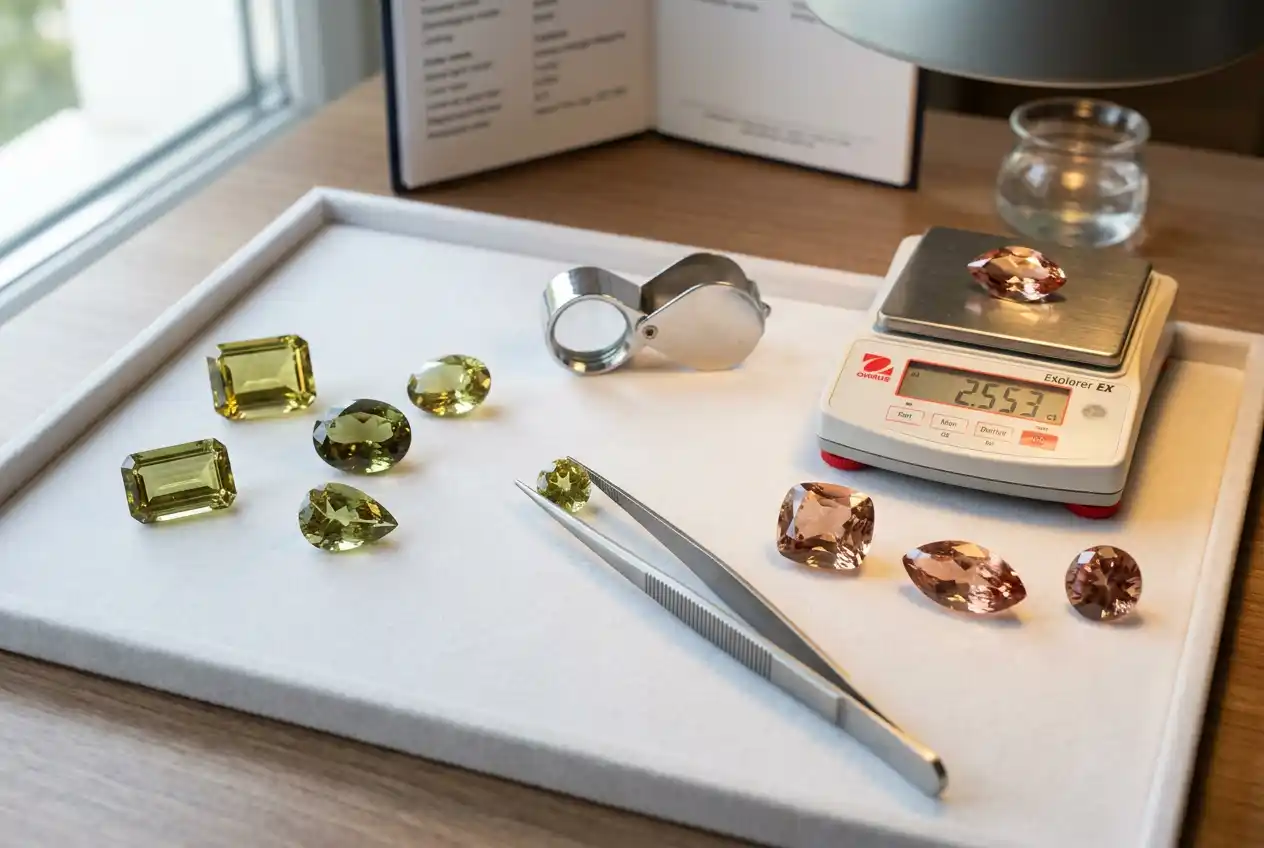
The market is particularly associated with color-change diaspore from Turkey. Under cooler daylight-equivalent illumination, fine stones may appear yellowish green, olive green, greenish yellow, or related tones, while warmer incandescent-style light can bring out champagne, pinkish, orangish, cinnamon, reddish-brown, or purplish impressions. The exact change varies from stone to stone and should not be described as though every diaspore makes the same dramatic green-to-red transition. Some gems show a strong transformation, while others display only a moderate shift in hue and tone.
Diaspore is an aluminum oxide hydroxide, AlO(OH), crystallizing in the orthorhombic system. It has a Mohs hardness around 6.5 to 7, but hardness alone does not describe its durability because the mineral has pronounced cleavage and can be brittle. This combination affects cutting yield, jewelry suitability, and ultimately value. Fine rough can be difficult to orient and facet without damage, which means a beautifully cut clean stone represents both natural rarity and considerable lapidary skill.
9 Value Factors That Determine Diaspore Price Per Carat
- Strength of the color change between different light sources
- Beauty of the daylight or cool-light color
- Beauty of the warm-light color
- Pleochroism and cutting orientation
- Clarity, transparency, and inclusion visibility
- Cut quality, brilliance, and face-up proportions
- Carat weight and rarity of larger clean stones
- Turkish origin, provenance, and trade-name positioning
- Natural identity, treatment status, condition, and market confidence
These nine factors should be evaluated together because a stone can excel in one area while remaining ordinary overall. A large diaspore with weak color change and poor transparency may be worth less per carat than a smaller gem that changes distinctly, remains bright under both light sources, and has been cut carefully to reveal its optical behavior.
Typical Diaspore Price Per Carat
Diaspore does not trade through one universally standardized price list, and the market is much smaller than the markets for sapphire, ruby, emerald, or diamond. Prices also vary according to whether a stone is sold generically as diaspore or through a branded color-change trade channel. The following ranges are best treated as broad orientation for natural loose stones.
| Diaspore Quality | Approximate Price Per Carat | Typical Characteristics |
|---|---|---|
| Commercial quality | $30 to $100 | Pale color, weak change, visible inclusions, ordinary cut |
| Good jewelry quality | $100 to $300 | Noticeable color change, good transparency, competent cutting |
| Fine quality | $250 to $600 | Strong change, attractive colors in both lights, good clarity |
| Fine larger stones | $500 to $1,000+ | Multi-carat size, strong change, high transparency, skilled cut |
| Exceptional collector or branded gems | Highly variable | Rare size, exceptional optical performance, provenance, premium cutting |
These ranges are not a formal tariff. A custom or precision-cut gem can exceed ordinary rates because cutting color-change diaspore requires careful orientation and carries a risk of cleavage-related loss. Finished jewelry may also cost much more because precious metal, side stones, design, labor, and brand positioning can outweigh the value of the center stone itself.
Strong Color Change Is the Main Driver of Diaspore Value
The defining attraction of gem diaspore is its ability to look noticeably different under light sources with different spectral distributions. Cool daylight or daylight-equivalent illumination may favor greenish, yellow-green, or olive components, while warmer incandescent-style light can strengthen champagne, pink, orange, reddish-brown, or purplish tones.
A fine stone should show a change that is obvious enough to appreciate without requiring extreme viewing conditions. If the gem appears nearly the same under both light sources, its color-change premium is naturally limited even when clarity and cutting are excellent.
The best color change is not determined by a universal percentage scale. The visual importance comes from how different the two appearances seem and whether both are attractive. A gem that changes strongly from dull gray-green to muddy brown may be less desirable than a stone with a somewhat smaller change between lively yellow-green and attractive warm rose-champagne.
Lighting must also be controlled during comparison. Modern LED lamps vary enormously in spectrum, so simply moving a stone from one room to another does not always provide a reliable test. Comparing a cool daylight-equivalent source with a genuinely warm source produces a more meaningful impression of the gem’s behavior.
The Daylight Color Needs to Be Attractive on Its Own
A strong change cannot compensate completely for an unattractive starting color. Fine diaspore should look appealing before the lighting is changed, with enough saturation to appear intentional rather than gray, washed out, or muddy.
Yellow-green and olive-green hues are common. Some stones can show brighter kiwi-like greens or more golden greenish-yellow appearances, while others lean toward brownish olive. Market preferences vary, but cleaner and more lively color generally commands greater demand.
Tone also matters. A very dark stone can lose transparency and brilliance, especially at larger sizes. Very pale stones may remain bright but can lack enough color strength to make the change impressive.
The daylight appearance therefore needs balance. Buyers should judge hue, saturation, tone, brightness, and transparency before allowing an appealing trade name or large carat weight to influence the decision.
Warm-Light Color Can Add Much of the Gem’s Emotional Appeal
Under warmer illumination, quality diaspore can shift toward champagne, peach, pinkish, cinnamon, reddish-brown, or purplish tones. This warm appearance is often the more dramatic half of the color-change experience because it contrasts strongly with the cooler greenish daylight state.
A warm-light color that becomes muddy or excessively brown can reduce desirability even if the change is technically strong. The best stones remain transparent and lively, allowing warm hues to appear through clean facet reflections rather than as a flat dark body color.
The strength of this effect also depends on the spectral output of the lamp. Old-fashioned incandescent lighting produces a different spectrum from many warm LEDs, which is why online images of color-change diaspore can vary dramatically.
A buyer should therefore evaluate the gemstone under multiple known light sources and not assume that one photograph captures its entire appearance.
Color Change and Pleochroism Are Different Optical Effects
Diaspore is strongly pleochroic, which means different crystallographic directions can display different colors even under the same light source. Color change, by contrast, describes a change in apparent color when the spectral composition of the illumination changes.
These two effects can occur in the same gemstone and interact visually. A cutter must orient the rough carefully so the most attractive pleochroic directions appear through the crown while also preserving a desirable color-change response.
If orientation is poor, one dull or overly brown pleochroic direction can dominate the face. A skilled orientation can create a more balanced mixture of green, yellow, pink, champagne, or warm brown components depending on lighting and viewing angle.
This is one reason cutting contributes disproportionately to value. The cutter is not merely shaping a transparent crystal. The cutter is deciding which optical directions become most visible in the finished gem.
Clarity and Transparency Strongly Influence Fine Diaspore Prices
Transparent facetable diaspore can contain crystals, fractures, veils, cleavage-related features, and other inclusions. Fine stones are most desirable when these features do not interfere significantly with light return or the color-change effect.
Eye-clean stones can command substantial premiums, particularly at larger sizes, because suitable transparent rough is limited. Small internal features visible only under magnification may have little effect when color and cut are strong.
Surface-reaching fractures deserve more attention because they can affect durability in a mineral that already has important cleavage. A stone with strong color but a major open fracture may be less suitable for a frequently worn ring than a slightly less saturated gem with better structural integrity.
Clarity should therefore be judged face-up first, then under magnification. The key question is whether inclusions reduce beauty, transparency, or durability rather than whether the gem achieves microscopic perfection.
Cut Quality Has an Unusually Large Effect on Diaspore Value
Diaspore presents a demanding cutting problem because the lapidary needs to manage cleavage, pleochroism, color change, weight retention, and light performance at the same time.
A good cut should distribute brightness across the face and avoid a large central window. Windowing occurs when pavilion angles are too shallow, allowing the viewer to see through the stone rather than receiving strong returned light. In pale diaspore, a window can make the color appear even weaker.
Excessive depth creates different problems. It can hide weight beneath the girdle, reduce face-up size, and make darker stones appear overly closed. The best proportions preserve sufficient depth for color while still returning useful light.
Symmetry and polish matter as well. Clean facet junctions help the complex color impressions appear deliberate, while scratches, uneven facets, or an off-center design can make the gem look less refined.
Because rough can be difficult to cut safely, precision work may justify a noticeable premium even when the finished gem weighs less than a commercially cut stone from comparable rough.
Larger Clean Diaspore Becomes Progressively Rarer
The mineral diaspore itself is not extraordinarily rare in geology, but transparent, attractive, color-changing rough suitable for jewelry is much less common. Large crystals can contain cleavage, fractures, clouds, or orientation problems that reduce faceting yield.
This means the price per carat can rise significantly as finished stones become larger while retaining strong color change and transparency. A ten-carat clean gem with excellent color behavior belongs to a very different rarity category from a small commercial stone.
The relationship remains quality-dependent. A large brownish gem with weak change should not automatically receive a premium merely because its weight is impressive.
Face-up dimensions also matter. Deep cutting can preserve valuable carat weight, but a stone that carries substantial hidden depth may look surprisingly small once mounted. Buyers should therefore compare length, width, depth, and optical quality alongside the number on the scale.
Turkish Origin Has Strong Market Recognition
Modern gem-quality color-change diaspore is strongly associated with Turkey, especially deposits in southwestern Anatolia. This association has shaped much of the gemstone’s commercial identity.
Turkish provenance can add confidence and collector interest when supported appropriately, particularly for large fine stones. However, the visible qualities of the gem should still determine much of its jewelry value.
A weak stone does not become exceptional simply because it carries a famous source name. Color change, clarity, orientation, size, and cutting remain central.
Origin claims should also be separated from branding. A trade name may refer to a particular commercial program, quality selection, or distribution channel rather than representing a different mineral species.
Zultanite and Csarite Are Trade Names, Not Separate Minerals
Names such as Zultanite and Csarite have been used commercially for color-change diaspore associated with Turkish material. These names can carry branding recognition, but the underlying mineral is still diaspore.
A branded stone may cost more because of marketing, cutting, provenance controls, distribution, presentation, or guarantees. That premium does not mean the crystal belongs to a different mineral species from unbranded natural color-change diaspore.
Buyers should therefore separate mineral identity from commercial naming. The correct gemological question is whether the stone is natural diaspore, how well it changes color, how it has been cut, and whether the origin and treatment claims are credible.
A strong branded market can support higher retail pricing, but visual quality should still justify the premium.
Treatment and Natural Identity Need Accurate Disclosure
Color-change diaspore is generally valued for its natural optical behavior, and widespread routine color enhancement is not central to the market in the way heat treatment is for sapphire or aquamarine.
That does not eliminate the need for identification. Other color-changing gemstones, synthetic products, glass, and manufactured substitutes can imitate portions of the visual effect.
A laboratory report may be worthwhile for expensive stones because correct mineral identity, natural origin, and treatment disclosure materially affect value.
Buyers should also be cautious when a seller suggests that a dramatic change alone proves authenticity. Optical behavior is useful evidence, but it should be combined with standard gemological testing when The Price is substantial.
Diaspore Durability Affects Jewelry Value
Diaspore has a Mohs hardness around 6.5 to 7, giving it moderate scratch resistance, but its pronounced cleavage means it is not as forgiving as sapphire, spinel, or diamond.
A hard blow delivered in an unfortunate direction can chip or split the stone. This makes protective settings important, particularly for rings.
Pendants and earrings are lower-risk choices because they experience fewer impacts. Rings can still be worn successfully when the stone is protected and the wearer accepts the need for care.
Ultrasonic and steam cleaning should be approached cautiously, especially when fractures are present. Gentle cleaning with mild soap, lukewarm water, and a soft brush is generally the safer routine.
Structural condition therefore influences value directly. A fine large stone with a significant cleavage-related fracture should not be valued as though durability were irrelevant.
How to Compare Two Diaspore Stones Before Buying
Begin by viewing both stones under the same cool daylight-equivalent light and compare their starting colors, transparency, and brightness. Then move them together into a genuinely warm light source and judge the degree and attractiveness of the change. This side-by-side method prevents photography and memory from exaggerating differences.
Next rotate the stones under the same light to evaluate pleochroism and cutting orientation. A fine gem should remain visually interesting through normal movement instead of turning muddy or excessively dark from most angles.
Inspect clarity, windowing, symmetry, and face-up dimensions before checking the carat labels. Only then should provenance, branding, laboratory documentation, and Price be used to complete the comparison.
This sequence keeps the optical qualities that make diaspore special at the center of the buying decision.
Conclusion
Diaspore price per carat is driven primarily by color-change strength, attractiveness in both cool and warm light, pleochroism, clarity, cutting, carat weight, Turkish provenance, natural identity, and structural condition. Commercial stones can remain relatively accessible, while fine multi-carat gems with strong change, excellent transparency, and skillful orientation can command several hundred dollars per carat or substantially more.
The strongest value comes from balance rather than a single dramatic feature. A fine diaspore should look attractive before and after the light source changes, remain bright enough for its colors to be appreciated, avoid major durability problems, and be cut in a way that uses its pleochroism rather than fighting it. Buyers who evaluate those characteristics directly can understand value far more accurately than buyers relying solely on carat weight or a branded trade name.
FAQs About Diaspore Price Per Carat
How much does diaspore cost per carat?
Commercial color-change diaspore may sell for roughly $30 to $100 per carat, while good jewelry-quality stones can move into approximately $100 to $300 per carat. Fine and larger gems with strong color change and good transparency can reach several hundred dollars per carat or more.
Why is color-change diaspore expensive?
Fine transparent rough with an attractive color change is limited, and larger clean stones are increasingly difficult to cut because of cleavage, orientation, and internal fractures. Skilled cutting also contributes significantly to value.
What colors should natural diaspore show?
Many gem-quality stones appear yellowish green, olive, or greenish yellow under daylight-like illumination and change toward champagne, pinkish, orangish, reddish-brown, or related warm tones under incandescent-style light.
Does every diaspore change from green to red?
No. The exact colors and strength of change vary substantially. Some gems produce a dramatic transformation, while others show a more subtle shift between yellow-green, champagne, pink, or brownish tones.
Is Zultanite a different gemstone from diaspore?
No. Zultanite is a trade name used for certain color-change diaspore. The underlying mineral species remains diaspore.
Is Csarite a different mineral?
No. Csarite is another commercial trade name associated with color-change diaspore. Trade branding should be separated from mineral identity.
Does larger diaspore cost more per carat?
Fine larger stones can command substantially higher rates because maintaining strong color change, transparency, and structural integrity becomes increasingly difficult as size rises. Large weak-color stones do not receive the same premium.
Does clarity matter in diaspore?
Yes. Fine transparent stones are highly desirable, particularly in larger sizes. Inclusions and fractures that reduce transparency or threaten durability can lower value.
Is pleochroism the same as color change?
No. Pleochroism means different crystallographic directions show different colors under the same light source. Color change refers to a change in apparent color when the spectrum of the illumination changes.
Is Turkish diaspore more valuable?
Turkey has the strongest commercial association with fine color-change gem diaspore, and reliable provenance can add collector interest. Individual color change, clarity, cut, and size still determine much of the stone’s value.
Is diaspore commonly treated?
Routine color enhancement is not a dominant feature of the gem diaspore market. Accurate identification and treatment disclosure are still important for valuable stones.
Is diaspore durable enough for a ring?
Diaspore has moderate hardness but important cleavage, so rings require more care than sapphire or diamond. A protective setting and avoidance of sharp impacts are advisable.
Does precision cutting increase diaspore value?
Yes. Correct orientation can improve color change, pleochroic balance, brilliance, and face-up size. Precision cutting is particularly valuable because the rough can be difficult to facet without cleavage damage.
Is diaspore a good investment?
Exceptional stones can have collector appeal, especially in larger sizes with strong color change and provenance, but ordinary jewelry should not be treated as a guaranteed financial investment. Resale depends on rarity, documentation, demand, and purchase Price.
What makes diaspore collector quality?
Collector-quality diaspore combines a strong and attractive color change, appealing pleochroism, excellent transparency, significant size, fine cutting, strong condition, natural identity, and credible provenance.