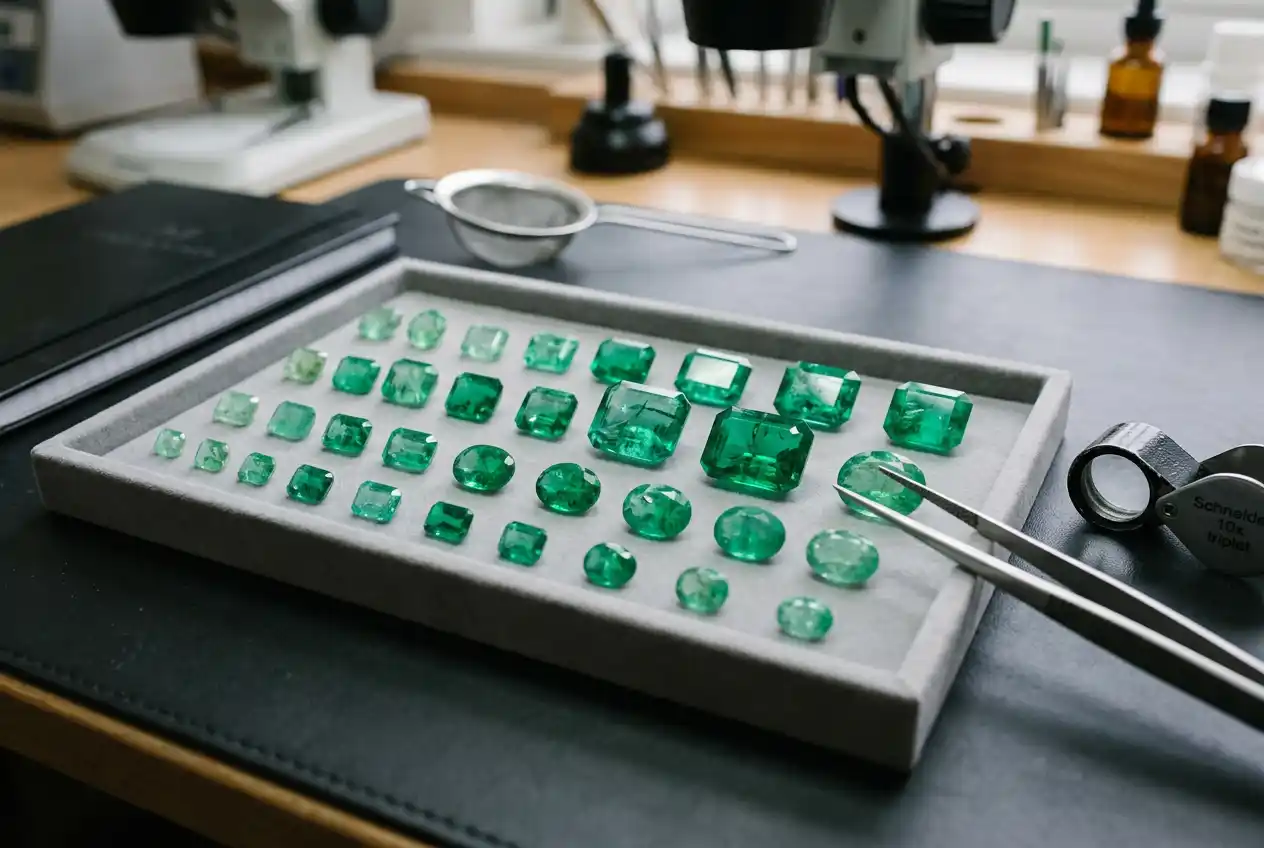
Emerald Quality Grading: 9 Ways to Rate Color, Clarity & Origin
Emerald quality grading begins with color, but a dependable grade must also account for transparency, jardin, treatment, cut, size, natural identity, origin, and structural condition. Fine emerald should display a vivid green that remains attractive in realistic lighting, enough transparency for the stone to look luminous, inclusions that do not overwhelm the face, and cutting that preserves both color and durability. Unlike many transparent gemstones, fine emerald does not need to be internally flawless because natural inclusions are expected and can occur even in highly valuable stones.
Emerald is chromium- or vanadium-bearing green beryl with the formula Be₃Al₂Si₆O₁₈. Its Mohs hardness of approximately 7.5 to 8 gives good resistance to scratching, but emerald commonly contains fissures that can reduce toughness. That combination explains why grading must consider internal structure as well as appearance. A beautiful stone with an open fracture near an exposed corner may require more careful jewelry use than a slightly more included gem whose inclusions are structurally harmless.
There is no single universal AAA or AAAA grading system governing the entire emerald market. Seller-defined labels vary greatly, and origin names can also become misleading when used as substitutes for actual quality. A serious assessment grades the stone characteristic by characteristic and then considers provenance as an additional factor rather than assuming Colombian, Zambian, or another locality automatically determines excellence.
9 Ways to Rate Emerald Color, Clarity and Origin
- Confirm natural emerald identity
- Grade green hue and color modifiers
- Evaluate saturation and tone
- Assess transparency, clarity, and jardin
- Determine the type and degree of clarity enhancement
- Judge cut quality, proportions, and color distribution
- Consider carat weight, dimensions, and structural condition
- Evaluate geographic origin and provenance
- Review laboratory documentation, treatment disclosure, and overall rarity
These nine standards create a practical framework that recognizes emerald’s natural characteristics rather than applying diamond-like clarity expectations. Fine grading depends on balance, especially between rich color and sufficient transparency.
Natural Emerald Identity Must Be Confirmed Before Quality
A transparent green gemstone should not receive an emerald grade until its identity is established. Green tourmaline, peridot, glass, synthetic spinel, dyed beryl, composite stones, and other products can overlap visually with emerald under certain conditions.
Natural emerald belongs to the beryl species and can be identified through refractive properties, birefringence, specific gravity, spectroscopy, inclusions, and other gemological observations.
Synthetic emerald complicates the picture because hydrothermal and flux-grown emeralds share the basic beryl structure and can display intense green color. Their laboratory origin places them in a different rarity category even when their visual quality is excellent.
Natural versus synthetic separation can require microscopic examination and advanced testing, particularly in clean stones. High value should therefore increase the importance of reliable identification.
Hue Should Be Clearly Green Rather Than Merely Greenish
Fine emerald should possess a distinctly green body color. Slight blue or yellow modifiers can occur, but the hue should remain recognizably within the emerald range rather than drifting toward pale green beryl.
Slightly bluish green is highly prized in many markets, particularly when saturation is strong. Yellow-green stones can also be attractive, but too much yellow may weaken the classic emerald appearance.
Color should be judged in neutral lighting and against an appropriate background. Warm room lighting can make a stone look more yellow, while cool illumination can emphasize blue components.
The setting also influences perception. Yellow gold can warm the apparent green, while white metals may emphasize cooler tones.
A high-grade emerald should remain compelling across ordinary viewing conditions rather than depending on one specially selected lamp.
Saturation and Tone Need to Work Together
Saturation describes the intensity of the green, while tone describes how light or dark it appears. The most desirable emeralds generally show strong saturation without becoming so dark that large portions of the stone lose transparency.
Very pale stones may technically belong to green beryl territory in some market usage rather than occupying the strongest emerald category, depending on the nature and concentration of the coloring elements and the conventions being applied.
Excessively dark emerald can look rich in transmitted light but nearly black face-up. That reduces the luminous appearance usually associated with fine stones.
A balanced medium to medium-dark tone often performs well, although ideal tone varies with size and cutting. Larger gems can appear deeper naturally because the light path is longer.
The grader should therefore evaluate saturation, tone, and brightness as an integrated color system.
Transparency Is More Important Than Absolute Cleanliness
Emerald is often described as a Type III gemstone in commercial clarity discussions because inclusions are expected. This means clarity grading should focus on the degree to which inclusions interfere with transparency and durability rather than demanding a perfectly clean interior.
A fine stone may show crystals, fluid inclusions, healed fissures, growth tubes, or other internal features and still look highly transparent from normal viewing distance.
Dense clouds, broad fractures, black inclusions beneath the table, and heavy jardin that blocks light reduce quality more significantly.
The best approach is to judge face-up transparency first. If the stone still appears luminous, bright, and richly green, moderate inclusions may be acceptable or even characteristic.
Magnification then helps determine whether any features create structural concerns or support natural origin and provenance interpretation.
Jardin Is Natural, but Not Every Inclusion Is Equally Desirable
Jardin is a traditional term for the garden-like internal scene formed by inclusions and fissures within natural emerald. The word recognizes that inclusions are part of emerald’s normal visual character.
A delicate jardin can be fascinating under magnification and may create confidence that the stone formed naturally. It should not be confused with a universal sign of high quality, however.
Large open fractures can reduce durability, dark crystals may interrupt face-up beauty, and dense cloudy inclusions can make the emerald look opaque.
Location matters as much as abundance. A fracture near the girdle or corner may create a setting risk, while a small internal crystal near the edge can have little effect on appearance.
Fine grading therefore distinguishes attractive or harmless natural features from inclusions that damage transparency or structural security.
A Practical Emerald Clarity Framework
| Face-Up Appearance | Practical Quality Interpretation |
|---|---|
| High transparency with limited visible jardin | Exceptional to fine |
| Attractive jardin with strong transparency | Fine |
| Visible inclusions with moderate brilliance reduction | Good |
| Heavy inclusions, broad fractures, or significant clouding | Commercial |
| Opaque appearance or serious structural weakness | Lower jewelry quality |
This framework is descriptive rather than an official universal grading system. It reflects emerald’s natural inclusion profile more realistically than a standard that expects complete internal cleanliness.
Clarity Enhancement Must Be Graded Separately
Many emeralds contain surface-reaching fissures that become less visible when filled with oils, resins, or other substances. This treatment improves apparent clarity by reducing the refractive contrast within the fissure.
Enhancement is often described in broad degrees such as minor, moderate, or significant, although exact terminology can vary by laboratory.
Minor enhancement is widely accepted in the market and can coexist with very fine quality. Moderate or significant filling generally reduces rarity and value because a larger part of the apparent clarity depends on treatment.
The type of filler also matters. Traditional oils and more durable resin products may differ in stability, detectability, and maintenance.
A quality grade should therefore state visual clarity and treatment level separately. Otherwise, a heavily filled emerald could appear superficially similar to a naturally cleaner stone even though their rarity profiles are very different.
Cut Quality Should Preserve Color Without Sacrificing Durability
Emerald rough commonly contains fissures, zoning, and elongated crystal shapes, so cutting decisions are often constrained by natural structure.
The classic emerald cut uses stepped rectangular facets and truncated corners. This shape can suit elongated rough, protect vulnerable corners, and display color through broad reflective planes.
A fine cut should minimize windowing while preserving enough depth for saturation. An overly shallow stone may reveal a large see-through center, while excessive depth can hide weight and create darkness.
Symmetry and polish should also be examined, but perfect geometric precision may sometimes be sacrificed to preserve rare color or avoid a dangerous fracture.
The best cutting judgment therefore asks whether the final shape uses the rough intelligently rather than demanding a standardized template regardless of natural limitations.
Carat Weight Becomes Important Only After Quality Is Established
Large emeralds can command extraordinary premiums, but weight alone does not produce a high grade. A ten-carat pale opaque stone and a three-carat vivid transparent emerald belong to completely different quality categories.
Size becomes powerful when the gem retains rich saturation, useful transparency, good cut, manageable enhancement, and structural integrity.
Face-up dimensions should accompany weight. Deep stones can carry significant hidden mass, while broad stones may deliver greater visual size at lower carat weights.
Important collector-level emeralds often combine several carats with fine color, limited enhancement, respected provenance, and attractive natural jardin. That combination is much scarcer than simply finding a large green crystal.
Colombian Origin Has Prestige but Is Not a Quality Grade
Colombia has a legendary place in emerald history, with mines such as Muzo, Chivor, and Coscuez producing important stones over centuries.
Fine Colombian emerald can display vivid saturated green, sometimes with a slightly warmer or balanced appearance that collectors find highly desirable. Characteristic inclusion scenes may also help laboratories assess origin.
This reputation creates a market premium for well-documented fine stones, but origin should not replace direct grading. Colombian mines produce a wide range of quality levels.
A transparent vivid Zambian emerald can grade above a pale Colombian gem even if the Colombian stone carries stronger historical prestige.
The proper sequence is therefore to grade visible quality first and apply a provenance premium afterward when justified.
Zambian Emeralds Can Reach the Highest Quality Levels
Zambia has become one of the world’s major sources of fine emerald. Many stones show vivid green to bluish-green color, excellent saturation, and good transparency.
Their inclusion patterns and chemistry can differ from typical Colombian stones, but these distinctions are useful for origin work rather than universal quality ranking.
Large clean Zambian stones can command very strong prices, especially when their color remains bright and treatment is limited.
The rise of Zambian material is an important reminder that fine emerald should be judged by actual appearance and documented characteristics rather than by an assumption that only one country can produce top quality.
Brazilian, Ethiopian, Afghan and Pakistani Emeralds Also Deserve Individual Grading
Brazil has produced emerald from several important deposits and remains a significant part of the global market. Stones vary widely in saturation and clarity, so Brazilian origin alone says little about individual quality.
Ethiopia has produced attractive emerald with vivid green color and commercially important transparency. Certain stones have entered the fine market and can compare strongly with better-known sources.
Afghanistan and Pakistan are notable for emeralds from difficult mountainous deposits, including material capable of excellent color and collector significance.
Every locality produces variation. Origin can support provenance and rarity, but the stone must still be evaluated for hue, saturation, tone, clarity, treatment, cutting, and condition.
Synthetic Emerald Can Be Visually Excellent but Has Different Rarity
Hydrothermal and flux-grown synthetic emerald can show vivid color and high transparency, sometimes with inclusion scenes deliberately similar to those found in natural stones.
The correct grading approach is not to call synthetic emerald visually poor simply because it is laboratory-grown. It can have excellent color and cutting.
Its geological rarity, however, is fundamentally different. Laboratory production can create additional supply, which normally places synthetic stones at substantially lower market values than comparable natural emerald.
Accurate identification is therefore essential whenever The Price assumes natural scarcity.
Laboratory Reports Are Especially Important for Fine Emerald
Independent laboratory documentation becomes increasingly useful because emerald value can depend heavily on natural identity, treatment level, and origin.
A report may state whether the stone is natural or synthetic, describe evidence of clarity enhancement, and provide an origin opinion when sufficient gemological evidence is available.
These findings can change value substantially. An emerald with minor oil and documented Colombian origin occupies a different rarity category from a heavily filled stone of uncertain origin.
The report still cannot capture everything. Actual color beauty, windowing, face-up transparency, and the aesthetic character of the jardin require direct visual judgment.
Common Emerald Grading Mistakes
A frequent mistake is treating the darkest emerald as the best. Fine saturation is desirable, but an overly dark stone can lose the transparency and lively green appearance that create beauty.
Another error is rejecting all inclusions. Emerald is naturally included, and a fine transparent stone can contain visible jardin while remaining highly valuable.
The opposite mistake is romanticizing every inclusion as desirable jardin. Large open fractures and dense clouds still reduce quality and can create durability problems.
Origin names are also overused. Colombian does not automatically mean exceptional, just as Zambian, Brazilian, Ethiopian, Afghan, or Pakistani origin does not establish a lower grade.
Finally, enhancement needs direct consideration. Two stones that look similar after filling can represent very different natural clarity levels.
A Practical Overall Emerald Quality Framework
| Quality Level | Typical Characteristics |
|---|---|
| Exceptional | Vivid saturated green, strong transparency, limited distracting jardin, fine cut, minor or no enhancement |
| Fine | Rich green, good transparency, characteristic inclusions, competent cut, limited enhancement |
| Good | Attractive green, moderate inclusions, some windowing or enhancement |
| Commercial | Pale or dark color, heavy jardin, stronger enhancement, ordinary cut |
| Lower quality | Weak color, poor transparency, major fractures, heavy filling or serious damage |
This framework is descriptive rather than universally standardized. Its strength is that every grade can be explained through observable qualities and treatment information.
Emerald Durability Should Be Part of the Final Grade
A hardness of 7.5 to 8 provides good scratch resistance, but fissures make emerald less tough than the hardness number alone suggests.
A fracture running near a corner or girdle can increase the risk of chipping during setting or wear. Protective design therefore matters particularly in rings.
Steam and ultrasonic cleaning can affect fissures and fillers, making gentle cleaning a safer choice for most stones. Harsh solvents can disturb some oils or resins.
A high-quality grade should therefore include condition and structural integrity, especially when the stone will be worn frequently rather than kept primarily as a collector gem.
Conclusion
Emerald quality grading depends on natural identity, green hue, saturation, tone, transparency, jardin, enhancement, cut, carat weight, origin, documentation, and condition. Fine stones achieve a vivid green appearance without becoming excessively dark and retain enough transparency for their color to appear luminous.
Emerald’s natural inclusions make balance especially important. A perfectly clean stone is not required, while a richly colored gem with characteristic jardin can be exceptional when its inclusions do not overwhelm transparency or durability. Buyers who separate visible quality, treatment level, and geographic provenance can judge emerald far more accurately than buyers relying on darkness, country name, or an unstandardized AAA label.
FAQs About Emerald Quality Grading
What is the most important emerald quality factor?
Color is usually the strongest visible factor. Fine emerald should show vivid green with strong saturation and enough brightness to remain lively rather than overly dark.
Should high-quality emerald be eye-clean?
Not necessarily. Natural emerald commonly contains visible inclusions, and fine stones can show jardin while retaining excellent transparency. Completely clean large natural emeralds are unusual and should be examined carefully for natural versus synthetic identity.
What does jardin mean?
Jardin refers to the garden-like internal scene created by natural inclusions and fissures within emerald. It can add character, but heavy jardin that reduces transparency or creates structural weakness still lowers quality.
Is Colombian emerald the highest grade?
Colombian origin can carry a premium, but it is not a quality grade by itself. A fine Zambian or emerald from another source can outperform a weaker Colombian stone in color, clarity, or cutting.
Are Zambian emeralds high quality?
Yes. Zambia produces fine emeralds with vivid green to bluish-green color and strong transparency. Exceptional stones can compete directly with fine material from other prestigious sources.
Does oiling lower emerald quality?
Minor oiling is common and widely accepted, while moderate or significant enhancement generally reduces rarity and value more strongly. Treatment level should be graded separately from the stone’s face-up beauty.
Are untreated emeralds always better?
No. Untreated status adds rarity when the stone already has excellent natural color and clarity. A poorly colored untreated emerald can still grade below a fine stone with minor enhancement.
What emerald color is considered best?
Vivid green to slightly bluish green is highly desirable when saturation is strong and the stone remains bright. Excessive yellow, gray, or darkness can lower conventional quality.
Why are emeralds so included?
Emerald commonly forms in geological environments that create internal crystals, fluids, fractures, and growth structures. These features are normal enough that clarity expectations are more tolerant than for aquamarine or diamond.
Does carat weight determine emerald grade?
No. Size is a rarity factor only after color, transparency, treatment, cut, and condition have been evaluated. A smaller vivid stone can grade far higher than a large opaque emerald.
Is synthetic emerald chemically real emerald?
Synthetic emerald has the beryl structure and appropriate emerald coloring components, but it is laboratory-grown rather than natural. It therefore belongs to a different origin and rarity category.
Why is laboratory documentation important for emerald?
A respected report can help establish natural identity, treatment level, and geographic origin, all of which can materially influence value. Visual inspection remains necessary for judging color and transparency.
Can emerald be worn every day?
It can be worn regularly with care, especially in protective settings. Natural fissures make emerald more vulnerable to impact than sapphire or diamond, so hard knocks and aggressive cleaning should be avoided.
Are AAA emerald grades standardized?
No. AAA, AAAA, premium, and similar labels vary between sellers. A meaningful grade should describe color, transparency, inclusions, enhancement, cut, size, origin, and condition directly.
What makes an emerald exceptional?
Exceptional emerald combines vivid saturated green, strong transparency, attractive natural jardin, fine cutting, significant size, limited enhancement, excellent condition, and reliable natural-origin documentation.