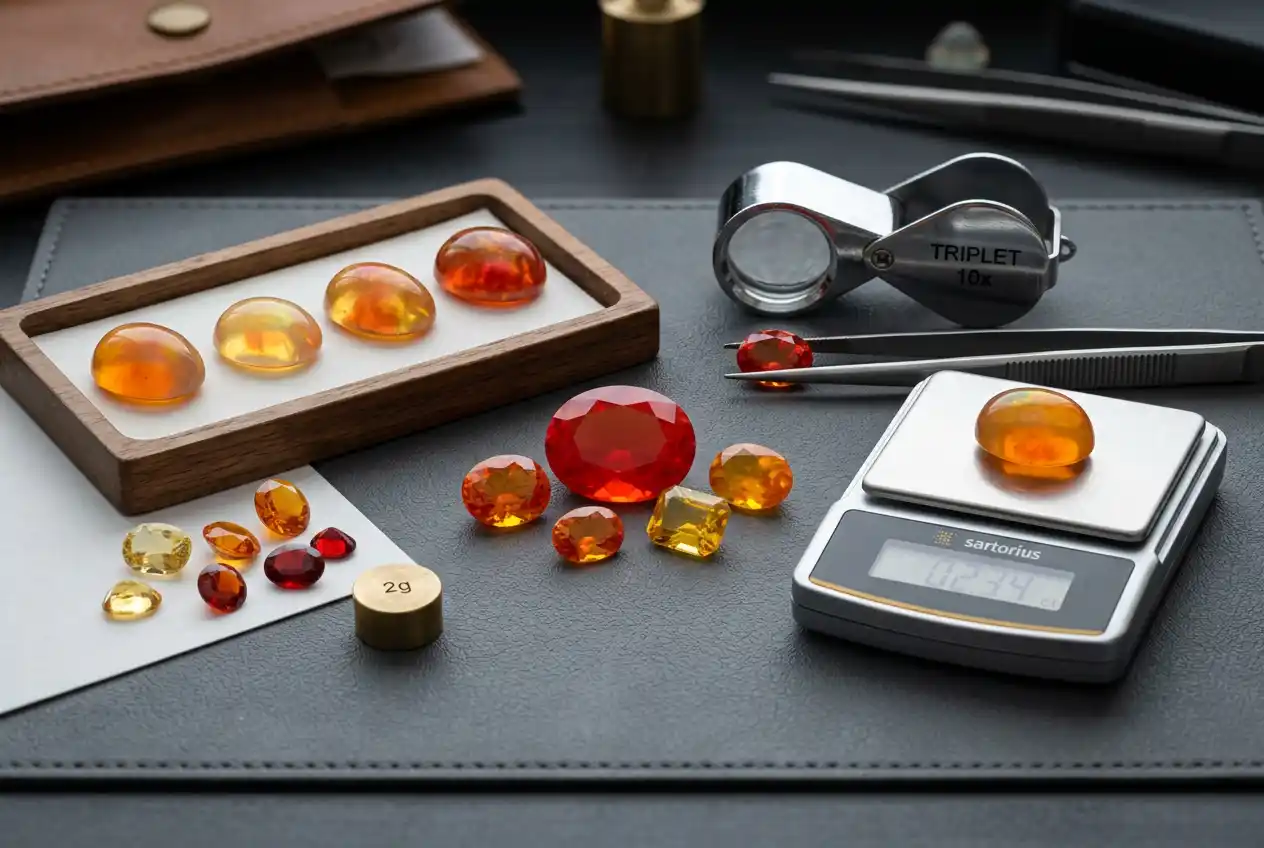
Fire Opal Price Per Carat: 9 Major Market Cost Factors
Fire opal price per carat can range from roughly $20 to $100 for commercial yellow or orange stones with modest transparency and ordinary cutting to several hundred dollars per carat for vivid orange-red gems with strong transparency, attractive proportions, and good stability. Fine transparent stones with intense red-orange body color can move into roughly $300 to $1,000 per carat, while exceptional large gems combining saturated color, high transparency, excellent cutting, natural play-of-color, desirable provenance, and strong condition may exceed $1,000 per carat substantially. The Price varies so widely because fire opal is judged through a combination of body color, transparency, play-of-color, clarity, cutting, size, structural stability, origin, and treatment rather than weight alone.
Fire opal is an opal variety characterized primarily by warm body colors ranging from yellow through orange to reddish orange and red. Unlike white or black precious opal, fire opal does not need to show play-of-color to qualify as fire opal because the defining feature is its warm body color. Some specimens are transparent enough to facet like conventional gemstones, while others are translucent and better suited to cabochons. A smaller number combine vivid orange or red body color with precious play-of-color, creating an especially desirable combination when the spectral flashes remain strong and the stone is structurally stable.
Mexico has the strongest historical association with fine transparent fire opal, particularly material from volcanic regions where vivid yellow, orange, and reddish stones have been mined for generations. Other sources also produce warm-colored opal, but Mexican origin has become deeply connected with the commercial identity of fire opal. Provenance can add interest, yet it does not override visible quality. A richly colored, transparent, well-cut stone from a documented source will generally command more than a pale, heavily fractured stone carrying a famous locality name.
9 Major Market Cost Factors Behind Fire Opal Price Per Carat
- Strength and attractiveness of yellow, orange, or red body color
- Tone, saturation, and freedom from muddy brown or excessive darkness
- Transparency and translucency
- Presence, brightness, and coverage of play-of-color
- Clarity, inclusions, cracks, and crazing
- Cut quality, polish, proportions, and face-up size
- Carat weight and rarity of larger fine stones
- Geographic origin, provenance, and natural identity
- Treatment status, stability, craftsmanship, and market demand
These nine factors need to be considered together because fire opal can occupy several visual categories at once. A transparent orange-red faceted stone may derive nearly all of its value from saturated body color, transparency, size, and precision cutting, while a translucent cabochon may receive a major premium from bright spectral flashes moving across the warm body. A large gem with weak yellow color and a deep window can still be worth less per carat than a smaller stone whose red-orange color remains vivid, transparent, and beautifully cut.
Typical Fire Opal Price Per Carat
Fire opal does not trade through a single standardized international price chart, and individual stones differ too much for one fixed The Price to describe the entire market accurately. The following ranges provide a practical orientation for natural loose stones while recognizing that exceptional provenance, unusual pattern, fine cutting, or documented untreated condition can move a gem outside these bands.
| Fire Opal Quality | Approximate The Price Per Carat | Typical Characteristics |
|---|---|---|
| Commercial quality | $20 to $100 | Pale yellow to orange, modest transparency, ordinary cut |
| Good jewelry quality | $80 to $300 | Attractive orange color, good transparency or translucency, competent cutting |
| Fine quality | $250 to $700 | Strong orange-red saturation, good clarity, lively face-up appearance |
| Exceptional transparent fire opal | $500 to $1,000+ | Vivid red-orange, high transparency, fine cutting, desirable size |
| Fine fire opal with strong play-of-color | Highly variable, often $500+ | Attractive body color combined with bright spectral play |
| Rare collector stones | Highly variable | Exceptional size, color, play-of-color, provenance, stability, or historical importance |
These categories should not be treated as a mechanical formula because a faceted transparent fire opal and a precious fire-opal cabochon are not valued through exactly the same visual priorities. The transparent faceted stone depends heavily on body color, transparency, symmetry, and brilliance, while the cabochon may derive more of its appeal from play-of-color, pattern, and surface coverage. Finished jewelry can also cost considerably more because precious metal, accent stones, custom design, setting labor, and brand positioning contribute to the total rather than belonging to the loose opal itself.
Vivid Orange and Red Body Color Drive the Strongest Premiums
Body color is the defining feature of fire opal, and the most valuable stones generally show a clean, attractive warm hue that remains lively rather than muddy. Yellow fire opal can be beautiful and bright, particularly when transparent, but richer orange and reddish-orange colors commonly receive stronger market demand when saturation remains high. Fine red-orange stones can become especially desirable because they combine visual intensity with the transparency needed for brilliant faceting.
Color quality depends on saturation and tone working together. A richly saturated orange stone can still lose appeal if it becomes so dark that transparency and light return collapse, while a very pale yellow gem may remain brilliantly transparent but lack the visual strength buyers expect from fine fire opal. Brown modifiers can create attractive cinnamon or burnt-orange appearances in some stones, yet heavy brown usually lowers conventional value when it overwhelms the cleaner orange or red component.
Lighting has a strong effect on perception, so fire opal should be compared under consistent conditions. Warm lamps can intensify orange and red dramatically, while cooler daylight-equivalent illumination may reveal whether the color remains naturally strong without artificial warmth from the environment. Fine stones retain an attractive identity under several realistic light sources rather than looking vivid only beneath concentrated jewelry-store lighting.
Transparency Can Transform Fire Opal Into a Faceted Gem
One of fire opal’s most distinctive characteristics is that some stones are transparent enough to facet, which is unusual within the opal family. Transparent faceted fire opal can produce a bright, glassy appearance in which body color becomes the main attraction rather than play-of-color. High transparency allows light to travel through the stone cleanly, making cut quality and internal clarity much more visible than they are in an opaque or heavily translucent cabochon.
Transparency alone does not guarantee high value because a nearly colorless transparent opal may lack the saturation required for strong market demand. The finest faceted stones combine clarity with intense yellow-orange, orange, or red-orange body color, creating a luminous appearance rather than a pale watery one. Internal clouds, fractures, or heavy inclusions can reduce this effect because they interfere with the clean passage of light and make the gem look less lively.
Translucent fire opal follows a somewhat different quality hierarchy. A stone can be less transparent yet display exceptional body color and bright precious play-of-color, allowing the spectral effect to compensate strongly for reduced transparency. This is why grading needs to identify the visual style of the individual gem before assigning too much importance to a single characteristic.
Play-of-Color Can Add a Major Rarity Premium
Not every fire opal displays play-of-color, and its absence does not mean the stone is not genuine fire opal. When bright spectral play does occur, however, it can raise The Price significantly because the gem combines two desirable features: warm body color and the diffraction-based color flashes associated with precious opal.
Fine play-of-color should appear bright enough to remain visible without requiring an extremely narrow viewing angle. Red, green, blue, orange, and violet flashes may move across the stone as it tilts, and broad coverage generally increases desirability when the pattern remains distinct. A vivid green or red flash crossing a transparent orange body can create an unusually complex visual effect that differs substantially from ordinary faceted fire opal.
The presence of spectral color should still be judged carefully because one small weak flash does not automatically create exceptional quality. Brightness, distribution, persistence through movement, and overall composition matter more than the mere ability to detect several colors under a spotlight. The highest premiums occur when body color and play-of-color strengthen each other rather than competing visually.
Clarity, Cracks, and Crazing Need Separate Evaluation
Transparent fire opal is usually more sensitive to clarity than opaque precious opal because internal features are easier to see. Fine faceted stones are most attractive when obvious inclusions, clouds, and fractures do not interrupt their transparency. Minor internal features visible under magnification may have little effect, but central cracks or cloudy zones can reduce brilliance substantially.
Structural condition is more important than conventional clarity alone because opal is hydrated amorphous silica and can contain internal stress. Crazing refers to a network of cracks that may develop when stress causes the stone to fracture internally or at the surface. A brilliantly colored gem with active crazing cannot be valued like a stable stone of equivalent appearance because long-term durability has become uncertain.
Single surface-reaching cracks also deserve attention, particularly in faceted fire opal where pressure at facet edges or girdle areas can lead to chipping. A stable minor inclusion may be aesthetically acceptable, while a relatively unobtrusive structural fracture can have a much greater effect on practical value. Fine grading therefore separates visual cleanliness from physical security rather than treating every internal feature equally.
Cut Quality Has a Major Effect on Transparent Fire Opal
Faceted fire opal requires careful proportions because the cutter is working with a gemstone whose value depends heavily on both body color and transparency. A pavilion that is too shallow can produce a large central window, allowing the viewer to see through the stone and weakening saturation. Excessive depth can preserve extra carat weight but make the face appear smaller while darkening the body color unnecessarily.
Fine cutting should distribute brightness across the stone while preserving the richest color direction available in the rough. Symmetry, polish, and crisp facet junctions become especially important in transparent gems because every irregularity is easy to see. An oval, cushion, pear, round, or custom shape can all perform beautifully when the proportions suit the rough rather than being chosen only to maximize weight.
Cabochon fire opal needs a different cutting approach because the goal is often to reveal body color and any play-of-color through a smooth curved surface. Dome height, surface polish, edge thickness, and pattern placement become more important than faceted brilliance. A skillfully cut freeform can therefore be far more valuable than a poorly proportioned calibrated shape if the freeform preserves rare color or an exceptional spectral pattern.
Carat Weight Creates a Premium Only When Fine Quality Survives
Fire opal can occur in respectable sizes, so large weight alone does not guarantee rarity. Commercial yellow or pale orange stones may remain affordable even at several carats, particularly when transparency, saturation, or cutting is modest. The Price per carat rises more meaningfully when strong color, transparency, clarity, stability, and good proportions continue into larger sizes.
Large transparent red-orange fire opal is substantially harder to replace than large pale material because the cutter needs a sizeable piece of rough that remains clean enough for faceting and strong enough to survive the process. A five-carat stone that combines saturated body color with high transparency therefore belongs to a different market category from a five-carat cloudy yellow gem.
Face-up dimensions should always accompany weight because a deep pavilion can hide several carats without increasing visible presence. Buyers seeking jewelry impact should compare length, width, depth, color distribution, and brilliance rather than assuming the heavier stone automatically offers greater visual value.
Mexican Origin Has Strong Historical Market Recognition
Mexico has long been associated with fine fire opal, and the name Mexican fire opal is deeply established within the gemstone trade. Volcanic deposits have produced transparent yellow, orange, and reddish material suitable for faceting as well as stones containing attractive play-of-color. This history gives documented Mexican provenance additional collector and commercial appeal when the individual stone is also fine.
Origin should remain an additional value factor rather than an automatic grade. Mexican deposits produce stones across a wide quality range, and a pale fractured gem does not become exceptional simply because its source is well known. Other countries can also produce orange or red opal, making direct gemological assessment more reliable than assuming locality from color alone.
For high-value stones, provenance can help distinguish a historically significant gem from an ordinary commercial product. A reliable record of mine locality, old collection ownership, or notable jewelry history can add value beyond the physical properties of the stone itself, particularly in large unusual specimens or antique pieces.
Treatment and Imitation Need Clear Disclosure
Fire opal is often valued for natural body color, but the wider opal market contains dyed, smoked, impregnated, coated, reconstructed, and synthetic products. Some treatments may create or intensify warm colors, while other manufactured stones imitate transparent orange opal effectively enough to confuse buyers relying only on photographs.
Natural fire opal should therefore be distinguished from synthetic opal, glass, resin products, and assembled stones before a rarity premium is applied. Treatment disclosure also matters because filling or impregnation can improve apparent clarity or stability in ways that affect value and future care.
A high-quality stone does not need a dramatic treatment story to justify its beauty. Fine natural body color, strong transparency, stable structure, and skilled cutting provide enough value on their own, which is why unsupported claims of exceptional rarity should be treated cautiously when documentation is absent.
Fire Opal Durability Influences Long-Term Value
Fire opal generally falls around 5.5 to 6.5 on the Mohs scale, so it is softer than quartz, topaz, sapphire, or diamond. Transparent faceted stones can therefore develop scratches and facet-edge abrasion more easily than harder gems, particularly in rings worn every day.
Opal’s toughness is also affected by internal fractures and water-related structure. A stable clean stone can perform well in jewelry when handled sensibly, while one containing significant cracks may require far more protection. Pendants and earrings naturally expose the gem to fewer impacts, whereas rings benefit from settings that shield edges and corners.
Gentle cleaning with lukewarm water, mild soap, and a soft cloth or brush is generally safer than aggressive methods. Steam, extreme heat, harsh chemicals, and ultrasonic cleaning should be avoided when fractures or treatment status are uncertain because unnecessary thermal or mechanical stress can damage a valuable stone.
How to Compare Two Fire Opals Before Buying
A useful comparison starts with body color under neutral lighting, where hue, saturation, tone, and transparency can be evaluated without the distraction of carat labels. The buyer should then rotate each stone slowly and determine whether either specimen shows play-of-color, how much of the face is active, and whether the spectral flashes remain visible through ordinary movement rather than only at one angle. This visual stage often reveals more about desirability than weight or origin.
The next step is to examine cutting, clarity, surface condition, and dimensions. A transparent faceted stone should be checked for windowing, excessive depth, central fractures, poor polish, and obvious extinction, while a cabochon should be evaluated for dome symmetry, surface polish, cracks, and pattern placement. Only after these characteristics are understood should carat weight, provenance, laboratory documentation, treatment disclosure, and The Price be used to complete the comparison.
Conclusion
Fire opal price per carat is shaped primarily by body color, tone, transparency, play-of-color, clarity, structural stability, cut, size, origin, treatment, and market demand. Commercial stones may remain affordable, while fine transparent orange-red gems and exceptional precious fire opals combining vivid body color with strong spectral play can command several hundred dollars per carat or considerably more.
The most desirable stone is not automatically the reddest, largest, or most transparent example. Fine fire opal needs balance, with saturated warm color remaining bright, a cut that supports rather than weakens the body color, a stable structure, and clearly understood treatment status. When strong transparency or vivid play-of-color appears alongside substantial size and trusted provenance, the gemstone can enter a much rarer and more expensive category.
FAQs About Fire Opal Price Per Carat
How much does fire opal cost per carat?
Commercial natural fire opal may begin around $20 to $100 per carat, while good jewelry-quality stones can move into approximately $80 to $300 per carat. Fine vivid orange or red-orange gems may reach several hundred dollars per carat, while exceptional transparent stones or specimens combining strong body color with bright play-of-color can move beyond $1,000 per carat depending on size, stability, provenance, and cutting.
Why is red fire opal more expensive than pale yellow fire opal?
Saturated red-orange and red body colors are generally less common and create stronger visual impact than pale yellow, particularly when transparency remains high. The premium still depends on tone, clarity, cutting, size, and stability because a dark muddy red stone can be less desirable than a luminous orange gem with excellent transparency.
Does fire opal have to show play-of-color?
No. Fire opal is defined primarily by its yellow, orange, or red body color and can be valuable without spectral play. When strong play-of-color is present, it can add a significant premium because the stone combines the warm body color of fire opal with the optical effect of precious opal.
Is Mexican fire opal more valuable?
Mexican origin has strong historical recognition and can add collector interest, especially when provenance is documented. The individual gem still needs fine color, transparency, stability, and cutting because locality alone does not create high quality.
Is transparent fire opal better than translucent fire opal?
Transparent stones are especially desirable for faceting because clarity allows light to move cleanly through the gem, but translucency is not automatically lower quality. A translucent cabochon with exceptional red body color and brilliant play-of-color can be more valuable than a transparent pale-yellow faceted stone.
Does fire opal become more expensive at larger sizes?
Fine larger stones can receive a substantial premium when intense body color, transparency, clarity, and stability remain strong. Large commercial stones with weak color or poor transparency do not receive the same increase simply because they weigh more.
Can fire opal craze?
Yes. Opal can develop networks of cracks known as crazing when internal stress compromises the structure. Existing crazing is a major value and durability issue even when the stone’s color is otherwise exceptional.
Is fire opal commonly treated?
Natural fire opal is often valued for its natural body color, but treatments and imitations can occur in the opal market. Dyeing, impregnation, coating, reconstruction, or synthetic production should be disclosed when present because these processes affect rarity, value, and care.
Can fire opal be faceted?
Yes. Transparent fire opal is one of the opal varieties commonly faceted. Good faceting can highlight its warm body color and brilliance, although the cutter must manage the gemstone’s moderate hardness, possible fractures, and risk of windowing.
What makes fire opal collector quality?
Collector-quality fire opal combines exceptional yellow-orange, orange, or red-orange color with high transparency or bright play-of-color, substantial natural size, strong stability, fine cutting, excellent condition, credible provenance, and accurate treatment disclosure.