Fire Opal Quality Grading: 7 Crucial Signs of High-Grade Gems
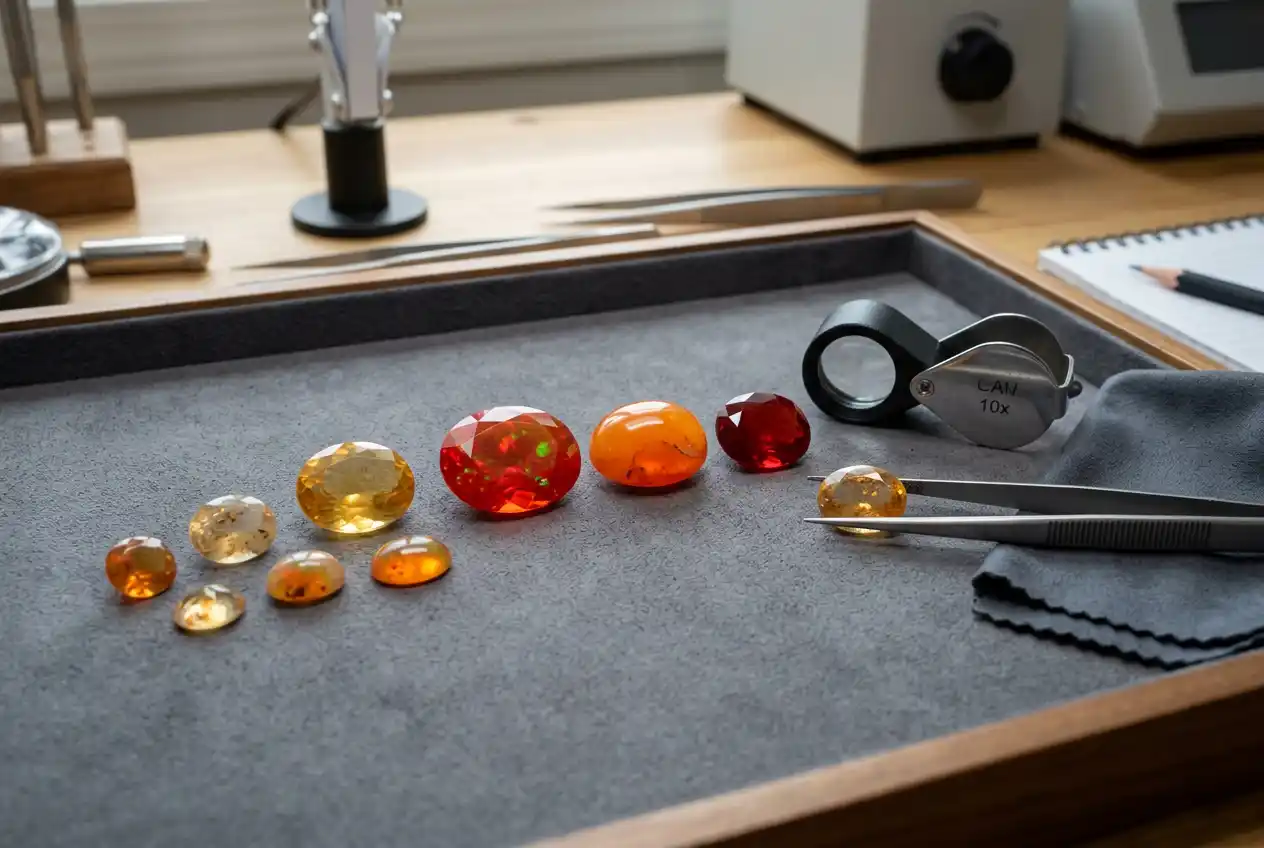
Fire opal quality grading begins with warm body color, but high-grade stones require much more than an intense orange or red appearance. Fine fire opal combines attractive hue, balanced saturation and tone, useful transparency or translucency, strong structural condition, appropriate cutting, and clearly understood treatment status. When play-of-color is present, its brightness and coverage provide another important quality dimension, but the absence of play-of-color does not prevent a transparent vividly colored stone from being excellent fire opal.
Fire opal differs from many other precious opals because body color is central to its identity. Transparent yellow, orange, and red-orange stones can be faceted, allowing them to display brilliance more like conventional transparent gemstones, while translucent specimens are often cut as cabochons. Some stones also show precious play-of-color, creating a hybrid appearance in which spectral flashes move through or across a strongly colored body. A useful grading system therefore needs to identify which visual style the individual gem belongs to before judging it through inappropriate standards.
The gem is hydrated amorphous silica rather than a crystalline mineral. Its hardness generally falls around 5.5 to 6.5, and structural stability can vary from one stone to another because cracks or crazing may occur. High-grade classification should therefore include durability as well as beauty, since a richly colored stone with active cracking does not belong in the same practical category as a stable gem with comparable color.
7 Crucial Signs of High-Grade Fire Opal
- Strong, attractive yellow, orange, orange-red, or red body color
- Balanced saturation, tone, brightness, and color distribution
- Appropriate transparency or translucency for the cutting style
- Bright and well-distributed play-of-color when present
- Good clarity with limited cracks, crazing, and structural weakness
- Skilled cutting, polish, symmetry, and efficient face-up proportions
- Natural identity, treatment disclosure, provenance, size, and overall condition
These seven standards create a practical grading structure without forcing every fire opal into one visual model. A transparent faceted stone can earn a fine grade through rich body color, high clarity, excellent proportions, and stable condition even without spectral play, while a translucent cabochon may achieve equally high quality because brilliant play-of-color interacts beautifully with its orange body.
Body Color Is the Foundation of Fire Opal Quality
The body color of fire opal usually ranges from yellow through golden orange and vivid orange to reddish orange and red. High-grade stones show a hue that looks intentional and saturated rather than weak, grayish, or muddy. Strong orange and red-orange tend to attract the greatest conventional market interest, but an exceptional golden-yellow stone can still grade highly when transparency, cutting, and brightness are excellent.
Color needs to be evaluated in neutral lighting because warm artificial illumination can make almost any orange stone appear richer. Daylight-equivalent light reveals whether the body maintains its saturation without relying on a lamp whose spectrum strongly favors red and yellow wavelengths. Fine fire opal should remain visually attractive under both neutral and ordinary indoor illumination, even though the precise warmth of the color may change.
Uniformity also affects quality. A transparent faceted gemstone generally benefits from reasonably even color distribution, while subtle zoning can be acceptable when the cutter has oriented it attractively. Large pale sections, abrupt muddy zones, or dark patches that interfere with the face-up appearance lower quality unless they contribute intentionally to a distinctive natural pattern.
Saturation and Tone Need to Preserve Liveliness
Saturation measures color intensity, while tone describes how light or dark the gemstone appears. These characteristics must work together because increasing saturation is useful only while enough light continues to return through the gem. A very dark red-orange stone may appear impressive in transmitted light yet look closed or brownish when viewed face-up under normal room illumination.
Medium to strong saturation with a balanced medium tone often produces a lively appearance, although ideal values depend on hue, size, transparency, and cutting. Larger stones can appear darker because light travels through more of the colored silica, while small stones may need stronger saturation to avoid looking pale.
Cutting changes apparent tone substantially. A deep pavilion can darken the stone and create unnecessary hidden weight, while a shallow pavilion can reduce saturation and form a window. Quality grading therefore needs to judge the finished face-up appearance rather than treating rough color or side-view darkness as proof of superior quality.
Transparency and Translucency Should Match the Gem’s Visual Style
Transparent fire opal can be graded much like other faceted colored gemstones in the sense that transparency, brilliance, and internal cleanliness become highly visible. Fine faceted stones should allow light to pass through cleanly enough for the body color to appear luminous, with inclusions or clouds remaining limited enough that they do not dominate the face.
Translucent fire opal requires a different expectation because diffusion inside the stone can create a glowing appearance rather than sharp transparency. Such material can be very attractive as a cabochon, particularly when body color is intense or when precious play-of-color is present. Penalizing every translucent stone merely because it cannot be faceted successfully would ignore a major and legitimate fire-opal category.
The correct question is whether the level of transparency supports the chosen cut and visual effect. A transparent but washed-out stone with poor proportions can grade below a translucent cabochon whose deep orange body and bright spectral flashes produce a much stronger overall appearance.
Play-of-Color Is an Added Quality Dimension, Not a Requirement
Fire opal can be common opal in the optical sense, meaning it has warm body color without play-of-color, or precious opal when diffraction creates shifting spectral flashes. Both categories can be high quality, which makes it important not to use the absence of spectral color as an automatic downgrade.
When play-of-color is present, the grader should evaluate brightness, dominant spectral hues, face-up coverage, movement, and pattern. Bright red, green, blue, or multicolor flashes extending across a substantial portion of the warm body can raise quality considerably because the stone offers two forms of color simultaneously.
The interaction needs to remain harmonious. A very strong body color can sometimes reduce the apparent contrast of subtle play-of-color, while a lighter orange body may allow spectral flashes to stand out more clearly. Fine grading therefore considers whether the play enhances the stone rather than simply recording that it exists.
Clarity and Structural Stability Need to Be Judged Separately
Transparent fire opal reveals inclusions readily, so fine faceted stones are generally more desirable when obvious clouds, crystals, and fractures remain limited. The goal is not microscopic perfection but enough cleanliness for body color and brilliance to remain uninterrupted. Small internal features may have negligible effect, especially in a larger naturally rare stone.
Structural defects require greater attention because opal can be vulnerable to cracking. A surface-reaching fracture near the girdle, a chipped corner, or a network of crazing can reduce durability even when the feature is not immediately distracting. Such conditions should lower the final grade more strongly than a harmless internal inclusion that is visible only under magnification.
Crazing deserves particular care because it describes a network of cracks rather than ordinary inclusions. A stone showing active or extensive crazing may continue to deteriorate, which means exceptional color alone cannot justify a top jewelry grade. Stability is therefore an essential part of high-quality fire opal rather than an optional consideration added after aesthetics.
A Practical Fire Opal Clarity and Stability Framework
| Appearance and Structure | Practical Quality Interpretation |
|---|---|
| High transparency, no significant fractures | Fine to exceptional faceted quality |
| Minor internal inclusions with good transparency | Very good |
| Translucent but stable with attractive body color | Fine cabochon potential |
| Visible fractures or clouding affecting beauty | Commercial to good |
| Crazing, major cracks, or structural instability | Lower jewelry quality |
This framework is descriptive rather than an official universal grading system. Its value lies in distinguishing harmless visual inclusions from defects that can reduce durability, which is especially important in an opal that may otherwise appear spectacular under strong lighting.
Cut Quality Must Suit Either Faceted or Cabochon Fire Opal
Transparent fire opal is frequently faceted, and the cut should return enough light to make the body color appear luminous rather than watery. Pavilion depth, table size, crown proportions, symmetry, polish, and overall outline all contribute to performance. A central window is particularly damaging because it allows the observer to see through the gemstone and weakens both color and brilliance.
Excessive depth creates the opposite problem by retaining carat weight below the visible face and potentially darkening the stone. Fine cutting balances sufficient depth for saturation with enough spread to provide an attractive visible size. Crisp facet junctions and smooth polish also matter because fire opal is softer than many common transparent gemstones and can show surface wear more readily.
Cabochon cutting requires different proportions. The dome should reveal body color and any play-of-color effectively, while the base needs enough thickness for structural support without adding unnecessary hidden weight. Freeform shapes can be excellent when they preserve a rare color patch or spectral pattern that would be lost in a conventional oval.
Size Strengthens Quality Only When Color and Stability Remain Fine
Large fire opal can be visually impressive, but size should strengthen an already good grade rather than create one. Pale, cloudy, or structurally unstable rough can produce large stones without entering the fine category, while a smaller transparent gem with vivid red-orange color and excellent cutting may rank much higher.
The rarity premium rises when strong color, transparency, and stability survive into larger sizes. A sizeable crystal suitable for faceting needs to be free enough from damaging fractures and inclusions for the cutter to recover a substantial polished gem, and every cutting decision risks losing weight because opal can be fragile.
Face-up measurements remain important because carat weight alone can hide inefficient cutting. A well-proportioned five-carat oval may appear larger and more attractive than a deeper seven-carat stone whose extra weight sits beneath the girdle, so physical dimensions belong alongside weight in a serious grade.
Mexican Provenance Can Add Interest Without Replacing Quality
Mexico has a historic reputation for fine fire opal and remains closely associated with transparent yellow, orange, and red-orange material. Documented Mexican origin can therefore add commercial and collector interest, particularly for important stones, old specimens, or gems tied to notable mining districts.
Origin should be assessed after visible quality rather than before it. Mexican deposits produce a wide range of material, from pale commercial opal to exceptional transparent red-orange gems, which means country name alone cannot serve as a quality guarantee. Other regions can also produce warm-colored opal worthy of jewelry and collecting.
For expensive stones, reliable provenance can strengthen confidence when it is combined with natural identity and treatment information. A vague sales description claiming Mexican origin without supporting evidence should not justify the same premium as a stone with documented provenance and fine physical quality.
Natural, Synthetic, and Treated Fire Opal Need Separate Grades
Synthetic opal can reproduce body color and, in some products, play-of-color, while glass and resin can imitate transparent orange fire opal convincingly enough for casual buyers. Natural identity should therefore be confirmed before rarity is graded, particularly when The Price is substantial.
Treatments can also modify appearance. Dyeing, coating, impregnation, or other processes may intensify color, conceal porosity, or improve surface appearance. An accurately disclosed treated stone can still be attractive jewelry, but the treatment-assisted appearance should not be valued as though it represented naturally rare color and clarity.
High-grade classification should therefore include disclosure as part of quality. A stone whose beauty and durability are understood accurately is easier to compare fairly than one carrying an impressive visual appearance but uncertain identity or treatment history.
Fire Opal Versus Precious White and Black Opal
Fire opal differs fundamentally from white and black opal because the warm body color itself carries much of the value. White and black precious opals are usually assessed primarily through play-of-color against their respective body tones, whereas a transparent orange fire opal can be highly valuable even with no spectral play whatsoever.
This distinction also affects cutting. Transparent fire opal can be faceted to emphasize body color and brilliance, while white and black opal are far more commonly cut as cabochons to display play-of-color. Precious fire opal occupies the middle ground by combining warm body color with spectral effects.
A buyer comparing these categories should therefore avoid using a single opal grading hierarchy. Each variety has different visual priorities, and quality should be evaluated according to the features that define that particular type.
Common Fire Opal Grading Mistakes
One frequent mistake is assuming that play-of-color is required for fire opal, which can lead buyers to undervalue fine transparent orange or red gems that are properly classified through body color alone. Another is selecting the darkest stone because it appears more saturated under intense display lighting, even though excessive darkness may suppress transparency and make the gem look brownish in normal wear.
A third mistake is using carat weight as the main indicator of quality. Large fire opal does not become fine automatically, especially when the stone contains windowing, cloudy areas, or unstable fractures. Buyers also sometimes overlook surface condition because the warm body color draws attention away from scratches, chips, or crazing that may have a much greater effect on durability.
The most dependable approach is to judge body color, transparency, structural condition, cutting, any play-of-color, size, provenance, and treatment together. That combination explains quality much more accurately than a seller-defined AAA label or one dramatic photograph.
Fire Opal Jewelry Care and Preservation
Fire opal’s moderate hardness means it can scratch more readily than quartz, sapphire, or diamond, so separate storage and sensible wear are important. Transparent faceted stones can also lose crispness if facet edges are repeatedly abraded, while cabochons can develop surface scratches that dull the body color and play-of-color.
Rings benefit from protective settings because they receive more impact than pendants or earrings. The stone should be removed before heavy manual work, exercise involving hard equipment, or activities where the gem may strike metal, tile, or stone surfaces.
Cleaning should remain gentle, particularly when fractures or treatments may be present. Lukewarm water, mild soap, and a soft cloth or brush are usually safer than steam, intense heat, ultrasonic vibration, or harsh chemicals, all of which can create unnecessary risk for a gemstone whose structure may contain water and internal stress.
Conclusion
Fire opal quality grading should evaluate body color, saturation, tone, transparency, play-of-color when present, clarity, stability, cut, size, provenance, natural identity, treatment, and condition together. High-grade gems look warm and saturated without becoming muddy, remain structurally sound, and use an appropriate faceted or cabochon cut to reveal their strongest visual characteristics.
The most important distinction is that fire opal does not need play-of-color to be exceptional. A transparent red-orange faceted stone can rank among the finest examples through body color, clarity, and cutting alone, while a translucent precious fire opal may earn an equally high grade because vivid spectral flashes interact beautifully with its warm body. Evaluating the gemstone according to its actual optical style produces a much more accurate quality judgment than forcing every specimen into one standard.
FAQs About Fire Opal Quality Grading
What is the most important quality factor in fire opal?
Body color is the defining visible factor, with clean, saturated orange and red-orange generally receiving strong market preference. High quality still requires the color to remain bright rather than excessively dark, and transparency, structural stability, cutting, and treatment status can change the final grade substantially.
Does high-quality fire opal need play-of-color?
No. Fire opal is defined by warm yellow, orange, or red body color rather than by spectral play. A transparent vivid orange-red faceted stone can be exceptional without play-of-color, while a stone that also displays bright spectral flashes may receive an additional rarity premium.
What is the best fire opal color?
Vivid orange through red-orange commonly receives the strongest demand when saturation is high and the stone remains luminous. Fine golden-yellow stones can also be excellent, especially when transparency and cutting are exceptional, so hue should always be judged with tone, brilliance, and clarity.
Should fire opal be transparent?
Transparent fire opal is especially prized for faceting, but translucency can be desirable in cabochons and precious fire opal. The correct grading question is whether the transparency level supports the gemstone’s intended visual style rather than whether every stone looks crystal clear.
What does crazing mean in fire opal?
Crazing is a network of structural cracks within or across the opal. It can reduce durability severely and may indicate continuing internal stress, so a crazed stone should not receive the same quality grade as a stable gem even when body color and play-of-color are excellent.
Is Mexican fire opal automatically high quality?
No. Mexico has strong historical prestige for fire opal, but individual stones still range from commercial to exceptional. Color, transparency, cut, stability, treatment, and condition determine quality before an origin premium is considered.
Can fire opal be synthetic or imitated?
Yes. Synthetic opal, glass, resin, and other products can imitate aspects of natural fire opal, while treatments can alter natural stones. Significant purchases should establish natural identity and disclose treatments before rarity and value are assessed.
Is darker fire opal always better?
No. Strong saturation is attractive, but excessive darkness can reduce transparency and make the stone appear muddy or brown. Fine quality usually balances color strength with enough brightness for the gem to remain lively under normal lighting.
Does carat weight determine fire opal quality?
No. Large size adds rarity only when fine color, transparency, stability, and cutting are preserved. A smaller vivid transparent gem can grade considerably higher than a large pale or fractured stone.
What makes fire opal exceptional?
Exceptional fire opal combines vivid yellow-orange, orange, or red-orange color with balanced tone, appropriate transparency, high structural stability, skillful cutting, excellent polish, useful size, accurate natural identity, and clear treatment disclosure. If bright play-of-color is also present, it can add another important layer of rarity and visual appeal.