Goshenite Price Per Carat: 9 Value Factors for Clear Beryl
Goshenite price per carat is usually modest because colorless beryl can occur in comparatively large, transparent crystals, making clean faceting rough much more available than fine emerald, morganite, or strongly colored aquamarine. Commercial faceted goshenite may sell for roughly $5 to $20 per carat, while attractive jewelry-quality stones with high clarity and competent cutting can move into approximately $20 to $50 per carat. Fine precision-cut gems, unusually clean larger stones, specialty shapes, or pieces with collectible provenance can rise into the $50 to $100 per-carat range or beyond, although in many cases the craftsmanship contributes more to The Price than the scarcity of the rough itself.
Goshenite is the colorless variety of beryl, Be₃Al₂Si₆O₁₈, the same mineral species that includes emerald, aquamarine, morganite, and heliodor. Its lack of strong body color reflects the absence, or extremely low concentration, of coloring elements and defect states that produce the more familiar colored beryls. Goshenite usually has a Mohs hardness around 7.5 to 8, good transparency when clean, and enough durability for many jewelry applications, yet its optical character is gentler than diamond or cubic zirconia because its refractive index and dispersion are lower.
The absence of color makes clarity and cutting especially important. In a vivid emerald, strong green saturation can distract from moderate inclusions, but a colorless goshenite exposes internal features, windowing, extinction, poor polish, and weak facet alignment immediately. The most desirable stones therefore combine neutral colorlessness, high transparency, efficient proportions, crisp polishing, and an attractive face-up spread. Large size can add visual impact, but because sizeable clean crystals exist, carat weight alone rarely creates a steep rarity premium.
9 Value Factors Behind Goshenite Price Per Carat
- Degree of colorlessness and absence of gray, yellow, or brown tint
- Clarity, transparency, and freedom from distracting inclusions
- Cut quality, brilliance, symmetry, and polish
- Carat weight, face-up dimensions, and proportion efficiency
- Natural identity as colorless beryl
- Treatment history and any induced or removed coloration
- Surface condition, fractures, chips, and durability
- Geographic provenance and collectible crystal history
- Precision craftsmanship, specialty cutting, matching, and market demand
These nine factors explain why one goshenite can cost substantially more than another despite both being colorless beryl. A large stone cut deeply to preserve weight may look dull and surprisingly small once mounted, while a lighter precision-cut gem can appear larger, brighter, and more refined. The Price therefore reflects the quality of the finished gemstone and the work invested in it rather than a simple assumption that heavier goshenite is automatically rarer.
Typical Goshenite Price Per Carat
Goshenite does not have a standardized international price chart comparable with commercial diamond pricing systems. Its value is usually established through visual quality, cutting, size, seller positioning, and whether the stone is being marketed primarily as a loose gem, a custom lapidary piece, or a mineral specimen.
| Goshenite Quality | Approximate The Price Per Carat | Typical Characteristics |
|---|---|---|
| Commercial quality | $5 to $20 | Colorless to faintly tinted, ordinary cutting, minor inclusions |
| Good jewelry quality | $20 to $50 | High transparency, attractive proportions, clean face-up appearance |
| Fine quality | $40 to $100 | Very clean colorless body, fine polish, strong symmetry and light return |
| Precision or designer cut | $75 to $150+ | Custom faceting, efficient proportions, unusual design, excellent finish |
| Collector crystal or important provenance | Highly variable | Fine natural crystal form, notable locality, associations or historical interest |
These figures should be read as general orientation rather than a fixed tariff because custom lapidary work can quickly become more valuable than the raw goshenite. Finished jewelry may cost several times the value of the center stone when gold or platinum, labor, accent gemstones, designer work, and setting quality are included.
Colorlessness Is the Starting Point for Goshenite Value
Goshenite is valued as the colorless expression of beryl, so obvious yellow, gray, brown, or green tint generally moves the stone away from the most desirable neutral appearance. Very subtle warmth may be difficult to notice once the gemstone is mounted, but fine loose stones should appear clean and essentially colorless when examined against a neutral background under controlled lighting.
Colorlessness does not produce the same dramatic rarity premium that it does in diamond because clean colorless beryl is not exceptionally scarce. The characteristic becomes valuable mainly when it is combined with transparency and cutting. A neutral stone with weak proportions can still look dull, while a slightly warmer example with superior faceting may appear much more attractive in jewelry.
Buyers should also distinguish natural colorlessness from a stone whose color history has been altered. Beryl can respond to irradiation, heating, or other processes depending on trace chemistry and defect structure, and some treatments can create or modify color. A gemstone offered specifically as natural colorless goshenite should therefore be represented accurately when treatment information is known.
Clarity Is More Important in Colorless Beryl Than in Strongly Colored Beryl
High transparency is expected in fine faceted goshenite because the gemstone has no strong body color to conceal internal features. Fluid inclusions, mineral crystals, growth features, healed fissures, or fractures can occur naturally, but obvious inclusions beneath the table become easy to see in a colorless stone.
This does not mean that microscopic perfection is necessary. Small inclusions visible only through magnification may have little effect on beauty or The Price, particularly in large or exceptionally well-cut stones. The more important distinction is whether an inclusion disrupts transparency, reflects strongly, creates an obvious dark feature, or reaches the surface in a way that affects durability.
Mineral specimens follow different standards because inclusions, crystal habit, associated minerals, etching, and geological provenance can actually add collector appeal. A natural goshenite crystal with visible internal features may therefore be valuable as a specimen even though the same features would reduce its desirability for faceting.
Cut Quality Often Contributes More to Value Than the Rough
The relatively accessible nature of goshenite rough allows cutters to prioritize optical performance instead of preserving every possible fraction of a carat. Fine faceting should produce an attractive pattern of light and dark reflections, balanced scintillation, and efficient face-up spread without a large transparent window.
Windowing is particularly obvious in goshenite because the absence of color makes a poorly proportioned center look almost like a piece of clear glass. If pavilion angles are too shallow, the viewer can see through the gemstone rather than receiving strong internal reflections. Excessive depth creates another weakness because it can preserve unnecessary weight below the girdle while making the stone appear smaller from the front.
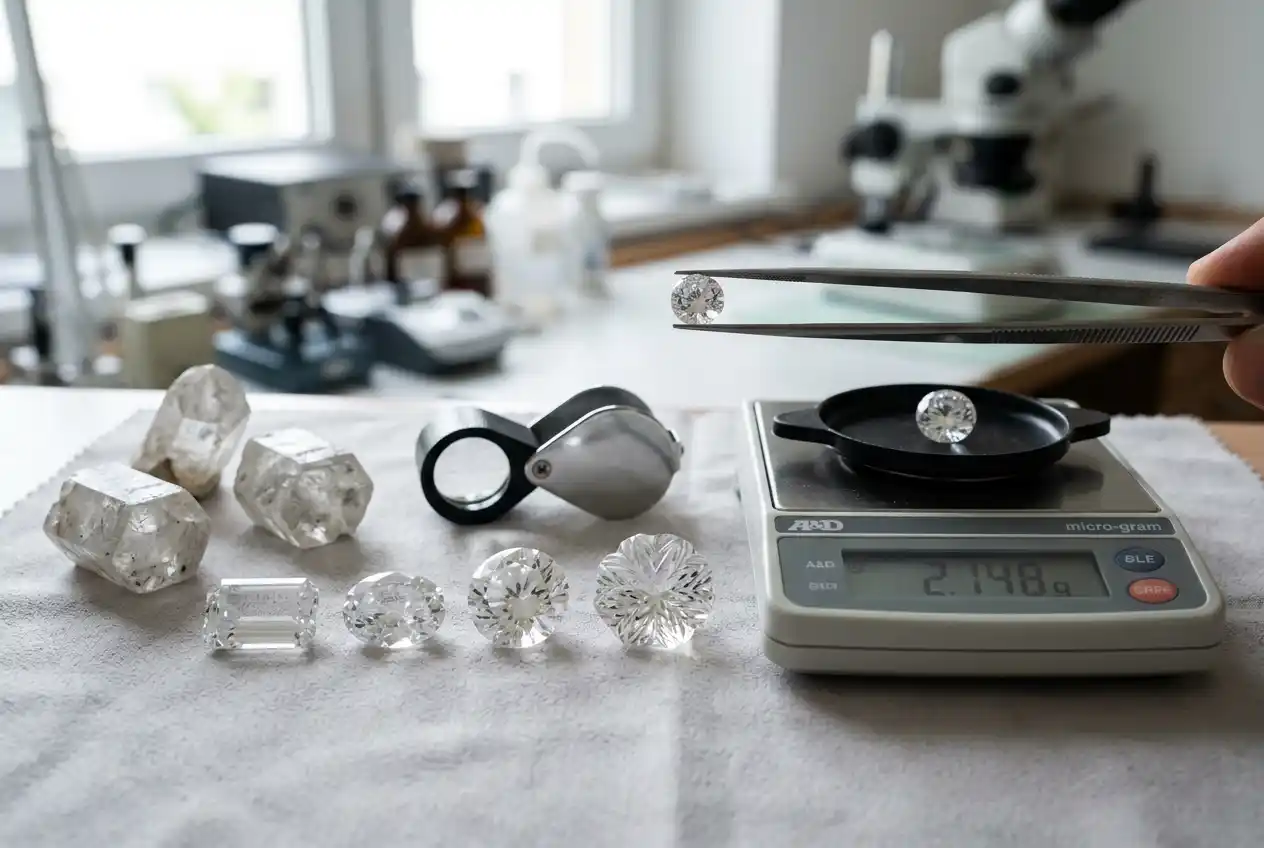
Precision cutters can transform otherwise modest colorless beryl into visually distinctive gemstones through Portuguese-style faceting, concave designs, custom step cuts, geometric patterns, and fantasy cuts. In such cases The Price may reflect hours of skilled labor, design originality, symmetry, and polish rather than intrinsic scarcity of the goshenite itself.
Goshenite Does Not Sparkle Exactly Like Diamond
Goshenite is sometimes chosen as a natural colorless gemstone for buyers who want an alternative to diamond, but its optical properties create a different appearance. Diamond has a substantially higher refractive index and dispersion, allowing properly cut stones to produce stronger brilliance and fire. Cubic zirconia also has higher optical intensity than beryl and can create more obvious spectral flashes.
Goshenite has a softer, clearer style of brilliance. Fine stones can look elegant and bright, especially when precision cut, but they should not be judged by whether they imitate diamond perfectly. Their appeal comes from natural beryl identity, high transparency, substantial available sizes, lower The Price, and the ability to showcase creative cutting.
The distinction matters when evaluating The Price because claims that a goshenite is valuable mainly because it looks like diamond can exaggerate the actual market. The most persuasive premium is usually attached to superior craftsmanship, exceptional clarity, and attractive size rather than imitation value.
Carat Weight Creates a Modest Premium Compared With Rare Beryl Varieties
Large transparent beryl crystals can form naturally, and colorless goshenite may occur in substantial sizes. This means the supply of facetable rough does not shrink as sharply with weight as it does in fine emerald or some intensely colored beryl varieties. A ten-carat clean goshenite can therefore remain much more affordable than a comparably sized fine emerald.
The Price per carat can still increase when a larger stone combines exceptional transparency, excellent proportions, perfect colorlessness, and precision cutting because recovering a large polished gem without fractures or cutting defects requires suitable rough and skilled workmanship. The increase, however, is usually much gentler than the size premium applied to extremely scarce gemstones.
Dimensions deserve close attention because goshenite’s visible appeal often comes from its generous size. A well-spread oval, cushion, emerald cut, or custom design may look impressive without excessive weight, while a very deep stone can carry many carats without producing equivalent face-up presence. Buyers comparing large stones should therefore examine length, width, depth, and optical performance alongside carat weight.
Natural Identity Separates Goshenite From Other Colorless Gems
A transparent colorless stone can be mistaken visually for quartz, topaz, white sapphire, zircon, cubic zirconia, synthetic spinel, glass, or even diamond when the viewer relies only on photographs. Goshenite should therefore be identified as beryl before The Price is assessed through beryl-specific expectations.
Gemologists can use refractive index, birefringence, specific gravity, optic character, inclusions, spectroscopy, and other observations to separate goshenite from visually similar stones. Beryl’s refractive index is considerably lower than diamond’s, while its birefringence and density also differ from many substitutes.
For ordinary modestly priced stones, extensive laboratory documentation may not be economically necessary, but natural identity becomes more important when a seller attaches a premium for unusual size, provenance, or allegedly untreated condition. Accurate identification protects the buyer from paying a specialty-gem price for common glass or another inexpensive colorless substitute.
Treatment History Can Influence Confidence More Than Appearance
Because goshenite is already colorless, treatment is usually less central to its ordinary jewelry value than it is for emerald or sapphire. The issue becomes important when the stone’s history includes color alteration or when colorless beryl is used as starting rough for irradiation or other procedures intended to create a colored appearance.
Some beryl can respond to irradiation with induced colors that may show varying stability under light or heat. When such a treated colored stone later appears colorless again, its treatment history may be difficult for an ordinary buyer to understand without documentation. A seller should therefore avoid making unsupported claims about completely natural color history when evidence is unavailable.
For conventional goshenite jewelry, the most important practical factors remain natural beryl identity, clarity, cutting, and condition. Treatment information becomes more valuable when The Price includes a premium for collector provenance or for a specific claim of untreated natural origin.
Provenance Matters More for Mineral Specimens Than Ordinary Faceted Goshenite
The name goshenite comes from Goshen, Massachusetts, where colorless beryl was historically recognized, although important colorless beryl occurs in many other regions. Brazil, Madagascar, Pakistan, Afghanistan, the United States, and other beryl-producing areas can yield transparent crystals suitable for cutting or collecting.
Geographic origin rarely creates the dramatic faceted-gem premiums associated with Colombian emerald or Russian demantoid because ordinary goshenite value depends more strongly on clarity and craftsmanship. A clean faceted stone from Brazil and a similarly attractive gem from Pakistan may be difficult to separate in market value based on origin alone.
Provenance becomes much more significant for natural crystals with documented locality, unusual crystal habit, exceptional size, attractive associated minerals, historic collection records, or important mining context. In those situations a mineral specimen may be worth more intact than it would be if cut into gemstones.
Surface Condition and Durability Affect Long-Term Jewelry Value
Goshenite shares the general durability of beryl, with a hardness around 7.5 to 8. This gives good resistance to ordinary scratching, although sapphire and diamond can still scratch it and hard impacts can chip exposed facet edges.
Beryl has imperfect to indistinct cleavage depending on direction and specimen, while internal fractures can further affect toughness. A clean stone in a protective setting can perform well in rings, pendants, earrings, and bracelets, but a heavily fractured gem deserves more cautious wear.
Surface condition is particularly visible in colorless stones because scratches, chips, and worn facet junctions interrupt the clean reflections that create brilliance. Fine goshenite should therefore be inspected under magnification for polish quality and edge wear, especially when buying pre-owned jewelry.
Gentle cleaning with mild soap, lukewarm water, and a soft brush is generally appropriate for sound untreated stones. Harsh impact and abrasive storage should be avoided so the polished surface retains the clarity that gives goshenite most of its appeal.
Conclusion
Goshenite price per carat is generally modest because large clean colorless beryl is more available than fine emerald or many intensely colored gemstones. Commercial stones may cost only a few dollars to a few tens of dollars per carat, while exceptionally clean, well-proportioned, precision-cut gems can command substantially more because craftsmanship rather than rough scarcity becomes the dominant value factor.
The best goshenite combines neutral colorlessness, high transparency, excellent polish, efficient face-up dimensions, sound durability, and accurate natural identity. Size adds visual drama without necessarily creating a steep rarity premium, which makes goshenite especially attractive for buyers who want a large natural colorless gemstone while placing greater importance on cutting and clarity than on prestige pricing.
FAQs About Goshenite Price Per Carat
How much does goshenite cost per carat?
Commercial goshenite may sell for roughly $5 to $20 per carat, while good jewelry-quality stones with strong transparency and competent cutting can move into approximately $20 to $50 per carat. Fine precision-cut gems can reach roughly $40 to $100 per carat or more, especially when custom lapidary work contributes significantly to The Price.
Why is goshenite usually less expensive than emerald?
Both are beryl, but fine emerald requires rare green coloration combined with useful transparency, and natural emerald rough commonly contains fissures and inclusions that reduce cutting yield. Colorless goshenite occurs more readily in large clean crystals, so scarcity is much lower even though the underlying mineral species is the same.
Does large goshenite become expensive?
Large size increases total value, but the per-carat premium is usually modest because sizeable clean crystals can occur naturally. The strongest premium appears when a large gem also has exceptional clarity, efficient proportions, fine polish, and precision cutting rather than simply carrying a high carat weight.
Is goshenite a good diamond substitute?
Goshenite can provide a natural colorless look at a much lower The Price, but its brilliance and dispersion are gentler than diamond’s because its optical properties are different. Buyers who appreciate goshenite for natural beryl identity and elegant clarity are likely to value it more realistically than buyers expecting an exact diamond appearance.
Is goshenite the same mineral as aquamarine and emerald?
Yes. Goshenite, aquamarine, and emerald all belong to the beryl mineral species. Their different commercial names reflect color and trace-element chemistry, with goshenite representing the essentially colorless variety.
Does clarity strongly affect goshenite value?
Yes. Because the stone lacks strong body color, inclusions and fractures remain easy to see, making high transparency especially important in faceted jewelry. Fine stones are generally expected to look clean face-up, although tiny inclusions under magnification may have little effect.
Can goshenite be treated?
Colorless beryl can participate in treatment processes that induce or alter color, including irradiation in suitable material. Conventional goshenite is valued for its colorless state, so treatment history becomes most relevant when a seller makes specific claims about completely natural color history or when the stone has previously displayed induced color.
Is goshenite durable enough for a ring?
Its hardness around 7.5 to 8 makes goshenite reasonably suitable for rings when the stone is sound and the setting protects vulnerable edges. It should still be protected from strong impact and from harder gemstones that can scratch its polished surface.
What makes goshenite collector quality?
Collector-quality goshenite can take two forms. A faceted stone may stand out through exceptional transparency, size, precision cutting, and condition, while an uncut crystal may be valuable because of natural crystal form, important locality, associated minerals, unusual size, or documented collection history.