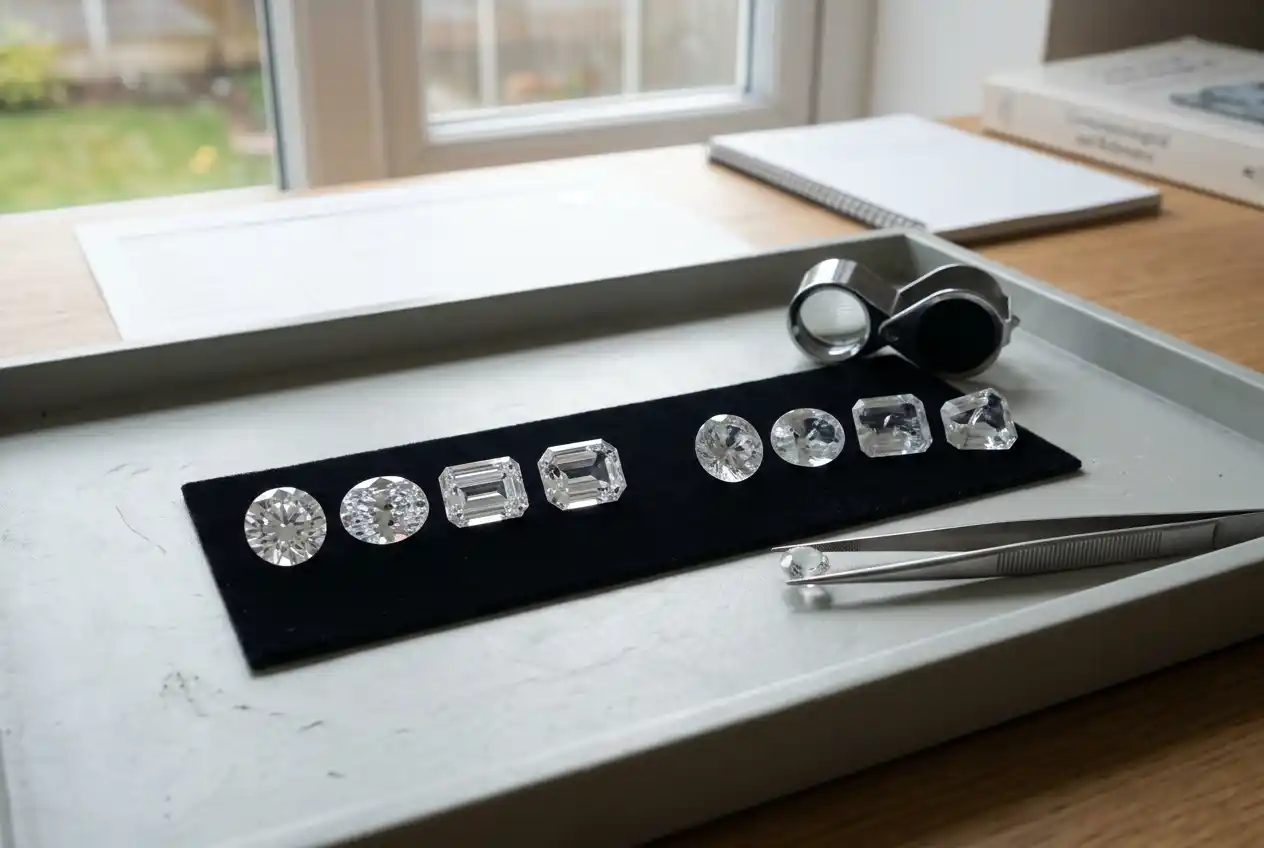
Goshenite Quality Grading: 7 Key Standards for Pure Clarity
Goshenite quality grading should focus on color neutrality, transparency, clarity, cutting, face-up proportions, structural condition, and natural identity because the absence of body color exposes every weakness in the finished gemstone. High-grade goshenite should appear essentially colorless under neutral light, transmit light cleanly, show few distracting internal features, and use an efficient cut that creates attractive reflections rather than a large transparent window. Since clean rough can occur in substantial sizes, carat weight is less important to quality than it would be in emerald or many rare colored gemstones.
Goshenite belongs to the beryl species, Be₃Al₂Si₆O₁₈, alongside emerald, aquamarine, morganite, heliodor, and other colored varieties. The gemstone is colorless because the crystal lacks sufficient concentrations or defect states to create the stronger body colors characteristic of those other beryls. This makes purity of appearance central to grading. Even a slight unwanted gray, yellow, or brown cast becomes easier to notice when no attractive body color competes for attention.
There is no universally enforced AAA, AAAA, or similar grading system for goshenite. Commercial labels may describe a seller’s internal sorting, but they do not establish a shared international standard. A meaningful grade should therefore state exactly what is being observed in terms of colorlessness, transparency, inclusions, cut quality, dimensions, condition, treatment, and identity rather than hiding those characteristics behind an unexplained letter category.
7 Key Standards for Goshenite Quality Grading
- Confirm natural colorless beryl identity
- Grade neutrality and absence of unwanted tint
- Evaluate transparency, clarity, and inclusion visibility
- Judge cut quality, brilliance, symmetry, and polish
- Assess carat weight, face-up dimensions, and cutting efficiency
- Inspect fractures, chips, abrasion, and structural condition
- Review treatment history, provenance, craftsmanship, and overall rarity
These seven standards reflect the fact that goshenite is visually subtle. Its quality does not depend on intense saturation or dramatic color zoning but on how cleanly the crystal, cutter, and finished surface work together. A small precision-cut stone can therefore receive a higher quality assessment than a much larger gemstone whose extra weight comes from unnecessary depth or whose face is dominated by windowing.
Natural Goshenite Identity Must Be Established Before Quality Is Rated
Colorless gems are particularly easy to confuse visually because many transparent substances can look similar in photographs or simple jewelry-store lighting. Quartz, topaz, white sapphire, zircon, cubic zirconia, synthetic spinel, glass, and diamond can all overlap superficially with goshenite when the observer does not examine physical and optical properties.
Beryl has characteristic ranges of refractive index, birefringence, specific gravity, and optic behavior that allow trained gemologists to distinguish it from these alternatives. Microscopic inclusions and growth structures can contribute further information, while spectroscopy and additional testing become useful when identity or treatment questions remain unresolved.
Confirming beryl identity is more important than asking whether the stone looks expensive. A precision-cut piece of glass can appear bright, while a natural goshenite may show softer brilliance because beryl’s refractive index is lower. Quality should therefore be graded within the correct gem species rather than through comparison with a substance that handles light differently.
Neutral Colorlessness Is the Ideal Body Appearance
High-quality goshenite should look essentially neutral and colorless under daylight-equivalent illumination. Slight warmth can occur naturally, but obvious yellow, brown, gray, or green components reduce the purity of the classic colorless appearance and may raise questions about whether the stone belongs more appropriately to another beryl color category.
The distinction between perfectly neutral and very faintly tinted goshenite can be subtle in jewelry, especially once reflections from gold, skin, clothing, or surrounding gemstones affect the appearance. Loose stones should therefore be graded against a neutral background and under consistent light so environmental color does not distort the assessment.
Unlike diamond, goshenite does not have a universally adopted D-to-Z color system, and there is little reason to mimic one artificially. A descriptive grade stating colorless, near-colorless, or faintly tinted is more useful than attaching diamond terminology that was never designed for beryl.
Color should also be judged together with transparency. A perfectly neutral but cloudy stone will not outperform a slightly warm gem with exceptional clarity and cutting simply because its body color is technically purer.
Transparency and Clarity Are Central to Fine Goshenite
Colorless beryl reveals its internal world openly, which makes clarity one of the strongest quality factors. Fine faceted stones should generally appear eye-clean from normal viewing distance, with enough transparency that light moves freely through the gem without obvious haze or clouding.
Natural goshenite can contain fluid inclusions, mineral crystals, growth tubes, veils, healed fissures, and fractures. Small features visible only with magnification may be perfectly acceptable, particularly in large gems or unusual cuts. The grade should fall more sharply when inclusions sit directly beneath the table, reflect strongly, create a cloudy appearance, or interfere with structural security.
Surface-reaching fractures need separate attention because they can affect durability even when the gem remains visually transparent. A harmless internal pinpoint and an open fissure at the girdle are not equivalent clarity features, so the grader should consider type, position, relief, visibility, and structural significance rather than simply counting inclusions.
A Practical Goshenite Clarity Framework
| Face-Up Appearance | Practical Quality Interpretation |
|---|---|
| Eye-clean with excellent transparency | Fine to exceptional |
| Minor inclusions visible only under magnification | Very good |
| Small visible inclusions with little brilliance loss | Good |
| Obvious clouds, veils, or fractures | Commercial |
| Major structural fractures or poor transparency | Lower jewelry quality |
This framework is descriptive rather than official, but it reflects how colorless beryl is actually experienced. The eye notices transparency and surface reflections immediately, so clarity should be evaluated through the face before magnification is used to study features that may have little practical visual impact.
Cut Quality Determines Whether Goshenite Looks Elegant or Glassy
Cutting is unusually important in goshenite because the gemstone’s moderate refractive index cannot disguise poor proportions. A shallow pavilion can create a broad window through which the background is visible, making the stone appear flat and glass-like. Excessive depth may preserve extra carat weight, but it reduces face-up spread and can produce dark regions that add little to the visual appeal.
A fine cut should distribute reflections evenly, preserve a balanced outline, and use facet angles appropriate to beryl’s optical properties. The goal is not to imitate diamond mechanically but to maximize goshenite’s own clean brilliance. Round brilliants, ovals, cushions, emerald cuts, Portuguese designs, concave faceting, and custom fantasy shapes can all succeed when the cutter understands how the rough and facet pattern interact.
Symmetry and polish deserve close inspection because a colorless body provides no saturation to distract the eye from workmanship. Off-center facets, an uneven girdle, polishing lines, chips, and rounded junctions become easy to notice. Precision cutting can therefore elevate goshenite dramatically, and in high-end custom stones the lapidary work may account for a substantial share of The Price.
Carat Weight Should Be Interpreted Through Face-Up Spread
Goshenite can form in large crystals, which means substantial faceted stones are more available than equally clean emerald or intensely colored beryl. Size is therefore not a quality grade by itself, and a ten-carat stone should not outrank a five-carat precision-cut gem merely because it weighs twice as much.
Face-up dimensions show how efficiently the cutter has used the rough. A broad well-proportioned oval may appear larger than a heavier deep stone while returning more light. The grader should therefore record length, width, total depth, and outline in addition to carat weight.
Large size becomes more meaningful when transparency and cutting remain exceptional because finding a sizeable piece of rough without structural flaws still requires suitable crystal. Even then, the rarity premium usually remains gentler than it does in high-quality emerald, where fine large rough is much harder to obtain.
Surface Condition and Structural Integrity Complete the Clarity Grade
Goshenite’s hardness around 7.5 to 8 gives it good resistance to ordinary wear, but it is not immune to scratches, chips, or fracture-related damage. A pre-owned gemstone can lose much of its clean appearance when facet edges become abraded or when surface scratches scatter light.
The girdle and corners deserve particular attention because they are common impact points in jewelry. Emerald cuts and other step-cut designs can have vulnerable corners if the setting does not protect them, while pointed fancy shapes need additional care around tips.
Beryl can show imperfect or indistinct cleavage, and internal fractures can weaken individual stones. A high quality grade therefore requires not merely an attractive face but a structure appropriate to normal jewelry use. Existing chips, open fissures, or severe abrasion should be recorded clearly rather than ignored because the gemstone still appears colorless.
Treatment and Color History Need Accurate Interpretation
Goshenite is ordinarily valued for its natural colorless appearance, and routine enhancement is not central to its market in the way oiling is central to emerald or heat treatment is common in some other gemstones. The issue is nevertheless relevant because suitable beryl can respond to irradiation or other processes that alter color.
Induced colors may not always remain permanent under prolonged light or heat, depending on the defect mechanism involved. If a stone has an unusual treatment history, that information can matter to collectors and to anyone paying a premium for a claim of untreated natural colorlessness.
For ordinary jewelry, treatment history generally influences confidence more than visible quality. An eye-clean precision-cut goshenite remains attractive because of its appearance and craftsmanship, but the description should still be accurate when treatment information is available.
Origin Has Limited Impact on Faceted Quality but Can Matter for Specimens
Colorless beryl occurs in several important pegmatite regions around the world, including areas of Brazil, Madagascar, Pakistan, Afghanistan, and the United States. Fine faceted goshenite from different sources can look extremely similar, so geographic origin rarely forms a major part of routine jewelry grading.
Natural crystals are different because locality can contribute to collector value. A sharply terminated goshenite crystal from a famous pegmatite, a specimen associated with tourmaline or feldspar, or an old piece with documented mining history can be desirable even if inclusions make it unsuitable for faceting.
This distinction means faceted-gem grading and specimen grading should not be mixed. A flawless cut stone is rewarded for transparency and craftsmanship, while an uncut crystal may be prized for natural form, associations, provenance, and geological significance.
Goshenite Versus Other Colorless Gemstones
White sapphire is harder and usually more expensive, while colorless topaz can also occur in large clean sizes and may compete with goshenite at relatively modest The Price. Quartz is generally softer and has different optical properties, while natural zircon can show stronger dispersion. Cubic zirconia is laboratory-produced and typically displays much more intense fire than beryl.
Diamond remains the most optically intense and hardest of the common colorless jewelry choices, but that does not make goshenite an inferior imitation by definition. Goshenite offers natural beryl identity, clean transparency, large available sizes, creative cutting possibilities, and comparatively accessible The Price.
A proper quality grade should therefore ask whether the goshenite is an excellent example of colorless beryl rather than whether it succeeds at pretending to be diamond.
Common Goshenite Grading Mistakes
A frequent mistake is giving too much importance to carat weight. Large clean goshenite is available enough that a heavy stone with a broad window or unnecessary depth may be much less desirable than a lighter precision-cut gem. Another mistake is borrowing diamond color or clarity terminology without explaining how those categories apply, which can make commercial labels sound more standardized than they really are.
Buyers can also mistake strong sparkle for correct identity. Cubic zirconia, zircon, sapphire, topaz, and glass can all look colorless, so visual brightness alone does not prove beryl. Finally, clarity should not be evaluated only through magnification. A tiny inclusion that cannot be seen face-up may matter far less than poor proportions or worn facet edges that affect the entire stone’s appearance.
A strong grading process keeps identity, face-up transparency, color neutrality, cutting, dimensions, and condition in a sensible order so the final grade describes what actually makes the gemstone attractive.
Conclusion
Goshenite quality grading is built around natural beryl identity, neutral colorlessness, high transparency, appropriate clarity, precise cutting, efficient dimensions, structural condition, and accurate treatment disclosure. Because large clean rough can occur naturally, size should strengthen an already fine stone rather than serve as the main evidence of quality.
The finest goshenite looks clear, balanced, and intentionally cut. It does not need diamond-like fire to succeed, nor does it require an inflated commercial grade. A well-proportioned natural colorless beryl with strong polish, minimal distracting inclusions, and good durability represents high quality because every visible part of the stone supports a clean and elegant optical appearance.
FAQs About Goshenite Quality Grading
What is the most important factor in goshenite quality?
Transparency and cutting work together as the strongest visible factors because colorless beryl exposes both internal features and poor proportions easily. A high-quality stone should look clean face-up while returning enough light to avoid a flat, glass-like appearance.
Should high-quality goshenite be completely colorless?
Fine goshenite should appear essentially colorless under neutral light, although an extremely faint tint may have little practical effect once the gemstone is mounted. Obvious yellow, gray, brown, or green components reduce the classic pure-colorless appearance and may shift how the beryl should be described.
Does goshenite need to be flawless?
No. Tiny inclusions visible only under magnification can be acceptable when transparency and durability remain excellent. The grade should fall more significantly when inclusions are obvious face-up, create cloudiness, or form surface-reaching fractures that weaken the stone.
Why is cut so important in goshenite?
Colorless beryl has no strong body color to conceal a central window, uneven symmetry, poor polish, or excessive depth. Precision cutting improves light return and face-up spread, making craftsmanship one of the strongest differentiators between ordinary and fine goshenite.
Does a larger goshenite receive a higher grade?
Not automatically. Large transparent beryl is more available than fine emerald, so size alone creates only a modest quality advantage. A large stone receives a stronger grade when clarity, colorlessness, proportions, polish, and structural condition remain excellent.
Is goshenite durable enough for everyday jewelry?
Its hardness around 7.5 to 8 makes it suitable for many jewelry applications, but it should still be protected from strong impacts and harder gemstones. A well-set clean stone can perform successfully in rings, earrings, pendants, and bracelets with reasonable care.
Are AAA goshenite grades standardized?
No. AAA, AAAA, premium, and similar commercial labels vary among sellers. A meaningful evaluation should describe color neutrality, transparency, inclusions, cut quality, dimensions, treatment, and condition directly.
Can goshenite be confused with diamond?
Yes visually, especially in photographs, but gemological testing separates them readily because their refractive index, dispersion, density, birefringence, hardness, and other properties differ. Goshenite should be valued as natural colorless beryl rather than as an exact diamond substitute.
Can goshenite be treated?
Suitable beryl can undergo treatments such as irradiation that alter color, so treatment history may matter in unusual or collector stones. Conventional colorless goshenite is generally valued for a natural clear appearance, making accurate disclosure more important than assuming every stone has an identical color history.
What makes goshenite exceptional?
Exceptional goshenite combines verified natural beryl identity, highly neutral colorlessness, excellent face-up transparency, minimal distracting inclusions, precision cutting, crisp polish, efficient dimensions, sound structural condition, and, where relevant, notable craftsmanship or provenance.