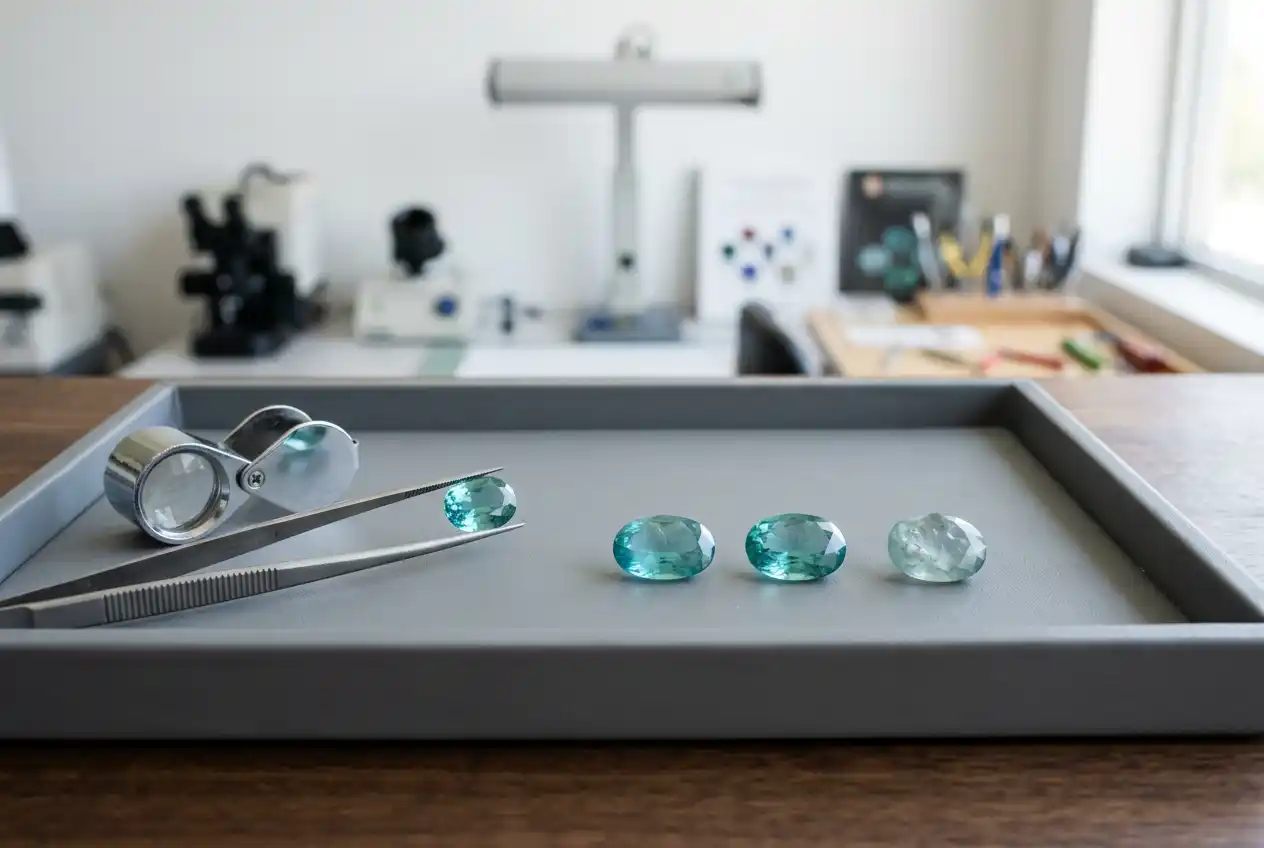
Grandidierite Quality Grading: 8 Critical Rules for Rare Gems
Grandidierite quality grading should begin with transparency and natural identity because the market difference between an opaque specimen and a fine transparent faceted gemstone is enormous. High-grade grandidierite combines attractive teal to blue-green color, strong but well-oriented pleochroism, high transparency, limited distracting inclusions, efficient cutting, useful size, and sound structural condition. A large stone does not automatically receive a high grade because much natural grandidierite is translucent or heavily included, whereas small transparent gems can occupy a much rarer quality category.
The mineral is an orthorhombic magnesium-iron aluminum borosilicate commonly represented as (Mg,Fe)Al₃(BO₃)(SiO₄)O₂. Its optical character is strongly pleochroic, allowing different crystal directions to display different colors. Fine transparent stones may show blue-green or teal in one direction, deeper green in another, and a much paler colorless to yellowish direction along a third axis. This means color grading cannot be separated from orientation because the cutter determines which directional color becomes dominant in the finished face.
No internationally universal AAA or AAAA system governs grandidierite. Seller-created labels can therefore be misleading when they fail to distinguish transparency, color, pleochroism, inclusions, and structural condition clearly. A reliable grade should describe each observable characteristic directly and reserve exceptional status for stones that combine rarity with visible beauty rather than simply carrying an impressive trade label.
8 Critical Rules for Grandidierite Quality Grading
- Confirm natural grandidierite identity
- Grade transparency before carat weight
- Evaluate blue-green hue, saturation, and tone
- Assess pleochroism and cutting orientation
- Examine clarity, inclusions, and structural fractures
- Judge cut quality, symmetry, polish, and face-up spread
- Consider carat weight within the transparent-quality category
- Review provenance, treatment, condition, and overall rarity
These eight rules establish a sequence that matches the way grandidierite is actually valued. Transparent blue-green gems belong to a different rarity class from translucent stones, and within that transparent category the finest examples are those in which pleochroism, clarity, and cutting work together rather than forcing the buyer to choose between strong color and useful brilliance.
Natural Identity Must Be Confirmed Before Rare-Gem Quality Is Assigned
Grandidierite’s blue-green color can overlap with tourmaline, aquamarine, sapphire, apatite, glass, and several other uncommon gemstones. A rare-gem grade should therefore never be applied simply because a transparent stone looks teal in a photograph.
Standard gemological testing can examine refractive properties, birefringence, optic character, specific gravity, absorption behavior, pleochroism, and microscopic inclusions. The combination of these observations allows trained gemologists to separate grandidierite from more common blue-green stones.
Identity becomes increasingly important as The Price rises because rarity is one of the strongest reasons transparent grandidierite commands a premium. A similar-looking gemstone may be equally beautiful, but it should not receive the market value associated with grandidierite unless the mineral species has been established reliably.
Laboratory documentation is therefore most useful for finer stones where identity, provenance, or treatment claims materially influence value rather than as an automatic requirement for every inexpensive translucent specimen.
Transparency Should Be Graded Before Size
The first visual distinction after identity is whether the stone is transparent, translucent, or opaque. Transparent grandidierite is substantially rarer because fractures, clouds, mineral inclusions, and internal growth features commonly prevent clean light transmission.
A fine transparent gemstone allows light to pass through the crystal and return from the pavilion facets clearly enough to create recognizable brilliance. Translucent stones can still possess attractive blue-green color and internal glow, but their optical performance belongs to a different category and should not be compared directly with fine faceted gems.
This distinction is more important than weight. A one-carat transparent stone can deserve a much higher quality grade than a five-carat translucent piece because finding transparent rough of suitable color and structural integrity is far more difficult.
The highest grades should therefore be reserved for gemstones whose transparency remains strong across most of the face and whose inclusions do not interrupt the pleochroic color display.
Blue-Green Color Needs Both Saturation and Brightness
Fine grandidierite usually displays an attractive combination of blue and green rather than a dull gray-green or pale nearly colorless body. Teal, greenish blue, and saturated blue-green are particularly desirable when the gemstone remains transparent and lively.
Color quality should be judged through hue, saturation, and tone together. High saturation gives the gemstone visual identity, but excessive darkness can suppress transparency and make the face look closed. Very pale stones may show excellent clarity yet lack enough color strength to represent the most desirable expression of the species.
A medium to medium-dark tone often provides an effective balance, although the exact ideal depends on size and cutting. Larger stones naturally present longer light paths and can appear darker, which makes proportion and orientation increasingly important as carat weight rises.
Neutral daylight-equivalent illumination is especially useful because warm or cool lamps can shift the perceived balance between blue and green. High-grade stones should remain attractive across several normal lighting conditions rather than depending on one carefully selected source.
Pleochroism Must Be Used Rather Than Merely Observed
Strong pleochroism is an essential part of grandidierite’s identity, but the existence of multiple directional colors does not automatically produce a beautiful finished gemstone. The cutter has to orient the rough so the desirable blue-green direction dominates the face while less attractive pale directions remain secondary.
If the table is placed poorly, a stone can look washed out from the normal viewing position even though the rough contained strong teal color along another axis. Correct orientation may require sacrificing substantial weight, particularly if the best color direction conflicts with the natural shape of the crystal.
The finest stones can reveal subtle shifts between blue-green and green as they move without becoming nearly colorless through ordinary viewing angles. This dynamic appearance gives transparent grandidierite much of its character and distinguishes good lapidary work from weight-preserving commercial cutting.
Pleochroism should therefore be graded according to the attractiveness of the finished orientation, not simply according to how strongly the rough changes color in a dichroscope.
Clarity Needs to Be Judged for Beauty and Durability
Transparent grandidierite can contain crystals, veils, fractures, clouds, and other internal features. Fine stones are generally most desirable when these inclusions remain difficult to see face-up and do not interrupt the strong blue-green appearance.
A small transparent inclusion near the girdle may have little effect, while a dark crystal beneath the table can become visually dominant. Broad clouds reduce transparency and therefore carry a particularly strong penalty because transparency itself is one of the mineral’s rarest gem qualities.
Surface-reaching fractures deserve even more attention because they can affect toughness. Grandidierite has useful hardness, but cleavage and pre-existing internal breaks can create vulnerability during setting or wear.
This means conventional clarity and structural condition should be recorded separately. A gemstone can look relatively clean while containing a strategically located fracture that creates greater practical risk than several harmless internal inclusions.
A Practical Grandidierite Clarity Framework
| Face-Up Appearance | Practical Quality Interpretation |
|---|---|
| Transparent and eye-clean | Exceptional to fine |
| Transparent with minor inclusions under magnification | Very good |
| Transparent with small visible inclusions | Good |
| Translucent with obvious internal features | Commercial jewelry quality |
| Major fractures, clouding, or opaque areas | Lower faceted quality |
This framework is descriptive rather than an official international scale. Its purpose is to distinguish rare transparent faceting quality from the much more available translucent or heavily included categories without pretending that one letter grade can describe every stone.
Cut Quality Should Balance Color, Transparency, and Weight Retention
Transparent grandidierite rough is rare enough that cutters often preserve weight aggressively, but excessive compromise can reduce the final quality. A deep pavilion may retain valuable carats while creating darkness and a small face-up spread, whereas a shallow pavilion may weaken saturation and produce windowing.
A fine cut should return light across the face while keeping the strongest blue-green orientation visible. Symmetry, polish, facet alignment, and outline contribute to overall quality, but slight asymmetry can be acceptable when it preserves exceptional natural color or avoids a serious fracture.
Precision cutting deserves particular recognition because it can require sacrificing more rough to achieve a better optical result. In rare gems, the cutter may remove valuable weight deliberately so the finished stone looks larger, brighter, and more saturated from the normal viewing position.
Custom shapes are therefore not inherently lower grade. A freeform, elongated cushion, or unusual geometric design can be excellent when it follows the rough intelligently and makes better use of pleochroism than a standardized shape would.
Carat Weight Matters Most Within the Transparent Category
Large size creates a powerful rarity premium only when the stone remains transparent and attractively colored. Translucent grandidierite can occur in substantially larger pieces without approaching the scarcity of a clean faceted gem.
Transparent stones above a few carats become increasingly uncommon because the rough must remain clear and structurally sound through a larger volume. Every additional carat raises the chance that fractures, clouds, or unfavorable color directions will interrupt the finished stone.
This scarcity can make a fine multi-carat gem exceptional even when a few small inclusions remain visible. The grader should still resist allowing size to excuse severe windowing, dark extinction, or poor orientation because those problems affect the beauty the buyer actually sees.
Face-up dimensions should accompany weight for the same reason. A deep stone can carry more carats but look smaller than a well-proportioned gem of lower weight, so quality depends on how effectively the cutter has used the rare rough.
Madagascar Provenance Adds Historical and Collector Interest
Madagascar is the classic locality for grandidierite and remains deeply connected with the mineral’s scientific and gemological history. Fine transparent stones from Madagascar helped establish the gem’s reputation for rarity and blue-green beauty.
Provenance can strengthen a high quality grade when it is reliable, particularly for unusually large transparent stones, natural crystals, or historically important specimens. It should not be used as a substitute for grading color, transparency, clarity, and cut.
Other localities can produce grandidierite, and an exceptional gemstone from a less famous source can still be superior to an ordinary Madagascan specimen. Visible quality should therefore come first, with geographic origin applied afterward as a collector and market factor.
Treatment Is Usually Less Important Than Correct Identification
Routine heat, irradiation, or clarity enhancement is not a defining feature of the grandidierite market. Fine stones are generally prized for natural blue-green coloration and their inherent pleochroism, which gives untreated appearance considerable appeal.
Because the name commands a scarcity premium, the more practical risk is often misidentification rather than routine enhancement. Blue-green tourmaline, glass, and other gemstones can be offered incorrectly in less controlled markets, making natural species confirmation important for valuable stones.
The final quality assessment should therefore record treatment when known but place greater emphasis on identity, transparency, color, cut, and condition. Unusual filling, coating, or other modification should be disclosed clearly because such processes can alter both durability and value.
Structural Condition Is Essential for a Rare Transparent Gem
Grandidierite’s hardness around 7 to 7.5 makes it reasonably resistant to scratching, yet cleavage and fractures mean it should not be treated as though hardness alone guarantees toughness. A transparent rare stone with a vulnerable open fracture may require careful setting and limited exposure to impact.
The girdle, corners, and tips deserve particular attention because these areas receive pressure during setting and are common sites for chips. Existing abrasions and worn facet junctions can also lower grade by reducing the crisp light return expected from a fine transparent gem.
Pendants and earrings are generally lower-risk uses than exposed everyday rings. When a ring is desired, protective prongs, bezels, or other design features can help keep direct impact away from vulnerable edges.
Condition belongs in the quality grade because a rare gem’s value depends not only on what the crystal was originally but also on how well the polished stone has survived.
Common Grandidierite Grading Mistakes
One of the most serious mistakes is comparing transparent and translucent grandidierite as though they belong to the same rarity category. Transparency changes the market dramatically, so the grader should establish that distinction before considering carat weight.
Another mistake is choosing the darkest stone because its color appears more saturated. Deep tone can reduce transparency and obscure pleochroism, while a slightly lighter teal gem may look much more lively and valuable.
Buyers also sometimes focus on size without checking face-up spread or cutting orientation. A large deep stone can preserve weight while hiding its best blue-green direction, whereas a smaller precision-cut gem may display far superior color and brilliance.
Finally, origin claims can distract from the actual gemstone. Madagascar provenance is desirable when documented, but no locality compensates for poor transparency, weak color, major fractures, or careless cutting.
A Practical Overall Grandidierite Quality Framework
| Quality Level | Typical Characteristics |
|---|---|
| Exceptional | Transparent, vivid blue-green, excellent orientation, minimal inclusions, fine cut, rare size |
| Fine | Strong transparency, attractive teal color, good pleochroism, limited inclusions, good proportions |
| Good | Transparent to slightly translucent, pleasant color, visible but acceptable inclusions |
| Commercial | Translucent, moderate color, obvious inclusions, ordinary cutting |
| Lower quality | Opaque, heavily fractured, weak color, severe damage, or uncertain identity |
This framework is designed to communicate visible and structural quality directly. It does not replace laboratory identification, but it provides a practical way to separate genuinely rare gem quality from attractive yet much more common translucent grandidierite.
Conclusion
Grandidierite quality grading depends first on natural identity and transparency, followed by blue-green color, pleochroism, clarity, cut, size, provenance, treatment, and condition. High-grade stones remain transparent enough for crisp light return while showing strong teal or greenish-blue coloration that has been oriented carefully rather than weakened by a pale pleochroic direction.
The finest grandidierite is rare because multiple demanding qualities must occur simultaneously. A crystal must be transparent, sufficiently clean, attractively colored, structurally sound, large enough to facet, and oriented skillfully by the cutter. When all of those characteristics survive into the polished gemstone, even a relatively modest carat weight can represent exceptional quality.
FAQs About Grandidierite Quality Grading
What is the most important quality factor in grandidierite?
Transparency is one of the strongest separators because transparent facetable grandidierite is much rarer than translucent or opaque material. Within the transparent category, blue-green color, pleochroism, clarity, and cutting determine how high the gemstone ultimately grades.
What color is the best grandidierite?
Vivid teal, blue-green, and greenish-blue are generally highly desirable when saturation remains strong without becoming excessively dark. Fine stones should preserve enough brightness and transparency for the color to look luminous rather than closed.
Should high-quality grandidierite be eye-clean?
Eye-clean transparent stones are especially rare and desirable, but minor inclusions can be acceptable when they do not reduce transparency or durability. Large clean stones receive strong premiums because suitably clear rough is scarce.
Why is pleochroism important in grandidierite grading?
Grandidierite shows different colors along different crystal directions, so cutting orientation controls which color dominates the face. A well-oriented stone emphasizes blue-green or teal while minimizing pale directions, making pleochroism central to both color quality and cutting quality.
Is darker grandidierite always better?
No. Excessive darkness can hide transparency and reduce brilliance. A somewhat lighter blue-green stone can grade higher when its color remains saturated and its facets return substantially more light.
Does a large grandidierite automatically receive a high grade?
No. Large size matters most when transparency, color, clarity, and cutting remain fine. A large translucent stone can grade well within its category but still rank far below a smaller transparent gemstone.
Does Madagascar origin determine quality?
No. Madagascar has historic importance and can add provenance value, but the individual stone must still perform well in transparency, color, clarity, cut, and condition. Geographic origin should refine the grade rather than replace it.
Is grandidierite commonly treated?
Routine treatment is not a major feature of the market. Correct natural identity, however, is extremely important because similar blue-green gemstones can be confused with grandidierite and the rarity premium depends on accurate species identification.
Is grandidierite durable enough for rings?
It can be used in rings, but hardness around 7 to 7.5 does not eliminate the risks created by cleavage and fractures. Protective settings and sensible wear are particularly important for rare transparent stones.
Are AAA grandidierite grades standardized?
No. AAA, premium, investment grade, and similar terms vary among sellers. A meaningful grade should describe transparency, hue, tone, pleochroism, inclusions, cutting, dimensions, treatment, provenance, and condition directly.
What makes grandidierite exceptional?
Exceptional grandidierite combines verified natural identity, high transparency, vivid blue-green or teal color, attractive pleochroism, minimal distracting inclusions, precision cutting, useful size, strong structural condition, and credible provenance.