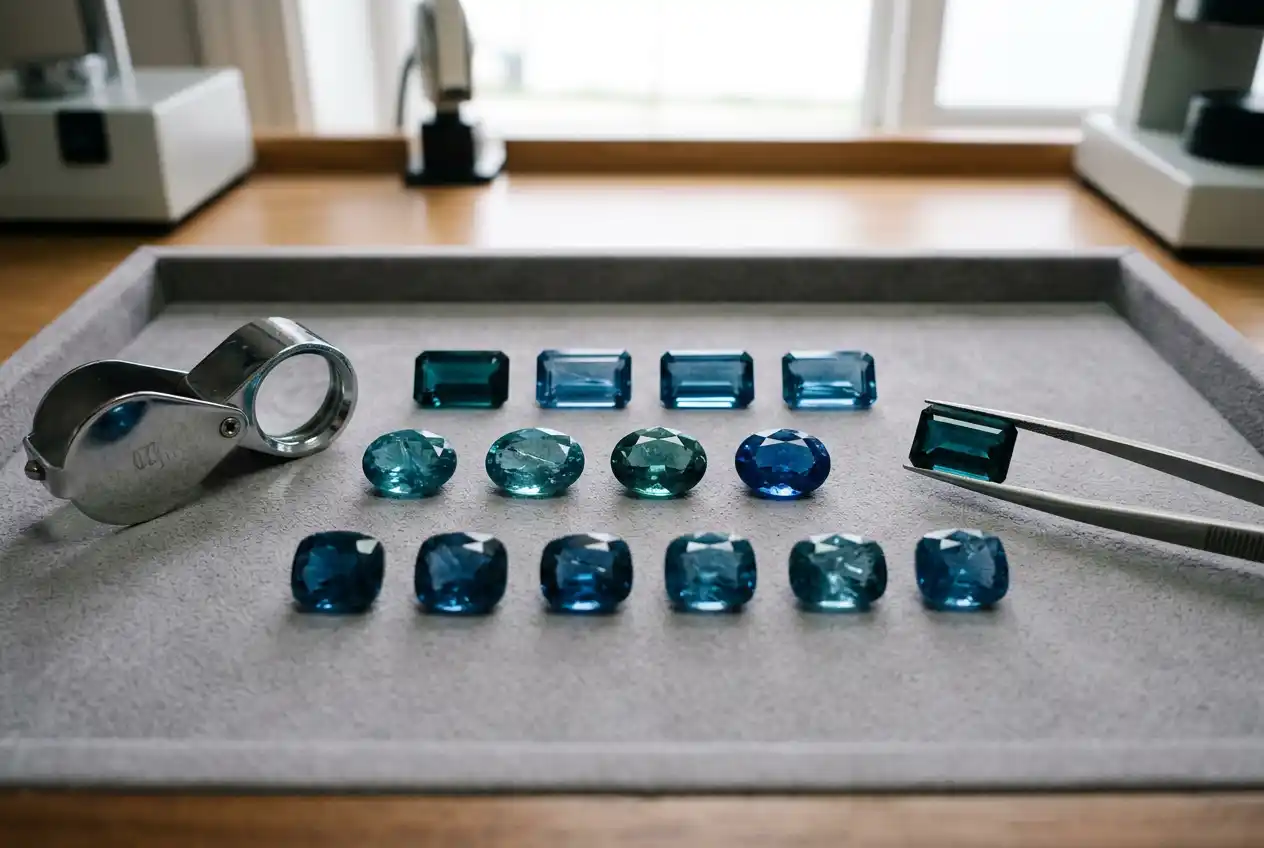
Indicolite Quality Grading: 8 Essential Standards for Color Depth
Indicolite quality grading should evaluate color depth without rewarding darkness for its own sake. Fine blue tourmaline needs enough saturation to look distinctly blue or teal, but it also needs sufficient transparency and brightness for the facets to remain visible under ordinary lighting. Strong pleochroism complicates this balance because one crystallographic direction can become dramatically darker than another, so cutting orientation has a direct influence on the final color grade.
Indicolite is blue to blue-green tourmaline, commonly associated with elbaite compositions within the complex tourmaline mineral group. Conventional blue tourmaline is often colored principally through iron-related mechanisms, while copper-bearing blue or green tourmaline belongs to the Paraíba-type category when its chemistry supports that designation. These groups should not be collapsed into one quality scale because copper-bearing stones can have different visual character, rarity, and market value.
There is no universal AAA or AAAA grading system governing indicolite. A useful grade therefore needs to describe identity, hue, saturation, tone, pleochroism, clarity, cut, size, treatment, and condition directly. This descriptive approach is particularly important for dark stones because a seller can describe almost-black tourmaline as deeply saturated even when its face-up appearance lacks the brightness expected from genuinely fine quality.
8 Essential Standards for Indicolite Quality Grading
- Confirm natural blue tourmaline identity and variety
- Grade blue or blue-green hue quality
- Evaluate saturation, tone, and face-up brightness
- Assess pleochroism and cutting orientation
- Judge transparency, clarity, and inclusion character
- Evaluate cut quality, symmetry, polish, and face-up spread
- Consider carat weight and size rarity within fine transparent material
- Review copper content, treatment, provenance, structural condition, and documentation
These eight standards keep the grading process focused on the complete gemstone rather than a single impressive color description. High-grade indicolite should show strong blue color without losing transparency, and its cutter should have managed the dark pleochroic axis so that saturation remains attractive rather than turning into widespread extinction.
Natural Blue Tourmaline Identity Comes Before Color Grading
A blue gemstone should not be graded as indicolite until tourmaline identity has been established. Sapphire, aquamarine, blue topaz, iolite, zircon, apatite, glass, and other gemstones can overlap with blue tourmaline visually, particularly in photographs where differences in luster, birefringence, and pleochroism may not be obvious.
Gemological identification can use refractive index, birefringence, specific gravity, pleochroism, optic character, spectroscopy, inclusions, and other observations. Tourmaline’s refractive properties and strong dichroism provide useful evidence, while chemical analysis may become necessary when the question is not merely whether the stone is tourmaline but whether copper is present.
This distinction becomes financially important when a seller suggests that an especially vivid blue stone is Paraíba-type. Copper-bearing tourmaline should be supported by appropriate analytical evidence when the designation materially affects The Price, while ordinary indicolite should be graded confidently within its own non-copper market rather than presented as a lesser imitation.
Hue Should Be Clearly Blue or Blue-Green
Fine indicolite can range from pure-looking blue through blue-green to teal. Some stones lean noticeably green, while others approach an inky navy appearance. The best hue depends partly on preference, but conventional high quality generally favors a clear blue or attractive balanced teal without excessive gray, brown, or murky green.
Hue should be judged under neutral daylight-equivalent illumination because warm lamps may emphasize green while cool LEDs can strengthen blue. Comparing several stones under the same light makes it much easier to distinguish genuinely fine color from a gem whose appearance depends heavily on one environment.
Color distribution also matters. Tourmaline can show zoning or directional differences, and an elongated crystal may preserve visible shifts along its length. Mild variation can be attractive, but obvious pale bands, black ends, or abrupt zoning generally lower the grade when they interrupt the face-up appearance.
Saturation and Tone Must Be Balanced Against Brightness
Indicolite is frequently overvalued when darkness is mistaken for strong color. Saturation describes color strength, while tone describes how light or dark the gemstone appears, and these characteristics need to remain balanced if the stone is to look lively.
A medium to medium-dark tone often provides an effective compromise because the blue appears rich without swallowing most of the reflected light. Very dark tourmaline can look nearly black through the crown, particularly in larger stones, while very pale material can lose the visual identity that makes indicolite desirable.
Extinction should therefore be examined across the entire face. Some dark areas are necessary for contrast and scintillation, but a gemstone dominated by black regions has lost too much light return. Fine color depth means concentrated blue that remains visible, not a stone whose saturation can only be appreciated by holding it against a powerful transmitted light source.
Pleochroism Is One of the Most Important Grading Variables
Tourmaline’s strong pleochroism means the color seen through one axis can differ dramatically from the color seen through another. In indicolite, the direction parallel to the crystal’s long axis can be very dark, while perpendicular viewing may reveal a much brighter blue or greenish blue.
The cutter therefore has to orient the rough according to its tone. A naturally pale crystal may benefit from an orientation that strengthens color, while a dark crystal needs a face-up direction that avoids the deepest absorption. This decision can force significant weight loss because preserving the natural crystal shape may not produce the best finished color.
A high-quality grade should reward successful orientation rather than raw saturation alone. The best stones reveal strong blue across the face and maintain attractive color as they move, while poorly oriented gems can alternate between pale and nearly black in ways that make them difficult to appreciate in jewelry.
Transparency and Clarity Should Support the Blue Color
Fine indicolite should transmit enough light that the blue body looks luminous rather than cloudy. Natural tourmaline can contain tubes, needles, fluid inclusions, crystals, veils, healed fissures, and fractures, and their impact depends strongly on tone because inclusions become more disruptive in already dark material.
A small internal feature near the edge may have little effect, while a central reflective fracture can break up the face and reduce transparency. Eye-clean stones generally receive the strongest grades, although minor inclusions can be accepted when the color is rare and the stone is unusually large.
Surface-reaching fractures need a separate durability assessment. Tourmaline is reasonably hard but can be brittle, and a fracture near the girdle or corner can increase the chance of damage during setting or wear. Fine clarity therefore means not just clean appearance but also structural confidence.
A Practical Indicolite Clarity and Color Framework
| Overall Appearance | Practical Quality Interpretation |
|---|---|
| Strong blue, bright, transparent, eye-clean | Exceptional to fine |
| Attractive blue with minor inclusions | Very good |
| Good color with some visible inclusions or extinction | Good |
| Very dark, cloudy, windowed, or heavily included | Commercial |
| Major fractures, severe black extinction, or poor transparency | Lower jewelry quality |
This framework is descriptive rather than an internationally enforced scale. Its value lies in combining color and transparency instead of allowing a deep tone to hide problems that would be obvious if the gemstone were judged only by normal face-up appearance.
Cut Quality Should Control Darkness Rather Than Preserve Every Carat
Tourmaline crystals are commonly elongated, so indicolite is often cut into rectangles, emerald-style shapes, long cushions, and elongated ovals. These shapes preserve rough efficiently, but a cutter focused too strongly on weight can leave a gemstone excessively deep and dark.
Fine cutting should control the interaction between pavilion depth, pleochroism, and saturation. A shallow pavilion creates a window, weakening the color, while an overly deep pavilion adds hidden weight and increases extinction. The best proportions preserve enough depth for richness while still returning useful light through the crown.
Symmetry and polish also affect the final grade because a transparent blue gem should show crisp reflections. Uneven facets, poorly aligned junctions, scratches, or thick girdles can make rare rough look ordinary. Precision cutting can therefore raise the quality grade substantially even when the finished stone weighs less than a commercial cut from comparable rough.
Size Rarity Depends on Color Staying Open
Tourmaline can occur in large crystals, so size needs to be interpreted carefully. Large dark blue rough may not be particularly rare, while a large transparent indicolite that remains bright and attractively saturated can be much harder to find.
As weight rises, the longer path of light through the gemstone can make the face appear darker. A color that works beautifully at two carats may become nearly closed at ten carats unless the rough is naturally lighter or the cutter compensates effectively.
This means a fine large indicolite deserves a strong rarity premium only when transparency, orientation, and face-up brightness remain high. Carat weight should never be allowed to excuse severe extinction or inefficient dimensions.
Copper-Bearing Blue Tourmaline Requires Separate Classification
Some blue and blue-green tourmalines contain copper and belong to the Paraíba-type market. These stones can show unusually vivid electric or neon-like colors and may command far higher Prices than conventional iron-colored indicolite.
The distinction cannot always be made reliably by eye. Iron-colored tourmaline can also be vivid, and copper-bearing stones are not necessarily bright in every case. Laboratory chemical analysis may therefore be necessary when the commercial designation depends on copper content.
A grading report should keep chemical category and visual quality separate. A copper-bearing stone can still have weak color or poor clarity, while a non-copper indicolite can be exceptionally beautiful. The copper designation changes market rarity, but it does not eliminate the need to grade hue, saturation, tone, clarity, and cut.
Treatment and Condition Complete the Quality Assessment
Heat may be used on some tourmalines to modify or lighten dark color, while other forms of treatment can occur across the wider tourmaline market. Treatment does not automatically make a gemstone unattractive, but disclosure is important when rarity and untreated status materially affect The Price.
Surface coating, filling, or other enhancement should be considered separately because these processes can affect durability and long-term appearance. For expensive gems, laboratory examination provides greater confidence when treatment or copper content is part of the sales claim.
Condition also matters because tourmaline can chip even without pronounced cleavage. Worn facet edges, scratches, open fractures, and chipped corners lower the grade, particularly in a precision-cut gem whose crisp surface reflections are part of its appeal.
Indicolite Versus Sapphire, Aquamarine, and Iolite
Blue sapphire generally has greater hardness and can show more concentrated blue at high quality, but it belongs to corundum and follows a different treatment and pricing system. Aquamarine is blue beryl, often lighter and less pleochroic than dark indicolite, while iolite shows very strong pleochroism but typically has lower refractive intensity and a different violet-blue to grayish color character.
These comparisons are useful because buyers sometimes treat all blue gemstones as substitutes for sapphire. Indicolite has its own visual identity built around tourmaline’s dichroism, wide color range, and characteristic crystal habit. The finest stones should therefore be graded according to how well they express blue tourmaline rather than how closely they imitate another species.
Conclusion
Indicolite quality grading depends on natural tourmaline identity, blue hue, saturation, tone, brightness, pleochroism, clarity, cutting, size, copper content, treatment, and condition. Fine stones show enough color depth to appear richly blue without becoming dominated by black extinction, and their cutters orient the crystal so the best direction remains visible through normal movement.
The most important grading discipline is to separate true color depth from excessive darkness. A transparent medium-blue gem with excellent orientation can rank above a heavier inky stone whose blue is visible only in transmitted light. Copper-bearing Paraíba-type tourmaline should also be kept distinct from ordinary indicolite because chemical rarity changes the market even when both stones occupy related blue and blue-green color ranges.
FAQs About Indicolite Quality Grading
What is the most important factor in indicolite quality?
Color is the strongest visible factor, but hue, saturation, tone, brightness, and pleochroism need to be considered together. A deeply saturated stone does not deserve a high grade if the face appears almost black, while a somewhat lighter gem can rank higher when its blue remains vivid and transparent.
What color is considered the best indicolite?
Fine indicolite commonly shows attractive medium to medium-dark blue, blue-green, or teal-blue. Excessive gray, brown, or black extinction lowers conventional quality, while enough brightness should remain for the blue to be obvious under ordinary lighting.
Why does indicolite look different from different directions?
Tourmaline is strongly pleochroic, so different crystallographic directions absorb light differently. In blue tourmaline this can produce a bright blue direction and another direction that looks much darker, making cutting orientation extremely important.
Should high-quality indicolite be eye-clean?
Eye-clean transparency is highly desirable, especially in dark stones where inclusions can reduce light return further. Minor inclusions may be acceptable in rare colors or larger gems, but obvious clouds and central fractures generally lower quality.
Is very dark indicolite high quality?
Not necessarily. A dark stone may possess strong saturation, but if most of the face appears black or closed, its practical beauty is limited. Fine quality balances depth of blue with enough brightness and transparency to keep the gemstone lively.
Is indicolite the same as Paraíba-type tourmaline?
No. Indicolite refers broadly to blue or blue-green tourmaline, while Paraíba-type tourmaline is copper-bearing and occupies a distinct rarity and price category. Chemical testing may be necessary when copper content is part of a high-value claim.
Does larger indicolite receive a higher grade?
Only when fine color, transparency, orientation, and cutting remain strong. Large dark tourmaline can occur, so size creates its greatest premium in stones that stay attractively blue and bright at substantial weight.
Can indicolite be heat treated?
Some tourmaline can be heated to modify or lighten dark color. Treatment should be disclosed when known, particularly for high-value stones where natural untreated color is being used as a selling point.
Are AAA indicolite grades standardized?
No. AAA, AAAA, premium, and similar seller grades are not universally standardized. A useful assessment should describe hue, saturation, tone, pleochroism, clarity, cut, size, treatment, copper content, and condition directly.
What makes indicolite exceptional?
Exceptional indicolite combines verified natural blue tourmaline identity, rich but open blue or teal color, high transparency, favorable pleochroic orientation, limited distracting inclusions, precision cutting, useful size, strong condition, and accurate disclosure of treatment and copper-bearing status.