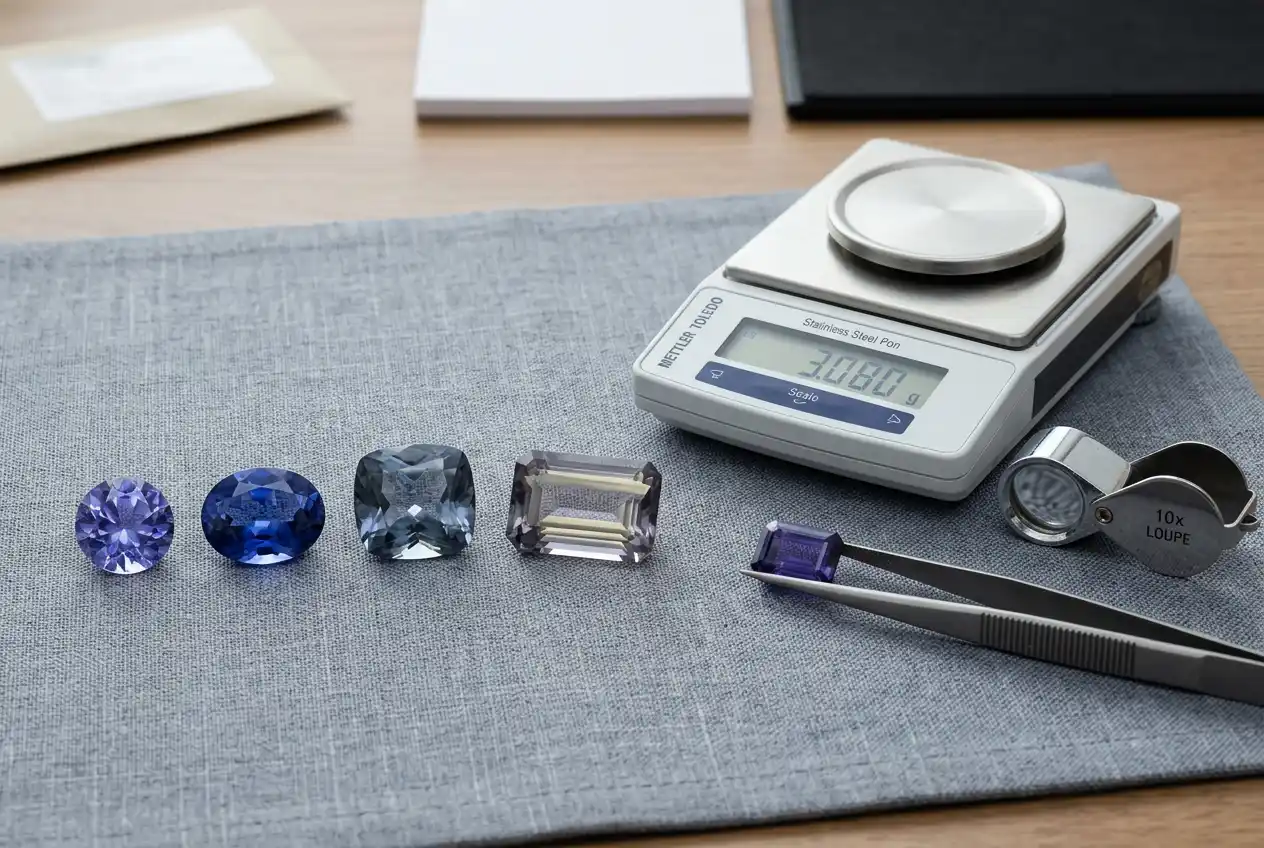
Iolite Price Per Carat: 9 Key Factors Determining Worth
Iolite price per carat is usually moderate compared with sapphire, tanzanite, or fine blue tourmaline because gem-quality cordierite can occur in useful sizes and is not exceptionally rare in commercial supply. Pale, grayish, included, or poorly oriented stones may sell for roughly $10 to $30 per carat, while attractive jewelry-quality iolite with stronger violet-blue color, good transparency, and competent cutting can move into approximately $30 to $100 per carat. Fine stones with rich blue-violet color, eye-clean clarity, excellent orientation, and attractive size may reach roughly $100 to $250 per carat, while unusually large precision-cut or collector-quality gems can exceed those levels when color and craftsmanship remain exceptional.
Iolite is the gem variety of cordierite, an orthorhombic magnesium-iron aluminum silicate commonly represented by the formula (Mg,Fe)₂Al₄Si₅O₁₈. It is famous for exceptionally strong pleochroism, more precisely trichroism, because different crystallographic directions can show markedly different colors. A single crystal may reveal violet-blue or deep blue in one direction, paler blue or gray in another, and yellowish-gray to nearly colorless tones along a third direction. This optical behavior gives fine iolite much of its identity, but it also makes cutting orientation one of the strongest value factors.
The market therefore rewards stones whose cutters have positioned the richest blue or violet-blue direction through the face without allowing the gray or yellowish axis to dominate. A heavy stone with poor orientation can look dull despite excellent rough, while a smaller gem can appear far more valuable when the pleochroism creates a strong blue face-up color and attractive flashes during movement. Clarity, proportions, size, condition, and natural identity then refine the final The Price.
9 Key Factors Determining Iolite Worth
- Strength and attractiveness of violet-blue or blue body color
- Saturation, tone, and freedom from excessive gray
- Pleochroism and quality of cutting orientation
- Transparency, clarity, and inclusion visibility
- Cut quality, symmetry, polish, and face-up brilliance
- Carat weight and rarity of larger fine stones
- Face-up dimensions and cutting efficiency
- Special inclusion effects, treatment status, and natural identity
- Provenance, structural condition, craftsmanship, and market demand
These nine factors explain why iolite cannot be valued fairly through carat weight alone. A larger deep stone whose face is dominated by gray may be worth less per carat than a smaller gem showing saturated violet-blue color across a wider face. Because pleochroism is so strong, the cutter’s decisions can influence visible quality almost as much as the natural properties of the rough.
Typical Iolite Price Per Carat
Iolite does not have a standardized international price schedule, and the market is relatively accessible compared with many blue gemstones. The following ranges provide broad orientation for natural loose stones rather than a fixed tariff.
| Iolite Quality | Approximate Price Per Carat | Typical Characteristics |
|---|---|---|
| Commercial quality | $10 to $30 | Pale blue, grayish tone, visible inclusions, ordinary cutting |
| Good jewelry quality | $30 to $100 | Attractive violet-blue, useful transparency, competent orientation |
| Fine quality | $100 to $250 | Rich blue-violet color, eye-clean clarity, strong face-up brightness |
| Exceptional precision-cut quality | $200 to $500+ | Excellent orientation, fine color, high transparency, unusual size or cutting |
| Collector specimens or special phenomena | Highly variable | Rare inclusions, natural crystal form, important provenance, distinctive effects |
These values should be compared within similar quality categories. A large commercial stone may carry a lower per-carat rate than a smaller fine gem, while custom-cut iolite can cost more because design and lapidary labor contribute significantly to the finished Price.
Violet-Blue Color Is the Main Visible Price Driver
Fine iolite is valued most strongly for blue to violet-blue color that remains obvious under ordinary lighting. The best stones can resemble certain sapphires or tanzanites at first glance, but iolite typically shows a softer color personality because its refractive index, dispersion, and pleochroism differ from those gems.
The strongest conventional market preference generally favors medium to medium-dark violet-blue or blue with enough saturation to look rich while retaining transparency. Pale stones can remain attractive and brilliant, but they usually command less because the blue lacks visual strength. Heavy gray modifiers can reduce value more substantially because they make the gem look muted even when clarity and cutting are otherwise good.
Lighting should remain consistent during comparison. Cool illumination can emphasize blue and violet, while warm light may make the gray or yellowish pleochroic directions easier to notice. Fine iolite should retain a convincing blue identity across normal viewing environments rather than appearing attractive only under carefully selected lighting.
Tone and Saturation Need to Stay Balanced
Deep tone can strengthen the visual impact of iolite, but excessive darkness reduces brilliance and can make the stone look closed. A lighter stone may show more sparkle yet lose some of the saturated violet-blue appearance that creates demand.
The ideal balance usually occurs when the gemstone remains clearly blue or violet-blue across the crown and still returns enough light for facet reflections to remain distinct. Larger stones may naturally appear darker because light travels through a longer path, which makes cut depth especially important as carat weight increases.
Gray is one of the most common quality limitations. Even a strongly saturated crystal can look less desirable if the cutter exposes too much of the gray axis. Fine grading therefore needs to distinguish genuine rich blue from simple darkness and from saturation weakened by an obvious gray veil.
Pleochroism Can Make or Break Iolite Value
Iolite is strongly trichroic, meaning three different crystallographic directions can display noticeably different colors. In a single stone, these directions may range from strong violet-blue through pale blue-gray to yellowish-gray or nearly colorless.
This characteristic gives iolite its distinctive visual behavior, but it creates a demanding cutting problem. The cutter needs to orient the rough so the desirable blue axis appears face-up while the gray and yellowish directions contribute as little as possible to the main viewing position.
Poor orientation can make a fine crystal look washed out, gray, or unevenly colored. Correct orientation may require sacrificing substantial weight, particularly when the natural crystal shape favors an axis that would produce a less attractive face.
This is why precision-cut iolite can deserve a meaningful premium. The cutter is not simply producing symmetry but managing the crystal’s optical directions to reveal the most valuable color.
Clarity Matters Because Fine Iolite Can Be Very Transparent
Many faceted iolites are expected to be eye-clean, especially in smaller and medium sizes. Natural inclusions can include fluid features, crystals, fractures, growth structures, and other internal characteristics, but heavy inclusions generally lower value when comparable clean stones are available.
A minor inclusion near the girdle may have little practical effect, while a reflective fracture directly beneath the table can dominate the face and reduce both brilliance and transparency. Clarity therefore needs to be judged according to visibility and placement rather than by simply counting internal features.
Some included iolite belongs to a different collector category. Stones containing aligned plate-like inclusions, including hematite in certain examples, can produce reddish sparkling effects sometimes associated with so-called bloodshot iolite or aventurescent appearances. Such phenomena should be judged for attractiveness and rarity rather than through ordinary eye-clean faceting standards.
Cut Quality Controls Both Color and Brilliance
Iolite’s refractive index is moderate, so good proportions are important if the gem is to look lively. A shallow pavilion can create windowing, allowing the observer to see through the center and weakening both saturation and brilliance. Excessive depth can preserve carat weight but make the stone darker and reduce its face-up spread.
Cutters often use ovals, cushions, rounds, emerald-style shapes, and custom designs depending on rough geometry and color direction. The best shape is the one that allows the strong blue axis to dominate while maintaining efficient light return and a practical outline.
Symmetry and polish refine the result further. Fine facet junctions, smooth surfaces, and balanced proportions help iolite look crisp rather than sleepy. Because the rough itself is not extremely expensive in many sizes, precision cutting can become one of the strongest reasons a particular stone commands a premium.
Larger Fine Iolite Is Less Common Than Large Ordinary Iolite
Iolite can occur in sizeable crystals, so large weight alone does not automatically signal rarity. Five- or ten-carat stones may remain affordable when color is pale, gray, included, or badly oriented.
The situation changes when larger size is combined with rich violet-blue color, high transparency, strong face-up brightness, and precise orientation. Maintaining all of those characteristics in a larger stone becomes more difficult because greater thickness can deepen tone and make gray pleochroic directions more obvious.
Face-up dimensions should therefore be considered with carat weight. A deep eight-carat stone may look smaller and darker than a well-proportioned six-carat gem, making the lighter stone more attractive despite its lower scale weight.
Iolite Is Usually Valued for Natural Color
Iolite is not commonly associated with routine heat treatment, irradiation, or clarity enhancement in the way many sapphires, topazes, or emeralds are. Much commercial iolite reaches the market with its natural color essentially unchanged.
This relative lack of routine enhancement adds to its appeal, but natural identity should still be established when The Price is significant. Blue glass, synthetic materials, and other gemstones can resemble iolite in photographs, while visual color alone cannot confirm cordierite.
Professional testing can use refractive index, birefringence, trichroism, specific gravity, spectroscopy, and inclusions to establish identity. Strong pleochroism is a major clue, but expensive purchases should not rely on a single observation alone.
Origin Usually Matters Less Than Visible Quality
Gem-quality iolite has been produced from regions including India, Sri Lanka, Madagascar, Tanzania, Brazil, Myanmar, and several other localities. Some sources are known for attractive color or large crystals, but country of origin generally influences ordinary iolite value less strongly than hue, clarity, cutting, and size.
Provenance becomes more meaningful for exceptional mineral specimens, unusual inclusions, or stones with documented historical significance. An intact crystal with fine natural form can have collector value that does not depend on whether it would produce the best faceted gem.
For ordinary jewelry purchases, buyers are better served by examining face-up color, pleochroism, clarity, and dimensions before paying a premium for an origin claim.
Iolite Durability Is Suitable for Jewelry With Sensible Care
Iolite has a Mohs hardness around 7 to 7.5, providing useful resistance to scratching in jewelry. It also has cleavage that deserves consideration, and hard impact can chip or split a vulnerable stone, particularly around thin edges or existing fractures.
Rings can use iolite successfully, but protective settings are sensible for larger gems or stones with exposed corners. Earrings and pendants expose the gemstone to fewer impacts and are well suited to finely cut examples.
Gentle cleaning with mild soap, lukewarm water, and a soft brush is generally appropriate for sound stones. Ultrasonic cleaning should be approached cautiously when fractures are present, while hard knocks and abrupt mechanical stress should be avoided regardless of clarity.
Iolite Compared With Sapphire and Tanzanite
Iolite is sometimes marketed as an affordable blue alternative to sapphire or tanzanite, but each gemstone has its own optical identity. Sapphire is harder and can produce more concentrated color and greater market prestige, while tanzanite commonly displays stronger blue-violet saturation and follows a different treatment history.
Iolite’s appeal lies in its natural trichroism, accessible Price, good transparency, and ability to produce attractive violet-blue stones without routine enhancement. Fine examples should therefore be appreciated for those characteristics rather than judged solely by how closely they imitate a more expensive blue gem.
This distinction also helps explain why iolite remains comparatively affordable. The supply of gem-quality rough is greater, and larger stones are more available, so market rarity is lower despite the beauty of well-cut material.
Conclusion
Iolite price per carat is driven by violet-blue color, tone, pleochroism, clarity, cutting, size, face-up dimensions, special inclusions, treatment status, condition, and demand. Commercial stones may remain inexpensive, while fine precision-cut gems with rich blue color, high transparency, and excellent orientation can move into several hundred dollars per carat.
The most important value factor is balance. Fine iolite should show enough blue or violet-blue saturation to look distinctive while remaining bright, transparent, and free from excessive gray. When the cutter has oriented the trichroism successfully and maintained good proportions, a relatively affordable mineral can become an exceptionally attractive faceted gemstone.
FAQs About Iolite Price Per Carat
How much does iolite cost per carat?
Commercial iolite may sell for roughly $10 to $30 per carat, while good jewelry-quality stones can reach approximately $30 to $100 per carat. Fine rich blue-violet gems with strong transparency and cutting may move into roughly $100 to $250 per carat, while precision-cut or unusual larger stones can reach higher levels.
Why is iolite usually cheaper than sapphire?
Iolite is more available in gem-quality sizes and has a much smaller prestige market than sapphire. Sapphire is also harder, more durable, and can command major rarity premiums for exceptional color, origin, and size, while fine iolite generally remains comparatively accessible.
What color iolite is most valuable?
Rich violet-blue to blue with limited gray is generally the most desirable. The color should remain visible and lively under normal lighting rather than becoming nearly black, overly gray, or washed out.
Why does iolite show different colors?
Iolite is strongly trichroic, meaning different crystallographic directions can display different colors. A single crystal can show violet-blue, blue-gray, and yellowish or nearly colorless appearances depending on viewing direction.
Does cutting orientation affect iolite value?
Yes. Proper orientation allows the richest blue or violet-blue direction to dominate the face, while poor orientation can expose gray or yellowish axes. A well-oriented smaller stone can therefore be more valuable than a heavier poorly oriented gem.
Should fine iolite be eye-clean?
Eye-clean clarity is generally preferred because transparent iolite is available. Minor inclusions may be acceptable, but central fractures, heavy clouds, and structural weaknesses usually lower value.
Does larger iolite cost more per carat?
Fine larger stones can receive a premium when strong color, clarity, and orientation remain intact, but large ordinary iolite is not extremely rare. Size becomes important only after the quality of the blue color and cutting has been established.
Is iolite commonly treated?
Routine treatment is uncommon compared with many other colored gemstones. Much iolite is sold with natural color, although identity and any unusual treatment claims should still be represented accurately.
What makes iolite collector quality?
Collector-quality iolite combines rich violet-blue color, high transparency, excellent trichroic orientation, precision cutting, significant size, strong condition, and, where relevant, unusual inclusions or documented specimen provenance.