Iolite Quality Grading: 10 Steps to Evaluate Pleochroism & Clarity
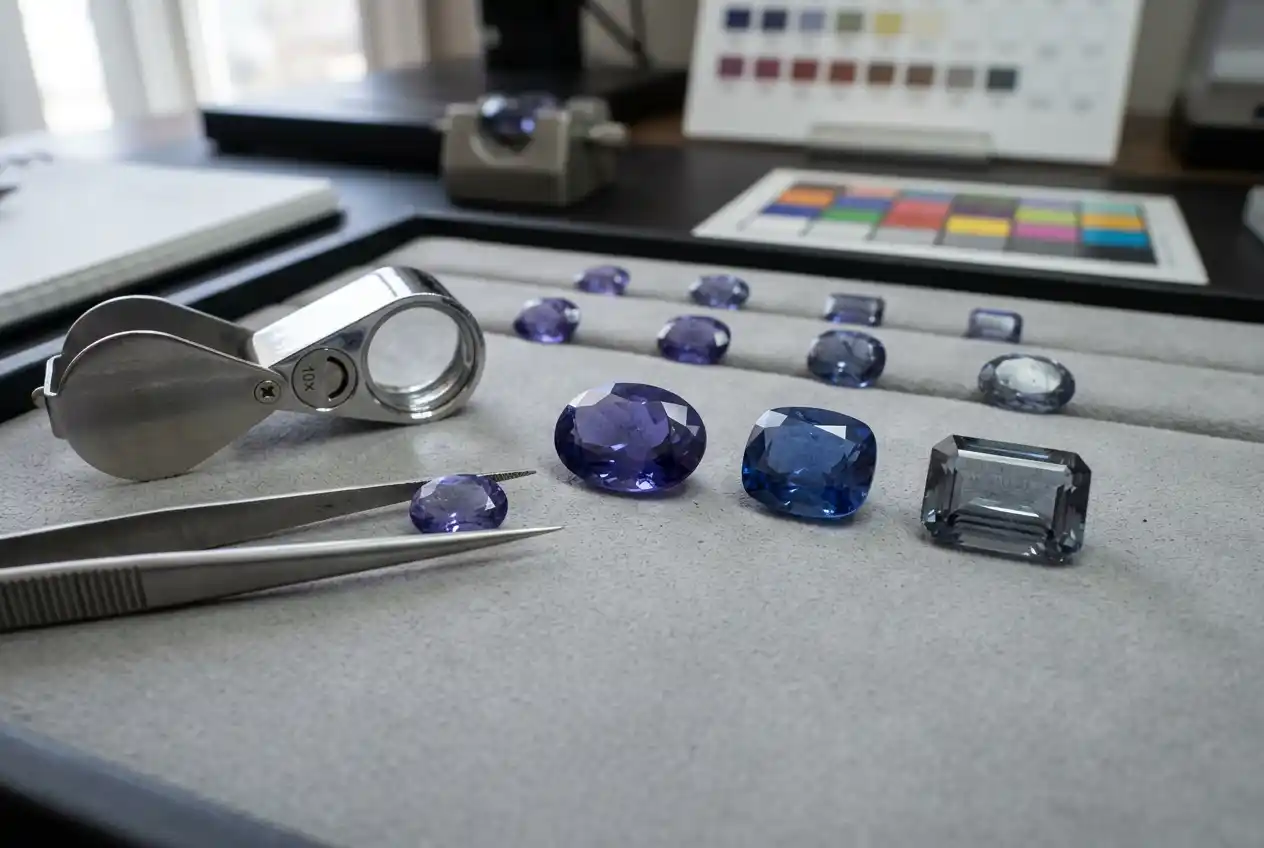
Iolite quality grading should focus on how successfully the gemstone combines blue-violet color, controlled pleochroism, transparency, clarity, cutting, and usable size. Fine iolite should look distinctly blue or violet-blue from the normal face-up position while avoiding excessive gray, yellowish zones, windowing, or black extinction. Because cordierite is strongly trichroic, the cutter’s orientation has an unusually large effect on the finished grade, and a stone that looked promising in rough form can lose much of its value if the wrong crystal direction dominates the face.
Iolite is gem-quality cordierite, an orthorhombic mineral with a composition commonly represented as (Mg,Fe)₂Al₄Si₅O₁₈. Its most famous property is strong trichroism, which allows three crystallographic directions to display different colors, commonly violet-blue or blue, pale blue-gray, and yellowish-gray to nearly colorless. This property can create beautiful directional variation, but it also means color grading and cut grading are inseparable.
There is no universal AAA or AAAA standard for iolite. Seller-created grades may sort inventory internally, but they do not replace direct examination. A useful quality assessment should explain identity, hue, saturation, tone, trichroism, clarity, cut, size, phenomena, treatment, and condition in specific terms so the buyer understands why one stone ranks above another.
10 Steps to Evaluate Iolite Pleochroism and Clarity
- Confirm natural cordierite identity
- Grade violet-blue or blue face-up hue
- Evaluate saturation and overall color strength
- Judge tone, grayness, and face-up brightness
- Assess trichroism and cutting orientation
- Evaluate clarity, transparency, and inclusion placement
- Judge cut quality, symmetry, polish, and windowing
- Consider carat weight, dimensions, and size rarity
- Evaluate special inclusion effects, treatment status, and color stability
- Review cleavage, condition, provenance, and overall craftsmanship
These ten steps create a practical framework that treats iolite as a pleochroic gemstone rather than merely as an inexpensive blue stone. High quality depends on how effectively the natural crystal directions have been managed, whether transparency remains strong, and whether cutting reveals attractive blue rather than simply preserving maximum carat weight.
Natural Cordierite Identity Should Be Confirmed First
Iolite can resemble sapphire, tanzanite, indicolite tourmaline, blue topaz, spinel, glass, and other blue gemstones. Photographs alone are particularly unreliable because color balance and lighting can suppress the trichroism that helps distinguish cordierite.
Professional identification can use refractive index, birefringence, specific gravity, optic character, pleochroism, spectroscopy, and inclusions. Strong directional colors provide useful evidence because few common blue gemstones display the same characteristic blue, gray, and yellowish combination.
Correct identity matters because iolite has its own market and durability profile. A blue gemstone should not be assigned an iolite grade until cordierite has been established, especially when the stone is unusually large, exceptionally colored, or offered with collector-level claims.
Face-Up Hue Should Be Clearly Blue or Violet-Blue
The most desirable iolite generally shows a distinct violet-blue or blue body color when viewed through the crown. Gray can be present naturally, but it should not dominate the face if the gemstone is to receive a fine grade.
Hue should be evaluated under neutral lighting because blue gemstones can shift noticeably according to lamp spectrum. Cool LEDs may exaggerate blue, while warm light can make gray and yellowish pleochroic directions more obvious.
The face-up position matters more than a strong side-view color. A poorly oriented stone may show magnificent violet-blue from one edge yet appear weak or gray through the table, which reduces its practical jewelry quality despite the impressive crystal color hidden inside.
High-grade stones therefore display the preferred hue where the wearer and observer actually see it.
Saturation Needs to Be Strong Without Becoming Muddy
Saturation describes the intensity of the blue or violet-blue. Fine iolite generally benefits from enough saturation to look distinctive, particularly because pale cordierite can appear washed out next to sapphire or tanzanite.
Strong saturation becomes less useful when gray modifiers overwhelm the color. A richly colored but heavily gray stone may look darker rather than more vivid, while a cleaner medium-blue can appear much livelier.
The best grade therefore rewards chromatic strength rather than sheer darkness. Violet and blue should remain visible across a useful part of the face, and the color should not depend on transmitted light or one narrow angle.
Tone and Brightness Need Careful Balance
Tone describes how light or dark the gemstone appears. Medium to medium-dark iolite often shows the most attractive balance because the body color looks rich while the facets still return enough light to remain lively.
A very dark stone can suffer from extinction, creating black or nearly black areas across the face. A very light stone may look bright but fail to show the saturated violet-blue color expected from fine quality.
Size can influence tone because thicker stones create longer light paths. A color that looks ideal in a two-carat gem may become too dark in a deeper eight-carat cut, making efficient proportions increasingly important as weight rises.
Trichroism Is the Core of Iolite Grading
Iolite’s trichroism produces different colors along three crystal directions, commonly violet-blue, blue-gray, and yellowish-gray to nearly colorless. This optical property should be examined by rotating the stone under consistent illumination and observing how the colors change.
A high-quality cut places the most desirable blue direction through the normal face-up view while keeping pale or yellowish directions less dominant. Some directional change is expected and can be attractive, but broad gray or colorless areas weaken the overall grade.
The cutter may need to sacrifice significant rough to achieve the correct orientation. This is why a smaller precision-cut stone can grade higher than a larger one whose table was placed to maximize weight.
Trichroism should therefore be graded according to the appearance of the finished gemstone, not simply according to how strongly the crystal changes color in theory.
Clarity Should Support Transparency Rather Than Microscopic Perfection
Fine faceted iolite is usually expected to be transparent and reasonably eye-clean. Natural inclusions can include crystals, fluid features, fractures, and growth structures, but their impact depends on visibility and location.
A minor inclusion near the girdle may have little practical effect, while a central fracture can interrupt brilliance across the entire table. Dense clouding is especially undesirable because it reduces the transparency needed for blue color to look luminous.
Structural fractures should be assessed separately from ordinary inclusions because they may interact with cordierite’s cleavage and increase the risk of damage. A stone can therefore look reasonably clean yet still deserve a lower durability grade when an open fracture crosses a vulnerable region.
A Practical Iolite Clarity Framework
| Face-Up Appearance | Practical Quality Interpretation |
|---|---|
| Eye-clean with high transparency | Fine to exceptional |
| Minor inclusions visible only under magnification | Very good |
| Small visible inclusions with limited brilliance loss | Good |
| Obvious clouds, central inclusions, or fractures | Commercial |
| Major structural fractures or poor transparency | Lower jewelry quality |
This framework is descriptive rather than internationally standardized. Its purpose is to keep attention on whether inclusions affect beauty and durability rather than encouraging a microscopic search for imperfections that have no visible effect.
Cut Quality Should Reveal Blue While Avoiding Windowing
A well-cut iolite should distribute light across the face while maintaining the preferred violet-blue orientation. Windowing is especially damaging because a shallow pavilion creates a transparent center and weakens both color concentration and brilliance.
Excessive depth creates a different problem by preserving hidden weight, reducing face-up dimensions, and often making the stone darker. Because iolite rough is not extraordinarily expensive in ordinary qualities, there is less justification for sacrificing optical performance merely to preserve an extra fraction of a carat.
Symmetry and polish matter because clean transparent stones reveal poor workmanship easily. Crisp facet junctions, an even girdle, balanced proportions, and smooth polishing can make iolite appear considerably more refined.
Custom cutting can be particularly successful because the lapidary can design around both crystal shape and pleochroism rather than forcing every piece of rough into a standardized pattern.
Carat Weight Should Be Judged After Color and Orientation
Iolite can occur in fairly large transparent crystals, so a high carat weight does not automatically indicate exceptional rarity. Large stones with weak gray-blue color or poor orientation may remain relatively affordable.
Fine size becomes more meaningful when saturated violet-blue color, eye-clean clarity, efficient cutting, and strong face-up brightness survive together. Such stones become harder to replace because increased thickness can deepen tone and magnify pleochroic problems.
Dimensions should therefore accompany weight. A broad six-carat oval may look larger and brighter than an eight-carat deep cut, making face-up spread a better measure of visual impact than scale weight alone.
Special Inclusions Can Create a Separate Collector Category
Not every inclusion lowers iolite value. Some stones contain reflective platelets, commonly associated with hematite or other iron-rich inclusions, that create reddish or coppery flashes. Such material may be described commercially as bloodshot iolite or may show an aventurescent effect.
These stones should not be graded through ordinary eye-clean standards because the inclusions are responsible for the phenomenon. Their quality depends on the strength, distribution, and attractiveness of the effect together with the underlying blue body color.
The key distinction is whether the inclusions create an intentional-looking optical phenomenon or simply reduce transparency. An organized, attractive effect can add collector interest, while random heavy clouding remains a conventional clarity weakness.
Treatment Is Usually a Minor Issue in Iolite
Iolite is notable because routine color enhancement is uncommon. Unlike many blue sapphires or topazes, much iolite is sold with natural color and without widespread heating or irradiation designed to create the marketable hue.
This does not eliminate the need for accurate identity or disclosure. Coatings, assembled products, imitations, or unusual treatments can appear in any gemstone market, and expensive stones should be represented honestly.
The relative absence of routine enhancement should therefore be treated as a positive characteristic of the species rather than as an excuse to skip basic gemological verification.
Cleavage and Condition Affect the Final Grade
Iolite has a Mohs hardness around 7 to 7.5, making it reasonably suitable for jewelry, but cleavage and brittleness mean that sharp impact can still damage a stone. Thin corners, exposed points, and existing fractures deserve particular care during setting.
The final quality grade should include present condition. Abraded facet edges, scratches, chips, and surface-reaching fractures lower the quality of a previously fine stone because iolite’s visual appeal depends heavily on crisp transparency and clean reflections.
Protective settings can make rings practical, while earrings and pendants naturally present less impact risk. Mild soap, lukewarm water, and a soft brush are appropriate for routine cleaning of sound stones, with aggressive mechanical cleaning avoided when fractures are present.
Common Iolite Grading Mistakes
One of the most common mistakes is choosing the darkest stone because it appears to have the strongest color. Heavy darkness can actually indicate poor orientation or excessive depth, and a somewhat lighter violet-blue gemstone may display far better brilliance and face-up beauty.
Another mistake is ignoring the yellowish or gray pleochroic directions. A stone may look exceptional from the side but weak through the table, making face-up orientation much more important than the strongest color visible anywhere in the gem.
Buyers can also overpay for size without comparing dimensions. Deeply cut iolite can hide significant carat weight beneath the girdle, so a smaller well-proportioned stone may offer greater visual impact and quality.
Conclusion
Iolite quality grading depends on natural cordierite identity, blue-violet hue, saturation, tone, trichroism, clarity, cutting, size, special inclusions, treatment status, condition, and provenance. Fine stones show the strongest desirable blue direction through the face while maintaining enough transparency and brightness for their facets to remain lively.
The defining feature is not simply blue color but how effectively the gemstone’s three directional colors have been managed. When strong trichroism is oriented correctly, clarity remains high, and proportions avoid windowing or excess depth, iolite can display sophisticated color behavior and excellent beauty at a comparatively accessible Price.
FAQs About Iolite Quality Grading
What is the most important factor in iolite quality?
Face-up color and trichroic orientation are among the strongest factors because a fine crystal can appear ordinary when the gray or yellowish axis dominates the table. High quality requires attractive violet-blue color, enough saturation to look distinctive, and enough brightness to avoid a dark closed appearance.
What color is considered the best iolite?
Rich violet-blue to blue is generally preferred when gray modifiers remain limited and transparency is strong. Excessive darkness, muddy gray, or a pale washed-out face usually lowers conventional quality even when the stone shows strong blue from another direction.
Why does iolite show three colors?
Cordierite is strongly trichroic, meaning light traveling through three different crystallographic directions is absorbed differently. As the stone is rotated, it can show violet-blue, blue-gray, and yellowish-gray to almost colorless appearances.
Should high-quality iolite be eye-clean?
Eye-clean transparency is generally preferred because clean faceted iolite is available. Small inclusions under magnification can be acceptable, but obvious clouds, dark crystals, or structural fractures usually lower the grade.
Is darker iolite always higher quality?
No. A very dark stone can suffer from extinction and may appear nearly black under normal lighting. Fine quality balances strong blue saturation with enough brightness and transparency to keep the gemstone lively.
Does cutting orientation affect quality?
Yes, dramatically. The cutter needs to place the richest blue direction through the normal face-up view while reducing the influence of pale or yellowish axes. Poor orientation can lower the grade even when the original rough was excellent.
Does larger iolite automatically grade higher?
No. Large stones are available, so size becomes important only when rich color, good orientation, clarity, and efficient cutting remain strong. A smaller precision-cut stone can grade considerably higher than a larger gray or windowed gem.
Is iolite commonly treated?
Routine treatment is uncommon compared with many other colored gemstones. Much iolite is sold with natural color, which adds appeal, but accurate identification and disclosure remain important for valuable stones.
What is bloodshot iolite?
Bloodshot iolite is a commercial term used for certain included stones showing reddish or coppery reflective effects, often associated with iron-rich plate-like inclusions. Fine examples can be collectible because the inclusions create a deliberate-looking optical phenomenon rather than simply reducing clarity.
Are AAA iolite grades standardized?
No. AAA, AAAA, premium, and similar labels vary among sellers. A meaningful evaluation should describe hue, saturation, tone, trichroism, clarity, cut, dimensions, phenomena, treatment, and condition directly.
What makes iolite exceptional?
Exceptional iolite combines verified natural cordierite identity, rich violet-blue face-up color, excellent trichroic orientation, high transparency, limited distracting inclusions, precision cutting, efficient proportions, significant size, and strong structural condition.