Jade Price Per Carat: 12 Major Value Drivers for Nephrite & Jadeite
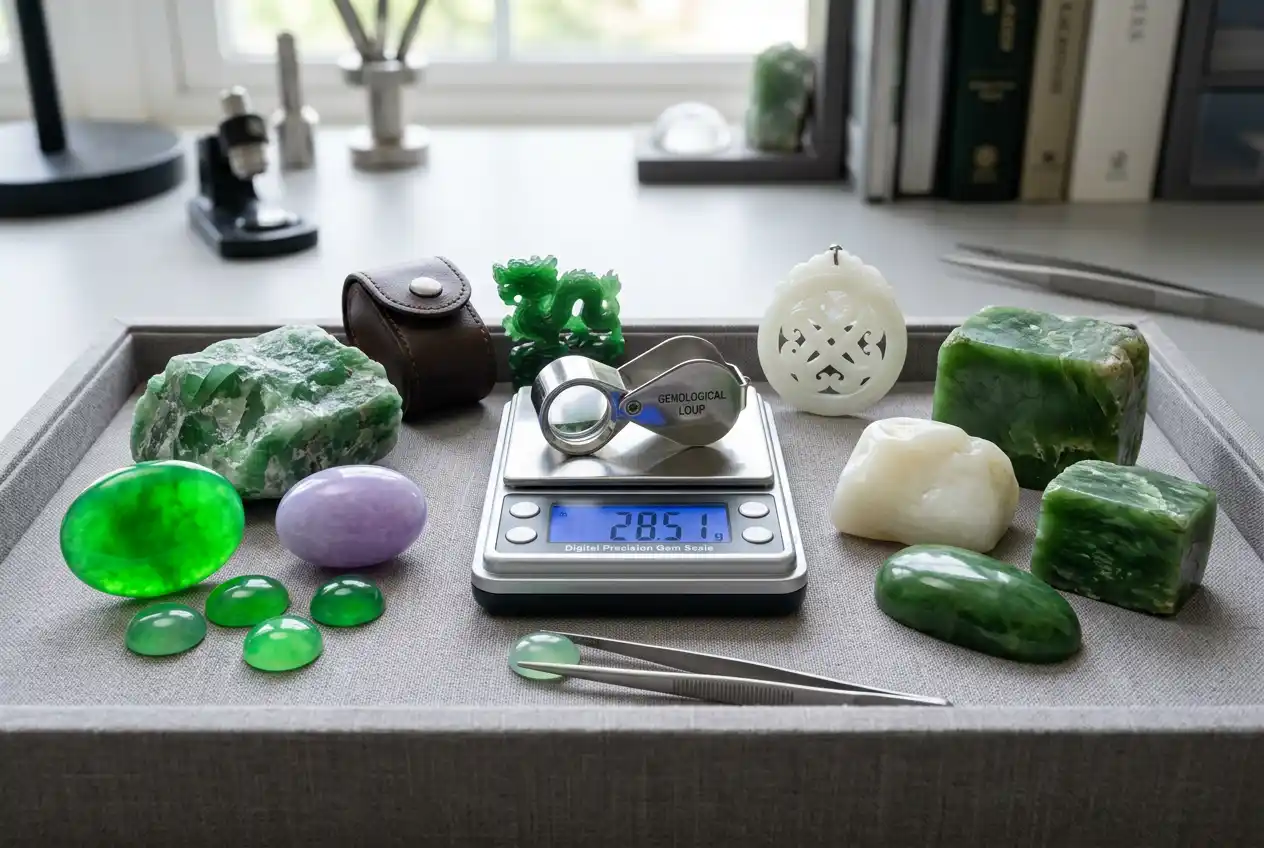
Jade price per carat can range from very modest levels for ordinary commercial nephrite or heavily included jadeite to thousands of dollars per carat for exceptional untreated jadeite with vivid green color, fine texture, and strong translucency. The very finest imperial-quality jadeite can move beyond ordinary per-carat comparisons altogether because exceptional cabochons, beads, bangles, and carvings are often valued as complete objects rather than by multiplying weight by a simple rate. Nephrite usually occupies a lower average Price range, but exceptional white nephrite, historically important Chinese pieces, fine Hetian-associated material, and master carvings can also command substantial premiums that far exceed ordinary commercial jade.
Jade is not one mineral. The name traditionally refers to two distinct gemstone groups: jadeite jade and nephrite jade. Jadeite is a pyroxene mineral dominated by sodium aluminum silicate, NaAlSi₂O₆, and can occur in green, lavender, white, yellow, orange, red, black, and other appearances. Nephrite is a compact interlocking aggregate within the tremolite-actinolite amphibole series and commonly appears white, cream, gray, brown, yellow-green, spinach green, dark green, or nearly black. The two differ in chemistry and microstructure, yet both earned the jade name because of their toughness, polish, carving potential, and cultural importance.
A simple Price-per-carat formula therefore gives only part of the answer. Jade is commonly sold as cabochons, beads, bangles, plaques, carvings, rough slabs, and complete jewelry pieces, and the usable distribution of color can matter more than total weight. A carved pendant with exceptional vivid green concentrated exactly where the design needs it may be more valuable than a heavier piece containing duller color and obvious fractures. Accurate valuation begins by identifying whether the object is jadeite or nephrite and then considering treatment, color, translucency, texture, workmanship, size, condition, and provenance together.
12 Major Value Drivers Behind Jade Price Per Carat
- Jadeite versus nephrite identity
- Natural untreated status and type of enhancement
- Hue, saturation, and tone of the dominant color
- Translucency and internal light transmission
- Texture, grain fineness, and structural compactness
- Color distribution and visual evenness
- Cracks, clouds, inclusions, and internal imperfections
- Size, weight, thickness, and usable shape
- Cutting, carving, polish, and craftsmanship
- Provenance, locality associations, and historical importance
- Toughness, structural condition, and absence of repairs
- Laboratory documentation, cultural demand, rarity, and market positioning
These twelve factors explain why two jade pieces of similar weight can have completely different values. A small untreated jadeite cabochon with fine texture, luminous translucency, and vivid saturated green can outperform a much larger but opaque stone, while a masterfully carved nephrite object with exceptional white color and documented historical provenance can command far more than ordinary nephrite priced only according to raw weight.
Typical Jade Price Per Carat
Jade is one of the gemstones for which per-carat Price needs especially careful interpretation because finished objects are frequently priced by the piece. Bangles, bead strands, carvings, and important cabochons may command premiums that cannot be separated neatly from form, craftsmanship, color distribution, and yield from the original rough.
| Jade Category | Approximate Price Per Carat | Typical Characteristics |
|---|---|---|
| Commercial nephrite | $1 to $20 | Ordinary green, gray, cream, or dark color, limited translucency |
| Fine nephrite | $20 to $150+ | Cleaner color, finer texture, better polish, attractive translucency |
| Commercial jadeite | $10 to $100 | Pale or uneven color, limited translucency, visible flaws |
| Good natural jadeite | $100 to $1,000+ | Attractive color, finer texture, useful translucency |
| Fine untreated jadeite | $1,000 to $5,000+ | Strong color, fine texture, high translucency, good condition |
| Exceptional imperial-quality jadeite | $5,000 to $10,000+ and potentially much higher | Vivid green, very fine texture, strong translucency, exceptional rarity |
| Important antique or master-carved jade | Highly variable | Historical importance, provenance, artistry, rarity, cultural demand |
These ranges are intentionally wide because jade does not behave like a standardized round brilliant gemstone market. An exceptional untreated bangle can be extraordinarily valuable even when dividing its Price by carat produces a number that looks inconsistent with loose cabochon pricing. The complete object’s geometry, color continuity, lack of fractures, and rarity often matter more than a mathematical per-carat rate.
Jadeite and Nephrite Occupy Different Value Structures
Jadeite generally has the greater potential for extremely high gemstone Prices because the rarest vivid green, lavender, and highly translucent qualities occur in combinations that are exceptionally difficult to find. Fine jadeite has a granular interlocking structure and can produce an almost glowing appearance when light penetrates the polished surface and interacts with a very fine texture.
Nephrite is generally more abundant and typically less expensive, but exceptional quality can still be highly valuable. Its tightly interwoven fibrous structure makes it exceptionally tough, allowing thin carvings, intricate details, and durable ornaments that have been prized for centuries. Fine creamy white or nearly pure white nephrite can carry major cultural and collector value, especially when texture is smooth, color is even, and provenance is important.
Buyers should therefore avoid assuming that jadeite is always valuable and nephrite is always inexpensive. Commercial jadeite can be relatively ordinary, while exceptional nephrite can become extremely desirable. The correct comparison is within the same jade type and quality level.
Treatment Status Can Change Jadeite Value Dramatically
Natural jadeite is often described in the trade through Type A, Type B, Type C, and combined treatment terminology. Type A jadeite generally refers to natural jadeite that has not undergone bleaching, polymer impregnation, or dyeing, although traditional surface waxing after polishing may still be accepted within this category. Type B jadeite has typically been subjected to chemical bleaching and polymer impregnation to improve apparent transparency and reduce visible discoloration, while Type C jadeite has been dyed. Stones receiving both impregnation and dyeing are commonly described as B+C.
This classification matters because fine untreated Type A jadeite receives the strongest rarity premium. A vivid green stone whose appearance results partly from dye or polymer treatment does not occupy the same natural rarity category, even when it looks attractive. Treatment can also influence long-term stability because dyes may fade and polymer-filled structures can react differently to heat, chemicals, and aging.
Nephrite can also be dyed, bleached, impregnated, coated, waxed, or otherwise modified, but the familiar A, B, and C terminology is primarily associated with jadeite and should not be applied carelessly to all jade. Expensive pieces deserve proper identification and treatment assessment rather than assumptions based on surface appearance.
Color Can Multiply Jade Value
Color is one of the strongest visible value factors, particularly in jadeite. The famous imperial-green ideal combines vivid saturated green with balanced tone, fine texture, and substantial translucency. The finest examples appear rich and luminous rather than dark, blackish, gray, or overly yellow.
Green is not the only valuable jadeite color. Fine lavender jadeite can command substantial premiums when the color is strong, even, and translucent. Colorless or near-colorless highly translucent jadeite, sometimes described commercially with icy terminology, can also be very valuable because the appeal comes from texture and light transmission rather than strong body color. Yellow, red, black, and multicolor jadeite may attract collectors when the colors are natural and visually distinctive.
Nephrite follows a different color hierarchy. Fine white, cream, pale celadon, spinach green, dark green, yellowish, and other natural appearances can all be desirable depending on texture, uniformity, locality association, and cultural preference. The strongest Price is therefore not tied to one universal green standard across both jade families.
Translucency Separates Fine Jade From Ordinary Stone
High-quality jadeite can transmit enough light to create a luminous appearance from within the stone. This translucency is especially valuable when combined with vivid color because light penetrates the surface and makes green or lavender appear deeper and more alive.
Opaque jadeite may still be attractive for carving or decorative use, but it generally lacks the exceptional gem quality associated with fine translucent cabochons and beads. Thickness must be considered during comparison because a thin piece naturally transmits more light than a thick one. A fair assessment therefore compares similar forms and dimensions.
Nephrite is often less transparent than the finest jadeite, but good translucency can still add beauty, particularly in pale white, celadon, or fine green stones. The effect tends to appear softer because of the fibrous structure, producing an internal glow rather than the more glassy translucency possible in exceptional jadeite.
Translucency should never be evaluated alone. A highly translucent stone with weak gray color or poor texture may be less valuable than a slightly less translucent gem with exceptional vivid green.
Fine Texture Is Essential to High-Value Jade
Texture describes the fineness and uniformity of the interlocking mineral structure. In jadeite, very fine grain can create a smooth, compact surface with excellent polish and attractive light transmission. Coarser texture may look granular and reduce the silky visual quality associated with fine pieces.
Nephrite derives much of its toughness from an interwoven fibrous structure. Fine nephrite can feel exceptionally smooth after polishing because the fibers are tightly integrated. Coarser or less uniform structures can create duller surfaces or reduce visual refinement.
Texture also influences translucency and polish, which is why these factors often rise together. Fine grain allows light to interact more evenly with the interior and helps the surface accept a clean polish. A stone with mediocre color but extraordinary texture may therefore attract more interest than a brighter stone whose coarse structure makes it look dry or granular.
Color Distribution Is as Important as Color Strength
Jade frequently displays mottling, veins, spots, clouds, or irregular color concentrations. These variations can either lower value or enhance it depending on how they interact with the finished design.
A jadeite cabochon usually benefits from strong desirable color concentrated across the visible dome rather than hidden near the base. Bangles require an even more demanding distribution because the color needs to continue attractively around a large circular form while the entire piece remains structurally sound.
Carvers can transform uneven color into an artistic advantage by positioning green, lavender, white, yellow, or brown areas as deliberate parts of a motif. A master carving may therefore gain value from color zoning that would lower the grade of a simple cabochon.
This explains why jade rough is difficult to value before cutting. The visible surface may reveal only part of the internal color distribution, and a change of a few millimeters can determine whether the rough yields an exceptional bangle or only smaller commercial pieces.
Cracks and Internal Flaws Can Override Beautiful Color
Jade is renowned for toughness, especially nephrite, but natural pieces can still contain fractures, healed seams, mineral inclusions, clouds, and weak zones. Structural cracks are particularly important in bangles and thin carvings because a fracture can turn a valuable wearable piece into a high-risk object.
Fine jadeite should appear internally clean enough that fractures do not interrupt translucency or create obvious pale lines. Minor clouds or natural structures may be acceptable, but open cracks, repaired breaks, and strongly visible fissures usually reduce value.
Nephrite can tolerate a visually complex internal appearance more readily because opacity and fibrous texture are normal, yet structural integrity still matters. A fine carving made from tough intact nephrite will generally outperform a prettier-colored piece containing serious fractures.
Condition needs to be judged separately from natural inclusions. An antique jade object can retain high collector value despite age-related wear, but modern chips, poor repairs, and structural damage should be reflected in The Price.
Size and Shape Can Create Enormous Premiums
Large jade objects are not valuable simply because they weigh more. What creates rarity is finding enough high-quality jade with continuous color and structural integrity to produce a demanding form.
Bangles illustrate this clearly because the cutter needs a large ring-shaped section of rough without major fractures. A vivid translucent green bangle requires a much larger starting block than a cabochon and wastes substantial surrounding stone during cutting. This low yield can make top bangles disproportionately valuable.
Bead strands create another challenge because multiple beads need to match in color, translucency, texture, diameter, and polish. A strand of well-matched fine jadeite beads can therefore command much more than the total value of mismatched beads of equal combined weight.
Large carvings depend heavily on artistry and rough quality. Weight is relevant, but the usable distribution of color and the skill with which the artist interprets the stone often matter far more.
Carving and Craftsmanship Can Exceed the Value of the Rough
Jade has one of the world’s richest carving traditions because its toughness allows artists to create thin walls, detailed relief, openwork, smooth curves, and polished surfaces that many more brittle gemstones cannot tolerate.
A master carver studies color zones, fractures, shape, and texture before deciding how to use the rough. A dark area can become hair, a green patch can become foliage, and a pale region can provide contrast within a figure. The resulting object may be valuable as art rather than merely as polished gemstone weight.
This is especially important in historical Chinese jade, where iconography, period style, tool marks, polish, provenance, and artistry can dominate valuation. A simple per-carat calculation has little meaning for an important antique carving whose value derives from cultural and historical significance.
Modern jewelry follows the same principle on a smaller scale. Excellent polishing, matching, carving precision, and setting quality can raise the total Price substantially beyond the raw jade itself.
Provenance and Origin Can Influence Collector Demand
Myanmar has the strongest association with high-end jadeite and has historically produced much of the material that defines the international imperial-jade market. Provenance connected to recognized old collections, established jewelry houses, or documented historical ownership can add another layer of value to exceptional pieces.
Nephrite has important cultural and geological associations with China, particularly the historic Hetian tradition, as well as deposits in regions such as Canada, Russia, New Zealand, and elsewhere. The market can attach large premiums to certain provenance claims, but those claims require care because origin terminology is sometimes used loosely.
Geographic origin is not always simple to determine scientifically from a finished jade object, so provenance records can be more meaningful than unsupported statements based solely on appearance. Fine quality should still be evident in the jade itself before origin or historical association adds a premium.
Jadeite and Nephrite Differ in Hardness and Toughness
Jadeite generally has a Mohs hardness around 6.5 to 7, while nephrite usually falls around 6 to 6.5. Hardness, however, does not explain why jade became famous for durability. The key property is toughness, which refers to resistance to breaking rather than resistance to scratching.
Nephrite’s tightly interwoven fibrous structure makes it extraordinarily tough and suitable for demanding carvings and tools. Jadeite is also tough because of its interlocking granular structure, though individual fractures can still create weaknesses.
Both types can be scratched by harder gemstones and damaged by strong impact. Proper storage, careful wear, and gentle cleaning preserve polish and structural integrity, particularly for antique pieces and valuable untreated jadeite.
Conclusion
Jade price per carat varies enormously because jade refers to both jadeite and nephrite and because the market values complete objects as much as raw weight. Commercial pieces can cost very little per carat, while fine untreated jadeite with vivid green color, high translucency, fine texture, excellent condition, and exceptional form can command thousands of dollars per carat or far more when sold as an important bangle, bead strand, carving, or historic jewel.
The most accurate valuation begins with mineral identity and treatment status, then moves through color, translucency, texture, distribution, structural integrity, form, craftsmanship, provenance, and documentation. Buyers who compare those characteristics directly will understand jade far more accurately than buyers who rely on weight, color alone, or an undefined label such as imperial, premium, or Grade A.
FAQs About Jade Price Per Carat
How much does jade cost per carat?
Ordinary nephrite can cost only a few dollars to a few tens of dollars per carat, while fine nephrite can reach much higher levels depending on color, texture, provenance, and craftsmanship. Jadeite has a much wider range, from modest commercial material to fine untreated gems costing hundreds or thousands of dollars per carat, with exceptional imperial-quality pieces potentially exceeding ordinary per-carat comparisons altogether.
Is jadeite more expensive than nephrite?
Jadeite generally has the higher maximum market value because exceptional vivid green, lavender, and highly translucent jadeite is extremely rare. Nephrite can still be highly valuable when it has exceptional white or green color, fine texture, important provenance, historic significance, or master carving, so the distinction should not be reduced to jadeite expensive and nephrite cheap.
What is imperial jade?
Imperial jade commonly refers to the finest vivid green translucent jadeite with exceptionally fine texture and balanced color. The term is used commercially and should not be treated as a laboratory grade by itself, so actual color, translucency, texture, treatment status, and documentation need to support the claim.
What does Type A jade mean?
Type A terminology is used mainly for jadeite that has not undergone bleaching with polymer impregnation or dyeing, although traditional surface waxing after polishing can still be compatible with this category. Fine Type A jadeite commands strong premiums because its color and translucency arise primarily from the natural stone rather than intensive enhancement.
What are Type B and Type C jadeite?
Type B jadeite has typically been chemically bleached and polymer impregnated to improve apparent clarity or appearance, while Type C jadeite has been dyed. A stone receiving both processes may be called B+C, and these treated categories generally carry lower rarity and value than comparable untreated Type A jadeite.
Why is jade often priced by the piece instead of per carat?
The form of a jade object strongly affects rarity because producing a bangle, bead strand, cabochon, or carving requires different amounts of clean continuous rough. Color placement, matching, structural integrity, carving quality, and cutting yield can make two objects of similar weight differ enormously in Price.
Does darker green mean better jade?
No. Fine jadeite should combine attractive green saturation with enough brightness and translucency to appear lively. Very dark green can look nearly black, while vivid medium to strong green with fine texture and good light transmission may be substantially more valuable.
What makes nephrite valuable?
Fine nephrite can command strong Prices when it has exceptional white, celadon, or green color, dense fine texture, attractive translucency, smooth polish, important provenance, or master craftsmanship. Historic Chinese nephrite pieces may also derive enormous value from age, artistic quality, and cultural significance.
Does jade need a laboratory report?
A laboratory report is particularly useful for expensive jadeite because mineral identity and treatment status can change value dramatically. Documentation can help distinguish natural untreated jadeite from bleached, polymer-impregnated, dyed, coated, or imitation products while supporting a more informed purchase.
What makes jade collector quality?
Collector-quality jade combines verified identity, desirable natural color, fine texture, strong translucency where appropriate, excellent structural integrity, outstanding form or craftsmanship, credible treatment disclosure, and meaningful provenance. Exceptional historical pieces can also carry value that far exceeds the gemstone’s weight-based calculation.