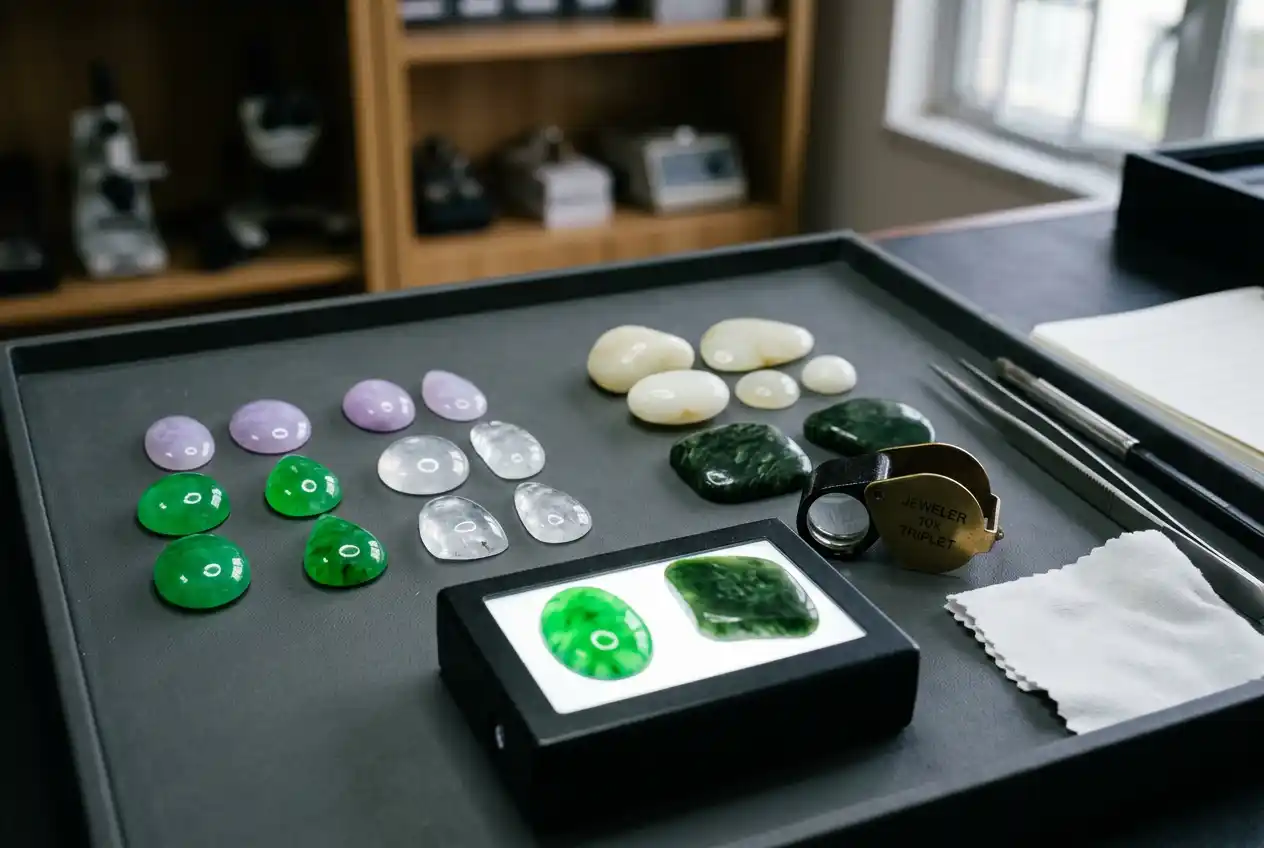
Jade Quality Grading: 9 Essential Criteria for Translucency & Color
Jade quality grading requires a different approach from grading transparent faceted gemstones because jade is valued through mineral identity, treatment, color, translucency, texture, color distribution, structural integrity, form, and craftsmanship rather than through brilliance or conventional facet clarity. High-quality jadeite can appear luminous and almost internally glowing when fine texture and strong translucency occur together, while fine nephrite often displays a dense, smooth, exceptionally tough structure with a soft visual glow. Neither should be graded solely by how green it looks.
The first distinction is mineralogical. Jadeite jade is a pyroxene dominated by NaAlSi₂O₆, while nephrite is a compact interlocking aggregate of amphibole minerals in the tremolite-actinolite series. These structures explain important differences in hardness, toughness, texture, and appearance. Jadeite can reach exceptional translucency and vivid color, whereas nephrite’s fibrous structure gives it extraordinary toughness and a characteristic smooth polish that made it ideal for carving throughout history.
There is no single universal AAA or AAAA grading system that works across all jade. Terms such as imperial, icy, glassy, mutton-fat, spinach green, Grade A, and premium may have established meanings in particular markets but are not interchangeable standardized quality grades. Serious evaluation should therefore describe the actual jade directly and distinguish gemological treatment categories from promotional labels.
9 Essential Criteria for Jade Quality Grading
- Confirm jadeite or nephrite identity
- Determine treatment and enhancement status
- Grade hue, saturation, and tone
- Evaluate translucency and internal light transmission
- Assess texture, grain fineness, and compactness
- Judge color distribution, clouds, inclusions, and fractures
- Evaluate shape, proportions, polish, carving, and craftsmanship
- Consider size, thickness, toughness, and structural condition
- Review provenance, documentation, rarity, and market significance
These nine criteria create a grading sequence that works for both jadeite and nephrite while recognizing that the ideal expression differs between them. Fine jadeite may be prized for vivid green combined with high translucency, while fine nephrite may derive more of its quality from exceptionally fine fibrous texture, creamy white color, dense structure, polish, and carving potential.
Jadeite and Nephrite Must Be Identified Before Quality Is Compared
The word jade is widely misused in commerce for many green ornamental stones, including serpentine, quartz, aventurine, prehnite, calcite, glass, and other products. A gemstone should therefore not receive a jade quality grade until its mineral identity has been established.
Jadeite and nephrite can be separated through a combination of refractive index, specific gravity, spectroscopy, microscopic structure, infrared analysis, and other gemological methods. The aggregate nature of both gems creates textures unlike ordinary single-crystal gemstones, and professional laboratories can usually establish whether a polished object belongs to jadeite, nephrite, or an imitation category.
Identity matters because jadeite and nephrite follow different market structures. A vivid green nephrite object can be valuable, but it should not be priced as imperial jadeite simply because the color is similar. Likewise, highly translucent jadeite belongs to a rarity class not directly comparable with most commercial nephrite.
Treatment Status Is Fundamental to Jadeite Quality
Jadeite treatment can alter appearance dramatically, which is why treatment assessment belongs near the beginning of the grading process. Type A jadeite generally refers to natural jadeite that has not been bleached and polymer impregnated or dyed, although normal polishing and traditional surface waxing may still be present.
Type B jadeite has commonly undergone chemical bleaching to remove discoloration followed by polymer impregnation that fills spaces and improves apparent transparency. Type C jadeite has been dyed, while B+C indicates combined impregnation and dyeing. These treatments can create attractive objects, but they change natural rarity and may affect long-term stability.
The highest gemological quality therefore requires not just beautiful color but confidence that the appearance is natural. A strongly dyed green stone can look more saturated than a fine untreated jadeite, yet the untreated gem remains much rarer and typically much more valuable.
Treatment terminology should also be used precisely. The A, B, and C system is associated mainly with jadeite and should not be applied automatically to every nephrite product encountered in the market.
Color Quality Requires More Than Simply Looking Green
Fine jadeite green is judged through hue, saturation, tone, and evenness. Imperial-type color is usually described as vivid saturated green with enough brightness to remain lively and with little gray, brown, or excessive yellow. The color should look rich but not so dark that translucency disappears.
Lavender jadeite follows its own hierarchy, with stronger even lavender or violet generally preferred over weak grayish tones when texture and translucency are comparable. Highly translucent near-colorless or icy jadeite can also achieve exceptional grades despite having little body color because its value comes from purity, texture, and internal light transmission.
Red, yellow, orange, black, and multicolor jadeite can be desirable as well, particularly when the colors are natural and visually balanced. The quality system should therefore recognize that green is dominant in the high-end market without pretending that every fine jadeite must be green.
Nephrite has its own valued colors, including white, cream, pale celadon, yellow-green, spinach green, dark green, and blackish tones. Fine white nephrite can be among the most highly prized categories in certain collecting traditions even though it contains no vivid green at all.
Translucency Is One of the Strongest Jadeite Quality Indicators
Fine jadeite can range from opaque to highly translucent. Greater translucency generally raises quality because light penetrates into the aggregate and creates a luminous internal appearance, particularly when the texture is very fine.
The best assessment uses transmitted or diffused light while considering thickness. A thin cabochon naturally transmits more light than a thick bangle, so comparing translucency without accounting for form can be misleading. Two pieces should be judged at reasonably similar thicknesses whenever possible.
Terms such as icy or glassy are often used commercially for highly translucent jadeite. These descriptions can be useful when they accurately describe appearance, but they do not replace treatment testing. A polymer-impregnated stone can appear deceptively clean, making natural translucency much more valuable than appearance alone suggests.
Nephrite generally shows softer translucency because its interlocking fibrous structure scatters light differently. Fine white or pale nephrite can still produce a beautiful internal glow, and this quality should be evaluated according to nephrite standards rather than by forcing it to imitate jadeite.
Texture Determines How Refined Jade Appears
Jadeite texture depends on the size, shape, and interlocking relationship of its mineral grains. Very fine-grained jadeite can appear smooth, compact, and highly polished, while coarse texture may look granular or dry.
Fine texture enhances translucency because light encounters fewer large boundaries that scatter it strongly. It also improves the visual evenness of color and allows cabochons or bangles to achieve a refined surface.
Nephrite’s texture is fibrous rather than granular. Its finest examples contain densely interwoven fibers that create exceptional toughness and a smooth almost oily-looking polish. Coarse fibers, uneven structure, or granular-looking zones generally reduce refinement.
Texture is one reason jade cannot be graded solely from a photograph. Surface appearance, transmitted light, close examination, and sometimes magnification reveal structural qualities that ordinary product images may hide.
Color Distribution Can Improve or Weaken the Grade
A vivid green patch is valuable only when it is positioned where it contributes to the finished piece. In a cabochon, buyers generally prefer desirable color across much of the dome rather than hidden near the back. In a bangle, continuous attractive color around the circumference can create a much stronger premium because such rough is difficult to obtain.
Mottling is not automatically a defect. Natural jade commonly contains veins, clouds, spots, and color transitions, and skilled carvers can integrate them beautifully. A multicolor carving may use green as foliage, lavender as clothing, and white as negative space, allowing uneven rough to become artistically exceptional.
For simple jewelry forms, however, uneven gray areas, muddy patches, or abrupt unattractive zoning usually lower the grade. The quality judgment therefore depends on whether natural color variation appears accidental or has been used successfully within the finished design.
Fractures and Structural Weakness Need Serious Attention
Jade is famous for toughness, but natural fractures still matter. A visible crack crossing a bangle or thin carving can substantially reduce both durability and value, even when color and translucency are excellent.
Fine jadeite should have limited disruptive fissures because fractures interrupt light transmission and can appear as pale lines or internal seams. Inclusions and clouds may be acceptable when they do not weaken the object, but open fractures, repaired breaks, and heavily damaged edges should lower the grade clearly.
Nephrite’s fibrous structure gives it exceptional resistance to breaking, yet fractures can still occur, especially in large carvings or pieces that have experienced impact. The famous toughness of nephrite should therefore not be confused with indestructibility.
Structural integrity becomes even more important in bangles because a complete ring cannot avoid impact as easily as a pendant. A fracture-free bangle cut from fine continuous jade represents a much greater achievement than a small cabochon cut from the same rough.
A Practical Jade Quality Framework
| Quality Level | Typical Characteristics |
|---|---|
| Exceptional jadeite | Natural untreated status, vivid color or highly prized icy appearance, strong translucency, very fine texture, excellent condition |
| Fine jadeite | Attractive natural color, good translucency, fine texture, limited fractures, strong polish |
| Good jadeite | Pleasant color, moderate translucency, some mottling or visible inclusions, competent finish |
| Fine nephrite | Excellent white, celadon, or green color, dense fine fibers, smooth polish, sound structure |
| Commercial jade | Limited translucency, ordinary color, coarser texture, visible imperfections or treatment |
| Lower quality | Major fractures, weak texture, heavy treatment, poor polish, serious damage, or uncertain identity |
This framework is descriptive rather than a universal certification system. Jade quality is multidimensional, and the grade should explain why a piece is desirable instead of reducing a complex object to one letter.
Shape, Polish, and Carving Can Transform the Final Grade
Simple jade cabochons should have balanced domes, smooth outlines, strong polish, and color positioned attractively across the face. Because jade does not depend on faceted brilliance, surface quality and form become major components of visual appeal.
Bangles require extraordinary cutting discipline because the piece must be shaped from a large continuous section of rough while avoiding fractures and preserving color. Thickness, symmetry, inner diameter, wall consistency, and polish all affect quality alongside the stone itself.
Carved jade requires an additional artistic assessment. Master carving should respect the natural stone, using color variations, veins, and shape as part of the design rather than simply removing them. Detail, proportion, surface finish, relief depth, and the artist’s ability to transform difficult rough can add enormous value.
This is why craftsmanship belongs within jade grading rather than being treated as an unrelated decorative factor. In many important objects, the art and the gemstone cannot be valued separately.
Size and Thickness Must Be Interpreted Through Rarity of Form
Jade can occur in large masses, so weight alone does not establish quality. A large opaque boulder may contain only small areas suitable for fine jewelry, while a much smaller piece of rough may yield an exceptional translucent cabochon.
The rarity lies in finding continuous high-quality stone large enough for a particular finished object. A thick vivid green bangle with excellent translucency requires an extraordinary section of rough because color and structure must remain consistent around the full circle.
Matched beads create another demanding form because every bead needs similar color, texture, translucency, diameter, and polish. A fine matched strand can therefore receive a much higher grade than an equal total weight of unmatched loose beads.
Thickness should always be considered when translucency is compared. A thin slice can look deceptively transparent, while a substantial bangle or cabochon demonstrating good light transmission represents much more impressive quality.
Provenance and Documentation Become Crucial at High Value
Myanmar has historic importance for fine jadeite, while nephrite has major cultural and mining associations with regions including China, Canada, Russia, and New Zealand. Provenance can affect collector demand, but quality should still be evident in the object itself.
Geographic origin can be difficult to establish conclusively for some finished jade, which makes documented ownership, mining records, old labels, auction history, and other provenance evidence important in high-end collecting. Unsupported source claims should not receive the same weight as reliable records.
Laboratory reports are especially useful for high-value jadeite because they can identify jadeite and investigate polymer impregnation, dyeing, and other treatments. A report does not grade artistry or cultural importance, but it provides a reliable foundation for the gemological part of the assessment.
Conclusion
Jade quality grading requires identification of jadeite or nephrite before treatment, color, translucency, texture, distribution, structural integrity, form, craftsmanship, provenance, and documentation can be interpreted correctly. High-quality jade is not merely the greenest piece but the object in which natural color, internal structure, polish, and usable form work together successfully.
Fine jadeite is especially prized when vivid color or an exceptional icy appearance combines with strong translucency, fine texture, untreated status, and sound structure. Fine nephrite follows a different visual path, often emphasizing dense fibrous texture, beautiful white, celadon, or green color, extraordinary toughness, and refined carving. Understanding those differences produces a far more meaningful grade than relying on undefined AAA labels or judging every jade object according to a single green-color standard.
FAQs About Jade Quality Grading
What is the most important factor in jade quality?
There is no single factor that works for all jade, but identity, treatment status, color, translucency, and texture form the core of serious grading. In fine jadeite, vivid natural color combined with strong translucency and fine texture can create exceptional quality, while fine nephrite may be judged more strongly through texture, color purity, toughness, polish, and craftsmanship.
Is the greenest jade always the best?
No. Green needs to have attractive hue, saturation, and tone while remaining compatible with translucency and fine texture. A very dark opaque green stone can grade below a lighter but more luminous untreated jadeite with finer structure and stronger internal light transmission.
What does translucency mean in jade grading?
Translucency describes how much light enters and travels through the jade. Fine translucent jadeite can appear internally luminous, especially when grain size is very fine, while nephrite generally produces a softer glow because its fibrous structure scatters light differently.
What is Type A jadeite?
Type A usually refers to jadeite that has not been chemically bleached and polymer impregnated or dyed, although traditional surface waxing after polishing may still be accepted. Type A status is important because the gem’s color and translucency are substantially natural rather than created through intensive enhancement.
Are Type B and Type C jadeite lower quality?
They can be visually attractive, but their gemological rarity is lower because Type B has been bleached and polymer impregnated and Type C has been dyed. Combined B+C treatment can alter both apparent color and transparency, so treated stones should be evaluated and priced separately from comparable untreated jadeite.
How is nephrite quality different from jadeite quality?
Nephrite usually places greater emphasis on fine fibrous texture, toughness, smooth polish, color purity, and carving quality, while top jadeite can achieve much stronger premiums for vivid green or lavender combined with high translucency. The two are different minerals and should not be forced into one identical grading hierarchy.
Why is texture important in jade?
Fine texture creates a smoother surface, better polish, more attractive light behavior, and a more refined appearance. In jadeite, fine grain often supports stronger translucency, while in nephrite tightly interwoven fibers create the dense smooth character associated with top quality.
Can heavily treated jade still look high quality?
Yes visually, which is why treatment testing matters. Bleaching, polymer impregnation, and dyeing can improve apparent clarity or color, but the resulting stone does not have the same natural rarity or long-term treatment stability as comparable untreated jade.
Are AAA jade grades standardized?
No. AAA, premium, imperial, and similar commercial descriptions are not universal grading systems. A meaningful jade assessment should describe mineral identity, treatment, color, translucency, texture, structural condition, craftsmanship, dimensions, and provenance directly.
What makes jade exceptional?
Exceptional jade combines verified mineral identity, desirable natural color, fine texture, strong translucency where appropriate, sound structural condition, excellent polish, outstanding form or craftsmanship, accurate treatment disclosure, and meaningful provenance. The highest-value objects often succeed simultaneously as gemstones, cultural artifacts, and works of art.