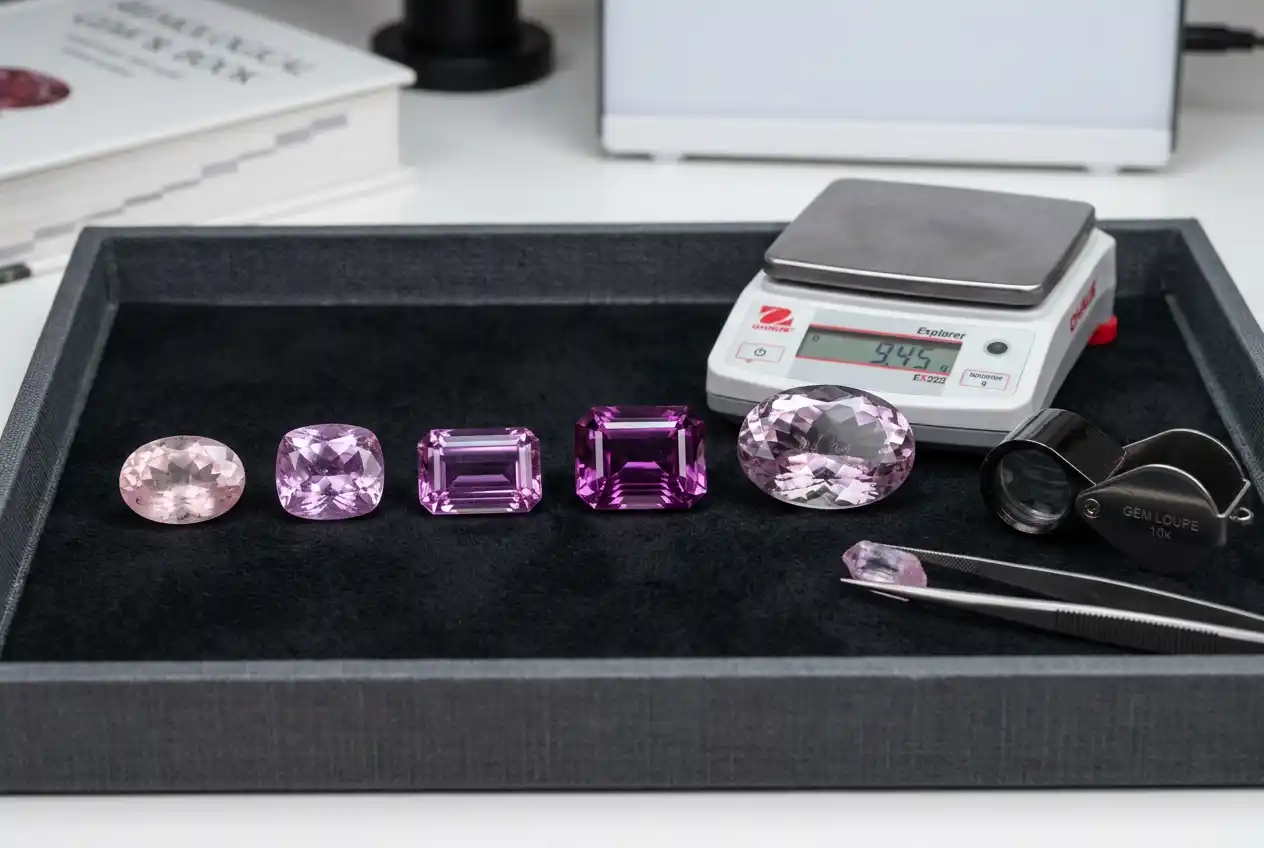
Kunzite Price Per Carat: 9 Key Cost Factors for Pink Spodumene
Kunzite price per carat is usually moderate because spodumene can form large transparent crystals, yet strong pink or violet-pink color is much less common than pale commercial material. Lightly colored stones may sell for roughly $10 to $40 per carat, while attractive jewelry-quality kunzite with cleaner pink color, high transparency, and competent cutting can move into approximately $40 to $100 per carat. Fine stones with stronger violet-pink saturation, excellent clarity, favorable pleochroic orientation, and refined cutting may reach roughly $100 to $250 per carat, while exceptional gems with unusually rich color, large clean size, precision cutting, and strong condition can rise to several hundred dollars per carat or more.
Kunzite is the pink to violet variety of spodumene, LiAlSi₂O₆, and its color is associated mainly with manganese-related centers within the crystal. The gemstone can range from barely perceptible pink through rose, lilac-pink, violet-pink, and stronger purple-pink shades. Large crystals are not unusual, which is why impressive multi-carat stones may remain surprisingly affordable compared with ruby, sapphire, or fine spinel. What creates the stronger premium is not size by itself but the combination of saturated color, high transparency, successful orientation, and color stability.
Kunzite also presents several valuation complications that buyers should understand before comparing Prices. The mineral is strongly pleochroic, so its most attractive pink or violet direction may appear much weaker from another axis. Spodumene also has pronounced cleavage and is brittle despite a Mohs hardness around 6.5 to 7, which makes cutting and setting more demanding than the hardness number suggests. In addition, kunzite is known for light sensitivity, and prolonged intense light can weaken some pink and violet coloration. Fine value therefore depends on how the stone looks, how it was cut, how stable the color appears, and how well its structure has been preserved.
9 Key Cost Factors Behind Kunzite Price Per Carat
- Pink, violet-pink, or lilac body color
- Saturation, tone, and overall color intensity
- Pleochroism and cutting orientation
- Transparency, clarity, and inclusion character
- Carat weight and availability of larger fine stones
- Cut quality, symmetry, polish, and face-up spread
- Color stability, light sensitivity, and treatment history
- Cleavage, fractures, chips, and structural condition
- Natural identity, provenance, craftsmanship, and market demand
These nine factors explain why two kunzites of equal weight can differ substantially in Price. A large pale stone can remain inexpensive because transparent spodumene rough occurs in sizable crystals, while a smaller but richly saturated violet-pink gem may command a stronger per-carat rate when its color has been oriented successfully and its clarity remains high. Buyers therefore gain more useful information from face-up color, cut, transparency, and condition than from carat weight alone.
Typical Kunzite Price Per Carat
Kunzite does not have a standardized global Price chart, and retail rates vary considerably according to color, size, cutting, seller positioning, and whether the gemstone has been custom faceted. The following ranges provide broad orientation for natural loose kunzite rather than fixed market rules.
| Kunzite Quality | Approximate Price Per Carat | Typical Characteristics |
|---|---|---|
| Commercial quality | $10 to $40 | Pale pink, ordinary cut, minor inclusions |
| Good jewelry quality | $40 to $100 | Attractive pink to lilac-pink, high transparency |
| Fine quality | $100 to $250 | Stronger violet-pink, eye-clean clarity, good orientation |
| Exceptional precision-cut quality | $200 to $500+ | Rich color, excellent clarity, refined cutting, strong face-up performance |
| Important collector stones | Highly variable | Exceptional size, vivid natural-looking color, notable crystal or provenance |
These ranges should not be applied mechanically to finished jewelry because precious metal, accent diamonds, design, brand positioning, and setting labor can contribute more than the loose kunzite itself. A precision-cut gemstone can also cost more than an ordinary commercial stone of greater weight because the cutter may remove substantial rough in order to produce better color and brilliance.
Color Strength Is the Main Visible Value Driver
Fine kunzite should show a recognizable pink, lilac-pink, or violet-pink body color without looking nearly colorless. The most desirable stones usually have enough saturation to create visual presence while preserving the transparency and brightness that make the gem attractive.
Pale pink kunzite can be elegant, particularly in larger cuts where greater thickness concentrates color, but weak saturation usually limits the per-carat premium. Strong violet or lilac modifiers can increase appeal when they remain balanced and do not make the stone look gray or dull.
Tone also matters because a darker stone is not automatically better. Kunzite is normally valued for luminous pastel-to-medium color rather than extremely dark saturation. A well-balanced medium pink with violet flashes can therefore look finer than a heavier stone whose color appears uneven, grayish, or overly muted.
Lighting should remain neutral during comparison because warm illumination can make pink gemstones look richer, while cool light can emphasize violet components. A fine stone should remain attractive under several normal lighting conditions rather than depending on one carefully selected lamp.
Pleochroism Can Transform the Face-Up Color
Spodumene is strongly pleochroic, so kunzite can show different color intensities when viewed along different crystal directions. One axis may display the strongest pink or violet, while another can appear much paler.
This behavior gives the cutter a demanding task. The table needs to be positioned so the most attractive color direction dominates the finished face, even if that orientation sacrifices weight. A cutter who follows the natural crystal shape too closely may preserve more carats while producing a stone that looks unexpectedly pale when viewed normally.
The effect becomes especially important in light-colored rough. A small improvement in orientation can make the finished gem look substantially richer without any actual change in chemistry. Conversely, poor orientation can reduce the visual quality of otherwise excellent rough.
For this reason, buyers should judge kunzite from the face-up position and through gentle rotation rather than relying on the strongest color visible from one side. Fine pleochroic orientation adds real value because it allows the gemstone to show its best natural color consistently.
Clarity Is Expected to Be High in Fine Kunzite
Kunzite frequently occurs in transparent crystals, so high clarity is common enough that eye-clean stones generally receive stronger market preference. Natural inclusions can include fractures, growth features, fluid-related structures, crystals, and veils, but obvious central inclusions usually lower value when cleaner alternatives are available.
A small internal feature near the girdle can have very little influence, while a bright reflective fracture beneath the table may reduce brilliance across a large part of the stone. Surface-reaching fractures deserve even greater attention because spodumene already has pronounced cleavage and can be vulnerable to impact.
The clarity assessment should therefore separate harmless microscopic inclusions from structurally significant breaks. A stone can look nearly flawless yet still contain a cleavage-related weakness near a corner, making structural inspection especially important before setting a large expensive gem.
Large Size Is Available, but Fine Large Color Is More Selective
Kunzite is one of the gemstones capable of producing impressive multi-carat stones without automatically entering an extreme Price category. Spodumene crystals can become very large, and transparent rough may yield gemstones weighing ten, twenty, or even more carats.
That availability keeps the size premium relatively moderate when color is pale. A twenty-carat light pink kunzite may still cost less per carat than a much smaller rare gemstone because size itself is not the limiting factor.
The rarity increases when a large stone also shows rich pink or violet-pink color, excellent transparency, favorable orientation, and clean structure. Maintaining strong color across greater thickness is valuable because the stone needs enough saturation to remain attractive without appearing gray or too dark.
Face-up dimensions matter as much as weight. Deep cutting can preserve carats but reduce visible spread, while a well-proportioned lighter stone can look larger and brighter once mounted.
Cut Quality Needs to Balance Color With Cleavage Risk
Kunzite is challenging to cut because spodumene has pronounced cleavage. A cutter working in the wrong direction or applying excessive pressure can split valuable rough, so orientation must account for durability as well as color and optical performance.
The finished stone should still avoid obvious windowing. A pavilion that is too shallow can create a transparent center and weaken pink saturation, while excessive depth can hide weight and create a smaller face-up appearance.
Ovals, cushions, emerald cuts, pears, and elongated custom shapes are common because they can follow the natural shape of spodumene crystals while allowing the cutter to manage pleochroism effectively. Precision cutting can create a significant premium when symmetry, polish, color orientation, and face-up spread all improve together.
Minor asymmetry may be reasonable when it protects the crystal from cleavage or preserves an exceptional color direction. The most important result is a gemstone that looks balanced, bright, and structurally secure rather than one that follows a rigid geometric formula at the expense of valuable rough.
Light Sensitivity Is a Real Value Consideration
Kunzite is sometimes called an evening gemstone because prolonged exposure to strong light can weaken its pink or violet coloration. The effect varies from stone to stone, but light sensitivity is established enough that careful storage and wear are sensible for valuable examples.
This behavior matters for valuation because an unusually intense pink stone should not be judged only at the moment of purchase. Buyers should consider whether the color is stable under ordinary use and whether any treatment history could have intensified it temporarily.
Kunzite can be subjected to irradiation and heat-related processes that alter color, and some induced colors can be less stable than buyers expect. Treatment does not automatically make a gemstone unattractive, but disclosure becomes important when unusually rich color is being used to justify a premium.
Fine stones should be stored away from prolonged direct sunlight and strong display lighting when they are not being worn. This does not mean kunzite cannot be used in jewelry, only that preserving color requires more care than it does for sapphire or spinel.
Cleavage and Brittleness Influence Long-Term Value
Kunzite’s hardness of about 6.5 to 7 gives moderate scratch resistance, but hardness should not be confused with toughness. Spodumene has strong cleavage and can break along structural planes if struck sharply.
Large stones need particular protection because their exposed surface area increases the chance of impact. Rings can be worn successfully, but protective settings and careful habits are important. Pendants, necklaces, and earrings expose the gemstone to less mechanical stress and may be more suitable for exceptionally fine stones.
Existing chips, cleavage breaks, and facet-edge damage lower value because recutting can sacrifice substantial weight and may expose additional structural risk. Condition should therefore be examined closely in pre-owned jewelry and larger loose gems.
Gentle cleaning with mild soap, lukewarm water, and a soft cloth or brush is generally safer than ultrasonic or steam cleaning, especially when fractures are present. Sudden temperature changes and rough mechanical cleaning should also be avoided.
Origin Usually Matters Less Than Color and Cutting
Kunzite has been produced from important pegmatite regions in Afghanistan, Pakistan, Brazil, Madagascar, the United States, and other countries. Some sources can develop collector recognition, especially when crystals have notable natural form or mining history, but geographic origin generally influences ordinary faceted kunzite less strongly than color, clarity, size, and cut.
Provenance becomes more important for exceptional mineral specimens. A sharply formed spodumene crystal with strong pink color, intact termination, and documented locality may be worth more as a collector specimen than as cutting rough.
For ordinary faceted stones, buyers should therefore prioritize face-up color and stability rather than paying a large premium for a country name that cannot be verified or that adds little to actual visual quality.
Kunzite Versus Morganite, Pink Sapphire, and Pink Tourmaline
Kunzite can resemble morganite, pink tourmaline, spinel, and pink sapphire, but these gemstones differ in optical behavior, durability, rarity, and market value. Morganite is pink beryl and usually displays softer peach-to-pink hues, while pink tourmaline can show stronger saturation and follows a different pleochroic pattern. Pink sapphire is substantially harder and may command far higher Prices at fine quality.
Kunzite’s distinctive appeal comes from its violet-pink color, strong pleochroism, excellent transparency, and availability in impressive sizes. It should therefore be valued as spodumene rather than primarily as a substitute for a more expensive pink gem.
Correct identification becomes especially important when large stones are involved because a twenty-carat pale pink gem could belong to several species whose Price structures differ considerably.
Conclusion
Kunzite price per carat is determined by pink or violet-pink color, saturation, pleochroism, clarity, size, cutting, light sensitivity, treatment history, structural condition, natural identity, provenance, and market demand. Pale commercial stones can remain very affordable, while richly colored transparent gems with excellent orientation and precision cutting can command several hundred dollars per carat.
The most valuable kunzite is not simply the largest stone. Fine quality comes from strong face-up color, successful pleochroic orientation, eye-clean transparency, efficient proportions, color stability, and sound structure. When those characteristics remain intact in a large gemstone, kunzite can offer impressive visual presence while still occupying a more accessible Price range than many other fine pink and violet gems.
FAQs About Kunzite Price Per Carat
How much does kunzite cost per carat?
Commercial pale kunzite may sell for roughly $10 to $40 per carat, while good jewelry-quality stones can move into approximately $40 to $100 per carat. Fine violet-pink gems with strong clarity and cutting may reach roughly $100 to $250 per carat, while exceptional precision-cut or unusually saturated stones can rise higher.
Why is large kunzite relatively affordable?
Spodumene can form in large transparent crystals, so size by itself is not extremely rare. The stronger premium occurs when large size is combined with rich pink or violet-pink color, excellent clarity, successful orientation, and stable appearance.
What color kunzite is most valuable?
Rich pink to violet-pink generally receives the strongest demand when saturation is obvious but the stone remains bright and transparent. Pale pink can still be attractive, while grayish or washed-out color usually lowers conventional value.
Does kunzite fade in sunlight?
Some kunzite can lose color after prolonged exposure to strong light, which is why careful storage away from direct sunlight is recommended. The degree of fading varies, and unusually intense stones should be evaluated with color stability and treatment history in mind.
Does pleochroism affect kunzite value?
Yes. Kunzite shows different color intensities along different crystallographic directions, so proper cutting orientation can make a stone look much richer. Poor orientation can cause even good rough to appear pale from the face.
Should fine kunzite be eye-clean?
Eye-clean clarity is generally preferred because transparent spodumene can occur cleanly. Minor inclusions under magnification may have little effect, but central fractures and cleavage-related weaknesses can reduce both beauty and durability.
Is kunzite usually treated?
Irradiation and heat-related processes can alter spodumene color, and some induced colors may have limited stability. Treatment should be disclosed when known, especially when unusually strong color is being used to justify a high Price.
Is kunzite suitable for rings?
It can be used in rings, but pronounced cleavage makes it vulnerable to sharp impact. Protective settings and careful wear are sensible, while pendants and earrings generally expose the gemstone to less mechanical risk.
What makes kunzite collector quality?
Collector-quality kunzite combines unusually rich and stable pink or violet-pink color, strong transparency, excellent pleochroic orientation, large clean size, fine cutting or exceptional natural crystal form, sound condition, and credible provenance.