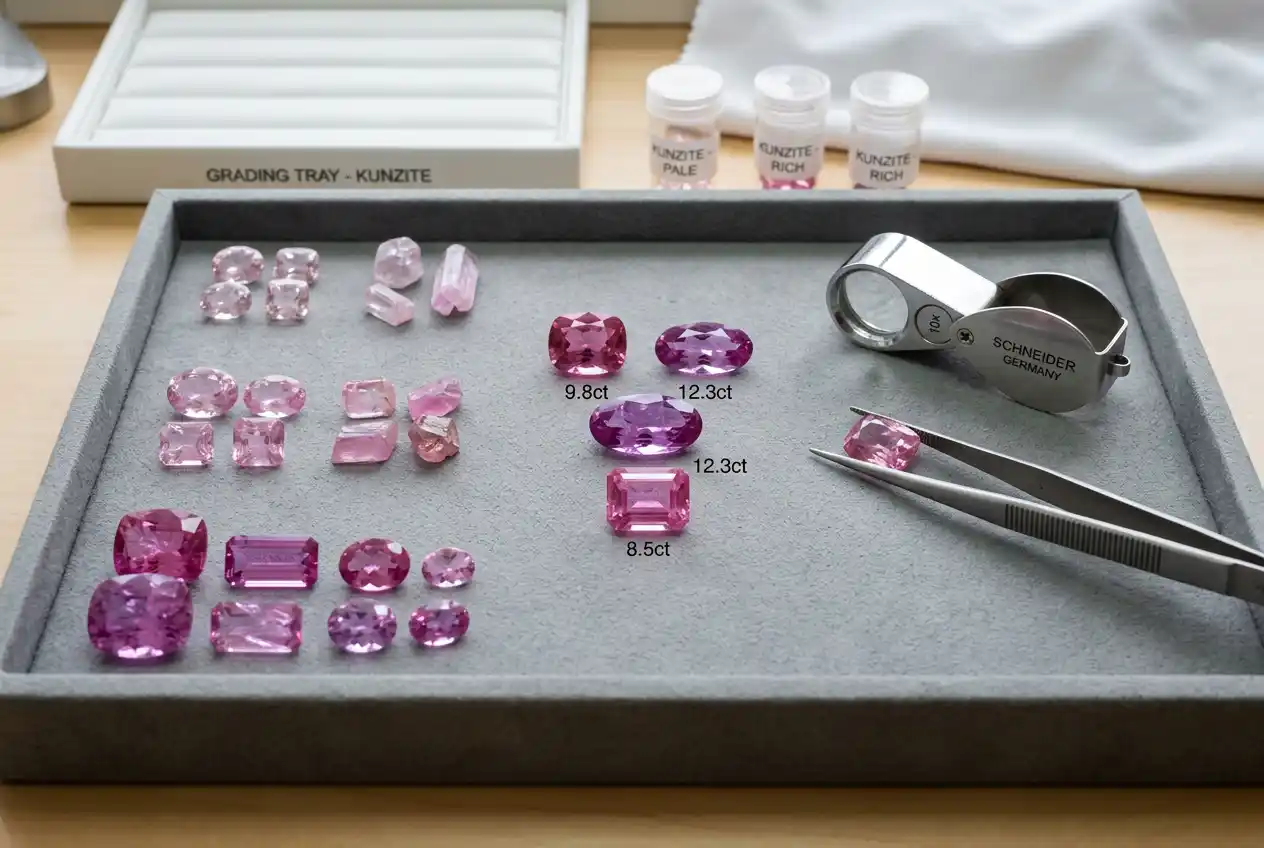
Kunzite Quality Grading: 8 Essential Rules for Color Intensity
Kunzite quality grading should focus on pink or violet-pink color, pleochroism, transparency, clarity, cut orientation, size, color stability, and structural condition rather than simply rewarding the deepest-looking stone. Fine kunzite should display a clearly recognizable pink to violet hue from the normal face-up position while remaining bright and transparent enough for the facets to return light cleanly. Because spodumene is strongly pleochroic, the same crystal can look richly colored in one direction and surprisingly pale in another, making cutting orientation essential to any meaningful quality grade.
Kunzite is the pink to violet variety of spodumene, LiAlSi₂O₆, and its coloration is primarily related to manganese in the crystal structure. It shares the same mineral species with hiddenite and other differently colored spodumene varieties, but its commercial appeal is built around soft-to-rich pink, lilac, and violet tones. The mineral can occur in large transparent crystals, which means size alone does not create top quality. A large pale stone can remain commercial, while a smaller gemstone with stronger color and precision cutting may deserve a substantially higher grade.
There is no universal AAA or AAAA system governing kunzite. Seller-created labels vary widely and can exaggerate the importance of size or color depth while ignoring light sensitivity and cleavage. A more useful grading approach describes observable characteristics directly and explains how color, pleochroism, clarity, proportions, treatment history, and condition interact in the finished gemstone.
8 Essential Rules for Kunzite Quality Grading
- Confirm natural spodumene identity
- Grade pink, lilac, or violet-pink hue
- Evaluate saturation, tone, and face-up color intensity
- Assess pleochroism and cutting orientation
- Judge transparency, clarity, and inclusion placement
- Evaluate cut quality, symmetry, polish, and face-up spread
- Consider carat weight and size within fine color quality
- Review light sensitivity, treatment history, cleavage, condition, and provenance
These eight rules keep the grade centered on the gemstone’s actual appearance and durability. A high-quality kunzite should not merely display strong color when viewed from one side. It should present an attractive pink or violet-pink face, maintain excellent transparency, show efficient proportions, and have no structural weakness serious enough to undermine its use in jewelry.
Natural Spodumene Identity Should Be Confirmed First
Pink transparent gemstones can resemble morganite, pink tourmaline, pink sapphire, spinel, topaz, glass, and several synthetic products. Color alone therefore cannot establish kunzite identity, particularly in photographs where differences in luster, birefringence, and pleochroism may be difficult to see.
Gemological identification can use refractive index, birefringence, specific gravity, optic character, pleochroism, absorption behavior, inclusions, and other observations. Spodumene’s strong directional color and cleavage provide additional supporting evidence, although no single feature should replace a complete identification when the stone is valuable.
This first step matters because kunzite’s quality expectations are tied directly to spodumene. A pink sapphire with similar color follows a different durability and Price system, while morganite belongs to beryl and has different optical properties. Quality grading becomes meaningful only after the species is established.
Pink and Violet-Pink Hue Should Be Clear Face-Up
Fine kunzite should show a recognizable pink, violet-pink, or lilac-pink hue through the table rather than appearing nearly colorless. Pale stones can still be attractive, but stronger clean color generally receives a higher grade when transparency and brightness remain intact.
A violet modifier can add depth and character, especially in stones that remain lively rather than gray. Excessive gray or brown reduces conventional quality because the pink becomes muted and less distinctive.
Face-up color matters more than side-view saturation. A stone may display strong violet along one edge because of pleochroism yet appear weak when viewed normally. Grading should therefore emphasize what the wearer and observer actually see rather than the most saturated direction visible anywhere in the gem.
Neutral lighting is useful for comparison because warm lamps can enrich pink while cool light emphasizes violet. Fine stones should remain attractive under several ordinary light sources.
Saturation and Tone Need to Work Together
Saturation describes how strong the pink or violet color appears, while tone describes overall lightness or darkness. Kunzite generally looks best when color is strong enough to be obvious but not so dark or gray that transparency suffers.
Because much kunzite occurs in lighter pastel tones, even a moderate increase in saturation can produce a significant improvement in quality. Strong color becomes particularly valuable in smaller stones because there is less crystal thickness available to concentrate the hue.
Large stones naturally appear deeper because light travels through more spodumene. The grader should therefore distinguish genuine color quality from darkness created mainly by excessive cutting depth.
A fine stone should look luminous, with the body color and facet reflections working together rather than competing. Maximum darkness is not the goal.
Pleochroism Is Central to Kunzite Color Grading
Spodumene is strongly pleochroic, so different crystallographic directions can display markedly different color intensities. In kunzite, one axis may reveal rich pink or violet while another becomes noticeably paler.
A skilled cutter studies these directions before deciding how to place the table. The strongest desirable color should dominate the face, even if this requires sacrificing rough that could otherwise have been preserved for weight.
Poor orientation can make a naturally attractive crystal look washed out or patchy. Good orientation creates a more consistent face-up color while still allowing subtle shifts to appear as the stone moves.
This makes pleochroism part of both the color grade and the cut grade. A stone should not receive an exceptional color classification simply because the rough possessed strong pink if the finished face fails to display it.
Transparency and Clarity Are Expected to Be High
Kunzite commonly forms in transparent crystals, so fine faceted stones are usually expected to look clean face-up. Natural inclusions can include fractures, veils, crystals, and growth features, but obvious internal features generally reduce quality when cleaner stones are available.
Minor inclusions visible only under magnification may have little effect, particularly in very large stones. Position matters more than simple abundance because a small feature near the girdle can be unobtrusive, while a reflective fracture directly beneath the table can disrupt much of the face.
Structural fractures deserve special attention because spodumene has strong cleavage. A stone may appear visually clean yet contain a cleavage-related break that creates a significant setting risk. Fine clarity therefore requires both optical cleanliness and reasonable structural security.
A Practical Kunzite Clarity Framework
| Face-Up Appearance | Practical Quality Interpretation |
|---|---|
| Eye-clean with excellent transparency | Fine to exceptional |
| Minor inclusions visible only under magnification | Very good |
| Small visible inclusions with limited brilliance loss | Good |
| Obvious clouds or fractures | Commercial |
| Major cleavage-related fractures or structural damage | Lower jewelry quality |
This framework is descriptive rather than an official international scale. Its purpose is to keep attention on whether inclusions affect beauty or structural integrity instead of encouraging a microscopic search for harmless features.
Cut Quality Should Reveal Color Without Hiding Weight
Kunzite can be cut into large ovals, cushions, emerald cuts, pears, rectangles, and custom shapes because spodumene crystals often provide substantial rough. The best designs balance pleochroic orientation, light return, structural safety, and visible size.
Windowing lowers quality because a shallow pavilion creates a transparent center where color weakens and the background becomes visible. Excessive depth produces the opposite problem by hiding weight below the girdle and sometimes making the gemstone darker than necessary.
Symmetry and polish matter greatly in clean transparent material. Crisp facet junctions, smooth surfaces, and balanced outlines allow the soft pink body color to look refined rather than sleepy.
Some asymmetry can be acceptable when it avoids a cleavage plane or preserves a particularly strong color direction. Fine grading should therefore recognize intelligent compromise rather than demanding perfect geometry regardless of the rough.
Large Size Does Not Automatically Mean High Quality
Large kunzite gemstones can be impressive, but spodumene can form crystals capable of producing substantial faceted stones. Size therefore needs to be interpreted after color, transparency, orientation, and cut have been assessed.
A twenty-carat pale kunzite may remain relatively ordinary, while an eight-carat stone with rich violet-pink color, high clarity, and precision cutting can represent much finer quality. The size premium grows when strong saturation survives in a larger clean stone rather than simply because the number on the scale increases.
Face-up dimensions should also be compared with weight because deep cutting can preserve carats without increasing visual presence. A well-spread gemstone often provides a more impressive appearance and better quality than a heavier but unnecessarily deep stone.
Light Sensitivity Must Be Included in the Final Grade
Kunzite is known for color sensitivity to prolonged intense light. Some stones can become noticeably paler after extended exposure, which is why the gemstone has historically been associated with evening wear and careful storage.
This does not mean every stone will fade rapidly or that kunzite is unsuitable for jewelry. It means color stability belongs in the quality conversation because the feature buyers value most can change if the gemstone is exposed repeatedly to strong sunlight or powerful display lighting.
Treatment history is related to this issue. Irradiation can intensify or alter spodumene colors, and some induced states may be unstable. A fine grading assessment should therefore distinguish visible beauty from confidence that the color will remain similar under normal care.
Valuable stones should be stored away from prolonged bright light when they are not being worn, allowing their natural pink and violet appearance to be preserved as effectively as possible.
Cleavage Is the Main Durability Concern
Kunzite has a Mohs hardness around 6.5 to 7, but this figure describes scratch resistance rather than resistance to breaking. Spodumene has pronounced cleavage and can split if it receives a sharp impact in an unfavorable direction.
The girdle, corners, pointed ends, and known fracture zones should therefore be inspected carefully. A chipped edge or cleavage break lowers the grade because repair through recutting may remove substantial weight and can expose additional weakness.
Rings require particularly thoughtful settings, while pendants and earrings naturally experience fewer impacts. Protective design can make kunzite wearable, but the gem should never be treated as though its large size and apparent transparency make it physically indestructible.
Common Kunzite Grading Mistakes
One frequent mistake is assuming that the largest stone must be the finest. Large transparent kunzite is available enough that size cannot compensate for pale color, poor orientation, windowing, or fractures.
Another mistake is judging color from the strongest side view instead of the face. Pleochroism can make one direction look far more saturated, so the table position needs to be evaluated carefully before assigning a high color grade.
Buyers can also overlook light sensitivity and treatment when an unusually vivid stone looks impressive under jewelry-store lighting. A beautiful appearance is important, but confidence in color stability and structural condition makes the grade more meaningful over the long term.
Conclusion
Kunzite quality grading depends on natural spodumene identity, pink or violet hue, saturation, tone, pleochroism, clarity, cut, size, color stability, treatment, cleavage, condition, and provenance. Fine stones display their strongest attractive color through the face while remaining transparent, efficiently proportioned, and structurally sound.
The highest quality is achieved through balance rather than one extreme characteristic. A richly colored but fractured gemstone cannot outrank a slightly lighter stone with excellent clarity and stability, just as a very large pale stone should not automatically outrank a smaller precision-cut gem. When color, orientation, transparency, and craftsmanship work together, kunzite can be both visually impressive and gemologically distinctive.
FAQs About Kunzite Quality Grading
What is the most important factor in kunzite quality?
Face-up color is one of the strongest factors, but it needs to be considered with pleochroism, transparency, and color stability. Fine kunzite should show obvious pink or violet-pink through the table rather than relying on one strongly colored side direction.
What color kunzite is considered best?
Rich pink to violet-pink is generally highly desirable when the stone remains bright and transparent. Pale pink can still be attractive, while excessive gray or very weak saturation usually lowers conventional quality.
Why does kunzite look different from different directions?
Spodumene is strongly pleochroic, so different crystal directions transmit different intensities of pink or violet. Skilled cutting positions the strongest desirable direction so it dominates the normal face-up view.
Should fine kunzite be eye-clean?
Yes, eye-clean transparency is normally preferred because clean spodumene can occur naturally. Minor inclusions under magnification can be acceptable, but central fractures and cleavage-related weaknesses reduce quality more strongly.
Is larger kunzite always better?
No. Large crystals are sufficiently available that size becomes valuable mainly when fine color, clarity, orientation, and cutting remain strong. A smaller saturated stone can grade much higher than a large pale or windowed gem.
Can kunzite fade?
Yes, some kunzite can lose color after prolonged exposure to strong light. Careful storage away from direct sunlight helps preserve the gemstone’s pink or violet appearance, and color stability should be considered when unusually intense stones are evaluated.
Is kunzite commonly treated?
Spodumene can be irradiated or subjected to heat-related processes that alter color, and some induced colors may have limited stability. Treatment should be disclosed when known, particularly when unusually strong color is part of the value claim.
Why is cleavage important in kunzite grading?
Spodumene has pronounced cleavage and can split from a sharp impact even though its hardness is moderate. A structurally clean stone with protected edges can therefore deserve a higher practical grade than a visually beautiful gemstone containing a dangerous cleavage-related fracture.
Are AAA kunzite grades standardized?
No. AAA, AAAA, premium, and similar commercial labels vary among sellers. A meaningful grade should describe color, saturation, pleochroism, clarity, cut, size, treatment, stability, cleavage, and condition directly.
What makes kunzite exceptional?
Exceptional kunzite combines verified natural spodumene identity, rich stable pink or violet-pink color, excellent pleochroic orientation, eye-clean transparency, precision cutting, useful size, strong structural condition, and accurate treatment disclosure.