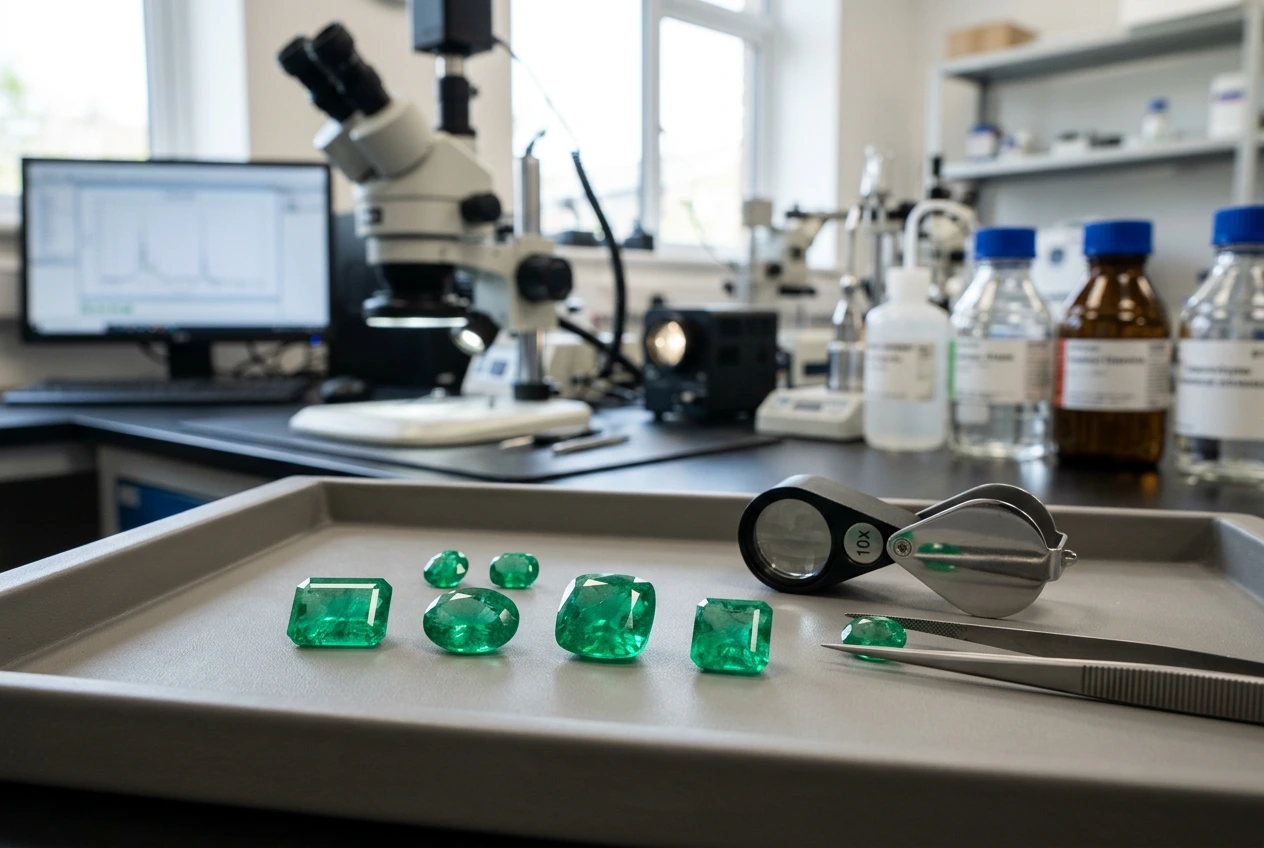
Lab Emerald Quality Grading: 7 Essential Rules to Assess Color & Purity
Lab emerald quality grading should focus on green color, transparency, growth features, cutting, size, treatment, and reliable identification rather than judging synthetic emerald only by how flawless it appears. A fine laboratory-grown emerald should display an attractive medium to medium-dark green with strong saturation, enough transparency for the stone to look lively, and proportions that avoid obvious windowing or excessive darkness. Because laboratory growth can produce cleaner crystals than nature commonly does, visible clarity standards are usually higher than they are for natural emerald.
Laboratory-grown emerald is synthetic beryl with essentially the same major crystal structure and chemical formula as natural emerald, Be₃Al₂Si₆O₁₈. Chromium, vanadium, or combinations of coloring elements create the green hue, while controlled growth methods such as hydrothermal synthesis and flux growth produce the crystal instead of geological processes. These methods can leave diagnostic features, but such features do not automatically mean low quality because some of them simply record the way the crystal formed.
There is no universal AAA or AAAA standard for lab emerald. A seller can apply premium terminology to almost any inventory category, which makes direct description more useful than unexplained labels. High-quality grading should state how the stone performs in color, transparency, inclusions, cutting, size, treatment status, and identification so the buyer can distinguish genuine synthetic emerald quality from marketing language.
7 Essential Rules for Lab Emerald Quality Grading
- Confirm laboratory-grown emerald identity
- Grade green hue, saturation, and tone
- Evaluate transparency, clarity, and visible growth features
- Distinguish hydrothermal and flux growth characteristics where possible
- Judge cut quality, proportions, symmetry, and polish
- Consider carat weight, face-up dimensions, and color consistency
- Review post-growth treatment, condition, documentation, and overall visual quality
These seven rules create a practical assessment that recognizes both the similarities and differences between synthetic and natural emerald. A lab emerald can be exceptionally clean, but flawless appearance alone does not make it fine if the color is weak, the cut is windowed, or the stone has been represented inaccurately. The highest grades come from balance, with vivid color, strong transparency, refined cutting, stable appearance, and trustworthy identification working together.
Identity Must Be Confirmed Before Quality Is Graded
A green transparent gemstone can be emerald, green beryl, synthetic spinel, glass, cubic zirconia, yttrium aluminum garnet, or another imitation product. A laboratory-grown emerald should therefore be identified as synthetic beryl rather than assumed from color or a retail label.
Gemologists can use refractive index, birefringence, specific gravity, spectroscopy, microscopic inclusions, growth structures, and other observations to separate synthetic emerald from simulants. Advanced examination can often distinguish laboratory growth from natural geological formation as well.
This distinction is essential because synthetic emerald and green glass do not belong to the same quality category. A well-grown hydrothermal emerald has the crystal structure and many physical properties of natural beryl, while glass merely imitates its visual appearance.
Accurate identity establishes the foundation of the grade before color, clarity, or cutting are considered.
Green Hue Needs Strong Saturation Without Excessive Darkness
Fine lab emerald should appear distinctly green, commonly with a slightly bluish or balanced green character that resembles high-quality natural emerald. Very pale green may move visually toward green beryl rather than the saturated appearance consumers expect from emerald, while an excessively dark stone can lose transparency and look nearly black in weak light.
Saturation should therefore be evaluated together with tone. Strong chromatic intensity creates visual richness, but the facets still need enough brightness for the stone to look alive. A vivid medium-toned green can grade higher than a darker stone whose color is technically stronger but whose face is dominated by extinction.
Gray, brown, or muddy modifiers generally reduce conventional quality because they weaken the clean green appearance. Slight blue or yellow components can be attractive depending on balance, but they should not overwhelm the dominant green identity.
Color should be examined under neutral daylight-equivalent illumination so warm or cool lamps do not artificially improve the apparent hue.
Transparency and Purity Should Be Judged More Strictly Than in Natural Emerald
Natural emerald is often included because geological growth commonly produces fissures, multiphase inclusions, crystals, and other internal features. Laboratory-grown emerald can be much cleaner, so the presence of obvious clouds or disruptive inclusions carries a stronger penalty in synthetic stones.
This does not mean the finest lab emerald must be completely flawless. Hydrothermal stones can show growth zoning, nail-head spicules, seed-related features, or other synthetic growth characteristics, while flux-grown emerald can contain wispy veils, flux residues, or fingerprint-like inclusions.
The important question is whether these features interrupt beauty. A small diagnostic growth feature visible only under magnification may have almost no effect on grade, while a cloudy region beneath the table can reduce transparency enough to lower the stone substantially.
Clarity should therefore be assessed from normal viewing distance first and then examined under magnification to understand the cause and structural significance of visible features.
Hydrothermal and Flux Features Should Be Interpreted, Not Automatically Penalized
Hydrothermal synthesis grows emerald from a water-rich solution under elevated pressure and temperature, often around a seed plate. The resulting crystals can be very transparent and may show growth zoning or seed-related structures that help identify the process.
Flux growth uses a molten chemical solvent that dissolves the components needed for emerald crystallization. The crystals can contain flux remnants, veils, or distinctive inclusions that may resemble natural features until examined carefully.
Neither method should receive an automatic higher grade. Quality depends on how the finished stone looks and performs, not on whether it formed in a hydrothermal vessel or flux environment.
Growth features become grading factors only when they reduce transparency, create durability concerns, or interrupt the face-up color. Diagnostic inclusions that remain microscopic can actually strengthen confidence in identity without harming visual quality.
A Practical Lab Emerald Clarity Framework
| Face-Up Appearance | Practical Quality Interpretation |
|---|---|
| Highly transparent and eye-clean | Exceptional to fine |
| Minor growth features visible only under magnification | Very good |
| Small visible inclusions with limited effect on transparency | Good |
| Obvious clouds, veils, or strong zoning | Commercial |
| Major fractures, severe haziness, or poor structural integrity | Lower jewelry quality |
This framework is descriptive rather than an official international scale. It reflects the higher clarity expectations appropriate for laboratory-grown emerald while still recognizing that microscopic synthetic growth features can exist in excellent stones.
Cut Quality Determines Whether Rich Green Looks Luminous
Emerald cuts are common because step facets can showcase color and transparency while the truncated corners improve durability compared with sharp rectangular points. Ovals, cushions, rounds, pears, and custom designs can also be attractive when their proportions suit the rough.
Windowing is one of the clearest signs of poor cutting. If the pavilion is too shallow, the center appears transparent and the viewer can see the background through the stone, weakening saturation and visual richness.
Excessive depth creates another problem by hiding weight and making the stone look smaller face-up. A deep cut can also darken an already saturated green stone, producing unnecessary extinction.
Fine symmetry and polish should accompany good proportions. Laboratory-grown crystals may be relatively affordable compared with natural emerald rough, so buyers have less reason to accept poor cutting solely for weight retention.
Carat Weight Should Be Evaluated Through Face-Up Performance
Large synthetic emeralds can be grown more predictably than large natural emeralds, so size carries a smaller rarity premium. A five-carat lab emerald can be visually impressive without being exceptionally scarce in the way a five-carat natural stone of comparable color and clarity would be.
The grade should therefore focus on how well quality survives at size. A large stone with vivid green color, high transparency, even saturation, and efficient proportions deserves a stronger assessment than a heavier gem whose color becomes too dark or whose cut hides weight.
Measurements matter because carat is a weight rather than a visual dimension. A well-proportioned four-carat emerald can appear larger than a five-carat stone with excessive pavilion depth.
Color consistency also becomes more important as size increases because zoning or seed-related features can become easier to see across a wider face.
Treatment and Post-Growth Modification Need Accurate Disclosure
Many laboratory-grown emeralds can be produced without the extensive fracture filling often used on natural emerald, but that does not mean treatment is impossible. Filling, coating, surface modification, or other post-growth processes may be used and should be disclosed when present.
The highest confidence comes from a stone whose green appearance and transparency primarily result from the grown crystal itself rather than extensive post-growth alteration. If fillers or coatings influence appearance, the buyer should know because care requirements and long-term stability may change.
Treatment assessment is also important because a very clean synthetic emerald can sometimes create false expectations that laboratory origin automatically means untreated. Synthetic origin and treatment status are separate questions and should be reported separately.
Laboratory Documentation Helps Verify Quality Claims
A reputable gemological report can identify a stone as laboratory-grown emerald and may provide information about growth method, treatment, or diagnostic observations. This becomes especially useful for larger premium stones because visual appearance alone cannot prove hydrothermal or flux origin reliably.
Documentation does not determine beauty. Two lab emeralds identified correctly can still differ considerably in color, transparency, cutting, and condition, so a report should support visual grading rather than replace it.
For buyers comparing expensive stones, reliable identification also prevents confusion with green glass or other inexpensive simulants. The report establishes that the gemstone is synthetic emerald, while the buyer or grader still needs to decide how fine an example it is.
Lab Emerald Quality Versus Natural Emerald Quality
Synthetic and natural emerald can be graded through similar visible characteristics such as color, transparency, cut, and condition, but the market expectations are different. Fine natural emerald can remain highly valuable despite substantial inclusions because geological rarity and origin contribute strongly to value.
Lab emerald generally receives less tolerance for obvious inclusions because cleaner crystals can be produced. A synthetic stone with weak clarity therefore has less rarity-based justification for visible flaws than a natural emerald from a famous deposit.
This difference does not mean synthetic emerald must be flawless to be attractive. It means the grading threshold should recognize the production possibilities of laboratory growth and judge the gemstone within its own category rather than copying natural emerald standards mechanically.
Durability Still Depends on the Beryl Structure
Laboratory-grown emerald has essentially the same hardness range as natural beryl, around 7.5 to 8 on the Mohs scale. This provides good scratch resistance for many jewelry applications, but internal fractures, sharp impacts, and vulnerable corners can still create damage.
A relatively clean synthetic emerald may be more structurally secure than a heavily fissured natural stone, but each gemstone needs individual inspection. Surface-reaching fractures should be recorded because they can affect setting safety even when the stone otherwise looks excellent.
Gentle cleaning with mild soap, lukewarm water, and a soft brush is generally appropriate for sound stones. Aggressive steam or ultrasonic methods should be approached cautiously when filling or significant fractures are present.
Common Lab Emerald Grading Mistakes
A frequent mistake is assuming that the cleanest synthetic emerald must automatically be the finest. Clarity is important, but weak green color or poor proportions can make a flawless stone visually less desirable than a slightly included gem with stronger saturation and better cutting.
Another mistake is assuming hydrothermal is always superior to flux growth, or the reverse. Growth method describes how the crystal formed, not an automatic quality rank, and both methods can produce excellent or ordinary stones.
Buyers can also overpay for large weight without checking measurements. Since large lab-grown crystals are comparatively accessible, a deep five-carat stone should not receive a strong quality premium if it looks smaller and darker than a well-cut four-carat gem.
Conclusion
Lab emerald quality grading should evaluate synthetic emerald identity, green hue, saturation, tone, transparency, growth features, growth method, cut, size, treatment, condition, and documentation together. Fine stones combine vivid green color with strong transparency and efficient proportions while keeping visible growth features limited enough that they do not dominate the face.
The highest quality does not come from flawless appearance alone. A premium lab emerald needs attractive color, lively transparency, precise cutting, balanced size, accurate treatment disclosure, and reliable identification. Hydrothermal and flux growth can both produce exceptional gems, so the final grade should describe the individual stone rather than turning growth technology into a substitute for visual and gemological evaluation.
FAQs About Lab Emerald Quality Grading
What is the most important factor in lab emerald quality?
Color is usually the strongest visible factor, but it needs to work together with transparency and cutting. A vivid medium to medium-dark green stone with strong light transmission can rank higher than an extremely clean gem whose color is pale or whose cut creates obvious windowing.
Should a high-quality lab emerald be flawless?
Not necessarily. Fine synthetic emerald can contain microscopic growth features that help identify laboratory origin without affecting beauty. Visible clouds, large fractures, or strong zoning are more important quality concerns than tiny inclusions that require magnification.
Is hydrothermal lab emerald higher quality than flux-grown emerald?
Not automatically. Both methods can produce exceptional emerald, and either can produce stones with weaker color or clarity. The finished gemstone should be judged according to hue, saturation, transparency, cutting, treatment, and condition rather than growth method alone.
What color is best in a lab emerald?
Vivid green to slightly bluish green with medium to medium-dark tone is generally highly desirable when the stone remains bright and transparent. Excessive darkness, gray, brown, or weak saturation usually lowers conventional quality.
Does size determine lab emerald quality?
No. Large synthetic crystals can be produced much more predictably than large natural emeralds, so carat weight alone does not establish rarity. A smaller stone with stronger green color, better transparency, and more efficient cutting can grade substantially higher.
Can lab emeralds be treated after growth?
Yes. Filling, coating, or other post-growth modification is possible even though many synthetic stones require less clarity enhancement than natural emerald. Treatment should be disclosed when known because it can affect durability, care, and market value.
How can a lab emerald be distinguished from green glass?
Professional gemological testing examines properties such as refractive index, birefringence, specific gravity, spectroscopy, and internal growth structures. A laboratory report is especially useful for higher-value stones because synthetic emerald and green glass may look similar to an untrained observer.
Are AAA lab emerald grades standardized?
No. AAA, premium, luxury, and similar commercial labels vary among sellers. A reliable grade should describe color, transparency, growth features, cut, size, treatment, condition, and identification directly.
What makes a lab emerald exceptional?
An exceptional lab emerald combines verified synthetic beryl identity, vivid green color, strong transparency, limited distracting growth features, fine proportions, excellent polish, useful size, sound structural condition, accurate treatment disclosure, and reliable documentation.