Lab Sapphire Price Per Carat: 10 Value Factors for Smart Buyers
Lab sapphire price per carat is usually far below the Price of comparable fine natural sapphire because synthetic corundum can be produced repeatedly instead of depending on rare geological deposits. Commercial flame-fusion sapphire may cost only a few dollars to a few tens of dollars per carat, while attractive jewelry-quality stones with stronger color, good transparency, and competent cutting can move into roughly $20 to $100 per carat. Fine specialty-grown or precision-cut sapphires may reach approximately $100 to $300 per carat or more when color, size, cutting, manufacturing method, branding, or documentation place the stone above mass-produced commercial material.
A laboratory-grown sapphire is synthetic sapphire, meaning it is corundum, Al₂O₃, with essentially the same crystal structure, hardness, refractive behavior, and fundamental durability as natural sapphire. The difference is origin. Natural sapphire crystallizes through geological processes, while lab sapphire is grown under controlled conditions through methods such as flame fusion, crystal pulling, flux growth, or other specialized manufacturing techniques. A lab sapphire is therefore not the same as blue glass, cubic zirconia, synthetic spinel, or another simulant that simply imitates sapphire color.
The financial savings come mainly from supply. Fine natural sapphire becomes expensive when desirable color, transparency, size, origin, and untreated status occur together, while laboratory production can create additional gem-quality corundum as manufacturing capacity allows. Buyers can therefore purchase larger, cleaner, and more strongly colored sapphires for much less, but they should judge the stone on visual quality rather than assuming all synthetic sapphire is equally good.
10 Value Factors That Affect Lab Sapphire Price Per Carat
- Hue, saturation, and tone
- Transparency, clarity, and growth features
- Flame-fusion, pulled-crystal, flux-grown, or specialty growth method
- Carat weight and availability of larger clean stones
- Cut quality, symmetry, polish, and face-up spread
- Fancy color rarity within synthetic production
- Star effects or other optical phenomena
- Post-growth treatment, diffusion, coating, or filling
- Laboratory identification, documentation, and brand positioning
- Manufacturing cost, retail margin, market demand, and resale value
These ten factors explain why two synthetic sapphires of identical weight can carry very different Prices. A mass-produced flame-fusion blue stone with ordinary cutting may be inexpensive, while a precision-cut specialty-grown sapphire with refined color and superior polish can cost many times more even though both are synthetic corundum. The final Price therefore reflects not only the grown crystal but also the difficulty of production, quality control, lapidary work, documentation, and retail positioning.
Typical Lab Sapphire Price Per Carat
Synthetic sapphire does not follow one standardized international Price list because manufacturers use different processes and retailers position their stones differently. The following ranges provide broad orientation for loose lab-grown sapphire rather than fixed market rules.
| Lab Sapphire Quality | Approximate Price Per Carat | Typical Characteristics |
|---|---|---|
| Commercial flame-fusion quality | $5 to $25 | Mass-produced, strong color, ordinary cutting |
| Good jewelry quality | $20 to $100 | Attractive color, good transparency, competent cut |
| Fine specialty-grown quality | $75 to $200 | Better color control, high clarity, refined finishing |
| Premium precision-cut quality | $150 to $300+ | Excellent color, superior polish, custom cutting, documentation |
| Specialty star or collector synthetic | Highly variable | Controlled optical effects, historic manufacturer, unusual growth technique |
These Price ranges overlap because cutting and retail presentation can become more expensive than the rough crystal itself. A highly skilled cutter can add significant value to inexpensive synthetic corundum by creating better light return, cleaner symmetry, or a distinctive custom design.
Blue Color Quality Drives Most Buyer Demand
Blue remains the best-known sapphire color, and fine lab-grown blue sapphire should show a clear attractive hue rather than appearing overly dark, gray, or weakly saturated. Iron and titanium are important color-causing elements in many blue sapphires, while controlled synthetic growth allows manufacturers to adjust chemistry and produce different shades.
Medium to medium-dark blue often provides the best balance because saturation remains strong while enough light returns through the crown to keep the gem lively. An excessively dark stone can look almost black in ordinary indoor light, while a very pale sapphire may appear watery and lack the visual impact buyers expect.
Retail descriptions such as royal blue or cornflower blue should therefore be treated as color language rather than universal laboratory grades. A smart buyer should compare the actual hue, saturation, tone, and brightness instead of assuming a prestigious color name guarantees superior quality.
Fancy Colors Can Add Interest but Not Natural Rarity Premiums
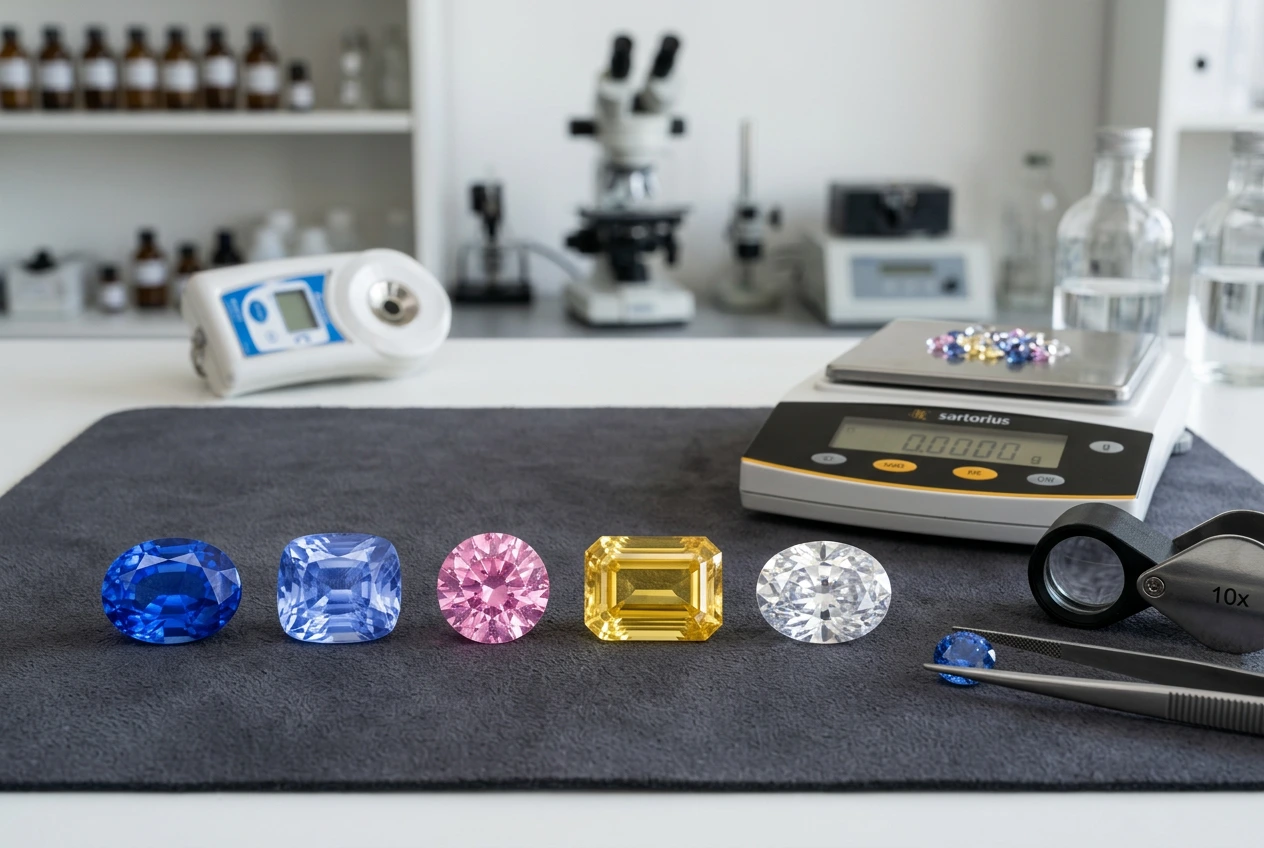
Synthetic sapphire can be produced in pink, yellow, orange, green, purple, colorless, and other colors because corundum responds to different trace elements and manufacturing conditions. These colors can be beautiful, but their value structure differs from natural fancy sapphire because laboratory growth can reproduce them without the same geological rarity.
Pink synthetic sapphire can be created through chromium-related coloration, while yellow and other colors can involve different trace-element chemistry or controlled processing. Colorless synthetic sapphire may be used in jewelry, watch crystals, optical components, and industrial applications.
A rare-looking hue can still command a retail premium when production is difficult or the finished gemstone is particularly attractive, but buyers should avoid transferring natural sapphire rarity assumptions directly to synthetic stones. The highest value is usually associated with visual beauty, manufacturing quality, and workmanship rather than scarcity in the ground.
Growth Method Influences Cost More Than It Determines Beauty
Flame fusion, also called the Verneuil process, can produce large quantities of synthetic sapphire efficiently and economically. Powdered ingredients melt in a flame and crystallize into a boule, which can later be cut into gemstones. This method is widely used because it is fast enough for commercial production and can produce strong colors.
Pulled-crystal methods such as Czochralski growth can produce high-quality synthetic corundum with controlled chemistry and large crystal dimensions. Other methods, including flux growth and specialized industrial crystal-growth techniques, may be slower or more expensive but can produce distinctive crystal characteristics.
None of these methods automatically creates the best gemstone. A well-cut flame-fusion sapphire can look better than a poorly cut specialty-grown stone, while a premium pulled crystal may justify higher cost because of production quality or unusually clean color. Growth method should therefore be understood as part of manufacturing history rather than used as a simple rank.
Clarity Is Usually Expected to Be High
Synthetic sapphire can be produced with substantially fewer inclusions than many natural sapphires, so buyers generally expect high transparency. Flame-fusion material may contain curved growth striae or gas bubbles, while other methods can produce different growth lines, inclusions, or seed-related features.
Microscopic diagnostic features do not necessarily reduce beauty. A curved growth line visible only under magnification may help identify synthetic origin while having no effect on the gemstone’s face-up appearance.
The Price should fall more noticeably when growth defects create visible clouding, color zoning, or structural weakness. Since clean lab-grown sapphire is widely available, obvious inclusions have less rarity-based justification than they might in a natural stone from an important deposit.
Carat Weight Carries a Much Smaller Scarcity Premium Than in Natural Sapphire
Large natural sapphire becomes increasingly rare as desirable color and clarity survive at higher weights. Laboratory production reduces this size scarcity because manufacturers can intentionally grow larger crystals.
A five- or ten-carat lab sapphire can therefore remain accessible even when the color and clarity are attractive. Total Price still rises because more usable crystal and more cutting labor are involved, but the per-carat increase is generally less severe than in fine natural sapphire.
Face-up dimensions remain important because deep cutting can hide weight below the girdle. A lighter sapphire with efficient proportions can appear larger than a heavier but overly deep stone, making measurements just as important as carat weight when comparing value.
Cut Quality Can Create the Biggest Difference Between Cheap and Premium Stones
Synthetic sapphire rough can be inexpensive, especially when produced through flame fusion, which means mass-market stones are sometimes cut for maximum weight rather than maximum beauty. Deep pavilions, thick girdles, uneven symmetry, and windowing can all reduce visual performance.
A high-quality cut should create strong brightness without making the stone look overly dark. Pavilion depth, crown shape, facet alignment, polish, and outline symmetry need to work together so the color remains rich while reflections stay lively.
Precision-cut lab sapphire can therefore command a substantial premium even when the rough itself was inexpensive. In some premium stones, the lapidary work represents a larger part of The Price than the synthetic crystal.
Star Sapphire Effects Create a Separate Value Category
Synthetic sapphire can be produced with oriented inclusions that create asterism, the star-like effect seen when light reflects from aligned needle-like structures. Laboratory-grown star sapphire has existed commercially for decades and can display sharp, dramatic stars.
A strong synthetic star should be centered, distinct, mobile across the dome as the light source moves, and supported by attractive body color. Cabochon proportions influence the quality of the effect because the dome must be oriented correctly relative to the internal structure.
The star itself can add visual and collector interest, but synthetic asterism should not be priced through the rarity standards applied to natural star sapphire. Manufacturing can reproduce the effect more predictably, so quality depends mainly on appearance, craftsmanship, and technical interest.
Treatment and Post-Growth Modification Need Clear Disclosure
Synthetic origin does not automatically mean a sapphire is untreated after growth. Heat, diffusion, coatings, filling, or other processes can be applied to lab-grown corundum depending on the manufacturer and intended appearance.
Some treatments may be unnecessary because the growth process already produces strong color and high clarity, but buyers should still understand that synthetic origin and treatment status are separate questions.
A premium lab sapphire should therefore be described accurately. If color comes partly from surface diffusion or coating, that information affects long-term care and market value even though the underlying stone is still synthetic corundum.
Documentation Helps Distinguish Synthetic Sapphire From Simulants
Synthetic sapphire shares many physical and optical properties with natural corundum, while blue glass, synthetic spinel, cubic zirconia, and other substitutes belong to different species. Professional gemological testing can establish whether a stone is synthetic sapphire rather than an imitation.
Refractive index, birefringence, spectroscopy, fluorescence, growth features, and microscopic inclusions can all contribute to identification. Curved growth striae are especially associated with flame-fusion material, while other methods produce different diagnostic patterns.
Laboratory documentation is most useful for premium stones, large sapphires, or pieces sold with a specific growth-method claim. It supports identity and treatment disclosure but does not replace visual evaluation of color and cutting.
Resale Value Is Usually Much Lower Than Initial Retail Price
Lab sapphire offers strong upfront savings because buyers can obtain large, vivid, durable gemstones without paying for geological rarity. Its secondary-market behavior is different because new synthetic sapphire can continue to be produced in large quantities.
A pre-owned lab sapphire may therefore compete directly with newly manufactured stones available at current production costs. This generally keeps resale recovery modest, particularly for standard flame-fusion stones.
Premium craftsmanship can preserve more value than ordinary mass production because custom cutting, signed jewelry, historic synthetic material, or an important maker may attract specialized collectors. Even then, the strongest financial reason to buy lab sapphire is usually enjoyment and affordability rather than investment potential.
Conclusion
Lab sapphire price per carat is influenced by color, clarity, growth method, carat weight, cutting, fancy color, optical phenomena, treatment, documentation, manufacturing cost, and market demand. Commercial flame-fusion stones can be extremely affordable, while specialty-grown or precision-cut sapphires command higher Prices because production quality and craftsmanship contribute more heavily to the finished gem.
The smartest purchase usually comes from prioritizing visible quality over manufacturing terminology. Strong face-up color, high transparency, efficient proportions, excellent polish, accurate treatment disclosure, and trustworthy identification provide meaningful value. Buyers should also remember that synthetic sapphire shares the durability of corundum but not the geological rarity or resale structure of fine natural sapphire.
FAQs About Lab Sapphire Price Per Carat
How much does lab sapphire cost per carat?
Commercial flame-fusion sapphire can cost only a few dollars to a few tens of dollars per carat, while good jewelry-quality stones commonly move into roughly $20 to $100 per carat. Fine specialty-grown, precision-cut, or premium branded stones can reach around $100 to $300 per carat or more depending on color, size, cutting, manufacturing method, and documentation.
Is a lab sapphire a real sapphire?
A laboratory-grown sapphire is synthetic corundum with essentially the same crystal structure and physical properties as natural sapphire. The difference is that it was grown under controlled conditions rather than formed geologically, which separates it from glass or other sapphire simulants.
Why is lab sapphire so much cheaper than natural sapphire?
Laboratory growth can create additional sapphire supply without depending on rare deposits. This removes much of the scarcity premium that affects fine natural sapphire, especially in large sizes, vivid colors, and high clarity.
Is flame-fusion sapphire lower quality than other lab sapphire?
Not automatically. Flame fusion is economical and widely used, but it can produce visually attractive gemstones. Slower or more expensive growth methods may command higher Prices, yet final quality still depends on color, transparency, cutting, and condition.
Does larger lab sapphire cost more per carat?
Larger stones generally cost more in total, but their per-carat Price usually rises less dramatically than natural sapphire because large synthetic crystals can be produced intentionally. Color and cutting often matter more than weight alone.
Are lab star sapphires valuable?
They can have jewelry and collector appeal when the star is sharp, centered, mobile, and supported by attractive color. Their Price remains far below exceptional natural star sapphire because laboratory production can reproduce asterism much more predictably.
Can lab sapphire be treated?
Yes. Synthetic sapphire can undergo heat, diffusion, coating, filling, or other post-growth processes depending on the product. Treatment should be disclosed separately from synthetic origin because the two describe different aspects of the gemstone.
Does lab sapphire have good resale value?
Resale recovery is usually limited because new synthetic sapphire can continue to be manufactured at competitive Prices. The strongest value proposition is the lower initial cost and access to large, durable, attractive stones rather than long-term appreciation.
What makes a lab sapphire expensive?
Premium lab sapphire usually combines vivid color, high transparency, larger clean size, slower or specialty growth, precision cutting, excellent polish, strong documentation, and premium branding. In many cases craftsmanship contributes more to The Price than the synthetic rough itself.