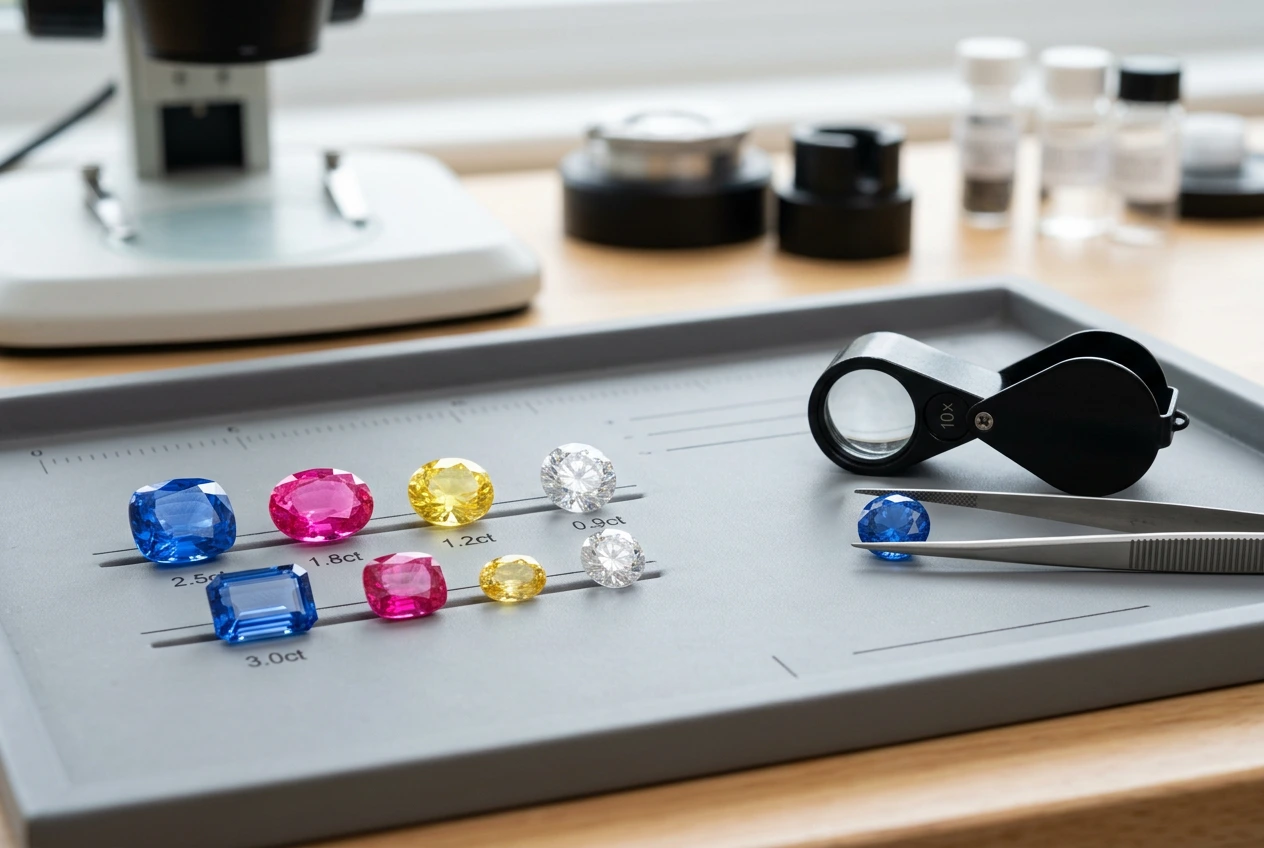
Lab Sapphire Quality Grading: 7 Standards for Color & Perfection
Lab sapphire quality grading should evaluate synthetic corundum identity, color, transparency, growth features, cutting, size, treatment, and condition rather than judging the stone only by whether it appears flawless. Fine laboratory-grown sapphire should show attractive hue and saturation, strong transparency, efficient proportions, clean polish, and few distracting growth irregularities. Because synthetic corundum can be produced with very high clarity, obvious clouding, uneven color, or careless cutting deserves a stronger penalty than it often would in a naturally rare sapphire.
Laboratory-grown sapphire is synthetic corundum, Al₂O₃, produced under controlled conditions rather than through geological formation. Different trace elements and manufacturing conditions can create blue, pink, yellow, green, purple, colorless, and other varieties, while specialized production can also create star effects or other optical appearances. Its Mohs hardness of 9 and fundamental durability are essentially those of natural sapphire, making it suitable for daily-wear jewelry when the finished stone is structurally sound.
There is no universal AAA or AAAA scale governing lab sapphire. Commercial grading terms can vary widely between sellers, and a stone advertised as premium may still have overly dark color or poor proportions. A useful quality grade therefore needs to explain what can actually be observed in hue, tone, clarity, growth structures, cutting, size, treatment, and overall face-up appearance.
7 Standards for Lab Sapphire Color and Perfection
- Confirm laboratory-grown corundum identity
- Grade hue, saturation, tone, and color distribution
- Evaluate transparency, clarity, and synthetic growth features
- Judge cut quality, symmetry, polish, and face-up brightness
- Consider carat weight, measurements, and size efficiency
- Evaluate optical phenomena, treatment, and color stability
- Review growth method, condition, documentation, and overall craftsmanship
These seven standards create a practical framework that works across blue and fancy-color lab sapphires without pretending that one growth method or clarity grade defines perfection. A high-quality stone should look beautiful through normal viewing conditions, remain transparent enough for lively light return, and be represented accurately regarding growth and treatment.
Synthetic Corundum Identity Must Be Confirmed First
Blue and fancy-color stones can be confused with glass, synthetic spinel, cubic zirconia, topaz, and other gemstones, so lab sapphire grading begins by establishing corundum identity. Synthetic sapphire should not be treated as merely a colored imitation because it shares the corundum species with natural sapphire.
Gemologists can identify synthetic corundum using refractive index, birefringence, specific gravity, spectroscopy, fluorescence, microscopic growth structures, and other observations. Flame-fusion sapphire may show curved growth striae or gas bubbles, while pulled or specialty-grown material can display different seed-related structures or growth zoning.
Correct identification becomes especially important when a retailer charges a premium for a specific manufacturing method. A laboratory report or professional examination can confirm synthetic corundum and may provide useful information about growth or treatment where those factors materially affect the sale.
Color Quality Requires Balance Rather Than Maximum Saturation
Fine blue lab sapphire should show a clearly attractive blue with enough saturation to look rich while remaining bright. Excessive darkness can cause extinction, making the stone appear black in low light, while very pale stones may look washed out even when transparency is excellent.
Tone and saturation therefore need to be evaluated together. Medium to medium-dark blue often provides a strong balance, but the ideal depends on shape, cut, and personal preference. Fancy colors follow similar principles, with strong clean hue generally preferred over gray, brown, or muddy modifiers.
Color distribution also affects the grade. Synthetic growth can create bands or zoning, and visible unevenness across the face can reduce conventional quality when one side of the stone appears noticeably lighter or darker.
Color terminology should remain descriptive. Labels such as royal blue, cornflower blue, or vivid pink can be useful but should not replace direct comparison under neutral lighting.
Transparency and Growth Features Need Careful Interpretation
Synthetic sapphire can be extremely clean, which raises clarity expectations. A fine stone should appear transparent enough that color and cutting dominate the face rather than bubbles, clouds, zoning, or other internal features.
Microscopic curved striae, seed-related structures, or small inclusions may have almost no effect on beauty and can help confirm laboratory origin. These features should not be penalized automatically simply because they reveal synthesis.
The grade should fall more clearly when growth irregularities cause visible cloudiness, create dull patches, or interfere with light return. Since very clean synthetic corundum is widely available, a heavily included lab sapphire generally belongs to a lower quality category unless the inclusions intentionally create an attractive optical phenomenon.
A Practical Lab Sapphire Clarity Framework
| Face-Up Appearance | Practical Quality Interpretation |
|---|---|
| Highly transparent and eye-clean | Exceptional to fine |
| Minor diagnostic growth features under magnification | Very good |
| Small visible features with limited optical impact | Good |
| Obvious clouding, bubbles, or strong zoning | Commercial |
| Severe haze, fractures, or major structural weakness | Lower jewelry quality |
This framework is descriptive rather than a universal laboratory standard. It keeps the focus on whether internal features affect actual appearance rather than rewarding microscopic perfection that produces no visible benefit.
Cut Quality Controls Brightness, Color Depth, and Face-Up Size
Synthetic sapphire can be cut into ovals, cushions, rounds, emerald-style cuts, pears, and many custom shapes because laboratory growth can provide rough in relatively predictable forms. The cutter should still balance brightness, color concentration, and visible spread.
A shallow pavilion can create windowing, allowing the background to show through the center and weakening saturation. Excessive depth can hide weight below the girdle and create dark areas that make the stone look smaller and less lively.
Symmetry and polish deserve close attention because clean synthetic corundum exposes poor workmanship easily. Off-center facets, uneven girdles, polishing marks, and thick bulky proportions can lower the grade even when color and clarity are strong.
Fine precision cutting often elevates lab sapphire dramatically because the optical performance becomes cleaner and more controlled. When the rough itself is inexpensive, cutting can become the most important difference between commercial and premium quality.
Carat Weight Should Be Judged Through Measurements and Face-Up Spread
Large lab sapphire is not extremely rare because synthetic crystals can be grown intentionally at substantial sizes. Carat weight therefore has less influence on quality than it does in fine natural sapphire.
A larger stone deserves a stronger grade only when attractive color, high transparency, and good proportions survive together. A ten-carat sapphire that looks overly dark or deep should not outrank a smaller stone simply because it carries more weight.
Length, width, and depth measurements help reveal whether the cut uses carat weight efficiently. A well-proportioned stone often appears larger than a heavier gem whose weight is hidden in a deep pavilion or thick girdle.
This makes face-up performance more important than the number on the scale.
Star Effects Need Their Own Quality Standard
Synthetic star sapphire contains oriented inclusions that create asterism when the stone is cut as a cabochon. A high-quality star should appear distinct, centered, and mobile across the dome as the light source moves.
The arms should intersect cleanly and remain visible without requiring an unnaturally intense point light. Body color should also support the phenomenon rather than becoming so dark that the star is difficult to appreciate.
Synthetic star sapphires can be highly attractive, but their rarity should not be confused with natural star sapphire because the phenomenon can be engineered more predictably during production.
Quality therefore depends on the sharpness of the star, the quality of the cabochon, body color, symmetry, and overall craftsmanship rather than geological scarcity.
Growth Method Should Be Recorded Without Becoming the Entire Grade
Flame fusion is efficient and inexpensive, while crystal-pulling, flux, and other specialty methods can require more complex equipment, longer growth cycles, or tighter process control. These differences can influence retail Price and diagnostic inclusions.
A slower or more expensive method does not automatically produce a more beautiful gemstone. A well-cut flame-fusion sapphire with excellent color may outperform a specialty-grown stone whose tone is too dark or whose cutting is poor.
The growth method should therefore be recorded as part of identity and manufacturing history, while the visible grade continues to depend on color, transparency, cutting, and condition.
Treatment and Post-Growth Modification Must Be Disclosed Separately
Synthetic sapphire can undergo heat treatment, diffusion, coating, filling, or other processes after crystal growth. These procedures may alter color, surface appearance, or clarity.
A high-quality synthetic gemstone should be described accurately so the buyer knows whether the appearance results primarily from the grown crystal or from substantial post-growth modification. Treatment does not automatically make the sapphire unattractive, but it can influence care and value.
Synthetic origin and treatment status should never be collapsed into one statement. A stone can be laboratory-grown and also treated, and both pieces of information belong in a complete quality description.
Durability Is Excellent but Not Absolute
Sapphire’s Mohs hardness of 9 makes lab-grown corundum highly resistant to scratching and suitable for engagement rings, everyday rings, earrings, pendants, bracelets, and other frequently worn jewelry.
Hardness does not mean indestructibility. Thin girdles, sharp corners, and existing fractures can still chip under impact, particularly in large stones or pointed fancy shapes.
A pre-owned lab sapphire should therefore be examined for edge wear, chips, abrasions, scratches, or setting damage. Excellent current condition supports a high grade even when the original stone was already well cut.
Lab Sapphire Quality Versus Natural Sapphire Quality
Synthetic and natural sapphire share the same corundum mineral species, so both can be evaluated for color, clarity, cut, and condition. Their rarity standards differ substantially.
Natural sapphire can command enormous premiums for exceptional origin, untreated status, geological rarity, and large clean size. Visible inclusions may be accepted because perfectly clean natural stones are difficult to find.
Lab sapphire can be produced much cleaner and larger, so the quality threshold shifts toward visual perfection, cutting precision, and color control. A synthetic stone with obvious flaws therefore has less scarcity-based justification than a comparable natural sapphire.
This difference reflects market rarity rather than a different fundamental mineral species.
Common Lab Sapphire Grading Mistakes
One common mistake is assuming the cleanest stone must be the best. A flawless lab sapphire can still look ordinary when the color is too dark, too pale, or badly distributed, while a slightly imperfect gem with excellent hue and precision cutting may be much more attractive.
Another mistake is assuming expensive growth methods guarantee better quality. Growth technology influences production cost but does not replace direct visual evaluation.
Buyers also sometimes overpay for size. Since large synthetic sapphire is relatively accessible, carat weight should not compensate for deep proportions, obvious zoning, or poor light return.
Conclusion
Lab sapphire quality grading should evaluate synthetic corundum identity, color, saturation, tone, transparency, growth features, cutting, carat weight, optical phenomena, treatment, condition, growth method, and documentation together. Fine stones combine attractive color with high transparency and precise proportions so that the gemstone remains bright rather than dark, windowed, or visually flat.
Perfection in lab sapphire does not mean microscopic flawlessness alone. The best synthetic gems achieve balance through clean color, excellent transparency, efficient cutting, strong polish, appropriate dimensions, accurate treatment disclosure, and reliable identification. Growth method can influence cost and technical interest, but the finished gemstone should ultimately be judged by how well those qualities work together.
FAQs About Lab Sapphire Quality Grading
What is the most important factor in lab sapphire quality?
Color is usually the strongest visible factor, but it should be judged with transparency and cutting. A richly colored sapphire that remains bright and evenly saturated generally ranks higher than a flawless stone that looks excessively dark, pale, or poorly proportioned.
Should high-quality lab sapphire be flawless?
Not necessarily. Microscopic growth lines or other diagnostic synthetic features can be present without affecting beauty. The more important question is whether inclusions or growth structures cause visible clouding, uneven color, or reduced transparency.
Is flame-fusion sapphire lower quality?
Not automatically. Flame fusion is economical, but it can produce excellent synthetic corundum. A well-cut flame-fusion sapphire with fine color can be visually superior to a more expensive specialty-grown stone with weaker proportions or tone.
What color is best in lab sapphire?
For blue sapphire, attractive medium to medium-dark blue with strong saturation and limited gray is generally preferred. Fancy colors should similarly show clean hue, balanced tone, and enough brightness to remain lively.
Does size determine lab sapphire quality?
No. Large synthetic crystals can be produced intentionally, so size becomes meaningful only when excellent color, transparency, and cutting remain strong. A smaller precision-cut stone can grade above a much larger dark or inefficiently cut gem.
Are synthetic star sapphires high quality?
They can be, particularly when the star is sharp, centered, mobile, and supported by attractive body color and a well-shaped cabochon. Their quality should be judged through the phenomenon and craftsmanship rather than natural rarity.
Can lab sapphire be treated after growth?
Yes. Laboratory-grown sapphire can undergo heat, diffusion, coating, filling, or other post-growth processes. Treatment should be disclosed separately from synthetic origin because it can affect appearance, care, and market value.
Are AAA lab sapphire grades standardized?
No. AAA, premium, luxury, and similar labels vary between sellers. A meaningful quality assessment should describe color, transparency, growth features, cut, size, treatment, condition, and documentation directly.
What makes a lab sapphire exceptional?
An exceptional lab sapphire combines verified synthetic corundum identity, vivid balanced color, high transparency, minimal distracting growth features, precision cutting, efficient dimensions, excellent polish, strong condition, accurate treatment disclosure, and reliable documentation.