Labradorite Price Per Carat: 9 Factors Determining Flash & Worth
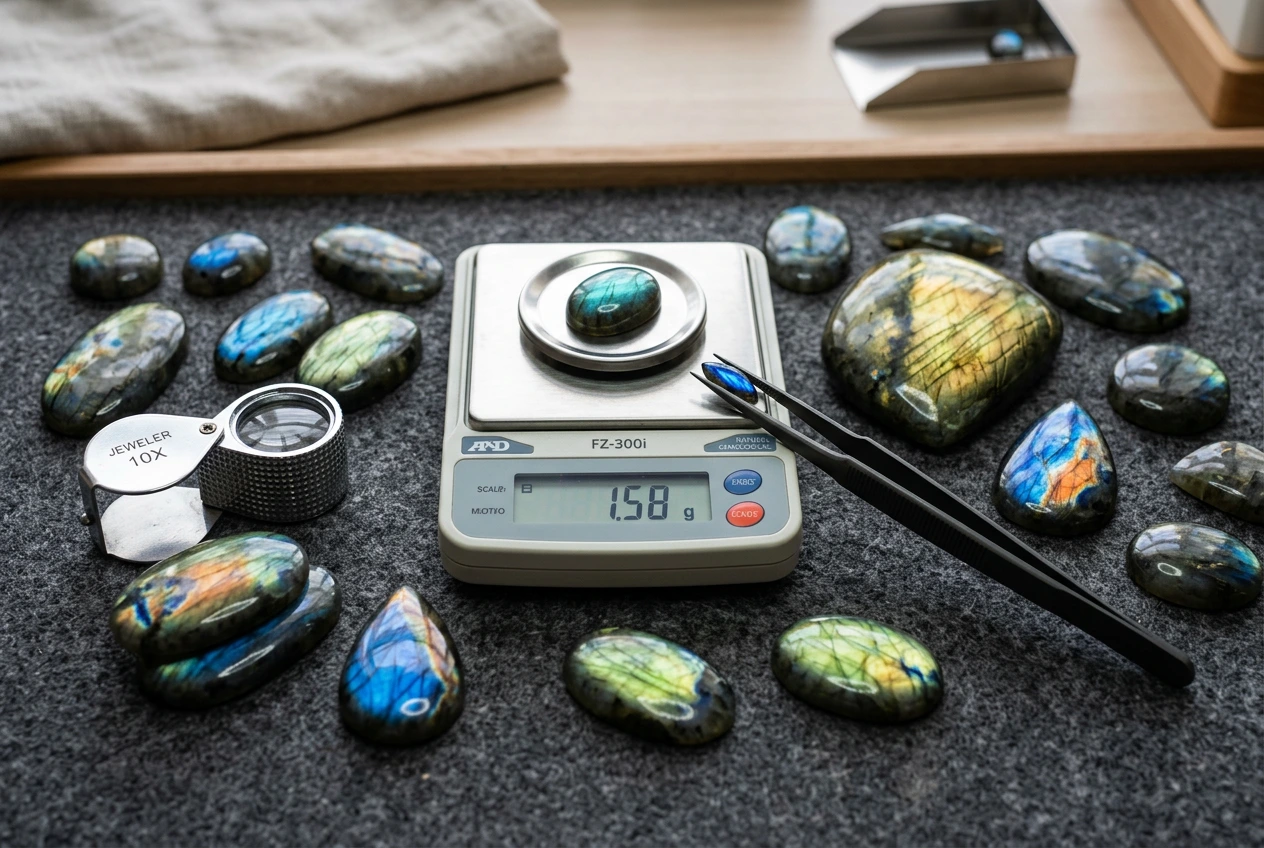
Labradorite price per carat is usually modest because the feldspar itself is not exceptionally rare, but fine pieces with vivid labradorescence can command significantly more than ordinary gray material. Commercial cabochon-grade labradorite may sell for roughly $0.50 to $3 per carat, while attractive stones with broad blue or green flash can move into approximately $3 to $10 per carat. Fine multicolor pieces, strong orange-red or full-spectrum flash, superior Finnish Spectrolite-type material, precision cutting, or unusually clean transparent varieties may reach roughly $10 to $30 per carat or more, especially when a cutter has oriented the optical effect across most of the face.
Labradorite is a plagioclase feldspar rather than a transparent faceted gemstone whose value depends mainly on clarity and brilliance. Its characteristic optical effect, called labradorescence, appears as shifting blue, green, yellow, gold, orange, red, or multicolor flashes that become visible when the stone is viewed from suitable angles. The phenomenon results from interference of light within extremely fine internal structures produced by compositional separation in the feldspar, so the quality of the flash depends not only on the chemistry of the crystal but also on how the rough is oriented and cut.
This means a heavy stone can be inexpensive if its face shows little or no flash, while a smaller cabochon can be worth substantially more per carat when vivid color covers most of the visible surface. Buyers should therefore judge labradorite in motion under controlled light instead of assuming weight, darkness, or polished appearance alone determines The Price.
9 Factors Determining Labradorite Flash and Worth
- Strength and brightness of labradorescence
- Flash color and spectral variety
- Percentage of face covered by the optical effect
- Viewing angle and persistence of visible flash
- Body color, transparency, and internal appearance
- Fractures, cleavage, scratches, and structural condition
- Cabochon orientation, polish, shape, and craftsmanship
- Size, thickness, provenance, and special varieties such as Spectrolite
- Market demand, matching, jewelry setting, and overall visual composition
These nine factors work together more strongly than carat weight alone. A large gray cabochon with one narrow blue streak may be commercially ordinary, while a smaller stone showing vivid blue, green, gold, and orange across nearly its entire face can belong to a much higher value category. The most desirable pieces make the optical effect easy to see rather than forcing the viewer to search for one narrow angle where the flash briefly appears.
Typical Labradorite Price Per Carat
Labradorite is often sold by the piece, cabochon, strand, slab, or kilogram rather than through a rigid per-carat market, so any Price range should be treated as practical orientation rather than a standardized tariff. The quality of the optical effect creates the largest difference.
| Labradorite Quality | Approximate Price Per Carat | Typical Characteristics |
|---|---|---|
| Commercial quality | $0.50 to $3 | Limited flash, dark or cloudy body, ordinary polish |
| Good jewelry quality | $3 to $10 | Strong blue or green flash, useful face coverage |
| Fine quality | $8 to $20 | Bright multicolor flash, good orientation, strong polish |
| Exceptional flash quality | $15 to $30+ | Broad intense flash, orange-red or full-spectrum color, excellent finish |
| Fine Spectrolite or collector pieces | Highly variable | Strong multicolor display, desirable provenance, exceptional aesthetics |
Finished jewelry may cost far more than these loose-stone rates because silver or gold, setting labor, designer work, matched stones, carving, and brand positioning can exceed the value of the labradorite itself.
Labradorescence Is the Main Value Driver
The defining feature of fine labradorite is the strength of its labradorescence. Weak stones may show a muted blue sheen in a small corner, while exceptional pieces can erupt into broad fields of blue, green, gold, orange, red, or violet as the stone is tilted.
Brightness matters because strong labradorescence should remain obvious without extreme lighting. A fine piece can look relatively subdued at one angle and then produce an intense reflective color when moved, but the transition should be dramatic enough that the phenomenon dominates the visual experience.
The effect is created internally rather than by a colored surface coating. Light interacts with submicroscopic layered structures inside the feldspar, producing wavelength-selective interference. Because these layers have directional orientation, the cutter must align the face correctly if the flash is to appear where the viewer expects it.
A large amount of rough can therefore be sacrificed to achieve a better face. The Price of a superior cabochon often reflects this cutting judgment as much as the cost of the original feldspar.
Blue Flash Is Common, but Multicolor Flash Can Carry a Premium
Electric blue is one of the most recognizable labradorite colors and remains highly popular in jewelry. Strong blue flash can command good value when it is broad, vivid, and well centered, particularly if the body underneath is clean and the polish is excellent.
Green and gold are also common and attractive, but stones showing several colors across the same face can receive stronger collector interest. Orange, red, violet, and broad full-spectrum combinations are less commonly encountered in attractive jewelry-grade pieces and may command a premium when the colors are vivid rather than muddy.
Color rarity should not be judged in isolation. A tiny red streak on an otherwise dull stone may be less desirable than a broad brilliant blue field covering the entire cabochon. The interaction between color, brightness, and coverage is more important than simply identifying the rarest hue present.
Face Coverage Can Matter More Than the Number of Colors
A fine labradorite should show the optical effect across a substantial portion of its visible face. Some stones display one small patch of flash while most of the surface remains dark gray, whereas others light up almost edge to edge.
Broad coverage creates a stronger visual impact in rings, pendants, and cabochons because the viewer can see the phenomenon immediately. Full or near-full coverage also reflects successful orientation by the cutter, who had to align the internal lamellae with the polished surface.
Partial flash is not automatically low quality. A dramatic concentrated blue or orange region can work beautifully in a freeform cut when the shape and setting are designed around it. The distinction is whether the optical effect looks intentional and visually balanced rather than accidental or poorly positioned.
Viewing Angle Determines How Easily the Flash Can Be Seen
Labradorescence is directional. A stone may appear gray or dark from one angle and become brilliantly colored when tilted only slightly. This directional behavior is normal, but the width of the useful viewing range has a large effect on quality.
A stone that flashes strongly through several common viewing positions is generally easier to appreciate in jewelry than one that requires a very precise angle. Broad-angle flash is especially desirable in pendants and rings because the gemstone moves constantly during wear.
Cutters can improve this performance by orienting the rough carefully before shaping it. If the internal structures are misaligned, the strongest flash may appear from the side instead of through the crown, leaving the main face disappointingly dull.
Buyers should therefore rotate the stone under a stable light source rather than evaluating a single photograph. One carefully chosen image can exaggerate the apparent quality if it shows only the perfect flash angle.
Body Color and Transparency Change the Character of Labradorite
Classic labradorite often has a gray, charcoal, brownish-gray, or greenish body. A darker base can create strong contrast with bright blue or green flash, making the optical effect look especially dramatic.
Some material is lighter or more transparent. Transparent to translucent colorless plagioclase that shows blue or multicolor optical effects is often marketed as rainbow moonstone, although mineralogically much of this trade material belongs to labradorite rather than orthoclase moonstone. Its value is judged somewhat differently because clarity, body transparency, and the cleanliness of the flash become more important.
Very cloudy or opaque areas can reduce conventional value when they obscure the optical phenomenon, although certain internal patterns may create attractive texture. The best body appearance depends on the variety, but the base should support the flash rather than overwhelm it.
Fractures and Cleavage Can Reduce Value Quickly
Labradorite has a Mohs hardness of roughly 6 to 6.5, making it suitable for many jewelry uses but significantly softer than sapphire, ruby, or diamond. Feldspar also has cleavage, so sharp impacts can produce chips or fractures even when the polished surface initially looks durable.
Natural rough frequently contains internal fractures, cleavage planes, or surface-reaching cracks. These features can sometimes be tolerated in inexpensive cabochons, but prominent breaks lower fine-quality value because they interrupt polish, weaken the stone, and may expand with impact.
Surface scratches are also more noticeable on broad polished cabochons because there are no facets to disguise them. A fine stone should therefore have a smooth reflective surface with limited abrasion, particularly when the flash is strong enough to justify premium pricing.
Pendants and earrings are lower-risk uses than exposed rings, although well-protected ring settings can work successfully with sensible wear.
Cutting Orientation Can Transform Ordinary Rough Into a Valuable Gem
Labradorite is one of the clearest examples of a gemstone in which orientation controls value. The cutter needs to study the rough and identify the plane where labradorescence appears most strongly before deciding where the polished face should be.
Cabochons are common because their broad smooth surfaces allow the optical effect to appear dramatically while minimizing facet-related distraction. Flat-backed freeforms are also popular when the natural flash pattern favors an irregular outline.
A poorly oriented cabochon may show its strongest color only through the edge or at an awkward viewing angle. A well-oriented cut positions the flash across the top and uses the dome height, outline, and thickness to support visual coverage.
Polish completes the effect. Fine labradorite should have a smooth surface because scratches scatter light and make the flash look less crisp.
Spectrolite Can Command a Higher Premium
Spectrolite is a trade name especially associated with high-quality labradorite from Finland that can display unusually intense spectral colors, often including blue, green, yellow, orange, and red within the same stone.
The name should not be applied casually to every multicolor labradorite. Finnish provenance and the distinctive high-quality visual character are part of what gives Spectrolite its market identity.
Fine Spectrolite can command substantially more than ordinary commercial labradorite when color coverage, intensity, polish, and pattern are exceptional. Collector pieces may also be valued for provenance or unusual natural crystal characteristics beyond jewelry use.
Even within Finnish material, however, quality still varies. The name itself does not guarantee a broad or bright flash, so the individual stone should always be judged directly.
Size Matters Less Than Flash Quality
Large labradorite is readily available compared with many transparent gemstones, and substantial cabochons, slabs, spheres, carvings, and display pieces can be produced without extreme rarity.
This means carat weight usually has a modest effect on The Price per carat. A very large stone with weak flash can remain inexpensive, while a smaller gem with rare red-orange color and near-full face coverage can command a much stronger rate.
Size becomes more important when exceptional optical quality survives across a large surface. A broad cabochon displaying bright multicolor labradorescence without major fractures is more difficult to cut because the internal effect must remain aligned across a greater area.
For jewelry, dimensions often matter more than weight because labradorite is frequently cut with substantial thickness. Buyers should compare face-up size, flash coverage, and setting practicality rather than relying only on carat numbers.
Labradorite Compared With Rainbow Moonstone
Rainbow moonstone is a trade name commonly used for transparent to translucent white or colorless labradorite that produces blue or multicolor optical flashes. Traditional moonstone, by contrast, is usually associated with adularescence in potassium-rich feldspar, especially orthoclase-related intergrowths.
The two effects can look related because both involve interference and scattering within feldspar structures, but the trade terminology can hide important mineralogical differences. A highly transparent rainbow moonstone with vivid blue flash can command a stronger per-carat Price than ordinary dark-body labradorite because body clarity and clean optical contrast are valued more strongly in that market.
Buyers should therefore evaluate what the stone actually is and how the phenomenon appears rather than assuming that every product labeled moonstone belongs to the same feldspar variety.
Treatment Is Usually Less Important Than Natural Orientation
Labradorite is generally valued for its natural optical effect, and routine color enhancement is not a central part of the market in the way treatment is common for some transparent gemstones. The most important improvement usually comes from cutting and polishing rather than altering the feldspar internally.
Coatings, composite constructions, dyed cracks, or other artificial modifications can still appear in ornamental gemstone markets, particularly in inexpensive jewelry. These processes should be disclosed when they materially change appearance.
A genuine high-quality labradorite does not need artificial glow or surface color to create its flash. Its labradorescence should emerge naturally from internal structure when the stone is moved through the correct viewing angle.
Conclusion
Labradorite price per carat is determined primarily by the strength, color, coverage, and viewing range of labradorescence rather than by weight alone. Commercial stones with weak flash can cost very little, while fine pieces with broad vivid blue or multicolor effects, excellent orientation, smooth polish, sound structure, and desirable provenance can command substantially higher Prices.
The best buying strategy is to examine the stone in motion. A fine labradorite should reveal its flash readily, maintain useful coverage across the face, and show craftsmanship that places the optical effect exactly where it creates the greatest visual impact. Size can enhance an already exceptional piece, but it cannot compensate for weak labradorescence or poor orientation.
FAQs About Labradorite Price Per Carat
How much does labradorite cost per carat?
Commercial labradorite may sell for roughly $0.50 to $3 per carat, while good jewelry-quality stones with strong blue or green flash can reach approximately $3 to $10 per carat. Fine multicolor, orange-red, precision-cut, or high-quality Spectrolite-type pieces can move into roughly $10 to $30 per carat or higher when the optical effect is exceptional.
What color labradorite is most valuable?
Blue is highly popular, but vivid multicolor combinations containing green, gold, orange, red, or violet can receive stronger premiums when the flash is bright and covers a large part of the stone. The quality of the optical effect matters more than the simple presence of a rare hue.
Why does labradorite flash only at certain angles?
Labradorescence is caused by interference of light within extremely fine internal structures in the feldspar. Because those structures have a directional orientation, the strongest reflected colors become visible only when the stone, light source, and viewer are aligned appropriately.
Is full-face flash more valuable?
Generally yes, because broad flash coverage creates greater visual impact and usually indicates successful cutting orientation. A partial flash can still be valuable when its color is unusually vivid and the design uses it intentionally.
Is Spectrolite more expensive than ordinary labradorite?
Fine Spectrolite from Finland can command a premium because it is known for strong multicolor labradorescence, often including spectral colors beyond the common blue-green range. The individual stone still needs good brightness, coverage, condition, and polish to justify the premium.
Does large labradorite cost more per carat?
Not necessarily. Large rough is available, so size alone creates only a modest premium. A smaller stone with exceptional flash can be worth more per carat than a much larger cabochon whose optical effect is weak.
Is rainbow moonstone actually labradorite?
Much of the transparent white or colorless stone sold as rainbow moonstone is mineralogically labradorite or closely related plagioclase rather than traditional orthoclase moonstone. Its value is usually based on transparency, blue or multicolor flash, clarity, and cutting.
Is labradorite durable enough for rings?
It can be used in rings, but its hardness around 6 to 6.5 and feldspar cleavage make it more vulnerable to scratches and sharp impacts than sapphire or spinel. Protective settings and sensible wear help preserve fine cabochons.
What makes labradorite collector quality?
Collector-quality labradorite combines intense labradorescence, unusual spectral colors, broad face coverage, useful viewing range, excellent polish, limited fractures, strong natural patterning, and, where relevant, notable provenance such as fine Finnish Spectrolite.