Lapis Lazuli Price Per Carat: 10 Key Factors Affecting True Value
Lapis lazuli price per carat can range from well under a few dollars for ordinary commercial stone to around $10 to $20 per carat or more for carefully selected fine-quality pieces sold at retail. Exceptional cabochons, carvings, matched jewelry stones, historically significant specimens, or pieces with unusually desirable color can exceed typical ranges. Unlike transparent faceted gems, however, lapis lazuli is often sold by the gram, piece, strand, slab, or finished object rather than by carat, so a per-carat figure should be treated as a comparison tool rather than a universal market quotation.
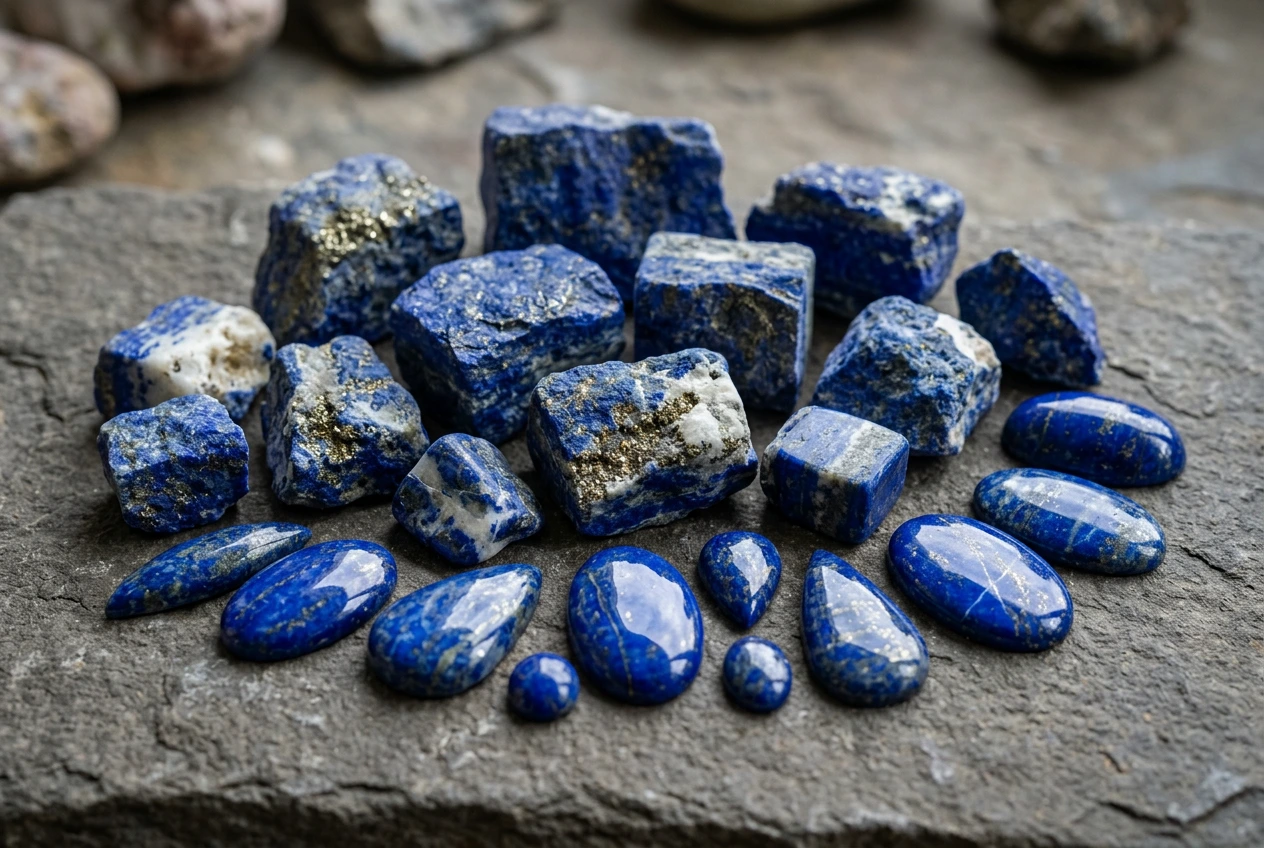
The most valuable lapis lazuli usually displays a rich, saturated blue with relatively even color, minimal distracting white calcite, and either little pyrite or fine, attractively distributed golden pyrite. Lapis lazuli is not a single mineral species. It is an opaque rock whose prized blue color is mainly associated with lazurite, while calcite, pyrite, sodalite-group minerals, and other constituents can occur within the rock. This distinction matters because the visible combination of those components strongly affects appearance, desirability, and price.
Two stones of equal weight can therefore sell for very different amounts. One may show intense ultramarine blue, a smooth polish, and delicate metallic flecks, while another may be pale, patchy, heavily calcitic, dyed, fractured, or poorly finished. Size, treatment, workmanship, seller positioning, origin documentation, and whether the lapis is rough or finished can further change what a buyer pays.
10 Key Factors Affecting Lapis Lazuli Price Per Carat
- Color saturation: Rich, vivid blue to deep ultramarine generally commands more than pale, grayish, greenish, or uneven blue.
- Color uniformity: Evenly distributed blue normally receives a stronger value than visibly patchy or mottled stone.
- Calcite content: Large white or gray calcite patches generally reduce value when buyers are seeking classic fine blue lapis.
- Pyrite appearance: Fine, well-distributed golden pyrite can be attractive, while excessive or coarse pyrite may interrupt the blue face.
- Surface quality: A smooth, well-polished face with good visual depth is usually more desirable than a dull, scratched, porous, or undercut surface.
- Treatment status: Undisclosed dyeing, impregnation, waxing, or other enhancement can significantly affect confidence and price.
- Size and usable yield: Large sections of evenly colored lapis without major fractures or unattractive areas can command stronger prices.
- Cut and workmanship: Well-shaped cabochons, beads, inlays, and carvings can cost substantially more than equivalent rough because skilled labor and selection add value.
- Origin and documentation: Credible provenance from historically respected deposits may influence demand, but unsupported geographic claims should not justify a large premium.
- Seller and market level: Wholesale rough, bead strands, artisan cabochons, luxury jewelry, and collector specimens can carry very different per-carat equivalents.
How Much Does Lapis Lazuli Cost Per Carat?
A useful way to interpret lapis lazuli price per carat is to separate ordinary commercial grades from increasingly selective retail qualities. Since one gram equals five carats, a lapis item priced at $10 per gram is equivalent to approximately $2 per carat before considering workmanship or setting costs. Sellers dealing in rough, beads, and carvings often prefer grams because carat pricing can make the numbers unnecessarily small for an opaque ornamental stone.
The ranges below are approximate retail-oriented comparisons rather than a formal price standard. Finished jewelry can cost much more because metal, design, labor, branding, and retail margins are added to the value of the lapis itself.
| Lapis Lazuli Quality | Typical Appearance | Approximate Price Per Carat |
|---|---|---|
| Low commercial | Pale or uneven blue, abundant calcite, weak finish or numerous inclusions | About $0.20 to $1 |
| Commercial to good | Recognizable medium to strong blue with visible calcite or uneven pyrite | About $1 to $3 |
| Good to fine | Saturated blue, limited calcite, attractive texture and polish | About $3 to $8 |
| Fine | Strong, relatively even royal to ultramarine blue with little distracting calcite | About $8 to $20 |
| Exceptional selected pieces | Especially vivid, uniform blue, excellent polish, desirable pyrite balance, strong workmanship or collector appeal | $20+ in some retail settings |
These levels can overlap substantially. A large carving made from mixed-quality lapis may have a low per-carat stone value but a high finished price because of labor. Conversely, a small, intensely blue cabochon cut from carefully selected rough may command a considerably higher per-carat amount even though the total price remains modest.
Why Color, Calcite, and Pyrite Have the Greatest Influence on Value
Color is usually the first feature buyers notice. Fine lapis has historically been admired for saturated blue that can range from royal blue to intense ultramarine. The most sought-after stones usually avoid large pale, grayish, greenish, or chalky areas. Extremely dark stone is not automatically superior, either. A stone that appears almost black in ordinary lighting may lose some of the vivid blue character that makes lapis attractive.
Color uniformity also matters. A evenly blue cabochon presents a cleaner face and gives the cutter more freedom to create symmetrical shapes without having to conceal unattractive zones. Patchiness may be acceptable in decorative carvings or stones chosen for unusual natural patterns, but it generally lowers value when the goal is classic gem-quality lapis.
Calcite commonly occurs in lapis lazuli and is part of the rock’s natural mineral assemblage, but visible white calcite can reduce the impression of saturated blue. Fine-quality lapis intended for jewelry often contains little obvious calcite on the face. This does not mean that every trace of calcite proves poor quality. Small veins or subtle patches may be perfectly natural and can even contribute character, particularly in specimens valued for geological appearance rather than uniform jewelry color.
Pyrite requires a more nuanced assessment. Tiny metallic-gold flecks scattered across an intense blue surface can produce the appearance many buyers associate with natural lapis lazuli. Fine pyrite is therefore not automatically a defect. Heavy concentrations, coarse patches, or large metallic areas can reduce the amount of visible blue and may lower value in stones graded primarily for uniform color. Buyer preference also matters, because some people deliberately seek star-like pyrite while others prefer almost pure blue.
Cut, Polish, Size, and Treatments Can Change the Price Dramatically
Lapis lazuli is commonly fashioned into cabochons, beads, tablets, carvings, mosaics, boxes, spheres, and ornamental objects. Its hardness is approximately 5 to 5.5 on the Mohs scale, and differences in the hardness of its constituent minerals can make polishing more difficult than its opaque appearance suggests. A skilled cutter must manage softer calcite areas, harder grains, fractures, and pyrite while preserving a smooth face.
A high-quality polish can deepen the visual impression of blue and make pyrite appear crisp against the surface. Poor polishing may leave scratches, pits, dull patches, or uneven areas around softer constituents. Workmanship becomes particularly important in matched beads and cabochons because consistency in color, dimensions, polish, and shape requires substantial selection from the original rough.
Larger pieces are not automatically more valuable per carat. If a large slab contains extensive calcite, cracks, weak color, or poorly distributed pyrite, its price per carat may remain low. Large pieces containing unusually continuous areas of fine, evenly colored blue are more difficult to obtain and may command a premium because they offer greater cutting possibilities.
Treatment also deserves close attention. Some lapis is dyed to make weak or uneven blue appear darker and more uniform. Waxing or impregnation may be used to improve polish or stabilize the surface. Such treatments do not necessarily make an item unusable, but they should be disclosed because an untreated stone with naturally strong color is generally more desirable at comparable quality.
Dyed lapis may show unusually intense color concentrated in cracks, pores, or lighter calcite-rich zones. A suspiciously uniform dark blue surface at a very low price may justify additional examination. Professional identification is preferable for valuable purchases because visual inspection alone cannot reliably establish every treatment.
Does Lapis Lazuli Origin Affect Price?
Lapis lazuli has been mined in several regions, and deposits in present-day Afghanistan are particularly famous for their long history of producing high-quality blue stone. Buyers may therefore encounter descriptions such as Afghan lapis, Badakhshan lapis, Siberian lapis, Chilean lapis, or other geographic labels. These names can influence commercial positioning, but visible quality should remain central to valuation.
Origin alone does not transform an unattractive stone into fine lapis. A piece with excellent saturation, limited calcite, attractive pyrite, and good polish can be highly desirable regardless of the label attached to it. At the same time, well-documented provenance may increase collector interest when a particular mine or region has historical importance.
Buyers should be cautious when a substantial premium rests entirely on an origin claim that cannot be supported. Determining geographic origin for lapis lazuli may require specialized examination and is not always possible from appearance alone. A seller’s statement about origin therefore carries more weight when it is backed by credible documentation.
How to Compare Lapis Lazuli Price Per Carat Before Buying
Price comparison works best when the stones being compared are genuinely similar. A polished cabochon should not be evaluated directly against inexpensive rough using only price per carat because the finished stone includes cutting losses, selection, shaping, polishing, and retail labor. The same principle applies when comparing individual stones with bead strands, carvings, antique objects, or jewelry set in precious metal.
Start by examining color under neutral lighting. Look for saturation, uniformity, visible calcite, the amount and distribution of pyrite, surface condition, and polish. A strong blue stone that remains attractive in ordinary indoor light is generally more useful for jewelry than one that looks impressive only under intense photography lighting.
Next consider treatment disclosure and seller transparency. A modestly priced untreated lapis with honest description may represent better value than a more expensive stone whose deep color was enhanced but not disclosed. For higher-priced pieces, documentation can help establish whether claims about treatment, origin, age, or provenance justify the asking price.
Per-carat calculation is most useful after these characteristics have been compared. If two similar untreated cabochons have comparable color, polish, size, and workmanship, their price per carat can reveal which one carries the stronger premium. If their quality differs substantially, the cheaper price per carat does not automatically represent the better purchase.
Natural Lapis Lazuli, Dyed Stone, and Imitations
Natural lapis lazuli should not be confused with blue-colored substitutes sold for a similar visual effect. Dyed howlite, dyed magnesite, glass, ceramic products, reconstructed stone, and other imitations may be marketed with descriptive names that sound similar to lapis. They can be attractive decorative products, but they should not be represented or priced as natural lapis lazuli.
Synthetic or reconstructed products also require clear identification. Reconstituted lapis-like products can contain crushed stone combined with binders, pigments, or other ingredients. Their appearance may resemble natural lapis from a distance, yet their composition and value are different from a naturally formed rock.
Pyrite alone is not proof of authenticity because metallic particles can be imitated or introduced into manufactured products. Likewise, the absence of obvious pyrite does not prove that lapis is fake. High-quality natural lapis can contain very little visible pyrite, so identification must consider the stone as a whole.
Conclusion
Lapis lazuli price per carat depends most strongly on blue saturation, color uniformity, calcite content, pyrite distribution, polish, treatment status, usable size, workmanship, provenance, and the level of the market in which it is sold. Ordinary commercial lapis can be inexpensive, while carefully selected fine blue stones may reach substantially higher retail prices per carat.
The best purchase is not necessarily the darkest stone or the most expensive one. A well-valued piece combines attractive natural blue, appropriate pyrite, minimal distracting calcite, good craftsmanship, honest treatment disclosure, and a price consistent with comparable quality.
FAQs About Lapis Lazuli Price Per Carat
What is a good lapis lazuli price per carat?
For many retail purchases, commercial lapis may cost roughly $1 to $3 per carat, better-quality stones may fall around $3 to $8, and fine examples can reach approximately $8 to $20 per carat or more. These figures are approximate because lapis is often sold by gram, piece, strand, or finished object rather than through a standardized per-carat market. Color, treatment, workmanship, and seller level can create substantial differences between apparently similar pieces.
Is dark blue lapis lazuli always more expensive?
Not necessarily. Saturated royal to ultramarine blue is highly desirable, but darkness alone does not determine quality. A stone can become so dark that its blue character appears muted, while another slightly lighter stone may show much richer saturation and a more attractive surface. Uniformity, calcite, pyrite, polish, and treatment should be considered together with tone.
Does pyrite make lapis lazuli more valuable?
Fine, attractive pyrite can enhance lapis lazuli, particularly when small golden flecks are evenly scattered across strong blue. Large concentrations of pyrite may interrupt the blue appearance and can reduce value for buyers seeking cleaner color. There is therefore no simple rule that more pyrite means a higher price. The distribution and visual balance are more important than the mere presence of metallic flecks.
Why is some lapis lazuli so cheap?
Low-priced lapis may contain pale or uneven blue, abundant calcite, coarse pyrite, fractures, weak polish, or treatment such as dyeing. Some inexpensive products are also reconstructed stones or imitations rather than natural lapis lazuli. Low price does not automatically mean fake, since ordinary-grade natural lapis is abundant enough to be affordable, but very cheap intensely blue items deserve careful examination.
Is lapis lazuli priced by carat or gram?
Both systems can be used, although gram pricing is common for lapis rough, carvings, beads, and larger pieces. One gram equals five carats, so converting between the two is straightforward. A stone priced at $15 per gram has a stone-price equivalent of about $3 per carat. Finished jewelry may not convert cleanly because its price also includes craftsmanship, metal, design, and retail costs.