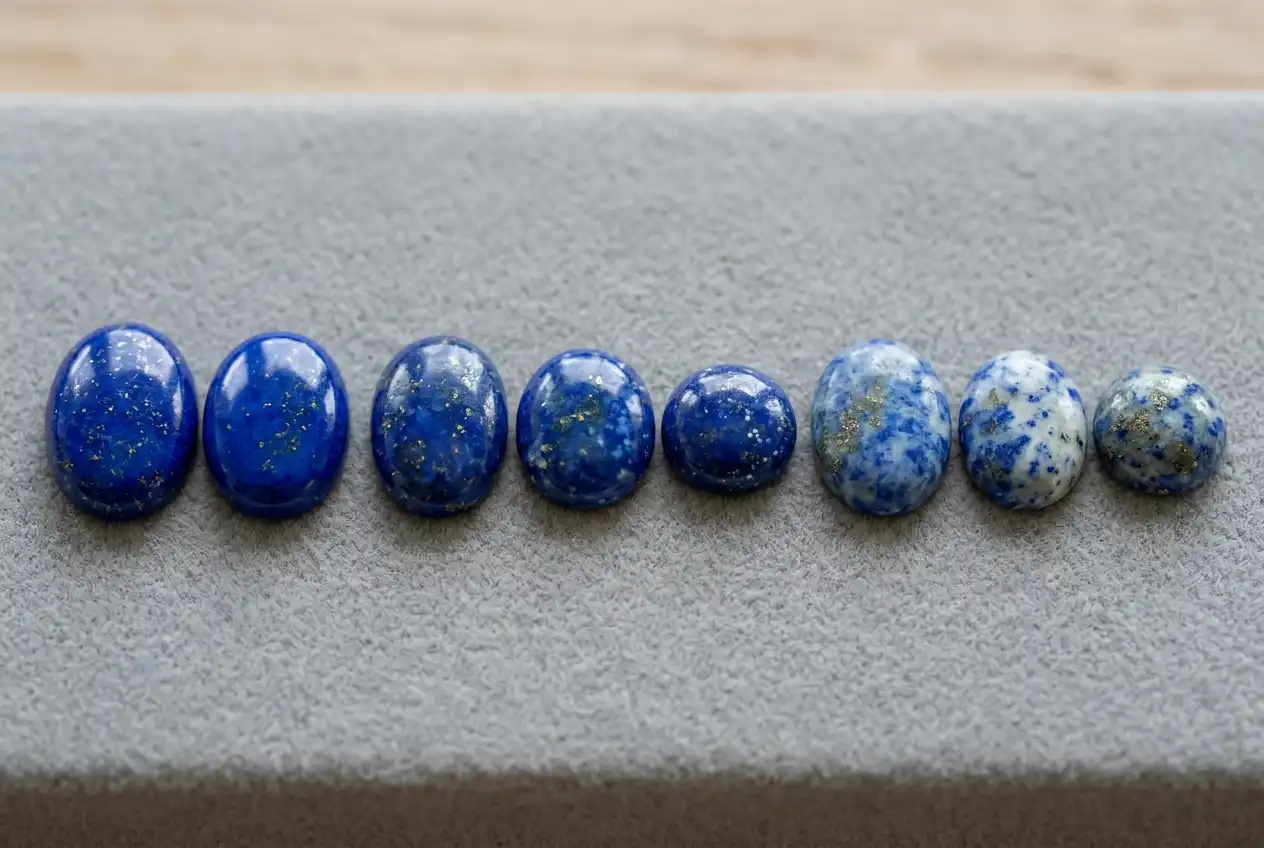
Lapis Lazuli Quality Grading: 9 Ways to Evaluate Royal Blue & Pyrite
Lapis lazuli quality grading is based primarily on the strength and uniformity of its blue color, the amount of visible calcite, the character of its pyrite, surface quality, treatment status, and workmanship. Fine lapis typically shows saturated royal to ultramarine blue, little distracting white calcite, and either minimal pyrite or small, attractively distributed golden flecks. There is no single internationally standardized grading scale equivalent to the systems widely used for some transparent gemstones, so commercial labels such as fine, premium, AAA, or top grade can vary considerably between sellers.
A buyer should also understand what lapis lazuli actually is before judging quality. Lapis is an opaque rock rather than a single mineral species. Its famous blue color is mainly associated with lazurite, while calcite, pyrite, sodalite-group minerals, and other constituents may occur within the rock. The relative proportions and distribution of these components create the blue, white, gray, and metallic patterns visible in polished lapis.
The term royal blue is commonly used in the trade for an attractive saturated blue, but it is not a formal laboratory grade with one universally fixed color boundary. Likewise, visible pyrite is neither automatically desirable nor automatically a defect. Fine pinpoints can add character, while coarse masses can reduce the visual dominance of blue. Reliable lapis lazuli quality grading therefore requires several features to be considered together.
9 Ways to Evaluate Royal Blue & Pyrite in Lapis Lazuli
- Judge blue saturation: Favor rich, vivid blue rather than washed-out, grayish, greenish, or weakly colored areas.
- Examine color uniformity: Fine lapis usually presents a relatively even blue face without distracting pale patches.
- Assess calcite: Large white or gray calcite areas generally lower jewelry quality when a clean royal-blue appearance is desired.
- Evaluate pyrite distribution: Fine scattered flecks can be attractive, while coarse masses or excessive metallic zones may dominate the stone.
- Check texture and compactness: Better lapis generally has a dense, coherent appearance rather than visibly porous, crumbly, or heavily fractured structure.
- Inspect polish quality: A smooth, even polish should enhance the blue without deep scratches, pits, dull zones, or severe undercutting.
- Look for treatments: Dye, wax, impregnation, or other enhancement should be identified and disclosed because naturally strong color is usually more desirable.
- Consider cut and visual balance: Cabochons, beads, carvings, and inlays should use the stone’s color and pattern effectively while maintaining good proportions and finish.
- Verify important claims: Geographic origin, untreated status, historical provenance, or exceptional grade should receive stronger weight when credible documentation supports them.
Understanding Lapis Lazuli Quality Grades
Because lapis lazuli lacks a universal commercial grading standard, buyers often encounter grade names that sound precise but are actually seller-defined. One merchant may call a stone AAA because it has strong blue with a few pyrite flecks, while another may reserve the same label for nearly pure ultramarine stone with almost no visible calcite. The grade label is therefore less informative than the actual appearance and treatment disclosure.
A practical quality system can still help buyers compare stones consistently. The following levels describe common visual differences rather than establishing an official gemological standard.
| Quality Level | Blue Color | Calcite | Pyrite | Typical Overall Appearance |
|---|---|---|---|---|
| Low commercial | Pale, grayish, greenish, or strongly uneven | Abundant or dominant | Variable | Patchy, chalky, fractured, or weakly polished |
| Commercial | Medium blue with noticeable variation | Clearly visible | Fine to coarse | Recognizable lapis but visually mixed |
| Good | Strong blue with moderate uniformity | Limited | Usually moderate | Attractive for many beads, cabochons, and carvings |
| Fine | Rich royal to ultramarine blue | Minimal and unobtrusive | Fine, limited, or attractively scattered | Strong jewelry-quality appearance |
| Exceptional | Highly saturated, evenly distributed blue | Little to no distracting calcite | Minimal or exceptionally well balanced | Carefully selected stone with excellent polish and visual consistency |
A stone does not have to contain pyrite to qualify as fine lapis. Some highly prized pieces are almost uniformly blue, while others are appreciated specifically for delicate golden flecks. What matters is whether pyrite improves or disrupts the visual composition.
Royal Blue Color and Uniformity Are Central to Lapis Grading
Color is usually the dominant factor in lapis lazuli quality grading because the stone’s historic appeal comes from its intense blue appearance. Fine stones often show vivid medium-dark to dark blue with strong saturation. Ultramarine and royal-blue descriptions are frequently used for particularly attractive shades, although these words remain commercial descriptions rather than strict scientific grades.
Strong saturation should not be confused with simple darkness. A lapis stone can be very dark yet appear dull, almost black, or visually flat. Another stone with a slightly lighter tone may display much stronger blue saturation and appear more vibrant in normal lighting. Quality grading should therefore examine hue, tone, saturation, and uniformity together.
Greenish areas, gray zones, pale patches, or obvious differences between one part of the stone and another usually reduce the clean appearance expected from fine jewelry-grade lapis. Some patterned lapis can still be attractive, especially for carvings and decorative objects, but a highly uniform blue surface generally receives stronger grading when the evaluation focuses on classic lapis color.
Lighting can significantly influence visual judgment. Strong cool lighting may intensify blue in photographs, while warm indoor light can make the same stone appear darker or less saturated. Comparing several pieces under the same neutral light gives a more useful indication of genuine color differences.
How Calcite and Pyrite Influence Lapis Lazuli Quality
Calcite is a natural component of many lapis lazuli rocks and often appears as white, cream, or grayish patches and veins. In classic jewelry grading, extensive visible calcite usually lowers quality because it interrupts the desired continuous blue surface. A stone with large white areas may still be unquestionably natural lapis lazuli, but it would usually be assigned a lower commercial grade than an equally saturated stone with little visible calcite.
Small traces of calcite are not necessarily serious defects. Their effect depends on position, contrast, and the intended use of the stone. A minor pale vein near the edge of a carving may be far less important than a bright white patch in the center of a cabochon. Geological specimens may even be valued for displaying the relationship between lazurite, calcite, and pyrite rather than for achieving perfectly uniform blue.
Pyrite behaves differently because many buyers consider its metallic golden appearance attractive. Fine pinpoints or small irregular flecks can create an appealing contrast against saturated blue and are often regarded as characteristic of natural lapis. A balanced scattering of pyrite can therefore coexist with high quality.
Large pyrite masses, dense metallic patches, or excessive concentrations can reduce the amount of visible blue and lower the stone’s grade for jewelry purposes. Coarse pyrite may also influence the smoothness of a polished surface. The best assessment asks whether the pyrite contributes to the stone’s beauty rather than simply counting how much is present.
This is why claims such as “more gold means better lapis” are unreliable. Pyrite is iron sulfide, not native gold, despite its metallic yellow appearance. Its quality contribution depends on fineness, placement, balance, and buyer preference.
Texture, Polish, and Workmanship Reveal Important Quality Differences
A fine piece of lapis should feel visually compact and take an attractive polish. Because lapis lazuli is a rock containing minerals with different physical properties, polishing can expose differences in hardness and texture. Calcite-rich zones may polish differently from lazurite-rich areas, while pyrite grains can create small irregularities if the cutter does not handle the surface carefully.
Examine a polished stone under reflected light. The surface should appear smooth and consistent rather than heavily scratched, pitted, wavy, or dull. Minor natural features can occur, especially in larger carvings, but severe pits and fractures reduce both appearance and durability.
Cabochon workmanship should also be assessed independently from the quality of the rough. A fine piece of lapis can be diminished by an asymmetrical shape, excessively thin edge, poorly finished back, or obvious polishing marks. Conversely, skilled cutting can make efficient use of moderately patterned rough and create an attractive finished piece.
Matched stones require additional selectivity. A pair of earrings or a strand of beads with closely matched color, pyrite distribution, shape, and polish may command a premium because finding numerous compatible sections of lapis requires more sorting than producing unrelated individual stones.
Treatments and Imitations Matter in Lapis Lazuli Quality Grading
Some lapis lazuli is dyed to deepen weak color or disguise pale areas. Wax, oil, resin, or other substances may also be used to improve surface appearance or fill porosity. Treatment does not make the stone cease to be lapis when genuine lapis is present, but the enhancement changes how its natural quality should be evaluated.
An untreated stone with naturally saturated blue generally ranks more highly than an otherwise similar stone whose color depends substantially on dye. Disclosure is especially important because a treated low-grade stone can visually resemble better lapis in photographs. Price and grade should therefore reflect whether the desirable appearance is natural or enhanced.
Dye may sometimes concentrate in pores, fractures, or lighter areas. Unnaturally intense color around cracks or on a porous surface can raise suspicion, although visual examination alone is not sufficient for every case. Valuable stones or important purchases may justify professional gemological examination.
Imitations require an entirely separate classification. Dyed howlite, dyed magnesite, glass, ceramics, reconstructed products, and other blue substitutes can resemble lapis but should not receive a natural lapis quality grade. Reconstituted products containing crushed stone and binders also differ from intact natural lapis rock and should be described transparently.
The presence of pyrite-like metallic particles cannot by itself confirm authenticity because manufacturers can imitate that visual feature. Natural lapis can also contain little or no obvious pyrite. Identification should therefore be based on several observations rather than a single supposed authenticity sign.
Does Geographic Origin Determine Lapis Lazuli Grade?
Geographic origin can affect commercial demand, particularly because deposits in Afghanistan have supplied celebrated lapis for centuries. Historical associations have made Afghan and Badakhshan descriptions especially recognizable in the gem trade. Other lapis-producing regions can also yield attractive stone, however, and geographic name alone does not establish quality.
A poorly colored or calcite-rich piece does not become fine grade merely because it is described as coming from a famous locality. Likewise, a strongly saturated and well-polished stone should not automatically receive a low grade because it comes from another source. Visible quality and treatment status remain more useful for most jewelry buyers.
Origin deserves greater weight when provenance itself contributes to collecting interest or historical significance. In those situations, documentation becomes important because appearance alone may not provide a reliable basis for assigning a mining locality. Unsupported origin labels should therefore be treated as seller claims rather than as automatic proof of additional quality.
A Practical Method for Comparing Two Lapis Stones
When comparing two pieces, begin with color under the same light. Place them side by side and determine which one shows richer saturation, better uniformity, and fewer distracting pale areas. This direct comparison is often more revealing than trying to interpret grade labels supplied by different sellers.
Then examine the calcite and pyrite. Decide whether white areas interrupt the central face and whether pyrite appears as pleasing fine flecks or overwhelming coarse patches. Look across the entire surface rather than judging a single attractive section, especially when buying beads or large carvings whose reverse side may differ from the front.
Surface condition should follow. Inspect the polish, edges, drill holes, fractures, pits, and any zones where softer minerals have been undercut. A highly saturated stone with severe cracks may be less desirable for regular jewelry than a slightly less vivid but structurally sound piece.
Finally, compare treatment disclosure, workmanship, origin claims, documentation, and price. This method produces a more reliable quality assessment than relying on marketing labels such as A, AA, AAA, premium, royal, or museum quality, none of which guarantees a consistent standard between different sellers.
Conclusion
Lapis lazuli quality grading depends on a combination of saturated blue color, uniformity, limited distracting calcite, balanced pyrite, compact texture, smooth polish, skilled workmanship, treatment disclosure, and credible support for important provenance claims. Royal blue and ultramarine descriptions can be useful visual terms, but they are not universal laboratory grades.
Fine lapis should therefore be judged by what the stone actually shows rather than by an impressive commercial label. Rich natural blue, harmonious mineral distribution, excellent finishing, and transparent disclosure provide a much stronger basis for evaluating quality.
FAQs About Lapis Lazuli Quality Grading
What is the highest quality lapis lazuli?
The highest-quality lapis usually displays strongly saturated royal to ultramarine blue with excellent visual uniformity, little distracting white calcite, and a smooth, well-finished surface. Pyrite may be absent, minimal, or present as fine attractive flecks without overwhelming the blue. Untreated color and good structural quality further strengthen the grade. No single commercial label such as AAA is universally standardized, so the actual characteristics should always be examined.
Is lapis lazuli better with or without pyrite?
Neither option is automatically better. Nearly pure blue lapis can be highly desirable, while fine golden pyrite flecks can produce an equally attractive classic appearance. Quality decreases when pyrite becomes so coarse or abundant that it dominates the surface or disrupts the blue. Personal taste therefore influences which high-quality appearance a buyer prefers.
Is white calcite bad in lapis lazuli?
Calcite is a normal natural constituent of many lapis lazuli rocks, so its presence does not mean the stone is fake or defective. Large white patches generally lower commercial jewelry grade because they reduce color uniformity and interrupt saturated blue. Small, discreet calcite areas may have little effect, particularly in carvings, specimens, or stones valued for natural patterning.
What does AAA lapis lazuli mean?
AAA is usually a seller-defined commercial grade rather than an internationally regulated gemological classification. One seller may use it for deeply saturated blue lapis with minimal calcite, while another may apply the label more generously. Buyers should therefore compare actual color, calcite, pyrite, polish, treatment, and workmanship instead of assuming that every AAA stone has equivalent quality.
How can I tell whether lapis lazuli has been dyed?
Dyed lapis may show unusually intense or excessively uniform blue, particularly when color appears concentrated in pores, cracks, or naturally pale areas. These signs can raise suspicion but are not conclusive because natural lapis itself varies greatly. Professional testing is the more reliable approach for valuable stones, especially when untreated status has a significant effect on price.
Does Afghan lapis always have the best quality?
Afghanistan is historically famous for producing exceptional lapis lazuli, but an Afghan origin claim alone does not guarantee superior quality. Individual stones still vary in blue saturation, calcite, pyrite, texture, polish, and treatment. Fine lapis can come from more than one region, while lower-quality stone can occur within historically respected producing areas. Quality should therefore be evaluated on the actual stone, with origin considered separately when reliable provenance is available.