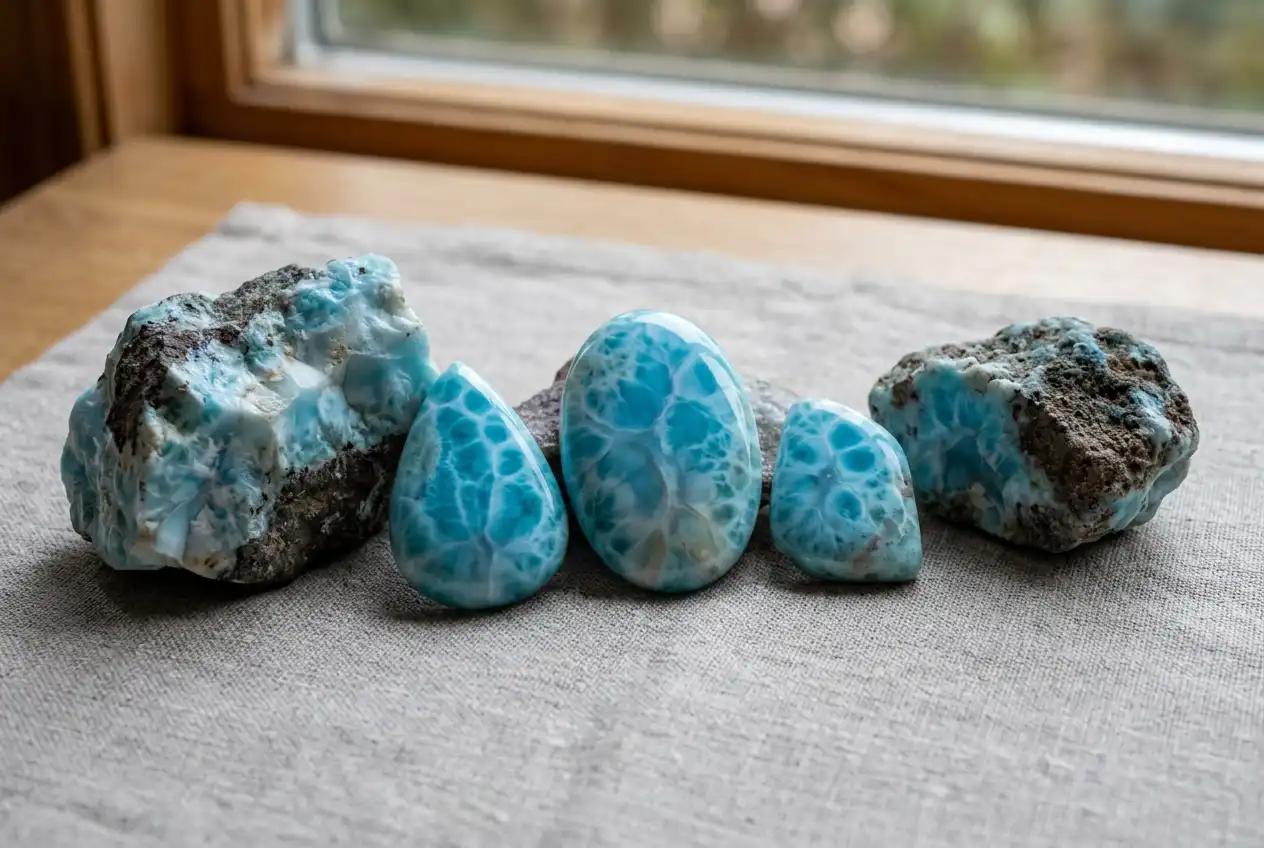
Larimar Price Per Carat: 8 Rarity & Cost Drivers for Sea Gems
Larimar price per carat can range from less than a few dollars for pale, heavily included, irregular, or commercial-grade pieces to around $10 to $30 per carat for attractive blue cabochons, with carefully selected stones showing saturated blue color, strong patterning, good translucency, and excellent cutting sometimes selling for considerably more at retail. There is no universally fixed larimar price list, and large carvings, bead strands, rough pieces, designer jewelry, and collector-quality cabochons may be priced by gram, piece, or finished object instead of by carat.
Larimar is a blue to blue-green variety of pectolite, a calcium-sodium silicate mineral. Its most commercially important deposits occur in the Dominican Republic, where attractive blue pectolite occurs within volcanic rocks. Copper is generally associated with the blue coloration. Although larimar is often promoted with ocean-inspired language because of its Caribbean source and wave-like patterns, it is a geological gemstone formed in rock rather than a product of the sea.
Value varies dramatically because buyers are not paying for weight alone. Saturated blue color, visually appealing white patterning, translucency, usable size, structural integrity, workmanship, treatment status, and seller positioning all influence what a particular stone is worth. Two cabochons weighing ten carats can therefore have very different prices even when their dimensions appear similar.
8 Rarity & Cost Drivers Affecting Larimar Price Per Carat
- Blue color strength: Saturated sky blue, turquoise blue, and deeper Caribbean-style blue usually command more than pale gray-blue, whitish, or weakly colored stone.
- Pattern quality: Attractive white webbing, cloud-like structures, and well-balanced blue-and-white patterning can increase visual appeal when the design is distinct rather than chaotic.
- Translucency: Better-quality larimar may show attractive translucency around thinner areas or edges, while chalky and fully opaque pieces usually occupy lower commercial grades.
- Size and usable yield: Large sections with strong color and few fractures are harder to cut efficiently, so fine larger cabochons may receive stronger per-carat premiums.
- Structural condition: Cracks, cavities, porous areas, weak zones, and unstable fractures reduce cutting yield and often lower value.
- Cut and polish: Symmetrical shapes, attractive domes, smooth surfaces, and skilled orientation of the pattern can substantially increase the price of finished larimar.
- Treatment and authenticity: Natural-color larimar with clear disclosure is generally more desirable than dyed, impregnated, reconstructed, or imitation products represented as equivalent.
- Market level and craftsmanship: Loose stones, bead strands, artisan jewelry, designer pieces, and branded retail jewelry can carry very different price-per-carat equivalents.
How Much Does Larimar Cost Per Carat?
Larimar pricing is easiest to understand through broad quality levels rather than a single average. Commercial-grade stones may contain substantial pale areas, grayish color, fractures, matrix, weak patterning, or an uneven surface. Fine stones combine more saturated blue with attractive natural patterning and better cutting yield, while exceptional examples may show unusually vivid color over a large usable area.
The approximate retail-oriented ranges below are intended for comparison rather than as fixed market quotations. Finished jewelry can cost substantially more because precious metal, design, labor, brand positioning, and retail margins are added to the gemstone value.
| Larimar Quality | Typical Appearance | Approximate Retail Price Per Carat |
|---|---|---|
| Low commercial | Pale blue, gray-blue, white-heavy, fractured, porous, or irregular | About $0.50 to $3 |
| Commercial | Moderate blue with noticeable white areas, mixed pattern, average polish | About $3 to $7 |
| Good | Attractive sky to turquoise blue, recognizable pattern, sound polish | About $7 to $15 |
| Fine | Strong blue, balanced white patterning, good translucency and cutting | About $15 to $30 |
| Exceptional selected pieces | Intense blue, especially attractive pattern, strong structural quality, excellent workmanship | $30+ in some retail settings |
These ranges overlap because larimar is not traded through a standardized exchange or universally accepted grading laboratory. A large freeform cabochon may cost less per carat than a smaller round stone because a round cut can require greater rough loss. Likewise, a collector may pay more for unusual natural patterning that another buyer considers too irregular.
Color and Pattern Have the Strongest Influence on Larimar Value
Color is usually the most important visible driver of larimar price per carat. Pale blue and whitish material is generally abundant within commercial production, while stronger blue zones are more desirable for jewelry. The most sought-after stones often display clear sky blue, turquoise blue, or deeper blue areas that remain attractive under normal lighting rather than appearing vivid only in heavily edited photography.
A darker stone is not automatically superior. Saturation, brightness, distribution, and pattern must be considered together. Larimar that is extremely dark but visually flat may be less appealing than a slightly lighter cabochon displaying lively blue, natural translucency, and well-defined white structures.
White patterning is another distinctive feature. Many polished stones display soft cloud-like patches, irregular webs, feathered areas, or patterns often compared with sunlight moving across tropical water. These descriptions are visual analogies rather than evidence of aquatic formation. From a pricing standpoint, the most attractive patterns tend to create pleasing contrast while leaving enough blue visible to dominate the design.
Heavy white or gray areas may reduce the value of stones being sold primarily for blue color, especially when the pattern appears chalky or overwhelms the face. Yet pattern preferences are subjective. A highly distinctive blue-and-white cabochon can command a premium even when it contains more white than a conventional fine-grade stone because the individual pattern makes it attractive for one-of-a-kind jewelry.
Why Translucency, Texture, and Structural Quality Affect Cost
Larimar ranges from opaque to somewhat translucent, and better stones can show attractive light transmission, particularly around thin edges. Translucency can make blue appear more luminous and can add visual depth to a polished cabochon. It should not be confused with transparency, since larimar is normally cut and appreciated as an opaque to translucent ornamental gemstone rather than as a transparent faceted gem.
Texture matters because pectolite commonly develops fibrous or radiating aggregates. Larimar rough can contain fractures, cavities, host rock, colorless or whitish zones, and differences in compactness. These characteristics affect how much usable gemstone can be recovered from a piece of rough.
Structural integrity becomes especially important for large cabochons. A visually beautiful blue section crossed by an unstable fracture may break during sawing, grinding, setting, or wear. A cutter may therefore pay more for rough that appears expensive by weight but offers a high percentage of solid, richly colored stone because the final yield is more predictable.
Conversely, inexpensive rough may contain substantial unusable portions. When cutting loss is considered, the effective cost of the finished blue area can be considerably higher than the initial rough price suggests. This is one reason that finished larimar should not be compared directly with rough solely on the basis of carat weight.
Size, Cut, and Polish Can Raise Larimar Price Per Carat
Large larimar stones are readily encountered, but large pieces combining strong blue, attractive patterning, minimal fractures, and a clean polish are more selective. Size by itself does not guarantee value. A 100-carat pale carving can cost less per carat than a 15-carat vividly colored cabochon cut from a much finer section of rough.
Cutters generally favor cabochons, freeforms, beads, carvings, and decorative shapes because larimar is not normally valued for transparent faceting. The orientation of the rough can have a major visual effect. A skilled lapidary may expose the strongest blue plane, position a desirable white pattern across the center, avoid weak areas, and shape the stone so that its natural design appears intentional.
Larimar has a Mohs hardness of roughly 4.5 to 5, making it softer than quartz, sapphire, or many familiar jewelry gemstones. The stone can therefore scratch and abrade more easily, and good polishing requires careful technique. A high-quality polished surface should be even and glossy without obvious pits, deep scratches, ragged edges, or poorly finished backs.
Matched cabochons and bead strands may carry additional premiums. Producing numerous stones with similar blue color and pattern requires considerable sorting. The price of a matched pair of earrings, for example, cannot always be estimated accurately by applying the per-carat value of one ordinary cabochon because the matching process itself creates additional scarcity.
Why Dominican Origin Does Not Replace Quality Grading
Larimar is strongly associated with the Dominican Republic, particularly the southwestern part of the country, and this limited geographic association contributes to its commercial identity. Genuine larimar is therefore much more geographically restricted than gemstones occurring in numerous major mining regions around the world.
Limited origin, however, should not be confused with uniformly exceptional quality. A deposit can produce pale, fractured, whitish, matrix-rich, and commercially ordinary stone alongside much more attractive blue material. The country of origin may explain why larimar has a distinctive market position, but an individual stone must still be assessed for color, pattern, translucency, structural condition, polish, and treatment.
Terms such as Caribbean gem or sea stone are commonly used in marketing because the colors resemble tropical water. They should not be treated as mineralogical classifications. Genuine larimar remains a variety of pectolite regardless of the commercial nickname attached to it.
Treatments, Reconstructed Stone, and Imitations Affect Value
Buyers should distinguish naturally colored larimar from products whose appearance has been altered or manufactured. Dyeing may be used on pale stones or other minerals to imitate stronger larimar color, while resins or other substances can be used to stabilize porous or fractured pieces. Treatments can improve appearance or durability, but they should be disclosed because they influence how the stone is valued.
Reconstructed products require additional caution. Crushed stone mixed with binders and pigments may be molded into beads, cabochons, or decorative shapes and sold under names suggesting natural larimar. Such products may contain some natural stone, but they are not equivalent to intact natural larimar cut directly from rough.
Blue glass, dyed howlite, dyed calcite, ceramics, polymer composites, and other substitutes can also resemble larimar from a distance. Pattern alone is not sufficient proof because artificial products can imitate white veining and blue patches. Conversely, genuine larimar does not need to display the stereotypical wave pattern to be authentic.
For inexpensive purchases, accurate seller disclosure may be sufficient for many buyers. For unusually expensive stones, significant collections, or jewelry priced on claims of exceptional natural quality, independent gemological examination can provide stronger confidence in identity and treatment status.
How to Compare Larimar Prices Before Buying
Begin by comparing stones under similar lighting. Photography can dramatically change blue gemstones, especially when image saturation and white balance are adjusted. A strong purchase should remain attractive in ordinary indoor light and natural daylight rather than depending entirely on high-intensity photographic presentation.
Next examine how much of the face is actually blue. Determine whether the white pattern creates attractive contrast or merely occupies most of the stone. Look for gray areas, brown host rock, fractures, cavities, and weak spots around the edges. On larger pieces, inspect the back because the front may have been deliberately oriented to show the best area.
Consider the shape and craftsmanship after judging the stone itself. A symmetrical cabochon with a smooth dome and carefully placed pattern may justify a higher price than a poorly shaped stone with similar rough quality. Freeform designs should still appear deliberate, balanced, and well finished.
Finally, compare price per carat only between reasonably similar stones. A pale 50-carat cabochon priced at $3 per carat is not necessarily better value than a saturated 15-carat stone at $18 per carat because they belong to different quality levels. Price per carat becomes meaningful only after color, pattern, condition, treatment, and workmanship are taken into account.
Conclusion
Larimar price per carat reflects far more than weight. Blue saturation, pattern quality, translucency, structural condition, usable size, cutting, treatment status, and retail positioning can move the price from inexpensive commercial levels to substantially higher amounts for carefully selected stones.
The strongest value usually comes from a larimar piece that offers attractive natural blue, balanced patterning, sound structure, skilled polishing, clear treatment disclosure, and a price consistent with stones of similar quality. Geographic association gives larimar its distinctive identity, but visible quality remains the most reliable basis for comparing individual stones.
FAQs About Larimar Price Per Carat
What is a reasonable larimar price per carat?
Commercial larimar may sell for only a few dollars per carat, while attractive good-quality cabochons often fall somewhere around $7 to $15 per carat. Fine stones with stronger blue, appealing patterning, better translucency, and excellent cutting may reach approximately $15 to $30 per carat or more. These figures are approximate retail comparisons because larimar does not have a universally standardized per-carat price.
Why is dark blue larimar more expensive?
Strong blue zones are generally more desirable because much larimar rough contains pale blue, white, grayish, fractured, or matrix-rich sections. A vivid blue stone can therefore require more selective cutting. Darkness alone is not enough, however. Saturation, pattern, translucency, polish, and structural quality must also be strong for a stone to justify a premium.
Is larimar a rare gemstone?
Larimar has a geographically restricted commercial source compared with many widely distributed gemstones, which contributes to its relative scarcity and market identity. That does not mean every piece is rare or highly valuable. Commercial-grade pale or fractured stone is much less valuable than carefully selected, strongly colored larimar, so rarity claims should always be connected to actual quality.
Does white patterning increase larimar value?
Attractive white patterning can increase value when it creates a balanced, distinctive design against saturated blue. Fine webbing, clouds, or wave-like structures are popular because they give each cabochon an individual appearance. Excessive white areas can lower value when they overwhelm the blue, so the effect depends on pattern quality rather than simply the amount of white present.
Is large larimar always more expensive per carat?
No. Large size increases total weight but does not guarantee higher quality or a stronger per-carat price. A large pale stone with fractures may cost considerably less per carat than a smaller, vividly blue cabochon with good translucency and excellent polish. Large stones receive significant premiums mainly when desirable color and structural quality remain consistent across the usable area.
Can larimar be treated?
Larimar or larimar-like products may be dyed, stabilized, impregnated, reconstructed, or otherwise modified. Treatments should be disclosed because they can affect durability and value. Natural-color larimar with strong blue and sound structure generally commands more respect than an otherwise similar piece whose appearance depends heavily on enhancement.