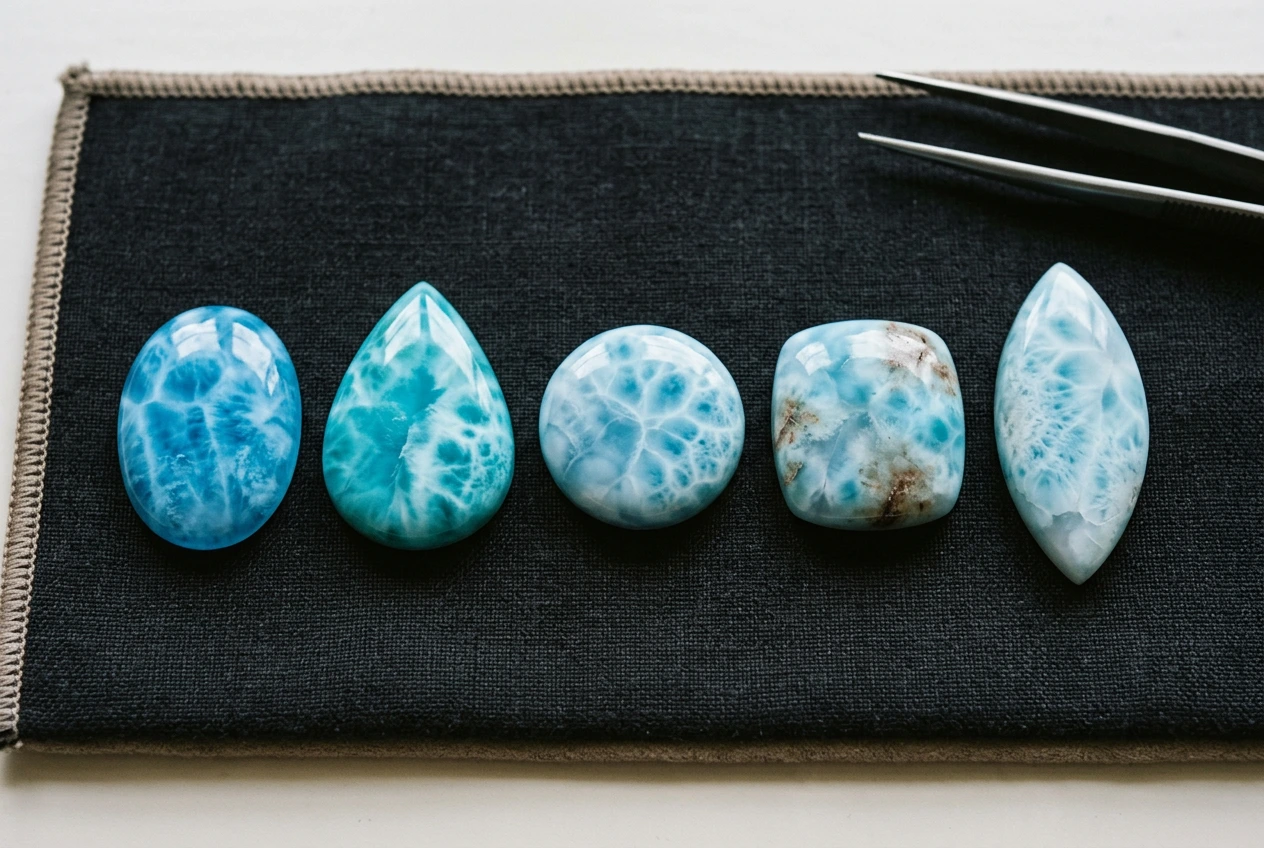
Larimar Quality Grading: 7 Key Criteria for Volcanic Blue Patterns
Larimar quality grading focuses primarily on blue color, natural patterning, translucency, structural integrity, polish, workmanship, and treatment status. Fine larimar typically displays attractive sky blue to saturated turquoise or deeper blue, balanced white patterning, good compactness, and a smooth polish without major fractures or porous areas. There is no single internationally standardized larimar grading scale, so commercial labels such as AAA, premium, volcanic blue, or top grade should be treated as seller terminology rather than universally defined gemological grades.
Mineralogically, larimar is a blue variety of pectolite, a calcium-sodium silicate mineral. The best-known commercial source is the Dominican Republic, where it occurs in volcanic rocks. Copper is associated with its blue coloration. White areas, radiating structures, fibers, veins, and variable translucency are natural features of the stone, although their arrangement can raise or lower commercial desirability.
The strongest larimar is not simply the darkest stone available. Quality depends on how color, pattern, texture, stability, and cutting work together. An intensely blue cabochon crossed by unstable fractures may be less desirable than a somewhat lighter stone with exceptional patterning and a flawless polish. Reliable larimar quality grading therefore requires the whole stone to be assessed instead of relying on one dramatic feature.
7 Key Criteria for Evaluating Larimar Quality
- Blue color quality: Assess saturation, brightness, tone, and whether the blue remains attractive under neutral lighting.
- Pattern definition: Examine how white, pale blue, and deeper blue areas form balanced webs, clouds, feathers, or volcanic-looking patterns across the stone.
- Translucency: Look for attractive light transmission, especially along edges or thinner zones, without assuming that greater transparency automatically means higher grade.
- Structural integrity: Check for open fractures, cavities, porous sections, weak edges, and unstable areas that may affect cutting or durability.
- Surface polish: A fine larimar stone should have a smooth, even polish without obvious scratches, pits, dull zones, or severe undercutting.
- Cut and pattern orientation: Good workmanship should position the strongest blue and most attractive pattern prominently while maintaining balanced proportions.
- Natural status and disclosure: Identify treatments, stabilization, reconstructed products, and imitations separately from natural-color larimar.
Practical Larimar Quality Grades From Commercial to Exceptional
Because there is no universal grading authority defining A, AA, or AAA larimar, a visual quality framework is more useful than relying on letters. Different sellers may use identical grade names for stones that vary considerably in color and structural condition.
A buyer can instead compare observable characteristics across broad quality levels.
| Quality Level | Color | Pattern | Structure and Finish | Overall Appearance |
|---|---|---|---|---|
| Low commercial | Pale, gray-blue, white-heavy, or uneven | Weak or chaotic | Fractures, pits, matrix, or rough polish common | Suitable mainly for inexpensive beads, carvings, or decorative use |
| Commercial | Light to medium blue | Recognizable but inconsistent | Generally usable with some visible imperfections | Attractive but not highly selective |
| Good | Clear sky or turquoise blue | Balanced white-and-blue design | Sound structure and good polish | Strong everyday jewelry quality |
| Fine | Saturated blue with good brightness | Distinctive webs, clouds, or well-distributed white structures | Few distracting flaws, excellent polish | Highly attractive jewelry-grade appearance |
| Exceptional | Vivid, well-distributed blue | Particularly striking and harmonious natural pattern | Strong integrity and superior workmanship | Carefully selected stone with unusual visual appeal |
These categories should remain flexible because pattern can alter how a stone is perceived. Some collectors prefer almost solid blue larimar, while others value dramatic white networks. A stone does not need to fit one stereotypical visual appearance to be high quality.
Blue Color Is the Foundation of Larimar Quality Grading
Larimar is most recognizable for its blue appearance, making color the first characteristic to assess. Better-quality stones commonly show clear sky blue, turquoise blue, blue-green, or deeper saturated blue rather than grayish, chalky, or weakly colored surfaces. Strong saturation tends to be more important than simple darkness.
The most desirable color should look convincing under normal neutral lighting. Blue gemstones can appear dramatically different depending on camera settings, background, exposure, and color correction. Product photographs with heavily increased saturation may make an ordinary stone appear unusually vivid, so buyers should compare several images or inspect the stone under different lighting when possible.
Color distribution is also important. A large patch of vivid blue surrounded by mostly pale stone may grade differently from a cabochon whose strong blue is distributed across most of the face. This becomes especially relevant with larger stones, where one photograph may emphasize the finest area while concealing weaker zones around the sides or back.
Extremely dark areas should be judged carefully. Deeper blue can be desirable, but a stone that appears nearly black or loses the fresh blue character associated with larimar is not automatically superior. The goal is an attractive balance of hue, saturation, tone, and brightness.
Evaluating White Webbing, Clouds, and Volcanic Blue Patterns
Larimar patterning is one of the main reasons individual stones can look so different. White pectolite-rich areas, lighter blue zones, fibrous structures, and changes in mineral aggregation can create irregular webs, clouds, feathers, islands, or wave-like visual effects. Such names are descriptive comparisons and should not be confused with formal geological structures.
Fine patterning tends to create clear contrast without overwhelming the blue. A cabochon with a vivid blue base crossed by delicate white networks can be highly desirable because its appearance is distinctive while the blue remains dominant. A stone containing broad chalky white areas may receive a lower jewelry grade if the blue occupies only a small part of the face.
There is no single ideal pattern. Some buyers prefer dramatic, high-contrast structures that resemble moving water, while others prefer cleaner blue with only subtle white accents. Pattern quality should therefore be evaluated through balance, definition, visual interest, and how well the design complements the cut.
Symmetry is not required because larimar’s patterns are naturally irregular. What matters is whether the lapidary has oriented the rough effectively. An irregular natural feature placed deliberately in the center of a cabochon can look more refined than an otherwise attractive pattern cut awkwardly through an edge.
Translucency, Texture, and Structural Integrity
Larimar is usually opaque to translucent rather than transparent. Better stones may transmit some light around thin edges or through selected areas, producing a visual depth that can make blue appear more luminous. Translucency can enhance quality, but it should not override color, pattern, and structural condition.
A translucent pale stone is not automatically better than an opaque but richly saturated blue stone. Quality grading requires the interaction of all characteristics rather than a single numerical hierarchy. The most successful cabochons often combine appealing color with enough translucency to add depth without losing the dense appearance buyers expect from larimar.
Structural quality deserves particular attention because pectolite has a fibrous mineral habit and larimar rough can contain fractures, cavities, porous sections, and host rock. Open cracks can weaken a stone and may expand during setting or wear. Cavities and uneven textures can also interfere with polishing.
Larimar has a Mohs hardness of about 4.5 to 5, so it is considerably softer than quartz and requires appropriate care in jewelry. Hardness is only one durability factor, however. A structurally compact larimar cabochon without major fractures may perform better in regular wear than a more vividly colored stone containing unstable cracks.
The back and edges should be inspected whenever possible. A polished face can appear flawless even when hidden fractures or matrix-rich zones are present underneath. Structural grading should therefore consider the whole stone rather than the display surface alone.
Polish and Cutting Quality Can Separate Similar Larimar Stones
Cutting has a major influence on larimar quality because the orientation of the rough determines which patterns appear on the finished face. Skilled lapidaries try to expose the most saturated blue sections, preserve attractive white structures, avoid unstable fractures, and position natural patterns so that they complement the final shape.
Cabochons should have balanced proportions and smooth transitions from dome to edge. Freeform stones do not need mathematical symmetry, but they should still look deliberate rather than unfinished. Excessively thin edges, irregular backs, sharp accidental corners, or uneven domes may indicate inefficient workmanship.
The polish should be examined under reflected light. A high-quality surface will appear smooth and continuous without deep scratches, cloudy regions, extensive pits, or visible grinding marks. Because larimar can contain zones of different texture, some pieces are harder to polish uniformly than others.
Good workmanship can add considerable value even when two stones originate from the same quality of rough. A cutter who preserves the strongest color while creating an attractive shape may sacrifice more weight, meaning the finished stone represents a smaller but more desirable portion of the original rough. This explains why the largest cabochon is not automatically the highest grade.
Matched pairs require additional skill and selection. Two larimar stones with similar blue intensity, pattern distribution, dimensions, and polish can be harder to produce than one individual cabochon. Matching therefore becomes a legitimate quality and value consideration for earrings and coordinated jewelry.
Natural Larimar Versus Treated, Reconstructed, and Imitation Products
A complete larimar quality grading system must consider whether the attractive appearance is natural. Genuine larimar may be sold untreated, but stabilization, impregnation, dyeing, or other enhancement can occur in the marketplace. Treatment should be disclosed because it affects how natural color and structural quality are interpreted.
Stabilization can improve the durability of porous or fractured stone by introducing resin or another substance into weak areas. Such a stone may remain attractive and suitable for jewelry, but it should not be graded as though its integrity were entirely natural. Likewise, dyed stone should be distinguished from larimar whose blue developed naturally.
Reconstructed products can contain crushed gemstone combined with binders, pigments, or other ingredients. These may be shaped into beads or cabochons that resemble larimar, but their manufacturing process makes them fundamentally different from a natural intact piece cut from Dominican rough.
Other blue stones and manufactured products can also imitate larimar. Dyed howlite, dyed calcite, glass, ceramics, polymer composites, and other substitutes may reproduce blue-and-white patterning. Pattern recognition alone is therefore not sufficient for identification.
A naturally irregular pattern should not be taken as absolute proof of authenticity, and an unusually uniform stone should not automatically be condemned as artificial. For higher-value purchases, reliable seller disclosure or independent gemological examination gives more confidence than visual assumptions alone.
Does Dominican Origin Automatically Mean High-Grade Larimar?
The Dominican Republic is central to larimar’s commercial identity because the gemstone’s recognized source is geographically restricted. This limited occurrence helps explain its strong association with Caribbean jewelry and its distinct market position.
Origin should not replace quality grading, however. Mining areas can produce everything from pale, fractured, white-heavy pieces to beautifully saturated blue rough. A lower-quality specimen does not become top grade simply because its origin is correctly identified.
Claims such as volcanic blue, Caribbean blue, or premium Dominican larimar can be useful descriptive terms, but they are not universally regulated grades. Buyers should still examine the stone’s actual saturation, pattern, translucency, structure, finish, and treatment status.
The same reasoning applies to rarity claims. Larimar’s geographic restriction is real, but commercial-grade stone and exceptional gem-quality sections are not equally scarce. A high price should therefore be justified by the specific quality of the stone rather than by origin language alone.
How to Grade a Larimar Cabochon Before Buying
A useful comparison begins with color. Examine whether blue dominates the stone, how saturated it appears, and whether the color remains attractive away from bright photographic lighting. Then evaluate the white pattern, asking whether it adds definition and movement or simply reduces the amount of blue.
Next examine the surface and edges for cracks, cavities, porosity, and areas where the polish changes noticeably. Check the back when possible because weak zones can be concealed by a well-oriented face. Structural soundness becomes particularly important in rings and bracelets, where the stone may experience more impact than in pendants or earrings.
After evaluating the stone itself, judge workmanship. Consider whether the shape complements the natural pattern, whether the dome is balanced, and whether the polish is consistently smooth. A well-cut smaller stone may be a better-quality purchase than a larger cabochon whose cutter prioritized weight retention over visual appeal.
Finally, consider disclosure. The seller should clearly identify the stone, describe known treatments, and avoid relying solely on undefined labels such as AAA or museum grade. When two stones are otherwise similar, transparent description and reliable identification are meaningful parts of a quality purchase.
Conclusion
Larimar quality grading depends on seven interconnected characteristics: blue color, pattern, translucency, structural integrity, polish, cutting, and natural treatment status. Fine larimar generally combines vivid blue with balanced white patterning, sound structure, good visual depth, and skilled workmanship rather than maximizing one characteristic at the expense of all others.
The most reliable approach is to judge the actual stone instead of accepting commercial grade labels at face value. A beautiful larimar cabochon should remain attractive under ordinary lighting, display a natural and well-oriented pattern, feel structurally sound, and be represented honestly.
FAQs About Larimar Quality Grading
What color of larimar is considered highest quality?
Strongly saturated sky blue, turquoise blue, and deeper vivid blue are generally more desirable than pale, grayish, or predominantly white stone. The best color should remain lively rather than excessively dark or dull. Uniformity and the way the blue interacts with white patterning also affect the overall grade, so the darkest stone is not automatically the finest.
What does AAA larimar mean?
AAA is typically a seller-created commercial designation rather than a universally recognized gemological grade. Different sellers may apply AAA to very different levels of blue saturation, pattern quality, translucency, and structural condition. Buyers should therefore inspect the actual stone characteristics instead of assuming the letters guarantee a defined standard.
Is larimar better when it has white patterns?
White patterning can be highly desirable when it creates attractive contrast and a distinctive natural design against strong blue. Delicate webs, clouds, or feathered patterns are especially popular. Too much chalky white can reduce the visual dominance of blue, however, so quality depends on balance rather than simply the presence or absence of white.
Is translucent larimar more valuable than opaque larimar?
Translucency can add depth and brightness, particularly around thin edges, and it may contribute to a higher grade when other characteristics are also strong. It is not an automatic quality guarantee. An opaque but vividly blue, structurally sound stone with excellent patterning can be more desirable than a translucent but pale or fractured piece.
How can I identify high-quality larimar?
Look for saturated natural blue, an attractive and well-distributed pattern, few distracting fractures or cavities, a smooth polish, sound edges, and cutting that makes good use of the stone’s strongest features. Treatment disclosure and seller transparency should also be considered because visual quality alone cannot establish whether a stone has been dyed, stabilized, or reconstructed.
Does larimar scratch easily?
Larimar has a Mohs hardness of roughly 4.5 to 5, so it can scratch more readily than quartz, topaz, sapphire, and many common jewelry gemstones. High-quality larimar can still be used successfully in jewelry, but protective settings and careful wear are sensible. Rings generally expose the stone to more abrasion and impact than earrings or pendants.
Is all genuine larimar from the Dominican Republic?
Larimar is the trade name associated with the distinctive blue pectolite commercially sourced from the Dominican Republic. The geographic association is an important part of its identity, but Dominican origin alone does not establish high quality. Individual stones still need to be graded for color, pattern, structure, finish, treatment, and workmanship.