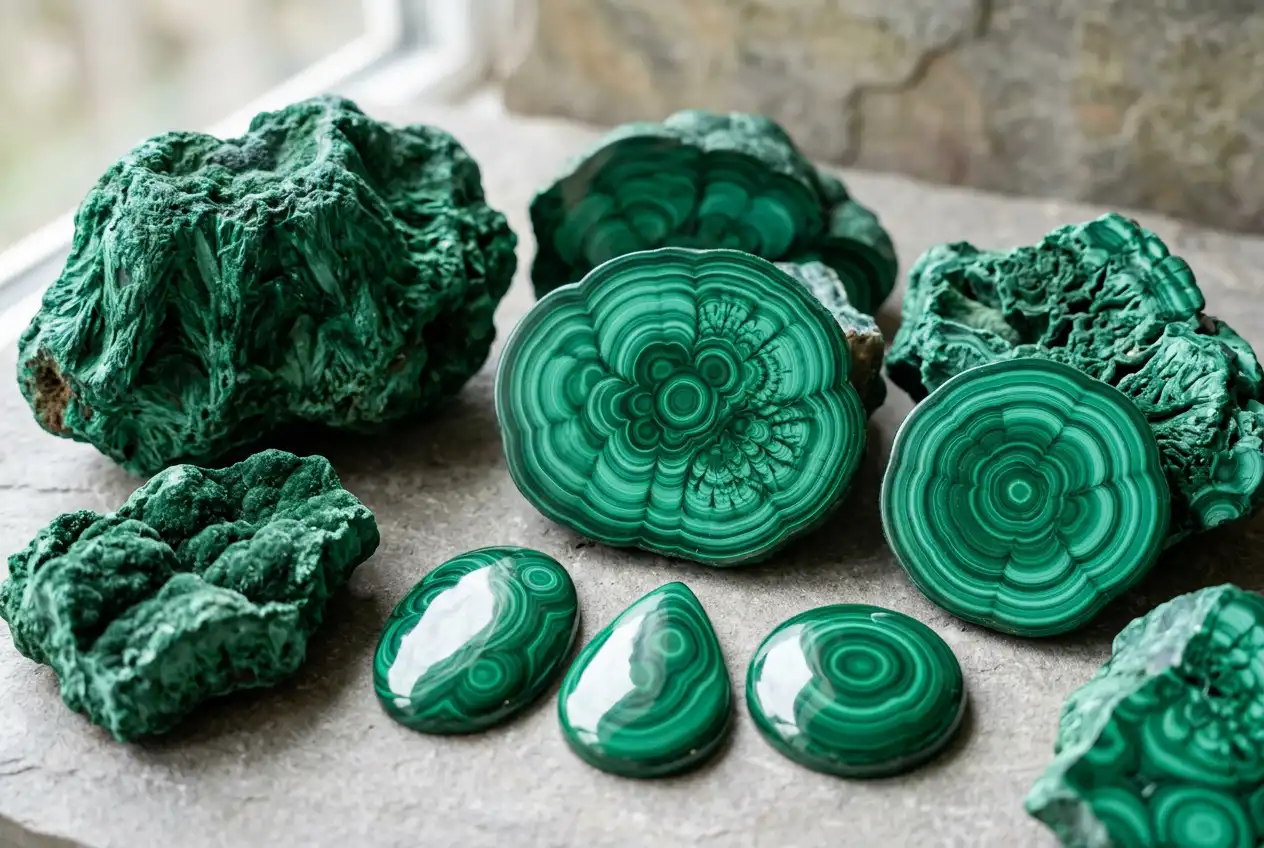
Malachite Price Per Carat: 9 Value Factors for Banded Minerals
Malachite price per carat is usually modest compared with precious transparent gemstones, but the range can become surprisingly wide once color, banding, compactness, size, cutting quality, and collector appeal are considered. Ordinary commercial malachite may have a per-carat equivalent well below $1, while attractive polished cabochons commonly fall around $1 to $5 per carat at retail. Carefully selected stones with exceptional concentric bands, eye patterns, unusual natural formations, high polish, or strong collector appeal can reach several dollars per carat and sometimes substantially more. Malachite is frequently sold by gram, piece, slab, carving, specimen, or kilogram rather than by carat, so per-carat figures are best used for comparing similar products rather than establishing one universal market price.
Malachite is a copper carbonate hydroxide mineral with the chemical formula Cu₂CO₃(OH)₂. It is famous for intense green colors ranging from pale green to deep forest green and for its characteristic concentric bands, waves, swirls, stripes, and eye-like patterns. These structures develop naturally during mineral growth and can become highly decorative when the rough is cut across favorable orientations. Malachite is opaque, normally polished rather than faceted, and relatively soft at about 3.5 to 4 on the Mohs scale.
Weight alone is therefore a poor predictor of value. A large piece with dull color, fractures, crumbly areas, poor polish, or repetitive patterning may cost less per carat than a much smaller cabochon displaying sharp alternating green bands and a dramatic bull’s-eye pattern. Buyers should compare malachite by visible quality, structural condition, treatment disclosure, craftsmanship, and the type of product being purchased before focusing on weight.
9 Value Factors Affecting Malachite Price Per Carat
- Color quality: Strong, attractive green with appealing contrast between light and dark zones generally commands more than dull, muddy, grayish, or weakly colored stone.
- Banding and pattern: Distinct concentric rings, eyes, waves, stripes, and complex natural patterns can create substantial premiums over plain or poorly defined malachite.
- Pattern placement: A well-positioned eye, swirl, or balanced band structure on the face of a cabochon is more valuable than comparable rough cut without regard to orientation.
- Compactness and stability: Dense, coherent malachite generally has greater cutting value than friable, porous, heavily fractured, or crumbly stone.
- Size and usable yield: Large continuous sections with attractive color and pattern can command stronger prices because much rough contains cracks or areas unsuitable for cutting.
- Cut and polish: Smooth cabochons, symmetrical beads, well-finished slabs, and skillfully executed carvings add labor and may reveal patterns far more effectively than ordinary rough.
- Treatment and reconstruction: Untreated natural malachite is generally preferred over stabilized, resin-filled, reconstructed, or manufactured products when other qualities are comparable.
- Specimen and origin appeal: Crystals, botryoidal formations, pseudomorphs, associated minerals, and documented localities can command prices unrelated to ordinary lapidary malachite.
- Retail level and craftsmanship: Raw pieces, wholesale beads, artisan cabochons, sculptures, antique objects, and designer jewelry can have dramatically different per-carat equivalents.
How Much Does Malachite Cost Per Carat?
Malachite is commonly traded in units larger than a carat because most finished pieces are opaque cabochons, beads, carvings, decorative objects, or mineral specimens. One gram equals five carats, which means malachite priced at $5 per gram has an equivalent stone price of about $1 per carat. This conversion is helpful when comparing loose stones, but it becomes less useful once substantial carving labor, jewelry metal, antique value, or collector significance is included.
The ranges below represent approximate retail-oriented comparisons for natural malachite rather than an authoritative global price schedule. Individual pieces can fall outside them depending on pattern quality, size, craftsmanship, treatment, provenance, and seller positioning.
| Malachite Quality | Typical Characteristics | Approximate Price Per Carat |
|---|---|---|
| Low commercial | Weak pattern, fractures, matrix, dull color, rough finish | About $0.10 to $0.50 |
| Commercial | Recognizable green banding, ordinary pattern, acceptable polish | About $0.50 to $1.50 |
| Good | Attractive contrasting bands, solid structure, good polish | About $1.50 to $4 |
| Fine | Strong color, distinctive eyes or complex banding, excellent finish | About $4 to $10 |
| Exceptional decorative or collector pieces | Unusually dramatic natural pattern, large clean sections, exceptional cutting or specimen appeal | $10+ in selected retail situations |
A carved object may have a much higher total selling price even when the malachite itself would not command a high loose-stone price per carat. Skilled carving can require many hours of labor and substantial weight loss, while antique objects may be valued partly for history, craftsmanship, and provenance. Mineral specimens can also occupy a completely different market because crystalline habit, locality, associated minerals, aesthetics, and rarity can matter more than lapidary yield.
Why Malachite Banding and Color Drive Value
Malachite’s most important visual characteristic is its range of green tones. Unlike many gemstones whose quality is judged partly by color uniformity, malachite often becomes more desirable when contrasting shades occur together in distinct natural patterns. Alternating pale, medium, and dark green bands can produce exceptional depth and movement after polishing.
Pattern quality can outweigh simple color intensity. A uniformly dark green piece may be attractive, but a cabochon containing concentric eyes, nested rings, feather-like curves, or sweeping bands can be more valuable because the pattern is visually distinctive. Malachite patterns are generated by the mineral’s growth structures, and cutting direction determines how those structures appear on the finished surface.
A lapidary who cuts parallel to one growth direction may reveal stripes, while a different orientation can expose concentric circles or irregular eyes. This means rough containing an exceptional structure can yield very different results depending on how it is sawn. Skilled cutters often study the exterior before deciding where to make the first cut because one poor orientation may waste the most attractive portion.
Contrast also matters. Strong separation between dark and light bands tends to make a pattern easier to appreciate from a distance. Fine lines combined with thicker zones can produce particularly intricate designs. Muddy transitions or extensive dull areas may reduce value even when the stone is genuinely natural.
Size, Structural Quality, and Usable Cutting Yield
Malachite can occur in large masses, so size alone does not make a piece rare or expensive. What becomes more selective is a large area that combines vivid color, exceptional patterning, solid structure, and few fractures. Large clean slabs with continuous ornamental banding can be desirable for boxes, tabletops, inlays, sculpture, and architectural decoration because maintaining visual consistency over a wide surface is more difficult than producing one small cabochon.
Structural quality is important because malachite may occur as dense masses, botryoidal crusts, fibrous aggregates, stalactitic growths, earthy coatings, and crystalline formations. Some rough is compact enough to polish beautifully, while other pieces contain porous layers, voids, cracks, or friable areas that break during cutting.
Cutting yield can therefore affect the real cost substantially. A seemingly inexpensive kilogram of rough may produce only a limited quantity of attractive polished stone after fractures, weak zones, matrix, and unattractive areas are removed. Dense rough with predictable structure may cost more initially but produce a higher percentage of usable cabochons.
The same principle applies to large finished pieces. A large polished slab showing continuous intricate banding without major filled cracks may command a strong premium because suitable rough had to be both sizable and structurally sound. Weight is valuable only when quality continues throughout the stone.
Cut, Polish, and Craftsmanship Can Transform Malachite Value
Malachite is typically shaped into cabochons, beads, tablets, cameos, boxes, eggs, spheres, carvings, mosaics, and decorative inlays. Because its defining beauty lies in pattern rather than transparency, cutters aim to reveal growth structures instead of producing brilliance through facets.
The best cabochons make deliberate use of those structures. An eye pattern may be centered, sweeping bands may follow the outline of an oval, or several contrasting zones may be positioned to create visual balance. A poorly oriented cabochon can turn exceptional rough into an ordinary finished stone, while careful cutting can reveal a remarkable pattern from a relatively modest piece.
Polishing quality is equally important. Malachite is softer than quartz and many familiar jewelry gems, so scratches and abrasion can develop relatively easily. A fine polish should be smooth and reflective without obvious sanding marks, pits, flat spots, or cloudy sections. Differences in compactness within one piece can make uniform polishing challenging, especially where porous growth zones are present.
Matched beads and cabochons deserve special consideration. Producing multiple stones with similar hue, pattern scale, dimensions, and finish can require extensive sorting from numerous pieces of rough. A matched pair for earrings or a consistent necklace strand may therefore command more than the sum of unrelated stones of similar weight.
Natural Malachite, Stabilized Stone, and Reconstructed Products
Natural malachite should be distinguished from enhanced, reconstructed, and imitation products because all can appear in the jewelry and decorative trade. Some porous or fractured malachite may be stabilized or impregnated with resin to improve strength, polish, or cutting yield. Such treatment can make a stone practical for use, but disclosure remains important because untreated compact malachite is generally preferred when quality is otherwise comparable.
Reconstructed malachite is different from a single natural piece. Crushed malachite or green mineral particles may be combined with binders, pigments, or resins and molded into blocks that can then be cut into beads, cabochons, or decorative objects. These products may contain genuine malachite particles, but they should not be represented as equivalent to intact natural banded malachite.
Imitations can also be manufactured from glass, ceramic compounds, polymer, dyed stone, or other substances. Some artificial patterns show repeated black lines, excessively regular stripes, or a visual appearance unlike the gradual range of natural malachite greens. However, pattern recognition alone should not be treated as an infallible authenticity test because natural malachite is extremely variable and imitations continue to improve.
For ordinary low-cost purchases, seller transparency may be sufficient. For expensive carvings, important collector pieces, or jewelry priced as exceptionally fine natural malachite, professional examination can provide greater confidence in identity and treatment status.
Mineral Specimens Can Follow Different Pricing Rules
Not all malachite should be valued as cutting rough. Mineral collectors may pay substantial premiums for specimens displaying botryoidal surfaces, velvet-like fibrous coatings, distinct crystals, stalactitic formations, pseudomorphs, or aesthetically arranged associations with azurite and other copper minerals. In these cases, converting the specimen price into dollars per carat can be misleading because weight is not the primary reason for the value.
Documented locality can also be important in specimen collecting. Certain mines are known for characteristic malachite formations, crystal habits, or historically significant discoveries. A specimen with reliable provenance from a celebrated locality can command more than a visually similar but undocumented piece.
Lapidary buyers and mineral collectors are therefore evaluating different qualities. A beautiful fibrous specimen may be unsuitable for cutting but excellent as a collector piece, while dense banded rough may be ideal for cabochons but less interesting as an untouched specimen. The intended market needs to be identified before the price can be assessed fairly.
How to Compare Malachite Price Per Carat Before Buying
Begin with the entire face of the stone rather than its darkest green area. Examine whether the colors are lively, whether the banding is distinct, and whether the pattern feels naturally balanced. Look closely for fractures, filled cavities, porous zones, surface scratches, and areas where polish quality changes.
Then consider pattern orientation and workmanship. A high price may be justified when the cutter has centered an exceptional eye, created a well-proportioned shape, and achieved an even polish. Large decorative pieces should be inspected for pattern continuity and structural repairs because resin-filled fractures can be difficult to notice in photographs.
Treatment disclosure should be considered before comparing price. A stable, attractive, resin-treated stone may still be perfectly usable, but it should not automatically command the same premium as comparably beautiful untreated compact malachite. Reconstructed and imitation products belong in a separate price category altogether.
Finally, compare only similar types of malachite. Rough should be compared with rough, cabochons with cabochons, bead strands with similar strands, and collector specimens with specimens of comparable aesthetic and locality importance. Once those variables are reasonably aligned, price per carat becomes a useful secondary tool for identifying unusually high or low asking prices.
Conclusion
Malachite price per carat depends primarily on color contrast, natural banding, pattern placement, structural integrity, usable size, polish, treatment status, collector significance, and craftsmanship. Ordinary commercial malachite can be inexpensive, while unusually patterned stones, large clean sections, sophisticated carvings, or important mineral specimens may command much stronger prices.
Weight should never be evaluated in isolation. The best value comes from a piece whose green color, natural pattern, stability, finish, authenticity, and asking price make sense together for the type of malachite being purchased.
FAQs About Malachite Price Per Carat
What is a typical malachite price per carat?
Commercial polished malachite may have a retail equivalent of roughly $0.50 to $1.50 per carat, while attractive good-quality cabochons can fall around $1.50 to $4 per carat. Fine examples with unusually strong color contrast, distinctive banding, eye patterns, or exceptional cutting can reach approximately $4 to $10 per carat or more. These ranges are approximate because malachite is commonly sold by piece or gram rather than through a standardized per-carat market.
Why is some malachite expensive?
Higher-priced malachite may combine vivid green color, intricate natural banding, excellent structural quality, large usable size, precise cutting, and a high polish. Collector specimens can become expensive for completely different reasons, including unusual crystal form, botryoidal structure, associated minerals, documented locality, and aesthetic arrangement. Large sculptures and antique decorative objects may also derive much of their price from craftsmanship and historical value rather than gemstone weight.
Is darker malachite worth more?
Dark green can contribute to attractive contrast, but darkness alone does not determine value. Malachite often looks best when several green tones form distinct natural bands. A medium-green stone with intricate eyes and sharp contrast can therefore be more desirable than a uniformly dark piece with little pattern. Color, banding, condition, and craftsmanship should be assessed together.
Are malachite eye patterns valuable?
Well-formed eye patterns can increase value because they create distinctive focal points and require favorable natural growth structures combined with careful cutting orientation. Large concentric eyes, multiple balanced rings, and unusual combinations of swirls and bands can be especially attractive. Their value still depends on color, polish, structural quality, size, and overall composition rather than the mere presence of circular markings.
Is raw malachite cheaper than polished malachite?
Raw malachite is often cheaper per unit of weight because the buyer accepts cutting risk, waste, fractures, matrix, and finishing labor. Premium rough with exceptional visible banding can still be expensive, especially when it is large and structurally sound. A finished cabochon incorporates selection, weight loss, shaping, pattern orientation, and polishing, so its per-carat price is usually higher than ordinary rough.
Does malachite origin affect price?
Origin can influence price, particularly for documented mineral specimens from historically important mines or localities known for distinctive formations. For ordinary jewelry malachite, visible quality generally matters more than an unsupported geographic claim. Strong premiums for origin make the most sense when provenance is credible and locality itself has genuine collector significance.
Is reconstructed malachite worth less than natural malachite?
Reconstructed malachite generally occupies a lower value category because it is manufactured from particles or crushed stone combined with binders or other ingredients rather than cut from one intact natural piece. It can still be attractive and useful for inexpensive jewelry or decorative objects, but it should be disclosed clearly and priced accordingly.