Malachite Quality Grading: 8 Ways to Rate Band Patterning & Weight
Malachite quality grading is based primarily on green color, band definition, pattern attractiveness, structural compactness, usable size, cutting orientation, polish, and treatment status. Fine lapidary malachite commonly displays vivid combinations of light and dark green, distinct natural bands or eye patterns, a compact surface capable of taking a smooth polish, and few distracting fractures. Unlike diamonds and several widely traded transparent gems, malachite has no universal international grading scale, so terms such as AAA, premium, first grade, or museum grade can mean different things from one seller to another.
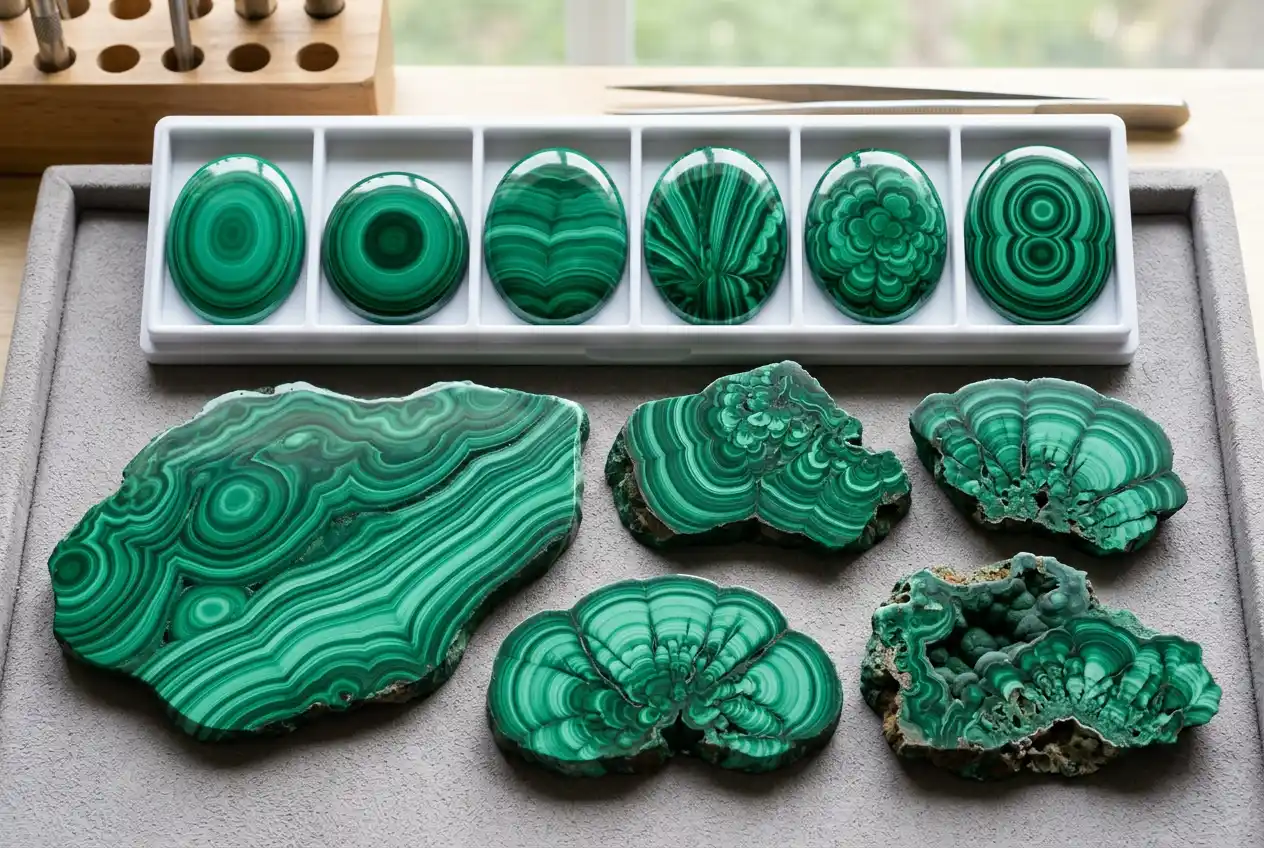
Malachite is copper carbonate hydroxide, Cu₂CO₃(OH)₂, and its visual appearance reflects its mineral growth rather than inclusions suspended inside a transparent crystal. It can form banded masses, botryoidal surfaces, fibrous structures, stalactitic growths, crusts, and less commonly distinct crystals. When compact banded rough is cut and polished, these structures may appear as concentric circles, eyes, waves, stripes, feathers, loops, or irregular green landscapes.
Weight must also be interpreted correctly. A heavier stone is not automatically a higher-grade stone. Quality depends on how much of that weight consists of attractive, structurally sound malachite with desirable patterning. A 20-carat cabochon with exceptional concentric eyes and excellent polish can grade substantially higher than a 100-carat piece dominated by fractures, plain areas, or weak bands. Weight becomes more important when fine color and structure remain consistent through a large usable section.
8 Ways to Rate Malachite Band Patterning & Weight
- Evaluate green color: Look for attractive saturation and natural variation between light, medium, and dark green rather than dull, muddy, or grayish areas.
- Examine band definition: Fine malachite often displays crisp, clearly separated bands that remain visually distinct after polishing.
- Judge pattern complexity: Eyes, concentric rings, waves, loops, stripes, and layered formations can strengthen quality when they create a balanced natural design.
- Inspect structural compactness: Dense, coherent stone generally grades higher for lapidary use than porous, crumbly, heavily fractured, or unstable malachite.
- Consider usable weight: Larger pieces deserve premiums only when desirable color, pattern, and stability continue across a meaningful portion of the stone.
- Assess cutting orientation: High-quality workmanship exposes the best natural structures and positions important pattern features effectively on the finished face.
- Examine polish and finish: Fine malachite should show a smooth, reflective surface without severe scratches, pits, flat spots, ragged edges, or poorly finished backs.
- Verify natural status and treatments: Untreated natural malachite, stabilized stone, reconstructed products, and imitations should be identified and graded separately.
Practical Malachite Quality Grades
Commercial grading labels are inconsistent, making direct observation more reliable than letters such as A, AA, or AAA. A seller’s top grade might refer mainly to vivid green color, while another may reserve that term for highly patterned stones with almost no visible fractures. Buyers should therefore compare specific characteristics rather than assuming identical labels represent identical quality.
A practical quality framework can separate ordinary lapidary stone from increasingly selective pieces.
| Quality Level | Color and Pattern | Structure | Finish and Use |
|---|---|---|---|
| Low commercial | Dull or uneven green, weak bands, large plain zones | Fractured, porous, matrix-rich, or unstable | Rough beads, inexpensive carvings, basic decorative use |
| Commercial | Recognizable banding with moderate color contrast | Generally usable with visible imperfections | Common cabochons, beads, small carvings |
| Good | Strong green contrast and attractive stripes, waves, or eyes | Solid with limited distracting fractures | Quality jewelry and polished objects |
| Fine | Crisp banding, complex pattern, vivid green variation | Dense and structurally sound | High-quality cabochons, matched stones, decorative pieces |
| Exceptional | Rare or unusually beautiful natural pattern, excellent contrast, strong visual balance | Large clean usable section with excellent stability | Collector-grade lapidary pieces, specialty cutting, exceptional decorative work |
This framework applies mainly to lapidary malachite. Mineral specimens require a different assessment because a fibrous, botryoidal, or crystalline specimen can be highly collectible even when it would perform poorly as cutting rough.
How Green Color and Contrast Influence Malachite Grade
Malachite is unusual among popular gemstones because a mixture of green shades is often more valuable than complete color uniformity. Pale green, vivid emerald-like green, medium grass green, and dark forest green can occur together, creating natural contrast that reveals the internal growth structures.
Fine color grading focuses on saturation and interaction between zones rather than choosing one ideal shade. Dark and light areas should complement each other instead of blending into a muddy appearance. Strong contrast can make delicate bands visible, while subtle transitions can create depth in larger swirls and eyes.
Brownish contamination, gray areas, dull surfaces, or extensive host rock may lower lapidary grade when they interrupt an otherwise attractive pattern. Their effect depends on position. A minor matrix area on the back of a specimen may have little importance, while a dull patch across the center of a polished cabochon can significantly reduce visual quality.
Color should be judged under neutral lighting whenever possible. Highly saturated photography may exaggerate green intensity, particularly in online listings. The best stones retain attractive contrast in ordinary daylight and indoor illumination rather than appearing impressive only in edited photographs.
Banding, Eyes, Swirls, and Pattern Complexity
Banding is central to malachite quality grading because the mineral’s growth structures create its distinctive identity. Straight or gently curved stripes can be attractive, but concentric eyes, bull’s-eye structures, nested rings, flowing waves, loops, and irregular combinations often command stronger interest because each finished stone becomes visually unique.
Crispness is important. Clearly separated bands tend to appear more refined than broad areas where shades merge without definition. Fine lines alternating with thicker dark and light bands can create sophisticated patterns, especially when the transitions remain clean after polishing.
Pattern complexity alone does not guarantee a high grade. A stone containing many chaotic lines can appear visually crowded, while a simpler pattern with one perfectly centered concentric eye may be more compelling. Composition therefore matters in the same way it does in other decorative arts. The natural design should feel balanced within the shape chosen by the cutter.
Cutting orientation has an enormous effect. The same rough can reveal stripes on one plane and concentric structures on another. A skilled lapidary may remove significant weight to reach the most attractive orientation. High-grade finished malachite therefore reflects both geological pattern and human judgment.
Patterns should also be evaluated for authenticity with caution. Natural malachite can produce remarkably regular structures, so regularity alone does not prove artificial manufacture. Conversely, manufactured products can imitate stripes and swirls. Identification should consider the entire appearance, texture, structure, and seller disclosure rather than relying on one visual rule.
Structural Compactness Is Essential for High-Grade Lapidary Malachite
Malachite occurs in several habits, and not all are equally suitable for jewelry cutting. Dense massive stone can accept an excellent polish, while fibrous, earthy, porous, or highly fractured forms may be difficult to shape into durable cabochons. A visually beautiful rough surface can therefore be a superb mineral specimen but poor lapidary rough.
Compactness should be checked across the whole stone. Open cavities, hairline cracks, crumbly zones, and porous layers can create problems during sawing and polishing. A fracture may also become more serious after the stone is mounted, especially in jewelry exposed to impact.
Malachite’s hardness of approximately 3.5 to 4 on the Mohs scale means it is relatively soft. This affects wear resistance but should not be confused with structural stability. A dense malachite cabochon can be structurally sound even though its surface scratches more readily than quartz, while a heavily fractured piece may be fragile regardless of hardness.
Because of this softness, polishing quality is revealing. Fine compact malachite can develop an attractive glossy surface, whereas porous zones may remain pitted or require stabilization to achieve a uniform finish. Buyers examining expensive pieces should look for abrupt changes in surface texture that might indicate weak or filled areas.
How Weight Should Be Used in Malachite Quality Grading
Weight becomes useful only after quality has been established. A large stone may command a premium when intricate patterning, vivid green contrast, and structural integrity remain consistent over a wide area. Large clean sections are especially useful for boxes, substantial cabochons, sculpture, matched decorative panels, and architectural inlay.
A heavy stone that contains large plain sections, fractures, host rock, or weakly colored zones should not receive a high grade simply because it weighs more. The relevant question is how much of the weight contributes to the qualities buyers actually want.
This distinction is particularly important with rough. A kilogram of inexpensive fractured malachite may yield less fine polished stone than a much smaller quantity of dense rough with excellent patterns. Experienced cutters therefore evaluate potential yield rather than paying strictly by gross weight.
Finished jewelry introduces another complication. Two cabochons of equal weight can represent very different cutting decisions. One may retain maximum weight but display a mediocre pattern, while another may have been cut smaller to center an exceptional eye. The lighter stone can be the higher-quality product because the cutter prioritized beauty over weight retention.
Matched stones also demonstrate why weight alone is insufficient. A pair of 10-carat cabochons with nearly identical color, band scale, and pattern balance can be more difficult to assemble than one unrelated 25-carat cabochon. Matching adds selectivity that a simple carat comparison cannot capture.
Cut Orientation and Polish Reveal Lapidary Quality
The cutter’s role in malachite grading is unusually important because pattern orientation can determine the entire visual character of the finished gem. Before sawing, experienced lapidaries may examine external banding, growth surfaces, and broken sections to estimate how internal structures will appear.
A well-oriented cabochon should make purposeful use of the pattern. Concentric rings may be centered or intentionally offset, sweeping bands may complement an oval outline, and dramatic curves may be preserved rather than cut through awkwardly. Freeform shapes can be particularly effective because they allow the cutter to follow the natural pattern instead of forcing the rough into a standardized outline.
Polish should then be inspected under reflected light. High-grade pieces show a smooth, glossy surface without obvious sanding lines, deep scratches, dull patches, pits, or poorly finished edges. The back should also receive attention, especially in loose cabochons, because a highly polished face does not compensate for an unstable or fractured base.
Malachite dust should not be inhaled during cutting or grinding because copper-bearing mineral dust can be harmful. This is primarily a lapidary handling issue rather than a concern with normally worn polished jewelry, but it helps explain why proper workshop practices are important when shaping the stone.
Treatments, Stabilization, and Reconstructed Malachite
Treatment status should be part of any serious malachite quality evaluation. Porous or fractured malachite may be stabilized or impregnated with resin to improve strength, fill voids, or create a more uniform polish. Stabilization can make otherwise difficult stone practical for jewelry, but it should be disclosed because it changes how the piece should be compared with naturally compact untreated malachite.
Reconstructed malachite occupies a different category. Crushed stone or mineral particles may be combined with resin, pigment, or other binders and formed into blocks. These products can then be cut and polished, sometimes displaying patterns designed to resemble natural banding. They can be attractive, but they should not receive the same grade as intact natural malachite.
Imitations may contain no malachite at all. Glass, polymer, ceramics, dyed stones, and other manufactured substances can reproduce green stripes or swirls. Some imitations use black lines or extremely repetitive patterns that differ from typical natural growth structures, although visual shortcuts should not be treated as definitive identification methods.
For valuable pieces, treatment and identity should be established through reliable disclosure or professional examination rather than assumptions based only on pattern. This becomes particularly important when high-grade pricing depends on the claim that a large patterned object was carved from intact natural malachite.
Mineral Specimen Quality Is Different From Jewelry Grade
Malachite specimens can be exceptional even when they cannot be polished into cabochons. Collectors may value botryoidal formations with smooth rounded surfaces, radiating fibrous aggregates, silky or velvet-like coatings, distinct crystals, pseudomorphs, stalactitic structures, and aesthetically balanced combinations with azurite or other copper minerals.
In specimen grading, damage, crystal development, completeness, aesthetics, locality, and provenance can matter more than polish or cutting yield. A fragile fibrous specimen might be a poor choice for jewelry but an outstanding mineralogical example.
Origin also becomes more significant in this part of the market. Well-documented specimens from famous mines can command strong premiums because collectors may seek a particular locality, formation style, or historical mining period. The same origin claim would usually carry less importance for an ordinary mass-produced bead.
Buyers should therefore decide whether they are evaluating lapidary malachite, decorative carving stone, or a mineral specimen before assigning a quality grade. Combining those markets into one system can lead to misleading conclusions.
A Reliable Method for Comparing Two Malachite Stones
Begin with color and pattern under the same lighting. Determine which stone offers stronger green contrast, cleaner band definition, and a more attractive natural composition. Examine the whole face instead of focusing on the most dramatic small area.
Next inspect structural condition. Look for open fractures, cavities, porous regions, repaired sections, chips, and unstable edges. Turn loose stones over and examine the back because structural problems can be concealed by a carefully chosen front orientation.
Then evaluate cutting. Decide whether the shape enhances the natural pattern, whether focal features have been placed deliberately, and whether excessive weight was retained at the expense of visual balance. Compare the polish under reflected light and check for scratches, pits, dull areas, and poorly finished margins.
Finally, compare treatment disclosure and price. If two stones have similar color and pattern but one is naturally compact while the other required substantial stabilization, they should not automatically receive the same quality grade. Transparent description is part of a trustworthy purchase, especially when commercial labels themselves are unstandardized.
Conclusion
Malachite quality grading works best when color, banding, pattern composition, structural compactness, usable weight, cutting orientation, polish, and treatment status are considered together. The finest lapidary malachite combines vivid green contrast with distinctive natural structures and a dense surface capable of taking an excellent finish.
Weight can add value when quality remains strong throughout a large piece, but size by itself is never a grade. A smaller cabochon with exceptional eyes, clean structure, and skilled cutting can easily outrank a much heavier but ordinary stone.
FAQs About Malachite Quality Grading
What does high-quality malachite look like?
High-quality lapidary malachite typically shows vivid natural greens, strong contrast between bands, attractive eyes, waves, rings, or stripes, and a compact structure with few distracting fractures. It should take a smooth glossy polish and display a pattern that works well with the chosen shape. Treatment status should also be disclosed because stabilization or reconstruction changes how the stone should be evaluated.
Is AAA malachite an official grade?
No. AAA is generally a commercial term created by individual sellers rather than a universally regulated malachite grade. One merchant may use it for intensely patterned untreated cabochons, while another may apply it to any polished stone with strong color. Evaluating visible characteristics and treatment disclosure is therefore more reliable than depending on the grade letters alone.
Is banded malachite better than plain malachite?
Distinctive natural banding is highly desirable in jewelry and decorative pieces because it is one of malachite’s defining visual characteristics. Crisp concentric rings, eyes, waves, and contrasting stripes usually create more interest than plain green areas. However, a simple pattern can still be high quality if the color, structure, polish, and overall composition are exceptional.
Do more malachite bands mean higher quality?
Not necessarily. Band definition, contrast, placement, and overall composition matter more than the number of individual lines. A stone with one beautifully centered concentric eye may be more appealing than another containing dozens of chaotic bands. Grading should therefore evaluate pattern quality rather than simply counting features.
Does a heavier malachite stone have a higher grade?
No. Weight affects total size but does not establish quality. A heavy stone containing fractures, plain areas, weak color, or poor polish may have a lower grade than a small cabochon with exceptional patterning and excellent structural integrity. Large size becomes valuable when fine characteristics remain consistent across the stone.
How can I tell if malachite has been reconstructed?
Reconstructed malachite may display manufactured-looking patterns, resin-rich surfaces, or structural characteristics different from intact natural stone, but visual examination alone is not always conclusive. Because manufactured products can imitate natural banding effectively, reliable seller disclosure or professional examination is preferable when authenticity has a significant effect on price.
Is polished malachite supposed to have pits?
Fine compact malachite should generally accept a smooth polish, so numerous pits can indicate porosity, cavities, weak growth zones, surface damage, or inadequate finishing. Small natural irregularities can occur, especially in unusual structures, but extensive pitting generally lowers lapidary quality unless the piece is being valued as a mineral specimen rather than polished jewelry stone.
What is the best malachite pattern?
There is no universally best pattern, but concentric eyes, bull’s-eye formations, sweeping waves, nested rings, and sharply contrasting bands are especially popular. The highest-quality examples combine distinctive natural structure with strong green color, good balance within the cut, sound structure, and excellent polishing rather than relying on one named pattern alone.