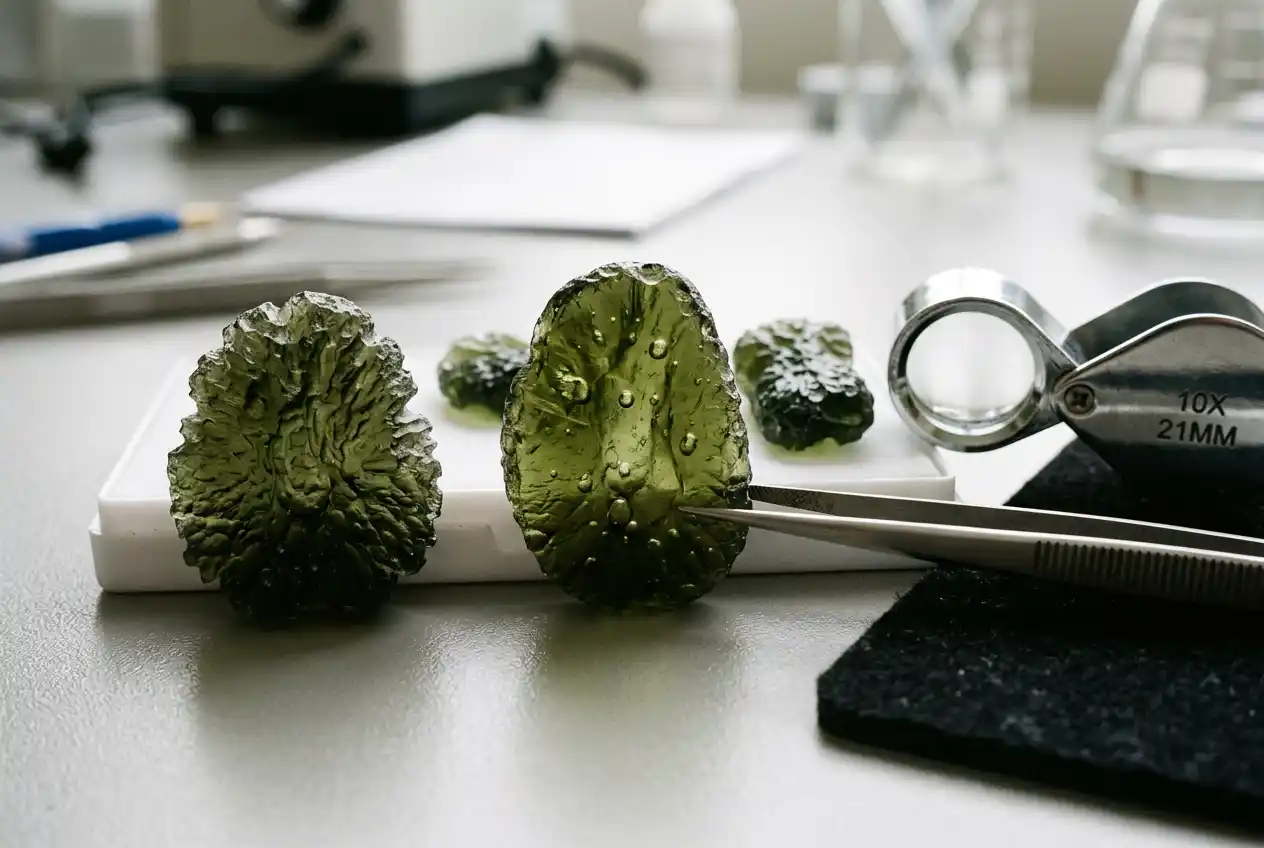
Moldavite Quality Grading: 8 Critical Tests for Cosmic Glass
Moldavite quality grading requires two separate judgments: first, whether the specimen is genuinely natural moldavite, and second, how desirable that genuine specimen is as a collector piece or gemstone. Authentication is especially important because manufactured green glass can imitate moldavite color, transparency, bubbles, and even a rough-looking surface. Once authenticity is reasonably established, collectors usually assess surface sculpture, shape, color, translucency, damage, size, locality, and provenance.
Moldavite is a natural green tektite associated with the Ries impact event that occurred approximately 15 million years ago. The impact melted terrestrial rocks and launched molten ejecta that cooled into natural glass. Most collectible moldavite comes from regions of the Czech Republic. The commercial expression cosmic glass reflects its impact origin, but moldavite should not be described literally as extraterrestrial glass or a meteorite.
There is no universal gemological moldavite grading scale comparable with standardized systems used for some major gemstones. Labels such as museum grade, investment grade, AAA, hedgehog, or top collector quality may describe appearance or seller opinion, but they are not universally defined laboratory grades. Reliable moldavite quality grading should therefore use observable characteristics and appropriate gemological examination rather than relying on marketing terminology.
8 Critical Tests for Evaluating Moldavite Quality and Authenticity
- Surface examination: Inspect pits, grooves, ridges, channels, weathering, and fracture edges to determine whether the surface appears naturally sculptured rather than molded or artificially textured.
- Magnification: Look for internal bubbles, flow structures, schlieren, and natural irregularities while checking for manufacturing evidence inconsistent with tektite glass.
- Color and light transmission: Evaluate whether the green, olive, yellow-green, or bottle-green appearance remains natural-looking through transmitted and reflected light.
- Density assessment: Genuine moldavite has physical density consistent with natural tektite glass, allowing specific-gravity measurement to support identification when performed correctly.
- Optical examination: Refractive behavior can help distinguish moldavite from some substitutes when appropriate gemological instruments are used.
- Damage and preservation grading: Separate natural weathered surfaces from recent chips, abrasions, polishing, repairs, or other alterations that affect collector value.
- Shape and locality assessment: Evaluate whether form, surface style, and credible provenance are consistent with known collecting areas without assuming appearance alone proves locality.
- Provenance and advanced verification: For valuable specimens, trustworthy records and professional instrumental analysis can provide stronger identification than visual inspection by itself.
How Genuine Moldavite Quality Is Commonly Evaluated
Once authenticity is established, quality depends on more than color. Natural moldavite varies from ordinary fragments to highly sculptured specimens with exceptional preservation. A collector’s finest specimen may be difficult to facet because deep surface texture is part of its value, while a jeweler may prefer comparatively smooth transparent rough that would not rank as highly in a natural-specimen collection.
A practical quality comparison can separate common pieces from increasingly selective examples.
| Quality Level | Surface and Shape | Color and Internal Appearance | Condition |
|---|---|---|---|
| Low commercial | Broken fragment, limited sculpture, ordinary form | Typical green with low visual distinction | Numerous chips, abrasion, or weak preservation |
| Commercial | Recognizable natural texture and irregular shape | Moderate translucency and typical color | Some damage but clearly collectible |
| Good | Attractive grooves, pits, or natural shaping | Appealing olive to bottle-green color with visible internal character | Limited fresh damage |
| Fine | Distinctive sculpture and balanced natural form | Strong translucency or visually attractive internal structure | Well preserved with minor damage |
| Exceptional collector quality | Deep or unusual sculpturing, rare form, desirable documented locality | Excellent visual character appropriate to the specimen type | Remarkably intact and well preserved |
This type of grading should remain flexible. A specimen with modest translucency can still be exceptional because of its surface, while a transparent faceting piece may be highly desirable even if its original exterior is relatively ordinary.
Surface Sculpture Is Important but Does Not Prove Authenticity
The surface of genuine moldavite can display remarkable natural sculpturing. Grooves, pits, narrow channels, sharp ridges, irregular depressions, and wrinkled areas may develop through processes affecting the glass after deposition. Different localities and geological conditions can produce noticeably different surface appearances.
Collectors often place a premium on deeply sculptured pieces because delicate ridges and intricate pits make the specimen visually distinctive. Exceptional surfaces can also be difficult to preserve, since fine projections may chip during extraction, cleaning, transport, or handling.
The authentication problem is that imitation manufacturers can mold or texture ordinary green glass. Artificial pieces may therefore possess pits, grooves, and even spike-like projections. A rough surface cannot be treated as a standalone authenticity test.
Under close examination, molded imitations may show repetitive textures, softened duplicated patterns, mold seams, unnatural symmetry, or surface details that look pressed rather than geologically weathered. Yet sophisticated imitations can avoid obvious clues, which is why surface examination should always be combined with internal and physical observations.
Fresh fracture surfaces deserve special attention during quality grading. Moldavite is glass, so a newly chipped area can display a smooth conchoidal fracture that contrasts strongly with an older etched exterior. Minor fresh chips may be acceptable on an otherwise fine specimen, but extensive recent damage can significantly reduce collector grade.
Magnification and Internal Structures in Natural Moldavite
Magnification is one of the most useful non-destructive ways to examine moldavite. Genuine specimens commonly contain internal bubbles, flow structures, and schlieren related to the rapid melting, movement, and cooling of impact-generated glass.
Bubbles may be rounded, elongated, stretched, or irregular. Their shape can reflect movement within the molten glass before solidification. Some moldavite contains long internal cavities or bubbles that are visually striking under transmitted light.
Schlieren are flow-related differences within glass that can appear as curved, streak-like, or layered structures. They can be valuable identification clues when their appearance agrees with other characteristics expected in natural tektites.
These observations still require caution. Manufactured glass can contain bubbles and flow lines, especially when intentionally produced to imitate natural material. A round bubble alone is not evidence of moldavite, and a bubble-free specimen is not automatically fake.
Magnification should instead look for a coherent combination of internal characteristics. Natural irregularity, appropriate flow structure, surface weathering, physical properties, and credible provenance together provide stronger evidence than any isolated inclusion.
Color and Translucency in Moldavite Grading
Moldavite occurs in several green tones, including yellow-green, olive, mossy green, bottle green, and deeper brownish-green shades. Color can vary within one specimen, particularly where thickness changes how much light passes through the glass.
A thick piece can look very dark in reflected light yet transmit a rich green when illuminated from behind. Thin edges may appear much brighter than the center. This behavior is normal for colored glass and should be considered before judging a specimen as excessively dark.
Collectors differ in their color preferences. Some favor bright yellow-green specimens, while others prefer classic olive or deep bottle-green pieces. Fine quality therefore cannot be reduced to one perfect shade.
Translucency can add visual interest because it allows bubbles, flow lines, and internal structures to become visible. Highly sculptured specimens can remain desirable even when they transmit relatively little light, however, so transparency should never override surface quality and condition.
Suspicious color should encourage further examination rather than an immediate conclusion. Manufactured glass can reproduce moldavite-like greens very effectively. Conversely, genuine specimens can appear darker, browner, or less vivid than stereotypical online photographs.
Density and Optical Properties as Supporting Tests
Because moldavite is natural glass with characteristic physical properties, gemological measurements can support identification. Specific gravity compares the density of the specimen with water and can help distinguish moldavite from some imitations whose composition produces significantly different density.
Genuine moldavite commonly falls within a relatively low density range for natural silicate glass, approximately around 2.3 to 2.4, although natural variation and measurement uncertainty must be considered. Specific-gravity testing should be performed carefully because trapped air around strongly sculptured surfaces can interfere with hydrostatic measurements.
Refractive-index examination can provide another supporting observation. Moldavite generally has a refractive index around the upper 1.4 range, commonly close to approximately 1.48 to 1.51 depending on composition and measurement technique. A reading substantially outside the expected range may indicate that further investigation is needed.
Neither density nor refractive index should be treated as a perfect single test. Different artificial glasses can overlap some moldavite properties, while irregular rough surfaces can make measurement difficult. These techniques are most useful when combined with magnification, visual examination, and provenance.
Destructive scratch, flame, acid, or breakage tests are unnecessary and can permanently damage a genuine specimen. Valuable moldavite should be examined with non-destructive gemological methods.
Natural Shape, Preservation, and Damage Grading
Moldavite occurs in varied natural forms, including irregular splash shapes, flattened pieces, drops, elongated forms, fragments, and other asymmetrical bodies. Some shapes reflect the original flight and cooling history, while subsequent breakage, transport, burial, and weathering can alter them.
A complete natural silhouette generally receives a stronger collector grade than an obvious broken fragment when other characteristics are comparable. This is especially true when delicate sculpturing remains intact around the specimen’s edges.
Preservation should be evaluated independently from authenticity. A heavily chipped piece can still be completely genuine. Its lower grade results from condition rather than identity.
Fresh chips are usually smoother than the etched exterior and may reveal lighter or more transparent green glass. Old naturally weathered breaks can acquire some surface alteration with time, making damage assessment more complex.
Polishing also changes collector value. A polished moldavite may display attractive color and internal features but no longer preserves the original surface across the polished area. Such pieces can remain desirable for jewelry or educational use while ranking differently from untouched specimens.
Locality and the Limits of Appearance-Based Identification
Collectors often associate particular Czech localities with characteristic surface patterns, colors, shapes, or preservation styles. Some areas are famous for deeply sculptured pieces, while others commonly produce smoother or differently shaped specimens.
These tendencies can be useful, but locality should not be assigned with certainty from appearance alone. Natural variation within one field can be substantial, and specimens from different areas may overlap visually.
Credible provenance therefore becomes important when locality carries a price premium. A piece collected by a known individual with location records provides much stronger evidence than a specimen whose locality was added later based on visual resemblance.
High-value purchases should be especially cautious when an exact village, field, or celebrated collecting area is used to justify a large premium. The more specific and financially important the claim, the more useful reliable documentation becomes.
Advanced Instrumental Verification for Valuable Moldavite
Professional laboratories can use analytical techniques when visual and standard gemological tests do not provide enough confidence. Methods that examine chemical composition, spectroscopic response, or microscopic structure can help determine whether a suspicious green glass is consistent with natural moldavite.
These techniques are particularly useful for expensive collector specimens, unusual faceted stones, or pieces whose authenticity has major financial importance. They can also help when an imitation has been manufactured carefully enough to reproduce typical color, bubbles, and surface texture.
The goal is not necessarily to apply advanced laboratory testing to every inexpensive fragment. Instead, the level of verification should match the financial and collector importance of the specimen. A modest piece purchased from a trusted specialist may not justify extensive analysis, while a major collector acquisition can.
Documentation should also identify exactly what has been tested. A generic card or seller-created certificate is not equivalent to an independent analytical report. Quality grading becomes more reliable when the evidence is proportional to the claims being made.
Moldavite Versus Common Green-Glass Imitations
Ordinary green glass is the most important imitation category because it can duplicate the basic color and vitreous appearance of moldavite. Molded products can also simulate pits and ridges, while bubbles may be introduced intentionally or arise naturally during manufacture.
Imitations sometimes appear too uniform. Identical pieces, repeated surface patterns, perfectly controlled colors, or obvious mold seams can reveal manufacturing. However, not every fake displays such simple warning signs.
Genuine moldavite also should not be rejected merely because it appears smooth. Natural specimens vary widely, and some pieces show relatively modest surface sculpture because of locality, abrasion, weathering, or breakage.
Likewise, highly textured examples are not automatically genuine. Authentication should integrate surface morphology, internal features, physical measurements, provenance, and professional examination when appropriate.
Cosmic Glass Is a Commercial Description, Not a Literal Composition
Calling moldavite cosmic glass can be evocative, but the phrase needs geological clarification. Moldavite formed because an extraterrestrial body struck Earth, yet the glass itself is associated predominantly with terrestrial source rocks melted and ejected by the impact.
Moldavite therefore belongs to the tektite family rather than to meteorites. Its scientific interest comes from preserving evidence of an extraordinary impact event and the extreme temperatures and pressures involved.
This distinction also separates mineralogical facts from metaphysical traditions. Moldavite is sometimes associated with transformation, spiritual awakening, energy sensations, or healing claims. Such beliefs are part of modern spiritual practice rather than established physical or medical properties of tektite glass, and they do not form a scientific quality grade.
How to Grade a Moldavite Specimen Before Buying
Begin with authenticity. Study the entire surface under neutral lighting and magnification, looking for natural irregularity rather than concentrating on one dramatic pit or ridge. Examine transmitted light for bubbles, schlieren, flow structures, and color variation.
Next assess preservation. Identify fresh chips, abrasions, polished zones, repaired areas, or missing projections. Determine whether those changes interfere significantly with the specimen’s natural form.
Then evaluate aesthetics. Consider the depth and complexity of surface sculpture, overall silhouette, color, translucency, and internal visual interest. An attractive specimen should feel coherent as a whole rather than depending on one small impressive feature.
Size should be assessed only after quality. A larger specimen deserves a stronger grade when fine characteristics remain intact across the increased weight. Large size cannot compensate for poor preservation or questionable authenticity.
Finally, consider provenance and any locality claim. A documented specimen from a desirable collecting area can justify stronger confidence and value than an undocumented piece whose origin depends entirely on seller assertion.
Conclusion
Moldavite quality grading combines authentication with evaluation of surface sculpture, internal structure, color, translucency, preservation, shape, locality, and provenance. No single bubble, green shade, surface pit, or commercial label is enough to establish genuine high-grade moldavite.
The strongest specimens bring several characteristics together: credible authenticity, naturally sculptured surfaces, attractive form, appropriate internal features, limited damage, and trustworthy provenance. Moldavite’s genuine connection to an ancient impact event provides remarkable geological significance without requiring inaccurate claims that it is literally extraterrestrial glass.
FAQs About Moldavite Quality Grading
What does high-quality moldavite look like?
High-quality collector moldavite usually combines attractive natural green color, distinctive surface sculpture, an appealing complete shape, good preservation, and limited recent chipping. Translucency and internal bubbles or flow structures can add interest, while documented locality and provenance may further strengthen the grade. A faceted stone uses somewhat different priorities because cut quality and transparency become more important than original surface preservation.
How can I tell whether moldavite is real?
No single visual feature proves authenticity. Genuine moldavite should display a combination of appropriate surface morphology, internal bubbles or flow structures, plausible color, expected physical properties, and overall characteristics consistent with natural tektite glass. Provenance and professional gemological testing become increasingly important as price rises.
Are bubbles inside moldavite a good sign?
Bubbles are common in genuine moldavite and can support identification when they occur with other appropriate characteristics. Some may be elongated or associated with visible flow structures. Manufactured glass can also contain bubbles, however, so bubbles cannot establish authenticity on their own.
Is highly textured moldavite always better quality?
Deep natural sculpturing can significantly increase collector appeal, particularly when delicate ridges and pits remain well preserved. Yet texture is only one factor. A heavily damaged or questionable specimen does not become top grade simply because its surface looks dramatic, and some genuine moldavite from particular localities naturally has smoother surfaces.
Can moldavite be tested with a refractometer?
Appropriate gemological refractive-index testing can support moldavite identification, particularly on surfaces that allow a usable reading. Rough sculptured pieces can be difficult to measure accurately, so the result should be interpreted alongside density, magnification, surface features, and provenance rather than treated as a standalone test.
Should I perform a scratch test on moldavite?
A destructive scratch test is unnecessary and can permanently damage a genuine specimen. Moldavite identification can be approached through non-destructive examination of surface features, magnification, specific gravity, refractive behavior, and professional analytical methods when needed. Preserving the natural surface is especially important for collector-grade pieces.
Is dark moldavite lower quality than bright green moldavite?
Not automatically. Thick genuine moldavite can appear quite dark in reflected light while transmitting attractive green under backlighting. Collectors have different color preferences, and quality depends on surface sculpture, preservation, shape, transparency, authenticity, and provenance as well as color.
Is moldavite actually from outer space?
Moldavite is not generally considered a piece of extraterrestrial glass or a meteorite. It is terrestrial impact glass formed when an asteroid impact melted near-surface Earth rocks and ejected molten droplets that later cooled into tektites. Its origin is impact-related, but the glass itself formed predominantly from terrestrial source rocks.