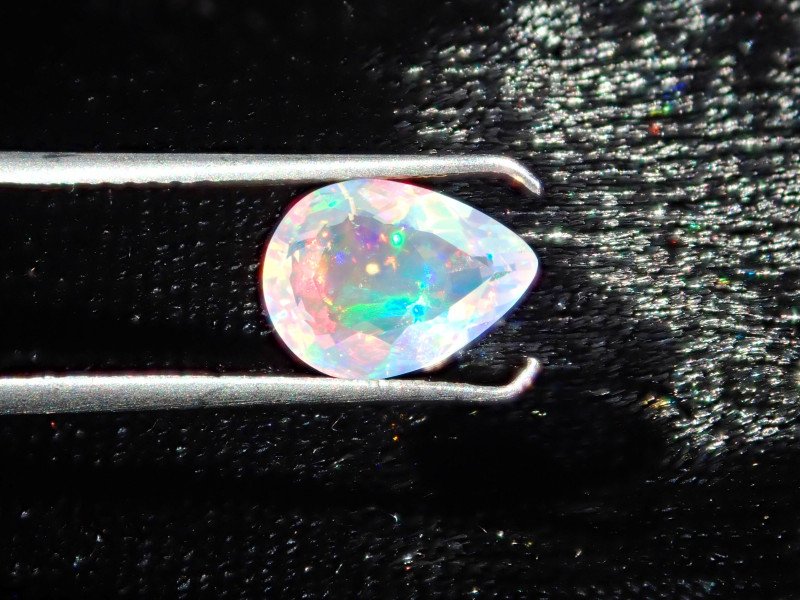
Opal Price Per Carat: 12 Key Factors Determining Play-of-Color Value
Opal price per carat ranges from only a few dollars for ordinary common opal or weak commercial precious opal to hundreds or even thousands of dollars per carat for fine stones with intense play-of-color. Exceptional black opal, top crystal opal, unusually vivid boulder opal, and important collector stones can exceed ordinary retail ranges by a wide margin. Unlike gemstones whose price can be estimated largely from color, clarity, cut, and weight, opal requires a more complicated assessment because body tone, brightness, color range, pattern, transparency, directional behavior, structure, and stability all influence value.
The first distinction a buyer should understand is between common opal and precious opal. Common opal lacks visible play-of-color, while precious opal displays shifting spectral colors produced by the interaction of light with an ordered arrangement of microscopic silica spheres. The phenomenon is structural, not an artificial glow inside the stone. A polished opal may show red, orange, yellow, green, blue, and violet flashes that change as the viewing angle changes, and the strength and distribution of this play-of-color are among the strongest drivers of price.
Opal is also sold in several commercial categories, including black opal, dark opal, light or white opal, crystal opal, boulder opal, and assembled products such as doublets and triplets. These categories should not be treated as interchangeable. A natural solid black opal with vivid red play-of-color can command a very different price per carat from a white opal of identical weight, while a doublet may look dramatic yet belong to a different value category because it is assembled from multiple layers.
12 Key Factors Determining Opal Price Per Carat
- Play-of-color brightness: Strong, vivid flashes that remain visible under normal lighting generally command more than weak or washed-out color.
- Color range: Opals showing several spectral colors, especially strong red and orange alongside green and blue, often receive higher premiums than stones dominated by one weaker color.
- Body tone: Dark and black body tones can make play-of-color appear more intense and are especially prized when combined with strong brightness.
- Pattern quality: Broad flash, harlequin-like arrangements, rolling flash, ribbon, pinfire, and other distinctive patterns can influence value substantially.
- Color coverage: Stones displaying play-of-color across much of the face generally command more than gems with large inactive areas.
- Directionality: Opal that remains colorful through a wide range of viewing angles is usually more desirable than stone that flashes only from one narrow direction.
- Transparency: Crystal and semi-crystal opal can be highly valuable when transparency combines with intense internal play-of-color.
- Opal type: Black, dark, white, crystal, and boulder opal follow different commercial value patterns and should be compared within their own categories.
- Structural integrity: Cracks, crazing, unstable areas, sand inclusions, potch, or weak seams can reduce both beauty and durability.
- Cut and orientation: Skilled cutting can maximize brightness, coverage, pattern, and face-up size while avoiding unnecessary thickness or weak areas.
- Natural, treated, or assembled status: Solid natural opal, treated opal, doublets, triplets, and synthetic opal belong to different pricing categories.
- Size, provenance, and market rarity: Larger fine stones, documented important localities, unusual patterns, and exceptional collector examples can command strong premiums.
How Much Does Opal Cost Per Carat?
Opal prices are unusually broad because the visual quality of two stones can differ dramatically even when their size and weight are similar. Commercial white opal with modest color may sell at relatively accessible prices, while fine black opal with broad red flashes can reach several thousand dollars per carat.
The following ranges are approximate retail-oriented guides for loose stones. They are intended to illustrate the scale of the market rather than establish fixed quotations.
| Opal Quality | Typical Appearance | Approximate Retail Price Per Carat |
|---|---|---|
| Common or very low commercial | Little or no play-of-color, weak appearance, ordinary cutting | About $1 to $10 |
| Commercial precious opal | Noticeable but limited play-of-color, lower brightness or coverage | About $10 to $75 |
| Good jewelry quality | Stronger brightness, better color coverage, attractive pattern | About $75 to $300 |
| Fine precious opal | Vivid multi-color display, strong pattern, good orientation and finish | About $300 to $1,000 |
| Exceptional black, crystal, or collector opal | Intense brightness, desirable red or multicolor pattern, strong coverage, rare size or structure | $1,000+ and potentially far higher |
The widest variation occurs at the fine end. One exceptional black opal can sell for many times the per-carat price of another natural black opal if its brightness, red content, pattern, and color coverage are markedly stronger. This is why opal cannot be priced reliably by body tone or geographic origin alone.
Why Play-of-Color Brightness Is the Strongest Value Driver
Brightness determines how forcefully the spectral colors stand out from the body of the stone. A valuable opal does not merely contain color. The color should appear vivid, distinct, and easy to see as the stone moves under ordinary lighting.
Weak opal may display pale green or blue flashes only under a strong point-source light. Fine opal can show intense color in softer daylight and remain visually active through normal movement. The difference can be dramatic even when both stones technically qualify as precious opal.
Brightness should also be distinguished from body tone. A black opal can have a very dark background but weak play-of-color, while a lighter crystal opal can display spectacularly bright spectral flashes. Dark body tone often enhances contrast, but it does not replace actual color intensity.
The best comparison is side by side under the same light. Photography can exaggerate saturation, especially when exposure and contrast are adjusted, so real movement and consistent lighting provide a better basis for judging value.
Red, Orange, Green, and Blue Play-of-Color
Not all visible colors contribute equally to commercial value. Red play-of-color is often especially prized because the conditions required to produce longer-wavelength red diffraction tend to be less common than those producing blue or green. A stone showing bright red together with orange, green, and blue can therefore command a stronger premium than an otherwise similar blue-green opal.
This does not mean blue or green opal is automatically low quality. Brilliant electric-blue or vivid green patterns can be exceptionally attractive, particularly when brightness, pattern, and coverage are excellent. The complete appearance matters more than checking whether one particular hue is present.
Color balance can also influence preference. Some collectors seek strong red dominance, while others value multicolored stones in which spectral colors move across the face in coordinated patches. An opal with broad, vivid green and violet flash may be more visually compelling than a weak stone containing a few small red points.
The key is that color must be judged by saturation, brightness, coverage, and pattern together rather than by color name alone.
Body Tone and Why Black Opal Can Command Exceptional Prices
Body tone refers to the apparent background darkness of the opal, independent of its play-of-color. Black and dark opal provide a strong visual background that can make spectral colors look brighter and more saturated.
This contrast is one reason fine black opal occupies the upper end of the market. When a genuinely dark body carries vivid red, orange, green, and blue play-of-color across much of the face, the effect can be extraordinary.
Dark body tone by itself does not create high value. A nearly black stone with weak color may be much less valuable than a lighter opal with outstanding brightness and pattern. Body tone is best understood as a supporting factor that can magnify the visual impact of already strong play-of-color.
White and light opals can also be fine gemstones, particularly when brightness is strong enough to stand out against the pale background. Their average prices are often lower, but exceptional stones still command significant amounts.
Opal Patterns Can Change Price Dramatically
Pattern describes the arrangement and behavior of play-of-color across the gemstone. Some opals display very small points of color, while others produce broad patches, moving sheets, ribbons, flashes, or geometric-looking structures.
Broad, well-organized patterns generally receive stronger collector interest because individual colors are easier to appreciate. Rare geometric arrangements often described with terms such as harlequin can command major premiums when the pattern is genuinely distinct and accompanied by strong brightness.
Rolling flash describes color that appears to move smoothly across the stone, while broad flash may cover substantial portions of the face at once. Pinfire consists of much smaller points of color. None of these terms guarantees quality on its own because a weak broad flash may be less attractive than intense pinfire.
Pattern grading therefore needs to consider definition, brightness, coverage, color range, and movement together. A named pattern is meaningful only when the visual effect actually supports the description.
Color Coverage and Dead Areas
Fine opal should ideally show play-of-color across a substantial portion of the face. Large inactive zones can reduce value because they interrupt the visual display, particularly if they occupy the center of a cabochon.
Coverage should be judged during movement. Some stones look fully colorful at one angle but reveal large inactive areas as they are tilted. Others continue to display changing color throughout most of the face.
Small inactive areas near the edge may have limited effect on value, especially if the central display is strong. A dead zone under the center, however, can substantially reduce desirability because it remains visible in normal viewing.
Cutters sometimes orient the stone so the strongest color sits on the crown and weaker portions are removed or placed near the edge. This can increase finished value even though significant rough weight is lost.
Directionality and Viewing Angle
Some opal displays brilliant play-of-color only when viewed from one precise direction. Other stones remain colorful through a much wider range of angles. The second type is generally more desirable for jewelry because the optical effect is easier to appreciate during normal movement.
Directionality is determined by the internal arrangement of silica spheres and by how the stone has been oriented during cutting. A skilled cutter examines the rough carefully to identify the plane that produces the strongest display.
A stone with extraordinary color from one angle can still be valuable, particularly for a pendant or collector piece where orientation can be controlled. However, a cabochon that maintains vivid color as it moves tends to be more practical and visually satisfying in everyday jewelry.
Videos can be useful for evaluating directionality because static photographs capture only one instant. The strongest online image may represent a viewing angle that occurs only briefly.
Crystal Opal, Transparency, and Internal Color
Crystal opal is valued for its transparent to translucent body combined with visible play-of-color. The term crystal refers to transparency rather than a separate crystal structure, since opal itself is not crystalline in the ordinary mineralogical sense.
Fine crystal opal can display spectral colors that seem suspended within the body, creating unusual visual depth. Transparent stones with vivid red or multicolor play-of-color can be extremely valuable.
Excessive milkiness or internal cloudiness may reduce the depth of the effect, although some semi-crystal stones remain highly attractive. As with other opal types, brightness usually matters more than transparency alone.
A transparent stone with weak play-of-color is not automatically high grade. The premium develops when transparency supports an already strong optical display.
Boulder Opal and Why Matrix Can Add Rather Than Reduce Value
Boulder opal forms in thin seams or patches within ironstone or another host rock, and the natural backing is often retained during cutting because removing it would destroy the opal layer. This means visible host rock is not automatically a defect in boulder opal.
Fine boulder opal can display exceptionally bright color because the dark ironstone provides natural contrast. Irregular shapes are also common because cutters follow the original opal seams rather than forcing every piece into a calibrated oval.
The ratio of precious opal to host rock influences commercial perception, but pattern and brightness remain central. A thin seam producing spectacular red and green color can be much more valuable than a thicker but visually weak layer.
Boulder opal should therefore be compared with other boulder opal rather than with solid crystal or black opal solely by carat weight. The retained host rock contributes weight but is part of the natural structure of the finished gem.
Solid Opal, Doublets, Triplets, and Synthetic Opal
A solid opal is cut from one natural piece of opal-bearing stone. A doublet typically combines a thin layer of natural precious opal with a darker backing, while a triplet adds a transparent protective cap over a thin opal layer and backing.
Doublets and triplets can show vivid color because the dark base enhances contrast. They are legitimate jewelry products when disclosed, but they should not be priced as equivalent to a solid natural black opal of similar appearance.
Synthetic opal is produced in laboratories or manufacturing environments to imitate the structure and play-of-color of natural precious opal. It can be attractive and may display highly regular patterns, but it belongs to a separate value category.
Treatments also occur in natural opal. Darkening, smoke treatment, sugar-acid treatment, impregnation, surface filling, and other methods may modify appearance depending on the type of opal. Treatment disclosure is therefore essential when a high price depends on natural body tone or untreated condition.
Structural Stability, Crazing, and Durability
Opal contains water within its structure and has different durability considerations from many crystalline gemstones. Some opal can develop networks of cracks known as crazing if internal stresses and water balance become unstable.
A crazed stone should be evaluated cautiously because the cracking can progress and substantially reduce value. Existing cracks, open fissures, sand inclusions, and weak host-rock boundaries can create additional durability concerns.
Not all opal is equally unstable. High-quality opal that has been properly dried, cut, and handled can remain attractive for generations. The risk depends on origin, structure, preparation, and individual specimen behavior rather than on a rule that all opal is fragile.
Opal has a Mohs hardness around 5.5 to 6.5, so it is softer than quartz, sapphire, and diamond. Rings can be worn successfully, but protective settings and careful treatment are sensible because surface scratching and impact damage are possible.
How Cut and Orientation Affect Opal Price Per Carat
Opal is most often cut as a cabochon because curved surfaces show play-of-color effectively. The cutter’s primary goal is not maximizing brilliance through facets but exposing the strongest color layer at the most useful viewing angle.
This can require sacrificing substantial weight. Rough may contain potch, sandstone, cracks, or weak color layers that must be removed before the final stone reveals its best face.
A high dome may increase visual depth in some opals, but excessive thickness can simply retain low-value weight beneath the color bar. Fine cutting balances body depth, face-up size, optical effect, and structural safety.
Shape is secondary to optical performance. Ovals and rounds are commercially convenient, yet freeform shapes may preserve a far better pattern and more valuable color. With exceptional opal, sacrificing an important color area just to create a standard shape would often reduce value.
Origin and Whether It Should Affect Price
Australia is historically associated with several major opal types, including black opal, white opal, crystal opal, and boulder opal. Ethiopia has also become an important source of precious opal, including many highly transparent and vividly colored stones.
Different deposits can produce opal with different structural characteristics, treatments, hydrophane behavior, host rocks, and market reputations. Origin may therefore matter, but it should not replace direct grading.
A weak stone from a celebrated locality is still weak, while a beautiful opal from another source can be highly desirable. Premiums based on origin are strongest when locality is documented and when the source is relevant to the specific type or collector market.
Hydrophane opal deserves particular attention because it can absorb water and temporarily change appearance. This property is common in some Ethiopian opal and should not automatically be treated as a defect, although owners need to understand how the stone reacts to liquids and environmental exposure.
How to Compare Opal Prices Before Buying
Start with play-of-color under consistent lighting. Move each stone through several angles and compare brightness, color range, coverage, and pattern. A still photograph is not enough to assess a gemstone whose appearance changes continuously.
Next identify the opal category. Determine whether the stone is solid black, dark, white, crystal, boulder, doublet, triplet, synthetic, or treated. Price comparisons become misleading when these categories are mixed.
Inspect the body carefully for cracks, crazing, potch, sand, weak seams, and surface damage. For boulder opal, distinguish natural host rock from structural problems. For transparent opal, look through the stone to understand internal features and color depth.
Only after these steps should price per carat be calculated. If two opals have similar body tone, brightness, pattern, coverage, condition, treatment status, and type, the per-carat figure becomes genuinely useful.
Conclusion
Opal price per carat is governed by a complex interaction of play-of-color brightness, spectral range, body tone, pattern, coverage, directionality, transparency, opal type, structural integrity, cutting, treatment status, and size. Commercial stones can be inexpensive, while exceptional black, crystal, and boulder opals can reach extraordinary prices.
The most valuable opal is not automatically the darkest, largest, or reddest. The strongest stones combine vivid color, attractive pattern, broad coverage, useful viewing angles, sound structure, skilled cutting, and clear disclosure of whether the gem is solid, treated, assembled, or synthetic.
FAQs About Opal Price Per Carat
How much is good opal worth per carat?
Good jewelry-quality precious opal may sell for roughly $75 to $300 per carat, while fine stones with vivid play-of-color, attractive patterns, and strong coverage can reach approximately $300 to $1,000 per carat. Exceptional black opal, crystal opal, boulder opal, and collector stones can exceed $1,000 per carat by a substantial margin. Exact prices vary dramatically because opal quality is highly individual.
Why is black opal so expensive?
Fine black opal combines a dark body tone with bright spectral colors, creating exceptional contrast. The highest premiums occur when the stone also displays red or multicolored play-of-color, strong brightness, broad coverage, an attractive pattern, and good structural condition. A dark body alone does not make an opal valuable if its color display is weak.
Is red play-of-color always the most valuable?
Red is often especially prized and can contribute strongly to value, particularly when it is bright and widespread. However, a weak red flash does not automatically outrank a brilliant green, blue, or multicolored stone. Brightness, pattern, coverage, and overall visual impact matter more than simply checking whether red is present.
Is crystal opal more valuable than white opal?
Crystal opal can command higher prices when its transparency allows vivid play-of-color to appear suspended within the stone. White opal can still be very valuable when brightness and pattern are exceptional. Neither category is automatically superior because individual optical quality remains decisive.
Are opal doublets worth less than solid opal?
Generally, yes. A doublet contains a relatively thin layer of precious opal attached to a dark backing, so less natural precious opal is present than in a comparable solid stone. Doublets can still be beautiful and suitable for jewelry, but they should be disclosed and priced within their own category rather than as solid black opal.
Does opal size increase the price per carat?
It can, especially when an unusually large stone retains vivid brightness, broad color coverage, attractive pattern, and strong structural condition. Large commercial opal with weak color may remain inexpensive, so size produces the strongest premium only when quality remains high.
Is Ethiopian opal less valuable than Australian opal?
Not automatically. Both regions can produce beautiful precious opal, and individual quality matters more than nationality alone. Market reputation, hydrophane behavior, body tone, treatment history, pattern, brightness, and structural stability all influence value. An exceptional Ethiopian opal can be far more desirable than an ordinary Australian stone.
Is opal a good investment?
Fine opal can have significant collector value, but future appreciation is not guaranteed. Resale depends on quality, provenance, buyer demand, market liquidity, and whether the stone is solid, treated, or assembled. Opal is best purchased because the specific gemstone is attractive and appropriately priced rather than because appreciation is assumed.