Opal Quality Grading: 10 Essential Rules to Rate Fire & Body Tone
Opal quality grading should begin with the strength and behavior of play-of-color, followed by body tone, color range, pattern, coverage, transparency, directionality, structural condition, cutting, and natural or treated status. There is no single worldwide grading system that converts every opal into one universally accepted letter or number, so labels such as AAA, premium, gem grade, or investment grade should not be accepted without examining what the stone actually displays.
The term fire is often used casually for opal’s flashes of color, but play-of-color is the more precise gemological description. Precious opal produces this phenomenon when light interacts with ordered microscopic silica spheres, creating changing spectral colors as the viewing angle shifts. Common opal lacks this play-of-color even though it may have attractive body color of its own.
Body tone is also separate from play-of-color. A black or dark background can intensify contrast, but a dark stone is not automatically high quality. The strongest opals combine an appropriate body tone with vivid brightness, broad color coverage, desirable patterns, good viewing angles, and sound structure. A lighter crystal opal with brilliant multicolor display can therefore grade much higher than a dark opal whose color is weak.
10 Essential Rules for Rating Opal Fire & Body Tone
- Grade play-of-color brightness first: Strong spectral flashes visible in normal lighting generally matter more than body tone alone.
- Separate body tone from color display: Dark, black, white, crystal, and other backgrounds should be evaluated independently from the brightness of the play-of-color.
- Evaluate color range: Multi-color stones and vivid red or orange can command strong premiums, but brightness and distribution remain essential.
- Assess pattern quality: Broad flash, rolling flash, ribbon, pinfire, block-like, geometric, and other patterns should be judged for definition and visual balance.
- Measure color coverage: Fine opal displays active color across much of the face instead of concentrating all interest in one small area.
- Check directionality: Higher-quality stones generally retain attractive play-of-color through useful viewing angles rather than flashing only from one precise position.
- Consider transparency appropriately: Crystal and semi-crystal opal can be exceptional when transparency supports vivid internal color rather than weakening it.
- Inspect structural stability: Cracks, crazing, weak seams, sand inclusions, potch, and surface damage can lower quality regardless of color.
- Evaluate cutting and orientation: Skilled shaping should place the strongest color where it is visible face-up and avoid retaining unnecessary low-value weight.
- Confirm opal type and disclosure: Solid natural opal, boulder opal, doublets, triplets, treated stones, and synthetic opal must be distinguished before assigning quality.
A Practical Opal Quality Framework
Opal grading is more visual than formulaic. Two stones can have the same body tone and weight yet belong to completely different quality levels because their brightness, pattern, and coverage differ.
A practical comparison can still separate commercial stones from increasingly fine examples.
| Quality Level | Play-of-Color | Body and Structure | Overall Appearance |
|---|---|---|---|
| Low commercial | Weak, narrow, or limited color | Ordinary body tone, visible potch or flaws | Modest visual impact |
| Commercial | Clear play-of-color with moderate brightness | Usable structure, some inactive areas | Attractive everyday jewelry |
| Good | Stronger color, improved coverage and movement | Sound body with limited distraction | Lively and visually balanced |
| Fine | Bright multicolor display, desirable pattern, broad coverage | Good stability and effective cutting | High-quality precious opal |
| Exceptional | Intense spectral display, rare pattern, excellent coverage and viewing range | Strong structure, superior orientation and finish | Collector-level visual performance |
This framework applies to the whole gemstone rather than forcing black, white, crystal, and boulder opal into an identical appearance. Fine quality looks different within each category.
Brightness Is More Important Than Body Tone Alone
Brightness describes the visual intensity of the play-of-color. When a fine opal moves under light, the colors should appear vivid and distinct rather than pale, watery, or difficult to locate.
A very dark body can improve contrast, but it cannot manufacture brightness that is not present. A black opal with subdued green pinfire may rank below a lighter crystal opal with strong red, orange, and blue broad flash.
Brightness should be judged under more than one lighting environment. Direct sunlight or intense spotlights can make almost any precious opal look more dramatic. A strong gemstone should retain attractive color in softer daylight and ordinary indoor light.
Side-by-side comparison is especially useful because the eye adapts quickly. A stone that appears impressive alone may look noticeably weak when placed beside a genuinely bright opal.
Commercial brightness scales exist within parts of the opal trade, but their exact application can vary. Direct visual comparison remains more reliable than assuming that a seller’s numerical brightness grade is automatically equivalent to another seller’s system.
Understanding Opal Body Tone
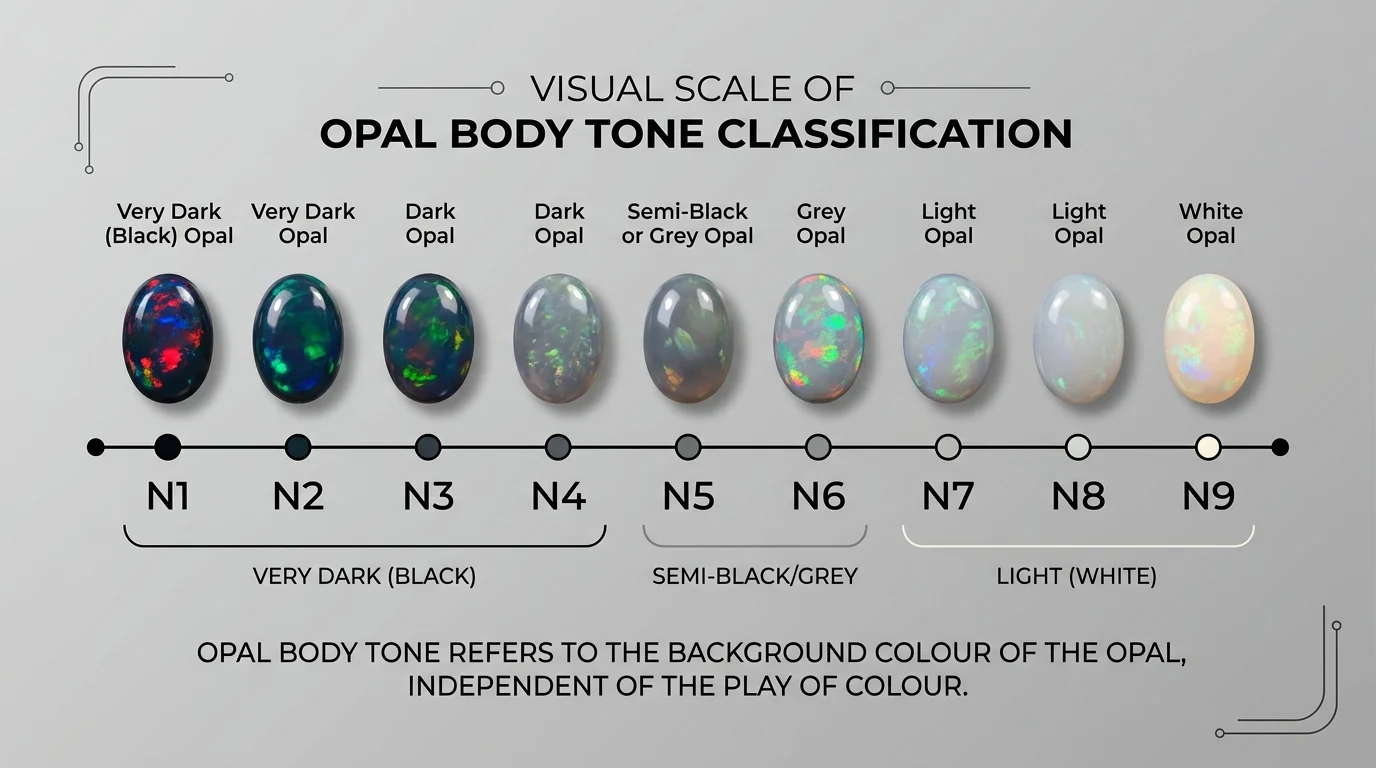
Body tone describes the underlying darkness or lightness of the opal rather than the colors flashing across it. Dark body tones can range from near-black through dark gray, while light opals may have white, cream, or pale backgrounds.
Australian opal trading commonly uses body-tone scales that run from very dark or black through progressively lighter tones. These systems can be useful when consistently applied, but they should not be treated as a universal global grade covering every opal source and type.
Body tone is particularly important when distinguishing black, dark, and light opal. The darker background can create greater contrast with play-of-color, which is one reason fine black opal is highly prized.
Crystal opal requires a different approach because transparency allows light to pass through the body. A highly transparent opal may not fit neatly into the same visual expectations used for opaque black or white stones.
The essential rule is to avoid confusing darkness with quality. Body tone describes the stage on which the spectral colors appear, while brightness, pattern, and coverage determine how impressive the performance actually is.
Color Range and the Importance of Red
Precious opal can show a wide range of spectral colors, including red, orange, yellow, green, blue, and violet. The combination and strength of these colors contribute to grade.
Bright red is especially prized because red-producing structures are generally less commonly encountered than those producing shorter-wavelength blue or green effects. Strong red play-of-color therefore can add a substantial premium when it is vivid and covers a useful portion of the stone.
Orange and yellow can also strengthen the display, particularly when combined with green and blue. A full-spectrum effect may create stronger collector appeal than a stone dominated by one color.
Color must still be evaluated through brightness. A barely visible red point should not outweigh a spectacular electric-green or blue pattern simply because red is theoretically rarer.
The finest grading asks how saturated the colors look, how many are present, where they appear, and whether they remain active as the stone moves.
Pattern Quality Separates Ordinary From Exceptional Opal
Pattern refers to the arrangement of play-of-color rather than the colors themselves. Some stones show tiny pinpoints, while others display broad patches, ribbons, rolling flashes, flagstone-like areas, or highly geometric arrangements.
Large, well-defined areas of color often receive strong premiums because they create a more dramatic display. Rare geometric patterns can be particularly valuable when the individual color blocks are bright and well separated.
Pinfire is common in many opals but can still be beautiful when the points are bright, dense, and evenly distributed. A named pattern should never be downgraded or upgraded automatically without considering how well it is expressed.
Pattern definition matters because vague or muddy color boundaries tend to produce less visual impact. A stone with clean, organized patches often looks more refined than one with scattered indistinct flashes.
The pattern should also work with the shape of the stone. A cutter who centers a strong color field or preserves a sweeping ribbon can improve the overall grade without changing the internal structure itself.
Color Coverage and Inactive Areas
Coverage asks how much of the visible face actually displays play-of-color. High-quality stones commonly show active color across a large percentage of the cabochon, while lower-grade gems may have only one or two colorful zones surrounded by inactive opal or potch.
Coverage should be evaluated through movement because some areas activate only from particular angles. A stone that appears nearly fully colorful in one photograph may show significant dead zones when tilted.
Inactive areas near the edge may be acceptable when the center is highly active. Large dull areas directly under the center of the stone are usually more damaging because they dominate normal face-up viewing.
A stone with excellent brightness but only 20 percent color coverage may therefore grade below a slightly less bright gem with spectacular coverage across almost the entire face.
The best opals combine brightness and coverage rather than forcing a compromise between the two.
Directionality and How the Opal Performs in Motion
Directionality describes how dependent the play-of-color is on a particular viewing angle. Highly directional opal may look spectacular from one position and almost inactive from another.
Less directional stones generally perform better in jewelry because the wearer and observer do not need to find one perfect angle. Color continues to shift and remain visible as the piece moves naturally.
Directionality is partly controlled by the orientation of the internal silica structure and partly by cutting. An experienced cutter tries to expose the strongest color bar so the best effect is available through useful face-up angles.
Some collector stones may still be exceptional despite strong directionality if the peak display is unusually dramatic. Quality grading should therefore describe the behavior rather than applying a rigid rule.
A short video under fixed lighting is particularly helpful when comparing directional behavior. It reveals whether the color remains active or disappears immediately when the stone leaves its strongest angle.
Transparency and Crystal Opal Quality
Crystal opal is transparent to translucent precious opal in which play-of-color can appear to float at different depths. The word crystal refers to transparency and should not be interpreted as meaning opal has a normal crystalline structure.
Fine crystal opal often combines excellent transparency with vivid internal color. Red, green, and blue flashes can appear suspended within the body, producing depth that opaque opal cannot reproduce in the same way.
Transparency alone is not enough. A colorless transparent opal with weak spectral effects may be less valuable than a semi-transparent stone with exceptional brightness and pattern.
Cloudiness can reduce the internal depth, although some semi-crystal opal remains highly desirable. The goal is a body that supports the play-of-color rather than obscuring it.
Crystal opal should also be checked against the background on which it will be worn. Because light passes through the gem, dark settings or backings can change its apparent contrast substantially.
Structural Stability, Crazing, and Surface Condition
Structural quality is essential because even spectacular play-of-color cannot fully compensate for severe instability. Crazing consists of networks of cracks that develop within opal and can progress over time in unstable stones.
Existing cracks should be distinguished from natural color boundaries, potch seams, and host-rock contacts. Surface-reaching fractures deserve particular attention because they may expand during setting or wear.
Opal also can contain sand, matrix, or potch. These features are not always defects. In boulder opal, ironstone is intentionally retained and is part of the natural gem structure. In a transparent crystal opal, however, a large dark inclusion may be far more distracting.
Surface scratches and chips also reduce finish quality. With hardness around 5.5 to 6.5 on the Mohs scale, opal requires more careful wear than sapphire or diamond.
Proper drying and preparation of rough are important before cutting. A stone that remains stable through appropriate handling provides far greater long-term value than an opal that develops significant cracking after purchase.
Cut Orientation, Dome, and Weight Retention
Opal cutting is primarily about optical orientation. The cutter identifies the best color bar and shapes the stone so the strongest play-of-color faces the viewer.
A well-proportioned dome can improve movement and provide a pleasing profile, but there is no single ideal height. Some thin color bars need lower domes, while other rough supports fuller cabochons.
Excessive backing thickness can retain low-value weight without improving the face-up appearance. This becomes especially relevant when comparing price per carat because a heavier stone may simply contain more potch or body beneath the visible color layer.
Freeform cutting can be superior to standardized shapes when it preserves rare pattern. A collector may prefer an irregular stone with exceptional color to an oval that lost important areas merely to satisfy a commercial template.
Edges, polish, and symmetry should also be examined. Fine opal deserves careful finishing even when its natural structure dictates an unconventional outline.
Solid Opal, Boulder Opal, Doublets, and Triplets
Quality grading should identify the construction before judging appearance. Solid natural opal consists of one continuous natural piece, while boulder opal includes natural precious opal attached to its host rock.
A doublet usually consists of a thin precious-opal layer bonded to a dark backing. A triplet adds a transparent cap, commonly over an even thinner opal layer. Both can create strong visual effects at lower cost.
These assembled stones are not necessarily poor products. They can offer excellent color and make attractive jewelry. Their value simply belongs to a different category from natural solid black or crystal opal.
Water exposure can also affect assembled pieces if moisture reaches the adhesive layers, so care requirements differ from those of solid opal.
Synthetic opal forms another separate category. It can imitate natural play-of-color impressively, but laboratory or manufactured origin should be disclosed because it changes both rarity and value.
Treatments and Why Disclosure Matters
Several treatments can alter opal appearance. Some porous opal can be darkened to increase contrast, while smoke treatment, sugar-acid treatment, impregnation, filling, dyeing, or other processes may be encountered depending on origin and product type.
A treated opal can still be attractive, but its grade should reflect the fact that part of the visual appearance was modified after mining. A dark body created by treatment should not be valued as though it were naturally occurring black opal.
Some hydrophane opal readily absorbs water and other liquids, temporarily changing transparency or color. This is a natural physical property rather than automatically a treatment, although it has practical care implications and can make the stone more vulnerable to contamination by oils or colored liquids.
Reliable disclosure allows the buyer to compare like with like. When treatment is uncertain and the price is high, professional gemological examination can provide much stronger confidence than visual assumptions.
How to Grade an Opal Before Buying
Begin by identifying the opal type and construction. Establish whether the stone is solid, boulder, doublet, triplet, synthetic, or treated before evaluating price or commercial grade.
Then examine play-of-color under consistent directional light. Move the stone slowly and judge brightness, color range, pattern, coverage, and directionality rather than focusing on the single brightest moment.
After the optical display, inspect body tone, transparency, cracks, crazing, potch, host rock, sand, and surface wear. These characteristics reveal whether the gemstone is structurally sound and whether inactive weight has been retained beneath the visible color.
Finally, evaluate cutting. Determine whether the strongest color has been oriented face-up, whether the dome supports the optical effect, and whether the shape preserves important pattern. An undefined AAA label should carry little weight if these observable qualities do not support it.
Conclusion
Opal quality grading depends on ten closely connected considerations: brightness, body tone, color range, pattern, coverage, directionality, transparency, structural stability, cutting, and accurate identification of type and treatment. The finest opal does not simply have a dark background or contain one red flash. It performs strongly as a complete gemstone.
Evaluating the stone in motion is essential. When vivid play-of-color remains bright across useful angles, covers much of the face, forms an attractive pattern, and occurs in a structurally sound, well-cut opal, the result belongs to a far higher quality level than commercial labels alone can communicate.
FAQs About Opal Quality Grading
What makes an opal high quality?
High-quality precious opal usually combines strong brightness, attractive spectral colors, broad color coverage, a desirable pattern, useful viewing angles, sound structure, and skilled cutting. Body tone and transparency influence the appearance but should not replace the direct assessment of play-of-color.
What does body tone mean in opal?
Body tone is the background darkness or lightness of the opal when the play-of-color is considered separately. Black and dark body tones can increase contrast, while white opal has a much lighter background. Crystal opal is assessed partly through transparency. Body tone describes the base appearance rather than the strength of the spectral color.
Is black opal always the highest quality?
No. Black body tone can create strong contrast and is highly prized, but a dark stone with weak play-of-color may rank below a lighter opal with exceptional brightness, pattern, and coverage. The highest quality comes from the complete interaction of body tone and optical performance.
What color is most valuable in opal?
Bright red is often particularly valuable, especially when it occurs with orange, green, blue, and other colors across a large portion of the stone. However, a weak red patch does not automatically make an opal superior. Brightness, pattern, coverage, and overall color balance remain essential.
What is the difference between fire and play-of-color?
Fire is a casual term often used for opal’s colorful flashes, but play-of-color is the more precise gemological term. It describes shifting spectral colors created by diffraction within the opal’s ordered microscopic silica structure. The phenomenon changes with viewing and lighting angles.
Is crystal opal considered high quality?
Crystal opal can be extremely high quality when good transparency combines with bright, well-distributed play-of-color. Transparency by itself does not establish grade. A nearly transparent stone with weak color may be less desirable than a semi-crystal opal with vivid red and green display.
Does crazing make an opal low quality?
Significant crazing generally lowers quality because the network of cracks affects appearance, structural integrity, and long-term durability. Minor stable surface features should be evaluated individually, but actively crazing opal requires particular caution regardless of how attractive its color may be.
Are opal doublets and triplets considered real opal?
They usually contain a layer of genuine precious opal, but they are assembled products rather than solid opal gemstones. A doublet has an opal layer bonded to a backing, while a triplet adds a transparent cap. They can be attractive and legitimate when accurately disclosed.
What does AAA opal mean?
AAA is not a universally standardized international opal grade. Different sellers can apply it to different brightness, pattern, body tone, and treatment levels. Buyers should evaluate the actual play-of-color, coverage, structure, cutting, and opal type rather than relying on the letters.
How should opal be judged online?
Video under consistent lighting is more useful than a single photograph because play-of-color changes continuously with movement. Buyers should look for multiple viewing angles, realistic color, clear disclosure of opal type and treatments, and images showing both the front and back where appropriate.