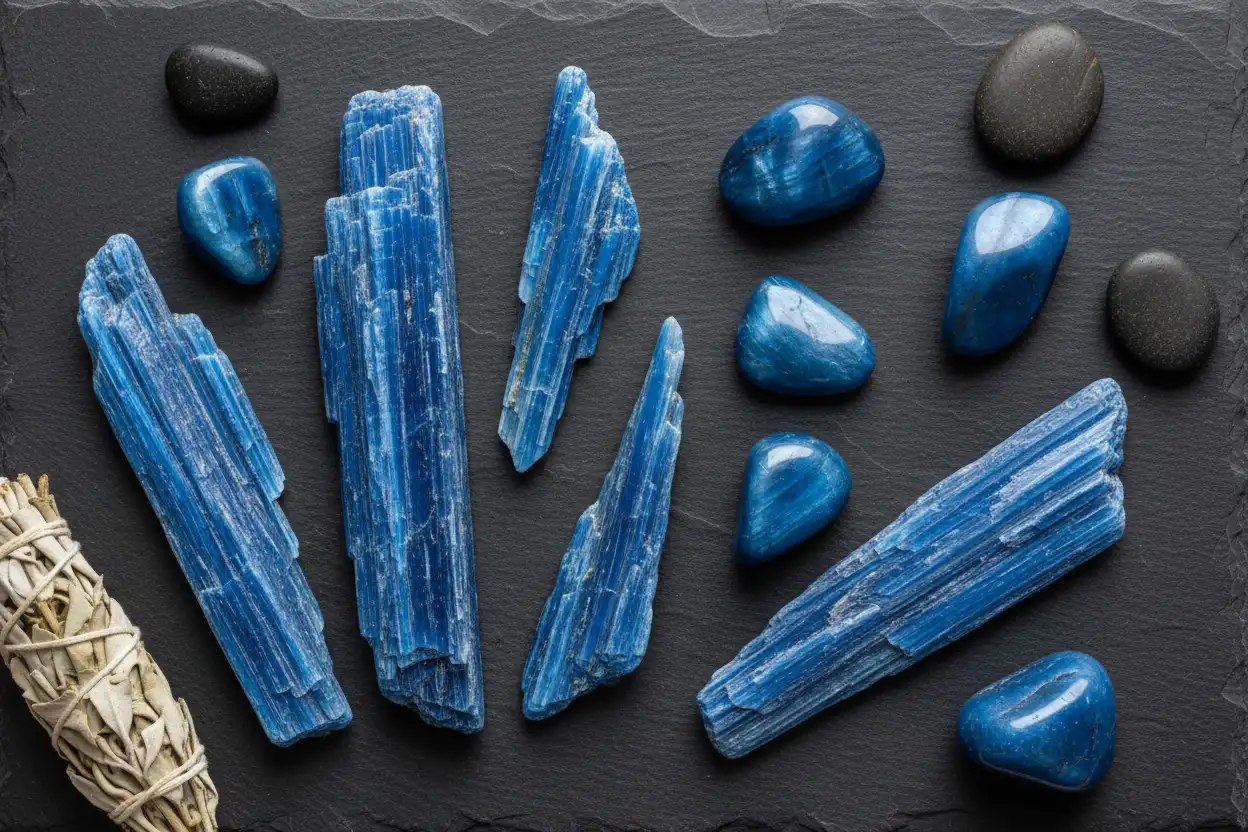
Blue Kyanite Meaning: Mineral Facts, History & Symbolism
Blue kyanite meaning is often described through themes of communication, clarity, calmness, honesty, alignment, and self-expression, but those interpretations belong to symbolism rather than to the mineral’s measurable properties. Materially, blue kyanite is the blue-colored form of kyanite, an aluminum silicate mineral with the composition Al₂SiO₅. It belongs to the same chemical system as andalusite and sillimanite, yet each mineral has a different crystal structure and is stable under different geological conditions.
Kyanite is especially interesting because its hardness depends strongly on direction. An elongated crystal can be considerably softer when scratched along its length than across it, an unusual trait that historically contributed to the alternate name disthene, meaning roughly “two strengths.” This directional hardness, together with its typically bladed habit, strong cleavage, relatively high density, and metamorphic geological setting, makes kyanite much more distinctive than its blue color alone suggests.
For related mineral-first references, browse the Gemstone Guides.
What Is Blue Kyanite?
Blue kyanite is not a separate mineral species. It is kyanite whose visible color falls within the blue range, from pale gray-blue and denim blue to medium or occasionally stronger blue. Individual crystals frequently show uneven color, streaks, lighter central areas, darker margins, or color zoning parallel to their elongated growth direction.
Chemically, kyanite is Al₂SiO₅. It crystallizes in the triclinic system and commonly develops long, flattened or bladed crystals. Cleavage is pronounced, and the mineral is brittle, so attractive crystals can split or chip even though some crystallographic directions are relatively hard.
| Property | Typical blue kyanite characteristics |
|---|---|
| Mineral species | Kyanite |
| Chemical formula | Al₂SiO₅ |
| Material type | Aluminum silicate mineral |
| Crystal system | Triclinic |
| Typical habit | Elongated, flattened or bladed crystals |
| Common color | Pale blue, gray-blue, denim blue to stronger blue |
| Hardness | Directional; roughly 4.5–5 along one direction and about 6.5–7 across another |
| Specific gravity | Commonly around 3.5–3.7 |
| Cleavage | Strong to perfect in prominent directions |
| Fracture behavior | Brittle, with cleavage often dominating breakage |
| Luster | Vitreous, sometimes pearly on cleavage surfaces |
| Transparency | Transparent in fine material to translucent or opaque |
| Separate species because it is blue? | No |
The hardness range should not be read as inconsistency in the data. Kyanite genuinely exhibits pronounced anisotropy, meaning its physical response changes according to crystallographic direction.
Why Kyanite Has Two Different Hardnesses
Kyanite is one of the classic examples used to demonstrate why Mohs hardness is not always adequately represented by a single number. When a crystal is tested in different directions, the resistance to scratching changes because atomic bonding is not mechanically equivalent throughout the structure.
Along the length of a typical blade, hardness can be approximately 4.5–5, while across the blade it can approach about 6.5–7. That difference is substantial enough to matter during identification, cutting, polishing, and jewelry wear.
This property should not be turned into a symbolic claim about the stone having “two energies” or balancing opposites. Directional hardness is a crystallographic and mechanical phenomenon.
Kyanite, Andalusite, and Sillimanite
Kyanite shares the composition Al₂SiO₅ with andalusite and sillimanite. Minerals that have the same chemical composition but different crystal structures are called polymorphs.
The three minerals form under different pressure-temperature conditions, so their presence in metamorphic rocks can provide geologists with evidence about the environment in which the host rock recrystallized. Kyanite is particularly associated with metamorphic conditions where comparatively elevated pressure favors its stability.
This geological significance is one reason kyanite is more than an ornamental blue mineral. Its occurrence can help reconstruct the pressure-temperature history of metamorphic rocks.
The detailed relationship among host rocks, pressure conditions, metamorphic grade, associated minerals, and deposit environments is covered separately in blue kyanite formation and deposit geology.
How Blue Kyanite Forms
Blue kyanite commonly forms during metamorphism of aluminum-rich rocks. Clay-rich sedimentary material can be transformed under heat and pressure, reorganizing existing elements into new metamorphic minerals including kyanite, mica, garnet, quartz, staurolite, and related assemblages depending on the conditions.
Kyanite can consequently occur in schist and gneiss as elongated blades aligned with the fabric of the rock. It may also occur in quartz-rich veins and other metamorphic or hydrothermal contexts, but a polished blue cabochon does not reveal its precise geological history by appearance alone.
When a locality or specific host environment is important, matrix relationships and provenance documentation are more useful than color resemblance.
What Causes the Blue Color?
Blue kyanite color is associated with electronic processes involving trace constituents within the crystal structure. Iron-related interactions are important in many blue specimens, and titanium can also participate in color-producing mechanisms. The exact balance can vary among deposits and individual crystals.
This is why statements such as “all blue kyanite is colored by one element” are overly simplistic. A blue appearance is the observable result; assigning a precise microscopic mechanism to an individual stone may require spectroscopy or chemical analysis.
Color can also be strongly zoned. A single blade may contain pale, nearly colorless regions beside deeper blue areas, demonstrating that the relevant trace-element distribution or structural conditions were not uniform during growth.
The detailed relationship among absorption, pleochroism, zoning, refractive properties, and viewing direction belongs in blue kyanite optical properties and color behavior.
Pleochroism Can Change the Apparent Blue
Transparent to translucent kyanite can show pleochroism, meaning its apparent color changes when viewed in different crystallographic directions. Depending on the specimen, one direction may look stronger blue while another appears paler, grayish, or nearly colorless.
This behavior is caused by directional absorption of light within an anisotropic crystal. It is a measurable optical property and should not be confused with claims that kyanite changes color according to a person’s mood, energy, spiritual state, or intention.
Cutters can sometimes use pleochroism and zoning deliberately by selecting an orientation that produces a more attractive face-up color.
A Blue Kyanite Specimen and Photo Checklist
The following checklist provides a non-destructive first-pass framework for evaluating an unknown specimen or product photograph. It does not replace laboratory identification.
Examine the crystal habit
Natural rough kyanite frequently develops elongated, flattened blades rather than equant quartz-like points. A well-preserved crystal habit is one of the strongest visual clues.
Look for lengthwise structure
Color zoning, cleavage traces, growth features, and surface texture often follow the long direction of the blade.
Examine cleavage
Broad planar cleavage surfaces can be conspicuous. Natural chips may expose smooth planes rather than only curved fracture.
Look for uneven blue color
Natural blue kyanite commonly shows zoning rather than perfectly uniform saturation. Uniformity does not prove treatment, but natural variation can support a geological interpretation.
Inspect the matrix
Quartz, mica, garnet, and metamorphic host material can provide useful geological context, although matrix alone cannot prove a mine locality.
Compare several viewing directions
Changes in color or brightness with orientation may reflect pleochroism, surface geometry, or cleavage.
Check surface luster
Fresh crystal surfaces can appear vitreous, while cleavage surfaces may show a more pearly character.
Look for brittle damage
Thin blades commonly show chips, fractures, or cleavage separation. Natural specimens need not be flawless.
Do not perform casual scratch testing
Kyanite’s directional hardness makes simple scratch demonstrations easy to misinterpret, and testing can damage collectible crystals or polished stones.
Do not identify it from blue color alone
Glass, quartz varieties, apatite, sapphire, dumortierite-bearing materials, and other blue substances can overlap visually.
Treat locality as a separate claim
A crystal cannot establish a famous mine or country simply because its color resembles marketed material from that location.
Separate material and metaphysical descriptions
Terms such as communication stone, alignment crystal, or energy cleanser are not identification evidence.
For magnified cleavage features, inclusions, fractures, polishing characteristics, and diagnostic limitations, use the blue kyanite microscope inclusion notebook.
A Claim-versus-Evidence Guide to Blue Kyanite
Blue kyanite attracts both legitimate mineralogical statements and claims that extend far beyond what the material itself demonstrates.
| Claim | Evidence status | Better interpretation |
|---|---|---|
| Blue kyanite is Al₂SiO₅ | Supported | This is the composition of kyanite |
| Kyanite has directional hardness | Supported | Its scratch resistance differs substantially with direction |
| Kyanite commonly forms bladed crystals | Supported | Bladed habit is characteristic |
| Kyanite is related to andalusite and sillimanite | Supported | They are Al₂SiO₅ polymorphs |
| Every blue kyanite has the same color mechanism | Too absolute | Trace-element and optical details can vary |
| Darker blue automatically means better quality | Unsupported as a universal rule | Transparency, zoning, cut, fractures, crystal form, and intended use also matter |
| Blue color proves a specific locality | Unsupported | Provenance requires additional evidence |
| Kyanite permanently cleanses itself energetically | Metaphysical belief | No gemological measurement establishes this property |
| Kyanite never needs cleansing | Spiritual practice statement | It may describe a belief system, not physical maintenance |
| Blue kyanite improves communication | Symbolic interpretation | It can serve as a personal reminder to communicate deliberately |
| Blue kyanite heals throat disorders | Medical claim | Not established |
| Kyanite aligns chakras | Spiritual framework | Not a measurable mineral property |
| Kyanite’s anisotropy proves energetic balancing | Unsupported inference | Directional hardness is crystallographic, not evidence of spiritual energy |
This comparison prevents a genuine scientific property from being used as indirect proof for an unrelated metaphysical claim.
Blue Kyanite Versus Blue Chalcedony
Blue kyanite can occasionally be confused with other blue materials after polishing, but its mineral structure differs sharply from chalcedony. Kyanite is a crystalline aluminum silicate with strong cleavage and directional hardness, while chalcedony is a microcrystalline silica aggregate with no comparable perfect cleavage.
Natural rough forms make the distinction much easier. Kyanite commonly forms obvious blades, whereas chalcedony generally occurs as nodules, masses, cavity fillings, crusts, or vein material rather than individual bladed crystals.
Readers working with compact translucent blue material rather than obvious blades can compare those traits in the blue chalcedony meaning reference.
Blue Kyanite Is Not Identified by a Scratch Test Alone
The unusual hardness of kyanite can be diagnostically useful, but casual testing can create misleading results. A person may scratch in one direction and obtain a relatively soft result, then test another area and conclude that the specimen is inconsistent or artificial.
Surface weathering, orientation, inclusions, polish, test pressure, and the hardness of the reference object can all affect interpretation. A polished gem should also not be deliberately damaged when non-destructive methods can answer the question.
For uncertain or valuable material, optical testing, refractive index, specific gravity, microscopy, Raman spectroscopy, or other laboratory methods may be more appropriate.
Laboratory Identification and Its Limits
A gemological laboratory can use several independent observations to distinguish kyanite from visually similar materials. Depending on the specimen, refractive index, birefringence, specific gravity, pleochroism, microscopy, and spectroscopy can provide useful evidence.
Raman spectroscopy can identify kyanite’s characteristic vibrational structure, while chemical analysis can investigate trace elements associated with color. X-ray diffraction can establish crystalline identity when structural confirmation is required.
These techniques still have boundaries. Confirming kyanite does not automatically establish a mine locality, historical ownership, or treatment history. Likewise, chemical data that explain blue color do not validate symbolic claims.
The test must address the claim actually being made.
The Name Kyanite and the Meaning of “Disthene”
The name kyanite comes from a Greek word associated with blue, reflecting the color for which the mineral became especially familiar. The alternate name disthene refers to its unusual directional hardness and can be understood as “two strengths.”
These names preserve two genuinely observable aspects of the mineral: its characteristic blue appearance and its anisotropic mechanical behavior.
That documented naming history is different from modern statements claiming that the mineral was universally regarded in antiquity as a chakra stone, telepathic aid, dream enhancer, or energetic alignment tool. Such cultural claims require specific historical documentation rather than repetition in contemporary crystal descriptions.
Historical Use and Cultural Claims
Kyanite’s major historical importance is strongly connected with mineralogy, geology, ceramics, refractories, and the study of metamorphic rocks. Its aluminum-rich composition and high-temperature behavior have made kyanite-group minerals industrially significant as well as collectible.
Gem-quality blue material is also cut for ornamental and jewelry use, although cleavage and directional hardness make cutting more demanding than appearance alone suggests.
When stories describe ancient peoples using blue kyanite for highly specific modern spiritual concepts, the appropriate question is whether an identifiable historical text, artifact, excavation record, or documented tradition supports that statement. Without such evidence, the claim should remain unverified.
Blue Kyanite Meaning in Modern Symbolism
Modern blue kyanite meaning commonly emphasizes communication, honesty, mental clarity, calmness, self-expression, alignment, and deliberate thought. These interpretations are understandable as symbolism because the blue color invites associations with communication and calmness, while the long straight blades suggest direction, organization, and alignment.
A person may place a crystal near a workspace as a reminder to communicate clearly, hold one while preparing for a difficult conversation, or use it during journaling about whether thoughts and actions are aligned.
In those contexts, the object functions as a deliberate visual and tactile cue. Nothing about the practice requires a claim that the mineral emits a scientifically established communication field.
Blue Kyanite and the Throat Chakra
Contemporary crystal traditions frequently connect blue kyanite with the throat chakra because blue stones are commonly associated with speech, listening, truthfulness, and expression.
This is a spiritual interpretation rather than a property detectable through gemological testing. A refractometer can measure optical behavior; a balance can help determine density; a spectrometer can investigate absorption. None measures whether a chakra is open, blocked, aligned, or activated.
Someone may still use blue kyanite within a chakra-oriented meditation practice. The claim should simply remain within that spiritual framework.
The Claim That Kyanite Never Needs Cleansing
One especially common belief states that kyanite does not accumulate negative energy and therefore never needs energetic cleansing. This idea is widespread in modern crystal practice, but it is not a mineralogical property.
Kyanite does, of course, require physical maintenance when necessary. Dust can collect on a specimen, oils can transfer from handling, jewelry can become dirty, and fragile cleavage surfaces can be damaged. Whether a person chooses to perform a symbolic cleansing ritual is a matter of personal practice and should not be confused with actual specimen care.
The distinction is important because a metaphysical claim that a stone “never needs cleansing” should not encourage neglect of physical condition.
Does Blue Kyanite Have Healing Properties?
There is no established medical evidence that blue kyanite treats throat disorders, anxiety, neurological conditions, inflammation, hearing problems, blood pressure, sleep disorders, or other diseases.
The mineral’s real properties include its Al₂SiO₅ chemistry, triclinic structure, density, pleochroism, cleavage, refractive behavior, and directional hardness. None establishes therapeutic action in the human body through ordinary contact.
A person who finds a familiar stone helpful during meditation or reflection can describe that subjective experience without claiming medical efficacy. Persistent or significant symptoms require appropriate healthcare rather than gemstone treatment.
Mineral Chemistry Does Not Translate Into Human Treatment
Kyanite contains aluminum, silicon, and oxygen as components of an ordered crystalline compound. It would be incorrect to infer health effects merely because those elements occur in the mineral.
A chemical formula describes composition and structure. It does not mean those elements are delivered therapeutically through the skin, nor does it demonstrate that the crystal alters human physiology.
This principle applies broadly to gemstones: real chemistry should not be repackaged as an unsupported biological mechanism.
Cutting Blue Kyanite Is Technically Demanding
Kyanite’s cleavage and directional hardness make lapidary work unusually sensitive to orientation. A cutter can encounter noticeably different grinding and polishing behavior as the direction changes across a stone.
Color zoning adds another constraint. Attractive blue areas may need to be positioned carefully, while fractures and cleavage planes must be managed to reduce the risk of splitting. Transparent gem-quality pieces may be faceted, while translucent or included material is commonly fashioned into cabochons, beads, or carvings.
The detailed cutting decisions belong in blue kyanite cutting, orientation and polish.
Jewelry Durability: Hard Does Not Mean Tough
A statement that kyanite can reach approximately Mohs 7 in one direction can give a misleading impression of jewelry durability. Scratch resistance and toughness are different properties.
Kyanite’s prominent cleavage and brittle behavior mean impact can split or chip a stone, particularly when a blow intersects a vulnerable direction. Rings therefore require more protection than pendants or earrings, and exposed corners or thin stones deserve special caution.
Detailed setting choices, bezel protection, orientation, impact zones, and wear scenarios are covered in blue kyanite setting and wear engineering.
Provenance Cannot Be Proven From Shade of Blue
Blue kyanite occurs in multiple geological regions, and desirable material enters international cutting and mineral markets through numerous supply chains. Similar colors can occur in geographically unrelated deposits.
A seller’s locality claim therefore needs evidence beyond appearance. Useful documentation can include original mine labels, specimen numbers, acquisition records, collection history, supplier records, or a traceable chain connecting the piece with the stated source.
Claims that a particular shade of blue proves a specific country or mine should be treated cautiously.
The blue kyanite provenance disclosure checklist provides a structured method for evaluating that evidence.
Buying Blue Kyanite: Verify the Material Before the Story
A useful seller description should focus on the object as well as its appearance. Dimensions, weight, condition, transparency, visible fractures, treatment disclosure where relevant, representative photographs, and provenance information are more useful for identification than statements about vibration or energetic power.
Bladed rough crystals should show features consistent with natural kyanite rather than merely being shaped into long blue points. Polished material requires greater caution because cutting removes some of the habit and cleavage clues that make rough kyanite recognizable.
Readers choosing an actual seller can use where to buy blue kyanite for the purchasing decision rather than treating symbolism as authentication.
Safe Ownership and Handling
Normal handling of an intact blue kyanite specimen does not require treating the mineral as inherently hazardous. The more immediate practical concern is mechanical: thin blades and cleavage-rich crystals can chip, split, or develop sharp broken edges.
Cutting, drilling, grinding, and polishing create mineral dust and should use appropriate lapidary controls, including wet methods where suitable, local extraction, eye protection, and respiratory protection appropriate to the process. Mixed matrix specimens may contain quartz or other minerals whose dust hazards also need consideration.
Blue kyanite should not be powdered for consumption or used in crystal elixirs. Symbolic use does not require ingestion.
Important mineral specimens can be documented with baseline photographs showing cleavage cracks, chips, matrix, labels, and crystal terminations. The blue kyanite specimen conservation record provides a structured approach.
A Practical Evidence Ladder for Blue Kyanite
When evaluating a statement about blue kyanite, match the claim to evidence capable of answering it.
Direct observation can document blade shape, blue zoning, cleavage, transparency, fractures, matrix, luster, dimensions, and visible condition.
Basic mineral and gem testing can examine hardness behavior, density, refractive properties, pleochroism, and other characteristics consistent with kyanite.
Microscopy can reveal cleavage features, inclusions, polishing marks, fractures, coatings, and internal textures.
Spectroscopy and diffraction can provide stronger mineral identification when physical observations are insufficient.
Chemical analysis can investigate trace elements when a specific color mechanism is being claimed.
Geological evidence can connect a specimen with a plausible host environment but does not automatically establish locality.
Provenance records are needed for mine, country, collection, and ownership claims.
Historical documentation is needed before assigning a particular spiritual practice to an earlier culture.
Symbolic interpretation describes what the stone means within personal or spiritual practice and is not converted into a mineralogical fact by additional laboratory testing.
What Blue Kyanite Meaning Can Reliably Include
Blue kyanite meaning is most accurate when mineralogy, history, and symbolism remain distinct. Mineralogically, blue kyanite is an Al₂SiO₅ mineral with a typically bladed triclinic structure, pronounced cleavage, notable directional hardness, frequent blue zoning, and geological importance as a metamorphic indicator.
Historically, its naming reflects genuine observable properties: blue color and unusual mechanical anisotropy. Claims about more elaborate ancient spiritual uses deserve documentary support rather than being repeated simply because they appear frequently in modern crystal literature.
Symbolically, blue kyanite can represent communication, clarity, alignment, calmness, or deliberate expression for people who choose to use it that way. Those meanings can support reflection without turning the mineral into a medical treatment, chakra-measuring device, or scientifically demonstrated source of protective energy.
For Gems Lore’s broader distinction between measurable gemological information and interpretive material, see About Gems Lore. Relevant limitations are explained in the Disclaimer, factual corrections can be submitted through Contact, and site data handling is described in the Privacy Policy.
Understanding blue kyanite meaning therefore begins with an unusually instructive mineral: one chemical composition shared with other polymorphs, a bladed structure shaped by metamorphism, color that can vary substantially within a single crystal, and hardness that changes according to direction. Its symbolic meanings are a separate human layer placed upon an already distinctive geological material.