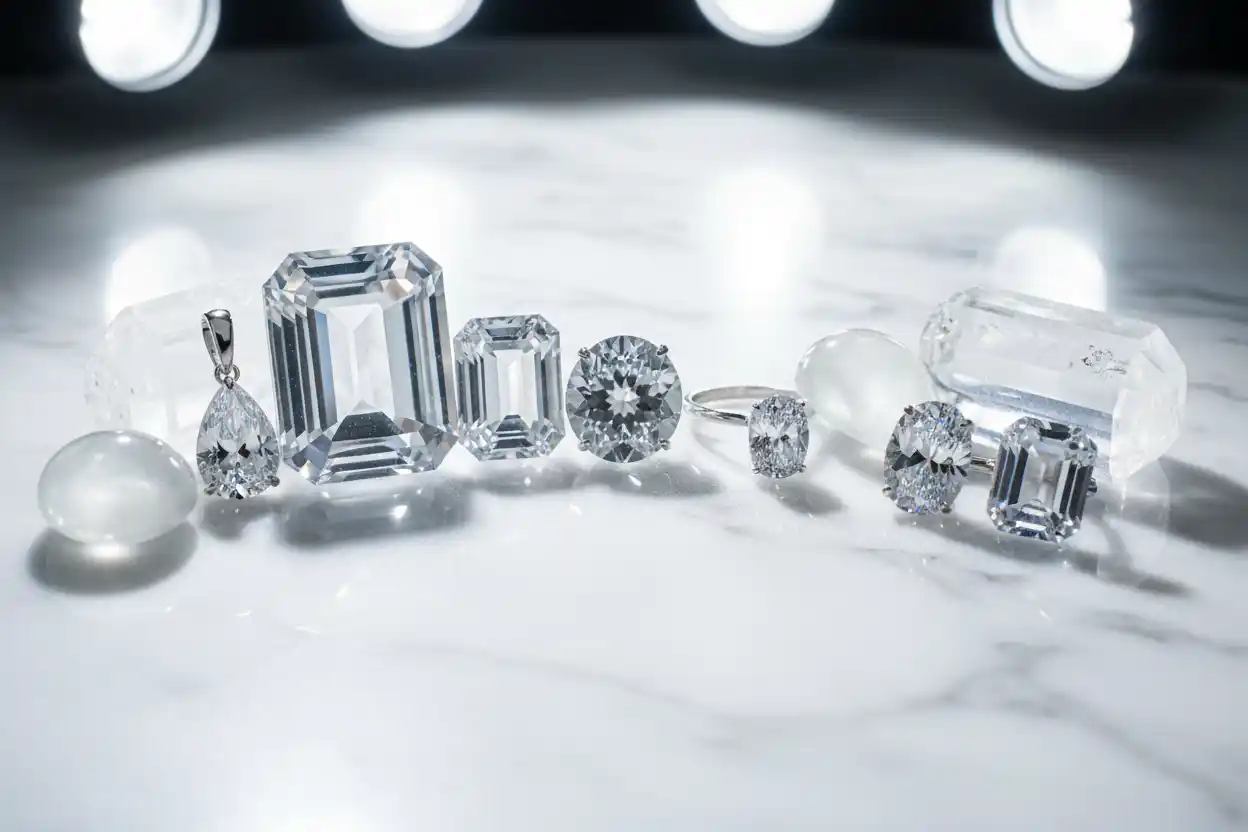
Goshenite Meaning: Properties, Uses & Symbolism
Goshenite meaning begins with a straightforward mineralogical identity: goshenite is the colorless to nearly colorless variety of beryl. It belongs to the same mineral species as emerald, aquamarine, heliodor, and morganite, but it lacks sufficient color-causing conditions to produce the distinctive green, blue, yellow, or pink hues associated with those better-known varieties. Its underlying beryl composition is Be₃Al₂Si₆O₁₈, and its crystal structure, hardness, optical character, and general geological behavior belong to beryl rather than to a separate mineral species. Mindat specifically describes goshenite as an almost colorless beryl variety originally described from Goshen, Massachusetts.
Colorlessness does not mean that every goshenite crystal is chemically perfect or completely free of trace elements. GIA notes that chemically pure beryl is colorless while trace elements create the familiar colors of other beryl varieties, and modern mineralogical research shows that colorless beryl can still contain impurities that either do not absorb strongly in the visible spectrum or occupy structural sites or valence states that do not produce obvious color. This distinction is central to goshenite meaning because transparency and lack of color are physical observations, while symbolic ideas such as clarity, honesty, simplicity, or mental focus are human interpretations.
Within the broader Gemstone Guides collection, this page defines goshenite as a material first and then examines its documented name history and modern symbolism. Questions about purchasing belong to the separate buy goshenite guide, while market-value methodology belongs to the goshenite price guide. Keeping those intents separate prevents a meaning reference from becoming a repetitive buying or pricing page.
Goshenite Meaning at a Glance
| Property or question | Evidence-aware summary |
|---|---|
| Mineral identity | Colorless to nearly colorless variety of beryl |
| Ideal beryl formula | Be₃Al₂Si₆O₁₈ |
| Crystal system | Hexagonal |
| Typical color | Colorless to near-colorless |
| Transparency | Commonly transparent; translucent material also occurs |
| Luster | Vitreous |
| Mohs hardness | Approximately 7.5–8 |
| Refractive index | Common gemological range approximately 1.562–1.615 across goshenite/beryl references |
| Specific gravity | Commonly about 2.60–2.90, depending on composition |
| Optical character | Uniaxial negative |
| Cleavage | Indistinct rather than a dominant durability feature |
| Name origin | Named for Goshen, Massachusetts, where early material was described |
| Colorlessness | Results from the absence of sufficient visible-light color centers, not necessarily absolute chemical purity |
| Common use | Faceted gems, collectors’ specimens, crystals, and occasionally jewelry |
| Modern symbolism | Frequently associated with clarity, truth, simplicity, reflection, or deliberate thinking |
| Scientific status of symbolism | Symbolic associations are not established physiological or medical effects |
| Safety principle | Intact handling is distinct from cutting, drilling, grinding, sanding, or generating mineral dust |
Gemological references place goshenite around Mohs 7.5–8 and identify it as beryl with the expected uniaxial-negative optical character. A documented GIA goshenite specimen, for example, showed refractive indices of 1.569/1.574 and specific gravity of 2.69, illustrating values comfortably within the broader beryl range.
What Is Goshenite?
Goshenite is the colorless variety of beryl, not a separate mineral species with unique chemistry. Beryl is a beryllium aluminum silicate whose framework structure can accommodate various elements and molecular species in structural sites and channels. When chromium or vanadium contributes strong green coloration, the resulting gem may be called emerald; iron can contribute blue or yellow coloration associated with aquamarine and heliodor; manganese is important in pink morganite. Goshenite occupies the essentially colorless end of this gemological spectrum. GIA summarizes the relationship succinctly: chemically pure beryl is colorless, while trace elements generate the colors of its major gem varieties.
Calling goshenite “white beryl” is common in commercial language, but genuinely transparent material is more accurately described as colorless or near-colorless rather than opaque white. Some specimens contain haze, internal fractures, fluid inclusions, mineral inclusions, or surface alteration that changes apparent transparency. Others can be exceptionally clean. Therefore, clarity level should not be used as proof of natural origin or as a universal defining feature.
Goshenite also should not be treated as “clear quartz under another name.” Quartz and beryl differ in chemistry, crystal structure, density, refractive index, hardness, optical behavior, cleavage characteristics, and geological occurrence. A colorless transparent appearance creates a visual similarity, not a mineralogical identity.
Goshenite Identity Table
| Characteristic | Goshenite |
|---|---|
| Species | Beryl |
| Variety status | Colorless to near-colorless beryl |
| Formula | Be₃Al₂Si₆O₁₈ |
| Crystal system | Hexagonal |
| Common crystal habit | Hexagonal prisms, sometimes with flattened or modified terminations |
| Typical body color | Colorless to faintly tinted |
| Transparency | Transparent to translucent |
| Luster | Vitreous |
| Hardness | Approximately 7.5–8 Mohs |
| Typical optical character | Uniaxial negative |
| Typical birefringence | Low, commonly around several thousandths |
| Specific gravity | Usually within the normal beryl range |
| Common internal features | Fluid inclusions, healed fissures, mineral inclusions, growth structures |
| Important identification boundary | Colorlessness alone does not distinguish goshenite from quartz, topaz, colorless sapphire, glass, synthetic gems, or other transparent materials |
| Variety-name boundary | Goshenite is a beryl variety, not a separately approved mineral species |
GIA’s beryl inclusion research demonstrates that natural beryl can contain diverse fluid, mineral, structural, and growth-related features, while an individual goshenite can also be remarkably clean. The dedicated Goshenite Microscope Inclusion Notebook owns that specimen-scale inclusion work rather than having individual inclusions treated as universal diagnostic signatures here.
Why Is Goshenite Colorless?
A useful explanation of goshenite meaning requires separating “colorless” from “chemically pure.” Pure beryl is colorless in the ideal sense, but natural goshenite can contain impurities. Whether those impurities create visible coloration depends on which elements are present, how much is present, where the ions occupy the crystal structure, their oxidation states, and whether their absorption bands significantly affect visible light.
Recent structural research on beryl specifically cautions against assuming that goshenite must be chemically pure. Some impurities may produce absorption outside the visible region, occur at sites that do not generate strong color, or exist in states that leave the crystal effectively colorless to the eye.
This is why phrases such as “goshenite is perfectly pure beryl” are too absolute. “Colorless beryl” is the stronger description. Colorlessness is an optical observation and gemological variety criterion; it is not a certificate of chemical perfection.
The detailed relationship between refractive behavior, trace constituents, transparency, weak tints, and light interaction belongs in the Goshenite Optical Properties and Color Behavior guide.
How Goshenite Forms
Goshenite forms wherever geological conditions allow beryl to crystallize without sufficient color-producing conditions to create another strongly colored variety. Beryl is particularly associated with granitic pegmatites and can also develop through metasomatic processes. GIA’s review of beryl micro-features notes pegmatitic environments as especially important because they can concentrate enough beryllium for beryl crystallization.
Pegmatites are coarse-grained igneous bodies that can concentrate uncommon elements during late stages of magma evolution. Fluids and melts enriched in beryllium, aluminum, silicon, and suitable alkalis can support beryl growth, sometimes producing large crystals. Depending on trace-element availability and later geological history, those crystals may emerge colorless, blue, green, yellow, pink, or zoned between several appearances.
Goshenite also occurs at multiple international localities rather than only at its Massachusetts namesake. GIA’s beryl research includes colorless goshenite samples from Pakistan, and its collection contains documented goshenite from Sri Lanka, showing that the variety occurs across geographically diverse beryl deposits. The separate Goshenite Formation and Deposit Geology guide owns the detailed deposit, host-rock, and locality discussion.
Diagnostic Characteristics of Goshenite
A transparent, colorless stone cannot be confidently identified as goshenite by appearance alone. Quartz, topaz, colorless sapphire, zircon, synthetic spinel, glass, and other natural or manufactured materials can overlap visually. Even experienced observation should therefore be treated as the beginning of identification rather than its conclusion.
Goshenite’s combination of beryl-like refractive index, low birefringence, uniaxial-negative optical character, density, hardness, inclusion scene, and crystallographic features can help establish identity. A retained natural crystal habit can be particularly informative because beryl commonly forms hexagonal prisms, although crystal shape by itself is still insufficient when specimens are broken, polished, carved, or imitated.
Hardness testing should not be performed casually on finished gems. Deliberately scratching a polished object may permanently damage it and still fail to distinguish among several candidates. Where identity matters financially, scientifically, or historically, appropriate non-destructive gemological testing is preferable.
Goshenite Versus Clear Quartz
Clear quartz is one of the easiest visual comparisons because both materials can be colorless, transparent, vitreous, and fashioned into faceted gems or polished objects. The mineralogical differences, however, are substantial. Quartz is SiO₂ and has Mohs hardness around 7, while goshenite is beryl, Be₃Al₂Si₆O₁₈, with hardness around 7.5–8. Their refractive indices, density ranges, optic properties, and typical crystal habits also differ.
A clear six-sided crystal is not automatically quartz or beryl. Crystal termination style, prism cross-section, surface growth markings, density, optical testing, and other diagnostic evidence must be considered together.
The practical lesson is broader than this one comparison: transparency is not an identity.
Goshenite Versus Diamond and Colorless Sapphire
Well-cut goshenite can be bright and attractive, but describing it as “diamond-like” should not imply equivalence. Diamond has far greater hardness, a much higher refractive index, substantially stronger dispersion, and a different crystal structure. Colorless sapphire is corundum with Mohs hardness 9 and its own distinct optical and physical properties.
Goshenite’s appeal is different. Large clean beryl crystals can occur, and faceted goshenite may provide crisp transparency and subtle brilliance without being a diamond substitute in every performance category.
Value and desirability should therefore be based on the material actually offered rather than on comparisons designed to make one gem sound like another.
Documented Name History
The name goshenite comes from Goshen, Hampshire County, Massachusetts. Mindat states that the variety was originally described from the Barrus Farm locality in Goshen and that its name derives from the locality where it was first found or described.
This is an unusually useful historical anchor because it distinguishes the history of the name from the much older history of beryl itself. Beryl minerals have been known and used for a very long time, but that does not mean the specific term goshenite or modern goshenite symbolism existed throughout antiquity.
A historical source mentioning beryl, emerald, or a transparent colorless stone should not automatically be rewritten as a reference to goshenite. Accurate historical interpretation requires enough descriptive, contextual, or analytical evidence to identify the actual material.
Original Information Gain: Goshenite Name and Claim Audit
Goshenite accumulates fewer extravagant trade names than many colorful stones, but several recurring claims still deserve separation.
| Name or claim | Evidence-supported interpretation | What should not automatically be assumed | Better evidence when important |
|---|---|---|---|
| Goshenite | Colorless to nearly colorless beryl | Separate mineral species | Beryl identification |
| White beryl | Informal synonym for colorless beryl | Opaque white material is automatically goshenite | Confirm beryl and actual color/transparency |
| Colorless beryl | Accurate descriptive variety term | Perfect chemical purity | Trace chemistry may still be present |
| Pure beryl | Idealized chemical idea or marketing language | Natural specimen contains no impurities | Chemical analysis |
| Goshen, Massachusetts goshenite | Provenance claim | Locality can be recognized visually | Original locality records or credible chain of custody |
| Natural goshenite | Natural-origin claim | Untreated status or specific mine origin | Gemological examination and provenance |
| “Diamond substitute” | Commercial comparison | Same optical performance or durability as diamond | Compare actual gemological properties |
| “White emerald” | Misleading marketing phrase | Goshenite is emerald without color | Emerald has a specific color and chromophore definition |
| “Ancient clarity stone” | Historical/metaphysical claim | Modern symbolism is ancient | Traceable historical evidence |
| “Stone of truth” | Modern symbolism | Physical ability to reveal truth | Personal metaphor only |
| “Mental clarity crystal” | Metaphysical language | Treatment of neurological or psychiatric conditions | Clinical evidence would be required |
| “Detoxifying beryl” | Medical claim | Removes toxins from the body | No support from mineral identity |
| “Beryllium healing stone” | Chemical-to-health claim | Beryllium in the crystal is therapeutic | Mineral composition does not establish medical benefit |
| “Rare” | Context-dependent commercial claim | All goshenite is rare or expensive | Size, clarity, locality, quality, market evidence |
| “Collector grade” | Commercial quality label | Standardized universal grade | Seller must define objective criteria |
This audit demonstrates a core rule of goshenite meaning: a true material fact cannot be used automatically to support an unrelated symbolic or medical statement. The fact that goshenite contains beryllium establishes mineral chemistry. It does not establish a beneficial biological effect from wearing, touching, or ingesting the material.
Original Specimen and Photo Checklist
A photograph can document goshenite effectively when its limits are recognized. Use several views rather than one highly edited image.
| Observation | A photograph can often show | A photograph cannot reliably prove |
|---|---|---|
| Apparent colorlessness | Colorless or faintly tinted appearance | Exact spectral absorption |
| Transparency | Relative clarity and visible cloudiness | Full internal clarity at every depth |
| Hexagonal habit | Retained crystal morphology | Chemical identity by itself |
| Surface striations | Growth-related surface features | Natural origin conclusively |
| Fractures | Large chips and internal cracks | Full fracture network |
| Visible inclusions | Some crystals, clouds, tubes, or healed fissures | Exact inclusion composition |
| Facet quality | Windowing, extinction, symmetry, polish | Exact refractive index |
| Seller locality label | Claimed provenance | Actual geographic origin |
| “Untreated” claim | Listing wording | Treatment status |
| “High clarity” | General visual cleanliness | Standardized grading category |
| Spiritual energy | Nothing objectively measurable | Metaphysical or medical efficacy |
Neutral illumination is especially important with goshenite because small differences in background, white balance, reflection, or nearby colored objects can make a genuinely colorless stone appear gray, blue, yellow, or green. A colorless gem should ideally be photographed against both neutral light and dark backgrounds so transparency and body color are not confused.
Modern Goshenite Meaning
Modern goshenite meaning commonly centers on clarity, honesty, simplicity, truth, reflection, and deliberate thinking. Its lack of strong body color makes these themes intuitively understandable: a transparent crystal can serve as a visual metaphor for examining something without decorative distraction.
Someone may keep a goshenite specimen near a notebook as a reminder to distinguish facts from assumptions, simplify a complicated decision, or state something more clearly. Another person may choose colorless beryl jewelry because it symbolizes openness or a fresh beginning.
Those uses remain symbolic. No gemological property demonstrates that goshenite automatically produces clear thinking, truthfulness, emotional balance, or spiritual insight.
Goshenite and Clarity
Clarity is perhaps the most natural theme within goshenite meaning, but the word itself has two different meanings. In gemology, clarity describes visible internal features and their impact on appearance. In symbolism, clarity can mean understanding, decisiveness, or a lack of confusion.
Those definitions should not be merged. A highly transparent goshenite may contain few visible inclusions, but that does not give it a measurable ability to improve cognition. Likewise, an included goshenite is not symbolically “less clear” unless an individual chooses to interpret it that way.
A grounded reflective practice might instead use the stone as a cue to write three columns: known facts, uncertain assumptions, and next actions. The useful mechanism is the decision framework, not a mineral emission.
Goshenite and Truth
Some modern crystal traditions describe goshenite as a stone of truth or honesty. As personal symbolism, that can represent a commitment to accurate communication, transparent records, or willingness to revise an opinion when better evidence appears.
The stone cannot detect lying, reveal hidden information, make someone confess, expose another person’s intentions, or guarantee that a relationship becomes honest.
Truth requires evidence. Honesty requires behavior. A gemstone can represent those values without causing them.
Goshenite and Simplicity
Colorless beryl can also symbolize simplicity because its appeal does not depend on intense color. That does not mean the material itself is simple: beryl has a complex ring-silicate structure capable of hosting various ions and molecules, and natural goshenite can contain complicated inclusions and chemical substitutions.
This contrast creates a more interesting symbolic interpretation. External simplicity can coexist with internal complexity. Someone may use goshenite meaning as a reminder to simplify a decision without pretending that the underlying situation has no complexity.
The metaphor becomes useful precisely because it remains a metaphor.
Goshenite and New Beginnings
Clear or colorless objects are often associated in modern symbolism with blank pages, openness, or new starts. Goshenite may therefore be chosen to represent beginning a project, reorganizing priorities, changing a habit, or entering a new phase of life.
It cannot guarantee that the new beginning succeeds, attract a particular partner, produce a job offer, ensure wealth, or eliminate consequences from earlier choices.
A stone can mark a transition. The outcome still depends on decisions, circumstances, and action.
Goshenite and Healing Claims
The word “healing” frequently appears across crystal literature, but goshenite meaning should not be used to claim treatment of anxiety, depression, neurological disorders, cardiovascular problems, hormonal conditions, fertility issues, immune disorders, pain, or any other medical condition.
Beryl’s chemical composition also should not be converted into a nutritional argument. Beryllium, aluminum, silicon, oxygen, or trace elements contained within a crystal lattice are not automatically nutrients, medicines, supplements, or transdermal treatments.
An intact gem can be appreciated visually or symbolically without assigning it biological functions that its mineralogy does not demonstrate.
Safe Ownership of Goshenite
Ordinary handling of an intact goshenite crystal or properly finished gem is different from processing mineral material. Cutting, drilling, grinding, sanding, or crushing beryl can generate particulate matter from the beryl itself and from matrix or associated minerals.
Lapidary work should therefore use suitable dust and fragment controls, wet methods where appropriate, eye protection, properly selected respiratory protection when required, equipment safeguards, and competent workshop practices. The detailed workmanship considerations belong in the Goshenite Cutting, Orientation and Polish guide.
There is no reason to deliberately powder goshenite for spiritual use. Intact ownership preserves the object and avoids creating an unnecessary exposure pathway.
Do Not Ingest Goshenite or Make Drinking Elixirs
Goshenite should not be crushed, powdered, swallowed, added to supplements, or deliberately soaked in drinking water for supposed health benefits. A gemstone is not a nutritional product simply because its chemical formula contains recognizable elements.
Natural crystals can also contain microscopic inclusions, fracture residues, associated minerals, polishing compounds, surface contamination, or treatments that are not obvious to the eye.
Symbolic engagement with goshenite meaning does not require ingestion or mineral-infused drinking water.
Goshenite in Jewelry
Goshenite’s hardness of roughly 7.5–8 gives it useful scratch resistance for many jewelry applications. That does not make every stone indestructible. Existing fractures, thin corners, poor cutting, accidental impacts, setting pressure, and wear pattern still influence durability.
Large transparent beryl can be fashioned into substantial gems, and the absence of strong color puts unusual emphasis on cutting quality. Windowing, extinction, symmetry, polish, and visible inclusions can become conspicuous when color does not dominate the eye.
The mechanical relationship between cut shape, setting protection, daily exposure, and repair risk belongs in the Goshenite Setting and Wear Engineering guide rather than being duplicated in this meaning reference.
Preserving Goshenite Specimens
Transparent crystals can reveal new inclusions, fractures, or surface details when viewed under changing lighting, which makes good photographic documentation worthwhile. Preserve original labels, acquisition records, dimensions, weight where relevant, reported locality, old collection numbers, and any laboratory documentation.
Avoid storing faceted goshenite loose against harder materials that could abrade polished surfaces. Natural crystal specimens should also be protected from unnecessary collisions that can damage terminations and edges.
The Goshenite Specimen Conservation Record provides the mapped framework for tracking physical condition and documentation over time.
Provenance and the Goshen Name
Because the name itself comes from Goshen, Massachusetts, sellers sometimes emphasize locality in ways that can create confusion. A stone called goshenite does not have to come from Goshen. The name identifies the colorless beryl variety internationally.
Conversely, a colorless beryl claimed specifically to be from the original Goshen locality requires provenance evidence. Crystal shape, transparency, or lack of color cannot establish a Massachusetts source.
Original collection labels, mine information, dealer records, ownership history, and appropriate documentation should be preserved where locality matters. The Goshenite Provenance Disclosure Checklist owns that evidentiary question.
Goshenite and Nearby Gemstone Names
Gem names can sound authoritative even when their mineral relationships are very different. Grandidierite Meaning covers a distinct mineral species rather than a beryl variety, illustrating why two gem names appearing near one another in commercial catalogs should never be assumed to share chemistry or formation.
The contrast with manufactured material is even stronger. Goldstone Meaning concerns deliberately produced aventurine glass containing reflective metallic crystals. Goshenite, by contrast, is naturally occurring crystalline beryl.
These comparisons reinforce the material-first principle: name, transparency, sparkle, or retail category cannot substitute for mineral identification.
Can Goshenite Be Treated?
Colorless beryl can respond to irradiation and other laboratory conditions in ways that create color centers, and experimental research demonstrates that impurities present in colorless beryl may become optically active after irradiation or heating.
That fact does not mean an ordinary colorless goshenite should automatically be suspected of treatment, nor does it justify turning this page into a treatment manual. If a specimen displays unexpected color or a seller makes a treatment-sensitive claim, appropriate gemological examination can be considered.
The important meaning-page lesson is simply that colorless appearance does not reveal a complete treatment history.
Evidence Hierarchy for Goshenite Claims
A good goshenite description should match the strength of the evidence.
| Evidence level | Reasonable conclusion |
|---|---|
| Seller photo only | “Appears to be a transparent colorless gem sold as goshenite” |
| Retained hexagonal crystal habit plus seller record | “Appearance and morphology are consistent with beryl” |
| Standard gemological properties agree with beryl | “Identification as colorless beryl is substantially stronger” |
| Laboratory identification | “Material confirmed as beryl/goshenite within the scope of the report” |
| Original locality records | Geographic provenance becomes supportable |
| Analytical trace-element data | Detailed chemistry can be discussed |
| Personal spiritual experience | Supports only that individual’s interpretation, not a universal effect |
A claim should not move upward in this hierarchy simply because it is repeated. Ten retail listings calling a crystal “rare Goshenite from a famous mine” do not equal one reliable chain of provenance.
Evidence and Technical Limits
This article does not claim first-hand mine visits, personal purchase histories, unpublished spectroscopy, private chemical analysis, or laboratory authentication of the reader’s specimen. The broader material-first approach used by Gems Lore is described on About Gems Lore.
When exact identity, treatment, chemistry, unusual inclusions, locality, or historical attribution materially affects a decision, appropriate gemological, mineralogical, geological, or laboratory confirmation may be needed. The site-wide limits around health, safety, and metaphysical interpretation are stated in the Gems Lore Disclaimer.
Readers with documented corrections, provenance records, or stronger technical evidence can submit them through Contact Gems Lore for review.
Frequently Asked Questions About Goshenite Meaning
What is goshenite meaning?
Goshenite meaning combines the material identity of colorless beryl with modern symbolic associations such as clarity, honesty, simplicity, reflection, and new beginnings. Those symbolic themes are interpretations rather than scientifically measured properties.
What is goshenite made of?
Goshenite is beryl with the ideal formula Be₃Al₂Si₆O₁₈. It is the colorless to nearly colorless member of the same mineral species that includes emerald, aquamarine, heliodor, and morganite.
Why is goshenite colorless?
Pure beryl is colorless, but natural goshenite does not have to be chemically impurity-free. Trace constituents may be absent, too dilute, positioned differently in the structure, or present in forms that do not strongly absorb visible light.
Where did goshenite get its name?
It was named after Goshen, Massachusetts, where the variety was originally described from the Barrus Farm locality.
Is goshenite a separate mineral species?
No. Goshenite is a color variety of beryl rather than a separate mineral species.
Is goshenite the same as clear quartz?
No. Goshenite is beryl, while clear quartz is SiO₂. Their chemistry, crystal structures, density, optical properties, and hardness differ even though both can be transparent and colorless.
Is goshenite rare?
The answer depends on what is being described. Colorless beryl occurs at multiple deposits, but unusually large, clean, well-formed crystals, fine faceted gems, or documented locality specimens can be less common. The variety name by itself does not establish rarity.
Is goshenite valuable?
Value depends on size, clarity, cutting, crystal form, condition, provenance, documentation, market context, and whether the material is being valued as a gem or mineral specimen. Colorlessness alone does not create a high price.
Does goshenite have healing properties?
There is no established scientific evidence that goshenite treats disease or produces specific physiological healing effects. Healing descriptions associated with goshenite meaning belong to modern metaphysical belief rather than medical gemology.
Can goshenite improve mental clarity?
A person may use a clear stone as a personal reminder to organize thoughts or examine evidence, but goshenite has not been scientifically demonstrated to treat confusion, anxiety, depression, neurological disorders, or cognitive conditions.
Does goshenite contain beryllium?
Yes. Beryllium is an essential structural element in beryl’s chemical formula. That does not make goshenite a supplement or create a therapeutic benefit through ordinary skin contact.
Is goshenite safe to touch?
Ordinary handling of an intact specimen is different from cutting or pulverizing beryl. Dust-generating lapidary work should use appropriate mineral-processing controls rather than being treated like casual handling.
Can goshenite go in drinking water?
It should not be crushed, ingested, or deliberately used to make mineral drinking-water elixirs. Its status as a natural gemstone does not make ingestion necessary or medically useful.
Can goshenite be identified from a photograph?
Only provisionally. A photograph may show a colorless transparent crystal, inclusions, crystal habit, or surface features, but it cannot reliably establish refractive index, specific gravity, exact chemistry, treatment status, or geographic origin.
Is goshenite an ancient spiritual crystal?
Beryl has a long history of human use, but the goshenite name derives from Goshen, Massachusetts. Modern claims about goshenite symbolism should not be projected backward into ancient cultures without specific documentary evidence.
Final Perspective
Goshenite meaning becomes much more useful when the stone’s physical identity is allowed to lead. Goshenite is colorless to near-colorless beryl, Be₃Al₂Si₆O₁₈, sharing the beryl structure with emerald, aquamarine, heliodor, and morganite. Its lack of strong color reflects the absence of sufficient visible-light coloration rather than a guarantee of absolute chemical purity, and natural specimens can still contain trace constituents, fluid inclusions, fractures, growth features, and other evidence of their geological history.
Its documented name history is similarly clear: goshenite takes its name from Goshen, Massachusetts, where early material was described. The variety now occurs in beryl deposits far beyond that locality, so the name identifies a gemological variety rather than a geographic origin.
Modern associations with clarity, truth, simplicity, reflection, and new beginnings can remain meaningful when presented as symbolism. They do not turn colorless beryl into a medical treatment, truth detector, source of guaranteed insight, or mechanism for controlling outcomes. The strongest interpretation of goshenite meaning therefore keeps three layers distinct: measurable mineral facts, documented naming and geological history, and clearly labeled modern symbolism.